

For most U.S. savers, T-bills win on liquidity and after-tax return if you live in a high-tax state, while CDs can beat T-bills on locked-in APY for terms of six months or longer and add FDIC insurance to the mix. The right pick depends on three things: how long you can lock up the cash, your state tax rate, and whether the money sits in a taxable account or something like an IRA.
TL;DR:
- High-tax state residents benefit more from T-bills due to their exemption from state income tax, especially at higher federal tax rates.
- Short-term T-bills often yield comparable annualized returns to short-term CDs but can trade at a discount or premium if sold before maturity, unlike fixed APYs on CDs.
- For balances exceeding $250,000, spreading funds across multiple FDIC-insured banks and Treasury securities provides better protection and flexibility.
- T-bills allow early sale on the secondary market without penalties but risk loss if interest rates rise; CDs impose fixed early-withdrawal penalties.
- Comparing current rates from Treasury auction results and bank disclosures regularly ensures choosing the best instrument for your timing and tax situation.
Table of Contents
- T Bills vs CDs: A Quick Side-by-Side Snapshot
- Understanding T-Bill Pricing and CD APY
- Why Tax Treatment Often Tips the Scale Toward Treasuries
- Access to Cash: Selling T-Bills vs. Breaking a CD
- Who Guarantees Your Money: FDIC Insurance vs. Government Backing
- Buying T-Bills and CDs: Steps, Minimums, and Platforms
- Which One Fits Your Situation? A Scenario Guide
- How Rate Grove Verifies the Numbers Behind This Guide
- What I’d Actually Do in Each Situation
- Compare Current CD and T-Bill Rates Before You Commit
- Primary Sources Worth Bookmarking
- Sources
T Bills vs CDs: A Quick Side-by-Side Snapshot
Before you dig into the mechanics, here’s how the two stack up on the factors that actually move your decision.
- Issuer and terms: T-bills come from the U.S. Treasury with maturities from four weeks to 52 weeks; CDs come from banks and credit unions with terms ranging from three months to five years or more.
- How you earn money: T-bills are sold at a discount and pay out at face value when they mature, so your return is the gap between what you paid and what you collect. CDs quote an Annual Percentage Yield (APY) and pay interest on a set schedule.
- Tax treatment: T-bill interest is taxed federally but exempt from state and local income tax. CD interest gets hit at both the federal and state level, unless your state has no income tax.
- Liquidity: T-bills trade on a secondary market, so you can typically sell before maturity. Bank CDs usually charge an early withdrawal penalty; brokered CDs can be sold early but at whatever price the market offers that day.
- Backing: T-bills carry the full faith and credit of the U.S. government. CDs are insured by the FDIC (or NCUA for credit unions) up to $250,000 per depositor, per bank, per ownership category.
- Where to buy: T-bills go through TreasuryDirect or a brokerage account in $100 increments. CDs come from your bank, credit union, or a brokerage’s CD marketplace, often with minimums between $500 and $2,500.
Every one of these differences matters more or less depending on your situation, which is exactly what the rest of this guide walks through.
Understanding T-Bill Pricing and CD APY
T-bills don’t quote an interest rate the way CDs do. Instead, the Treasury sells them at a discount to face value, and your earnings come from the spread between what you pay at auction and the $1,000 (or multiple) you collect at maturity.
Say a 26-week T-bill auctions at a price below its $5,000 face value. You collect the full $5,000 when it matures, so you’ve earned the difference as interest over 26 weeks. To compare that fairly against a CD’s APY, you need to annualize it by dividing the interest earned by your purchase price and adjusting for the term length. The exact annualized yield varies with each auction. TreasuryDirect posts the exact discount rate and investment rate for every auction, and the investment rate is the number that’s actually comparable to a CD’s APY.
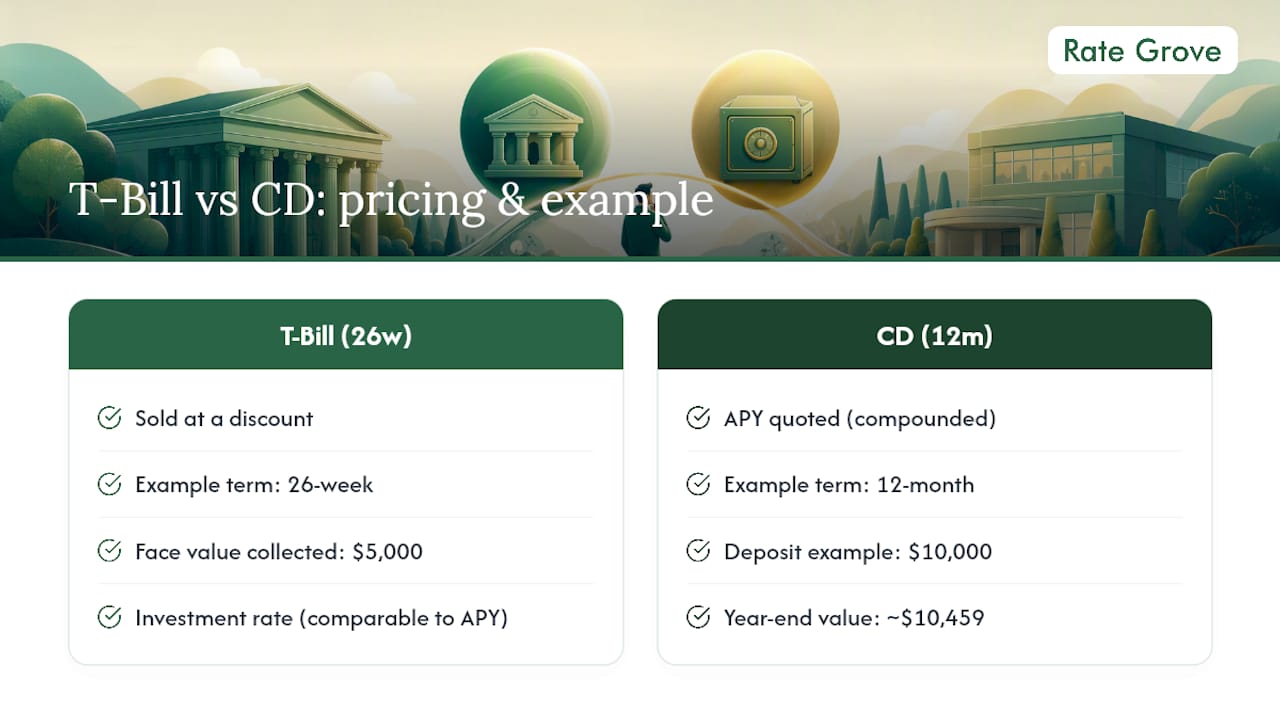
CDs work differently. A bank advertises an APY that already accounts for compounding, so a 12-month CD at 4.5% APY pays you 4.5% on your balance over the year, credited monthly, quarterly, or at maturity depending on the bank’s schedule. There’s no discount math involved. You deposit $10,000, and if the CD compounds monthly at 4.5% APY, you walk away with roughly $10,459 after a year.
The tricky part is comparing a short T-bill against a CD when the terms don’t line up cleanly. A four-week T-bill’s yield needs to be annualized before it means anything next to a one-year CD’s APY, and that annualized number can look deceptively attractive for a security you’re only holding a month. SmartAsset’s comparison of T-bills and CDs notes that short-term T-bill yields and short-term CD APYs often land close to each other, but which one actually wins shifts with the rate environment and the specific term you’re comparing. In 2026’s rate climate, that means checking both auction results and current bank rates before assuming either side has a permanent edge. Don’t just compare headline numbers. Match up the actual holding periods first, then look at yield.
Why Tax Treatment Often Tips the Scale Toward Treasuries
Here’s the detail that trips up a lot of savers: T-bill interest is exempt from state and local income tax, while CD interest is taxed at both the federal and state level. If you live somewhere with no state income tax, this distinction barely matters. If you live in California, New York, or another high-tax state, it can change which instrument actually pays you more.
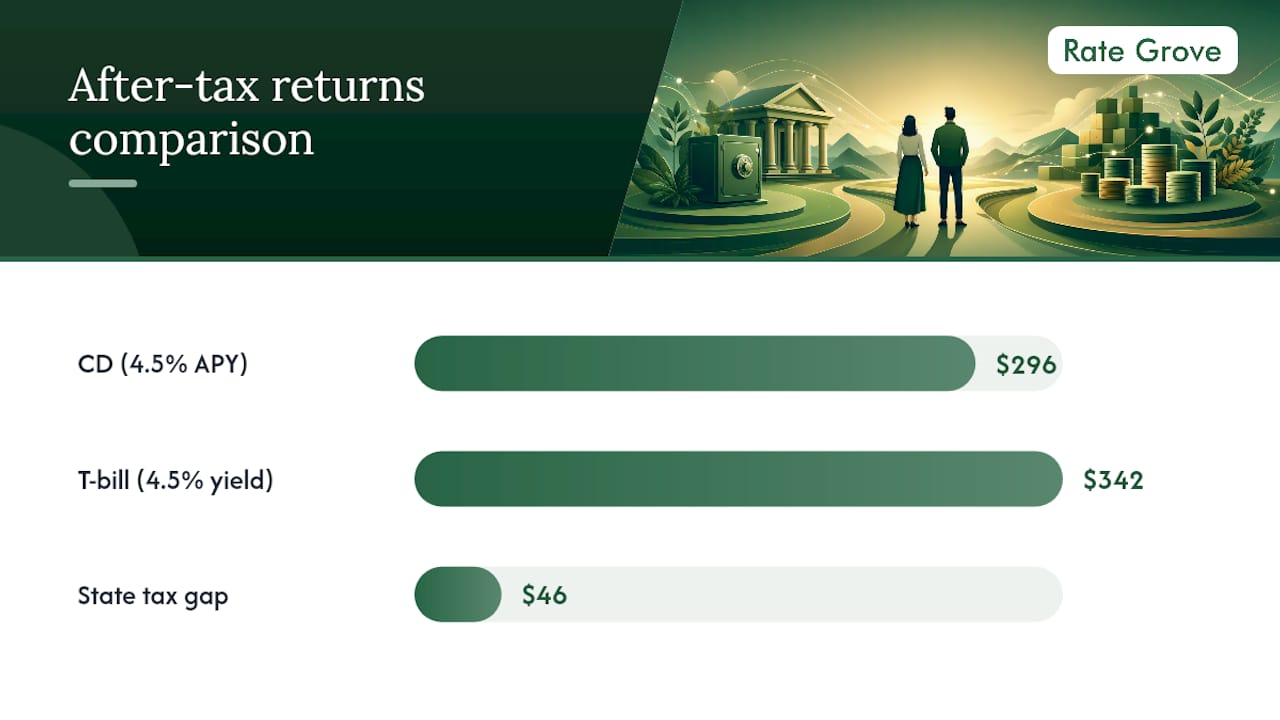
Consider an investor in California, where the top marginal state income tax rate runs close to 13%. Say they’re comparing a CD paying 4.5% APY against a T-bill yielding an annualized 4.5%, both federally taxed at a 24% bracket.
- CD: $10,000 at 4.5% earns $450. After federal tax (24%) and state tax (roughly 9%, depending on income bracket), the after-tax return drops to around $296.
- T-bill: $10,000 at the same 4.5% earns $450. After federal tax only, the after-tax return lands closer to $342.
Pro Tip: That roughly $46 gap on $10,000 scales with your balance and your state bracket, so the higher your state tax rate and the larger your cash position, the more the Treasury exemption is worth chasing.
SmartAsset’s analysis backs this up: investors in high-tax states frequently come out ahead with Treasuries over similarly priced CDs purely because of the state exemption. The math flips, though, if the money sits inside an IRA or 401(k). Tax-advantaged accounts shelter both instruments from current-year tax entirely, so the state exemption stops mattering and you can focus purely on which one pays more. One more wrinkle: T-bill interest gets reported in the year the bill matures, while CD interest is typically reported annually even if you haven’t touched the account, which can matter if you’re timing income across tax years.
Access to Cash: Selling T-Bills vs. Breaking a CD
If you need your money back early, T-bills and CDs handle it in almost opposite ways. Treasuries trade on an active secondary market, so you can generally sell before maturity through your brokerage. The catch is that the price you get moves with interest rates. If rates have risen since you bought, your T-bill’s market value drops below what you paid, and selling early locks in that loss. If rates have fallen, you could actually sell for a gain.
Bank CDs work on a penalty system instead of a market price. Break a CD early and you typically forfeit a chunk of the interest earned, often three to six months’ worth for a one-year CD, and sometimes more for longer terms. Brokered CDs split the difference: you can sell them on a secondary market like a Treasury, but that means price risk instead of a flat penalty, plus potential broker fees.
For real-world planning, a few rules of thumb help:
- True emergency funds belong in something with no early-withdrawal penalty and minimal price risk. A short T-bill or a high-yield savings account usually fits better than a CD with a penalty clause.
- Money you’re confident you won’t touch for a known period can go into a CD locked to that exact timeline, capturing the APY without liquidity risk.
- Mixed-certainty cash (you probably won’t need it, but might) fits well in short T-bills or brokered CDs, where you have an exit ramp even if it costs you something.
The bottom line: match the instrument’s liquidity profile to how confident you actually are about your timeline, not just to whichever one quotes the higher number today.
Who Guarantees Your Money: FDIC Insurance vs. Government Backing
CDs and T-bills protect your principal through two entirely different mechanisms, and understanding the difference matters more once your balance grows.
Bank and credit union CDs are covered by FDIC insurance up to $250,000 per depositor, per insured institution, per ownership category. That means a single account, a joint account, and a retirement account at the same bank can each carry their own $250,000 of coverage, which is worth understanding if you’re consolidating savings.
T-bills carry no FDIC label at all, because they don’t need one. They’re backed by the full faith and credit of the U.S. government, which is a different kind of guarantee: not deposit insurance, but the government’s taxing and borrowing power standing behind repayment. Default risk on a T-bill is considered about as close to zero as a dollar-denominated asset gets.
If your cash balance runs above $250,000, a few practical moves help:
- Split deposits across multiple FDIC-insured banks to multiply your coverage.
- Use different ownership categories (individual, joint, trust) at the same institution to add coverage layers.
- Shift the excess into Treasuries, which have no per-institution cap since the backing comes from the federal government rather than deposit insurance.
Schwab’s rundown of CD versus Treasury decision factors lists insurance and backing as one of five core variables worth weighing alongside yield, tax, maturity, and liquidity, and it’s usually the deciding factor once a balance crosses six figures.
Buying T-Bills and CDs: Steps, Minimums, and Platforms
Getting into either instrument takes less paperwork than most people expect.
- Open a TreasuryDirect account at treasurydirect.gov if you want to buy T-bills directly from the government. You’ll need a Social Security number, a U.S. bank account for funding, and a valid ID.
- Buy in $100 increments. TreasuryDirect lets you purchase T-bills starting at $100, with weekly auctions for most short-term maturities (four, eight, thirteen, seventeen, and 26 weeks) and monthly auctions for the 52-week bill.
- Alternatively, buy T-bills through a brokerage like Fidelity or Schwab if you’d rather keep everything in one account alongside your other investments; the mechanics are similar but you skip the separate TreasuryDirect login.
- For CDs, compare bank and brokered options. A bank CD ties you to that institution’s terms directly. A brokered CD, bought through a brokerage account, often offers a wider range of issuers and terms in one place, and can be sold on the secondary market if needed.
- Read the fine print before committing to either. Check for early-withdrawal penalties on bank CDs, callable features (some CDs let the bank redeem them early if rates drop), and whether a brokered CD trades at a premium or discount to its face value.
Expect no fees from TreasuryDirect itself, while brokered CDs and some bank CDs may carry transaction or maintenance fees depending on the institution. Shopping rate by rate matters here, since tracking savings comparison factors before you commit can save you from locking into a mediocre rate.
Which One Fits Your Situation? A Scenario Guide
Real decisions come down to real situations, not abstract yield comparisons. Here’s how the calculus tends to play out across common scenarios.
- Building an emergency fund: Favor T-bills or high-yield savings for the bulk of it, since you need to access the cash without a penalty and short T-bills sell easily if rates haven’t moved much. Pairing this with emergency fund best practices helps you size the fund correctly before picking the instrument.
- Living in a high-tax state: Lean Treasuries. The state tax exemption alone can be worth more than a modest CD rate advantage, especially for larger balances.
- Holding more than $250,000 in cash: Split between FDIC-insured CDs across multiple banks and Treasuries, since Treasuries have no per-institution insurance cap to worry about.
- Wanting steady periodic income: CDs with monthly or quarterly interest payouts fit better than T-bills, which pay out in a lump sum at maturity rather than periodically.
- Managing money across multiple time horizons: Build a ladder. Buy T-bills or CDs across staggered maturities (say, 4, 13, 26, and 52 weeks) so something matures every few weeks, giving you liquidity without sacrificing the better rate on longer terms.
A T-bill ladder and a CD ladder solve the same problem, rolling maturities that keep cash flowing, but a T-bill ladder adds the state tax break and easier resale if your plans change. If you’re weighing this against other low-risk options entirely, it’s worth comparing how Treasury-backed savings stack up against CDs more broadly, or how diversifying across savings instruments can reduce your dependence on any single rate environment.
How Rate Grove Verifies the Numbers Behind This Guide
Rates on both CDs and T-bills shift constantly, which is exactly why stale comparisons do readers a disservice. Current APYs are checked on a monthly cycle, pulling directly from bank and credit union disclosures rather than relying on outdated roundups.
This piece was reviewed by Mat C., part of Rate Grove’s editorial team focused on deposit products and short-term fixed income. Comparison tools show side-by-side APYs, minimums, and fee structures across CDs, so you can see where a bank’s advertised rate holds up and where the fine print eats into it. For T-bills, the numbers come straight from TreasuryDirect’s own auction results, not a secondhand summary.
What I’d Actually Do in Each Situation
If I were parking an emergency fund, I’d default to short T-bills or a high-yield account over a CD, because I’d rather never think about an early-withdrawal penalty. If I lived in a high-tax state and had a chunk of cash sitting for six months to a year, I’d run the after-tax math before assuming the CD’s higher advertised rate actually wins. It often doesn’t once state tax takes its cut.
For long-term savers building a cash reserve over several years, I’d build a ladder mixing both instruments rather than betting everything on one side. Rates change every few weeks. Check current numbers before you commit, and don’t treat last month’s best rate as this month’s answer.
— Mat C.
Compare Current CD and T-Bill Rates Before You Commit
Chasing the better yield between a CD and a T-bill means checking two very different rate systems, bank disclosures on one side and Treasury auction results on the other, and most people don’t have time to track both every week. Rate Grove pulls verified rates from issuer and regulator sources into one side-by-side view, so you can see current CD APYs next to comparable short-term yields without digging through separate sites.
If you’re building a ladder or just trying to park cash somewhere it’ll actually earn something, start by comparing current CD rates and terms side by side before you lock anything in. Rate Grove’s guides update monthly, so the numbers you’re comparing reflect what banks are actually offering right now, not a rate that expired last quarter. Visit Rate Grove to check today’s offers and see how your options line up before you make the call.
Primary Sources Worth Bookmarking
A few official sources answer most of the follow-up questions this comparison raises:
- TreasuryDirect: Auction schedules, current discount rates, and the platform for buying T-bills directly.
- FDIC Deposit Insurance FAQs: Coverage limits, ownership categories, and how to structure accounts above $250,000.
- Investor: Plain-language basics on how CDs work, including brokered CD mechanics and early withdrawal terms.
Each one is free, government-run, and updated directly by the agency responsible for the rules, which makes them a better final check than any third-party summary, including this one.
This article is general information, not a substitute for advice from a qualified financial advisor. Consult a qualified financial professional about your own circumstances before acting on anything here.