

If you’ve opened five or more personal credit cards in the past 24 months, Chase will almost certainly deny your application for most of its cards, regardless of your credit score or income. The fix isn’t guesswork: pull your Experian, Equifax, and TransUnion reports right now and count every account opened in that window. That number tells you exactly where you stand.
TL;DR:
- Having five or more accounts opened within the past 24 months from any issuer almost guarantees rejection by Chase for most of its cards.
- Personal, co-branded, and store cards count toward your 5/24 total, even if closed, while most business cards do not unless they report to personal credit.
- Accurate calculation requires reviewing all three credit reports for open and closed accounts with their exact opening dates, especially for authorized-user accounts.
- Exceptions like targeted offers or successful reconsideration calls are unreliable, so timing around your 5/24 status is crucial for approval chances.
- When over 5/24, the best approach is to focus on non-Chase issuers or wait until 25 months after your oldest qualifying account before applying again.
Table of Contents
- What Is the Chase 5/24 Rule?
- Which Cards Count Toward Chase 5/24?
- How Do You Calculate Your 5/24 Status?
- Do Business Cards and Authorized Users Really Count?
- Can You Get Approved Despite 5/24?
- What Should You Do If You’re At or Over 5/24?
- The Bottom Line on Chase 5/24
- Why Rate Grove Tracks 5/24 Changes Every Month
- Plan Your Next Card Application With Rate Grove
- Where to Verify Your Credit Report and Chase Policies
- Sources
What Is the Chase 5/24 Rule?
The Chase 5/24 rule limits how many new personal credit cards you can have opened in the past two years before Chase turns you down for most of its products. Opening multiple accounts in that window, whether from Chase, Amex, Discover, or a department store, generally disqualifies you until enough time passes.
Here’s the part that trips people up: Chase has never published this policy anywhere. No terms and conditions page mentions it. Enforcement comes from years of consistent reader data points and consumer finance reporting showing the same denial pattern over and over, which is exactly why it functions as policy even without a paper trail.
Why would a bank build risk management around an unwritten rule? Because 5/24 targets a specific behavior: churning. People who open cards purely for sign-up bonuses, collect the points, then move on cost issuers money without building a long-term relationship. Chase would rather approve someone who plans to keep a card for years than someone racing through five bonuses in a year and a half.
A quick example shows how the “opened date” logic works. Say you opened a store card in January 2025, a co-branded airline card in June 2025, and three more personal cards between then and now. Even if you closed two of those cards last month, all five still count because Chase is counting when they were opened, not whether they’re still active. That’s the detail most applicants miss.

Which Cards Count Toward Chase 5/24?
Not every account you own factors into your count, and the exceptions matter as much as the rule itself.
- Personal credit cards from any issuer count, even after you close them, as long as they were opened within the past 24 months.
- Co-branded and store cards typically count too, since most report to your personal credit file the same way a standard Visa or Mastercard does.
- Most business cards don’t count, but this isn’t universal. Some issuers, including Discover and, in certain cases, Capital One and TD, have been known to report small-business cards to personal credit, which pulls them into your 5/24 total.
- Authorized-user accounts usually count, since they show up on your personal credit report even though you didn’t apply for them.
For readers eyeing specific Chase products, this matters a lot. The Chase Sapphire Preferred® Card, Chase Sapphire Reserve®, Chase Freedom Unlimited®, and Chase Freedom Flex® are all subject to 5/24 with no meaningful workaround. The Ink Business Preferred® Credit Card, on the other hand, requires you to be under 5/24 to get approved, but the Ink card itself generally doesn’t add to your count going forward since business cards typically report separately.
Statistic Callout: Consumer finance coverage consistently finds that five or more personal accounts opened in a rolling 24-month window triggers automatic denial for nearly all Chase consumer cards, a pattern that has held for years across thousands of reported applications.
How Do You Calculate Your 5/24 Status?
You can’t guess your way through this. You need actual numbers from actual credit reports, and the process takes about 20 minutes if you know where to look.
- Pull all three credit reports through Annualcreditreport, the only federally authorized source for free Equifax, Experian, and TransUnion reports.
- List every credit card account, open or closed, and note the exact opened date next to each one.
- Count backward 24 months from today and tally every account that falls inside that window.
- Include closed accounts that were opened within the past two years. Closing a card doesn’t erase it from your count.
- Flag any authorized-user listings, since these often hide in plain sight among your accounts and can push your number higher than you expect.
Because issuers don’t all report to the same bureau at the same pace, your count can vary slightly depending on which report you check. Pull all three rather than trusting one.
Pro Tip: Count opened dates, not inquiry dates. A hard inquiry from a denied application doesn’t count toward 5/24, but an approved account’s opened date does, even if you never activate the card.
Do Business Cards and Authorized Users Really Count?
This is where most of the confusion lives, and it’s worth handling case by case rather than assuming a blanket answer.
- Chase’s own small-business cards generally don’t report to your personal credit, so the Ink Business Preferred and similar products usually won’t add to your future 5/24 count once approved.
- Some other issuers’ business cards do report to personal credit, which means a Discover or certain Capital One small-business card can quietly count against you without you realizing it.
- Authorized-user accounts typically show up on your report and count the same as accounts you opened yourself. If a family member added you to their card two years ago, check the opened date. It might be closer to falling off than you think.
- You can ask to be removed as an authorized user if an account is hurting your count, and some applicants have had success asking Chase reconsideration to exclude those accounts entirely.
- Product changes and upgrades are unpredictable. A product change that generates a new account number or triggers a hard pull is more likely to be treated as a new account, so call the issuer and ask directly before you convert a card.
Can You Get Approved Despite 5/24?
Exceptions exist, but they’re inconsistent enough that you shouldn’t build a strategy around them.
Chase occasionally sends targeted “Just for you” offers or pre-qualified mailers that some applicants have used to get approved despite being over 5/24. These offers come from Chase’s own marketing systems reaching out to specific customers, often existing account holders with a strong relationship, rather than any published loophole. The approval rate on these targeted offers is inconsistent and depends heavily on your existing history with the bank.
Reconsideration calls are the other route worth trying if you’re denied. When you call in, ask specifically whether any authorized-user accounts or closed accounts factored into the decision. Some applicants have had luck getting those excluded on appeal, though outcomes vary by representative and situation.
- Targeted offers occasionally bypass 5/24, but you can’t request one; Chase decides who receives them.
- Reconsideration calls sometimes work when authorized-user accounts are the reason for denial.
- Neither route is guaranteed. Treat both as backup options, not your primary plan.
Pro Tip: If you’re denied, ask the reconsideration agent exactly which accounts pushed you over 5/24. That answer tells you whether removing an authorized-user listing might change the outcome on a future try.
What Should You Do If You’re At or Over 5/24?
Your next move depends on how close you are and what you’re trying to accomplish.
- If you’re at 4/24, prioritize your top Chase card choice now, before a fifth account lands on your report and closes the window.
- If you’re over 5/24, shift focus to issuers that don’t enforce a similar cap, or pursue Chase business cards that typically don’t require being under 5/24 in the same way personal cards do.
- If you’re close to aging out, count to the 25th month after your oldest qualifying account’s opened date. Many experienced applicants wait until the first day of that 25th month before applying, since Chase appears to enforce the boundary strictly.
- Before applying, run through this checklist: pull your three reports, remove any authorized-user listings you no longer need, confirm how your business cards report, and consider whether a product change makes more sense than a new application.
| Your situation | Recommended action |
|---|---|
| Under 5/24 | Apply for your priority Chase card now |
| At 4/24 | Move fast before a fifth account counts against you |
| Over 5/24 | Pursue non-Chase issuers or eligible business cards |
| Close to aging out | Wait until the 25th month, then apply |
Timing decisions like these connect to bigger questions about how you structure your accounts overall, which our multi-account banking strategy guide breaks down in more detail.
The Bottom Line on Chase 5/24
Five or more personal cards opened in 24 months means denial for most Chase products, full stop. The reliable path is simple: verify your count using real credit reports, then time your application around it rather than hoping for an exception. Credit score and income still matter once you clear 5/24, so don’t ignore those either. Under the limit, apply to Chase first. Over it, redirect your strategy elsewhere until the math changes in your favor.
Why Rate Grove Tracks 5/24 Changes Every Month
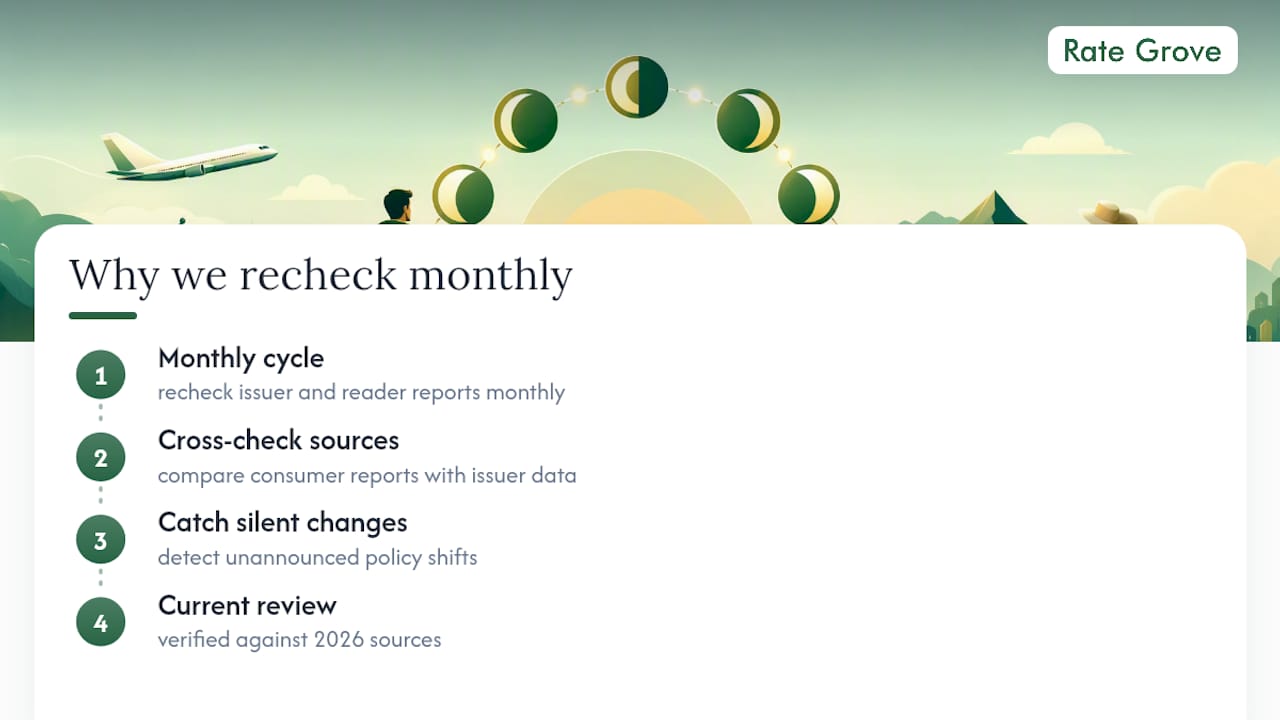
Chase never announces changes to this policy, which means guides built on old data can quietly go stale. Rate Grove rechecks issuer behavior and reader-reported outcomes on a monthly cycle, cross-referencing consumer finance reporting against verified issuer data rather than repeating whatever’s already circulating online.
If you’re weighing whether to open more cards now or hold off, our multi-account banking strategy guide walks through how account structure affects both your credit profile and your long-term rewards strategy. This piece was reviewed against issuer and consumer-reporting sources current as of 2026.
— Mat C.
Plan Your Next Card Application With Rate Grove
Rate Grove gives you a side-by-side view of card rates, fees, and tradeoffs pulled from verified issuer data, so you’re not piecing together your 5/24 timing from scattered forum posts and outdated blog posts.

Once you know your count, the next question is which card actually earns its keep once you’re eligible again. Comparing rewards structures and fees before you apply beats guessing after the fact, especially when a hard pull is already on the table. Our multi-account banking strategy guide is a solid place to map out your next 12 to 24 months of applications. Head to Rategrove to compare current card offers and start building a timeline that fits your actual credit profile.
Where to Verify Your Credit Report and Chase Policies
- Annualcreditreport: the official source for free Equifax, Experian, and TransUnion reports.
- Chase’s application status page: confirms where your application stands, though it won’t reference 5/24 directly.
This article is general information, not a substitute for advice from a qualified financial advisor. Consult a qualified financial professional about your own circumstances before acting on anything here.