

A credit card cash advance lets you borrow cash against your card’s credit line at an ATM, bank teller, or through a convenience check. Interest starts the moment the cash lands in your hands, no grace period, and fees typically run 3% to 5% on top. Treat it strictly as a last-resort emergency option, not a backup for everyday cash flow.
TL;DR:
- Cash advances typically incur fees of 3% to 5% plus ATM surcharges, with higher APRs than regular purchase rates and no grace period.
- The maximum withdrawal amount is usually a percentage of your credit limit, which is listed on your statement or online account.
- Using a cash advance increases your credit utilization instantly and can lower your credit score if the balance remains high over time.
- Before borrowing, consider alternatives such as personal loans, balance transfers, or borrowing from friends to avoid high fees and interest.
- Cash advances should only be used for urgent, unavoidable needs and paid off quickly to minimize costs.
Table of Contents
- How Does a Credit Card Cash Advance Work?
- How Do You Get a Cash Advance?
- What Does a Cash Advance Actually Cost You?
- How Much Can You Actually Withdraw?
- Does a Cash Advance Hurt Your Credit Score?
- What Should You Try Before a Cash Advance?
- When Does a Cash Advance Actually Make Sense?
- Why Rate Grove Built a Fee-First Approach to This Topic
- Compare Cards Before You Ever Need a Cash Advance
- Where This Guide’s Numbers Come From
- Sources
How Does a Credit Card Cash Advance Work?
A cash advance posts to your card balance separately from purchases, and it usually starts accruing interest from day one. There’s no 21-day grace period like you get on regular purchases. Some issuers even compound that interest daily, which quietly adds up faster than you’d expect over a few weeks.
The APR on a cash advance is typically its own number, and it almost always runs higher than your purchase APR. Capital One notes that cash advances are treated as short-term loans with this separate, elevated rate baked in from the start.
It’s not just ATM withdrawals, either. Convenience checks your issuer mails you, and even certain money-transfer-style purchases, can get classified as cash advances. The CFPB warns that convenience checks often carry the same fees and interest terms as a straight cash withdrawal, even when the check advertises a low intro rate.
How Do You Get a Cash Advance?
You have a few practical routes, and each comes with its own friction points.
- ATM withdrawal: Use your card’s PIN, and expect a daily withdrawal cap plus an ATM owner surcharge on top of your issuer’s fee.
- Bank teller withdrawal: Bring your card and a photo ID; policies on maximum amounts and processing time vary by issuer.
- Convenience checks: These issuer-mailed checks are processed as cash advances with the same fees and immediate interest, regardless of what the check’s cover letter promises.
- Online or push-to-bank transfers: A handful of issuers let you push funds directly to a checking account, though this can take a few business days to clear.
If you go the convenience-check route and need the money in a bank account fast, depositing cash from a check into an online account is worth understanding before you write one.
What Does a Cash Advance Actually Cost You?
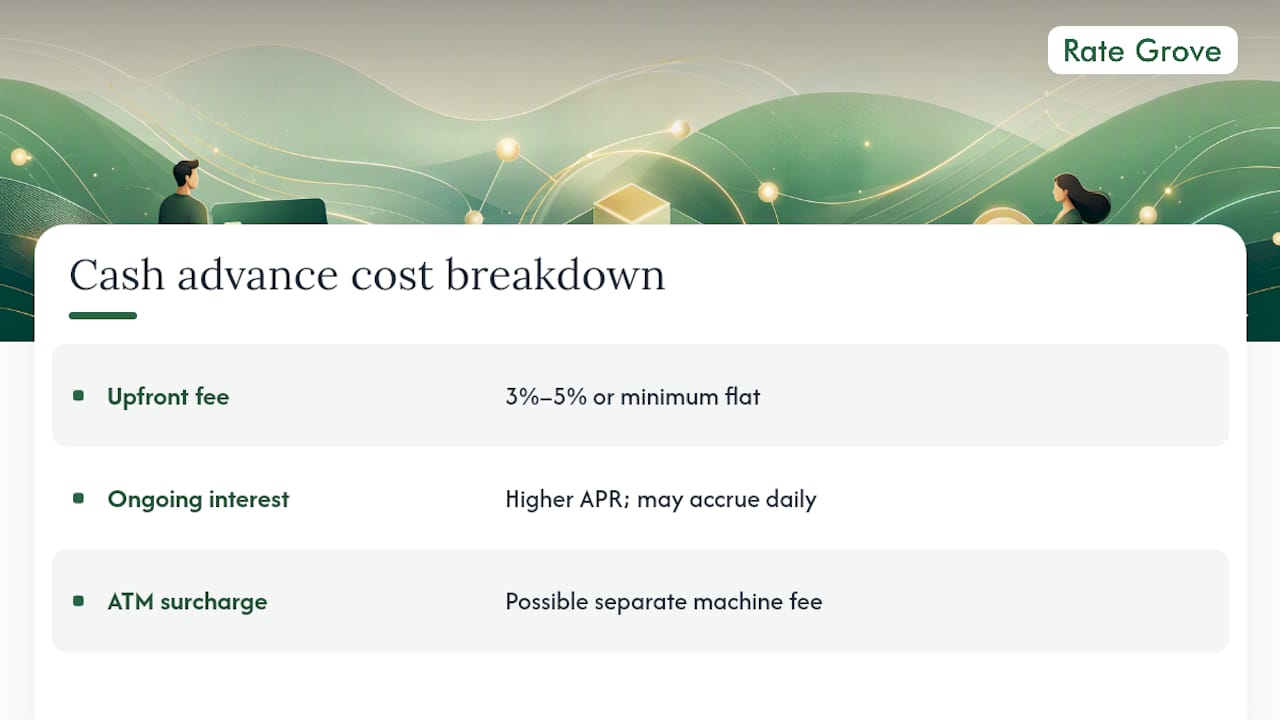
Two separate charges hit you every time: an upfront cash advance fee and ongoing interest at a rate higher than your purchase APR. Issuers commonly charge 3% to 5% of the amount advanced, or a flat minimum fee, whichever is greater. If you use an out-of-network ATM, you’ll likely eat a machine surcharge too, separate from anything your card issuer charges.
Here’s what that looks like on a $500 advance, using figures consistent with worked examples from major financial outlets:
That’s the cost of borrowing $500 for roughly a month, and it climbs the longer the balance sits. CNBC Select’s worked examples show that a $500 advance carried more slowly, across a couple of billing cycles at a high-20s APR, can rack up closer to $70 to $100 in combined fees and interest.
Pro Tip: Check your card’s interest calculation method before you assume a “one month” advance only costs one month of interest. If your issuer compounds daily, the number creeps up faster than a simple estimate suggests.
How Much Can You Actually Withdraw?
Your cash advance limit usually isn’t your full credit limit. Issuers often cap it at a percentage of your overall limit, or set a separate flat cap entirely, and Chase notes that this figure is typically listed on your monthly statement or online account. Any existing balance eats into what’s available. On top of your issuer’s cap, the ATM itself may impose its own daily withdrawal limit. The fastest way to check your real number: log into your account online or call customer service before you show up at an ATM expecting a specific amount.
Does a Cash Advance Hurt Your Credit Score?
Borrowing cash against your card raises your outstanding balance immediately, and that pushes up your credit utilization ratio. Experian explains that a higher utilization ratio can lower your credit score if the balance sits there for long, since utilization is one of the bigger factors scoring models weigh.
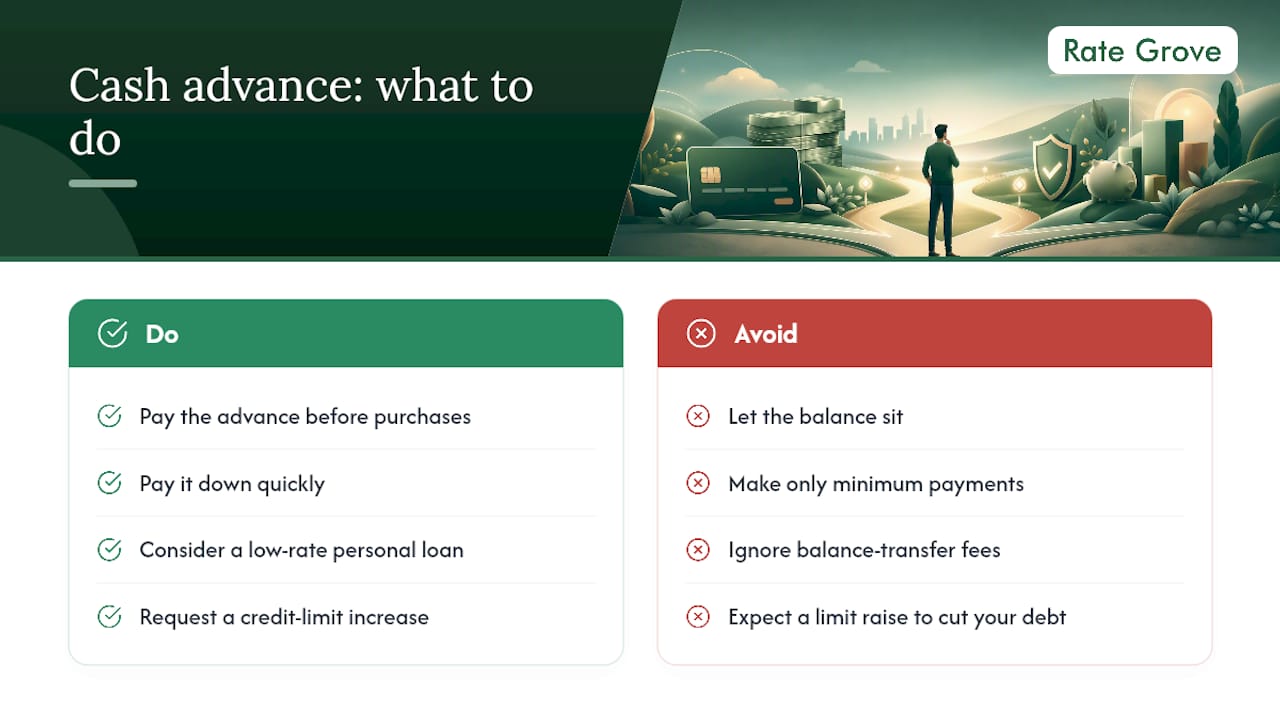
Once you’ve taken an advance, pay it down before your regular purchase balance, since it’s accruing interest at the higher rate and doing so from day one. Making only the minimum payment lets both the fee and the interest compound against you.
If you can’t clear it quickly, look at a low-rate personal loan or a balance-transfer offer to move the debt somewhere cheaper, though watch for balance-transfer fees eating into the savings. A credit limit increase on the same card can also help your utilization ratio recover faster once the balance is paid down, even though it doesn’t reduce what you owe.
What Should You Try Before a Cash Advance?
Run through these in order before you touch your card’s cash advance feature:
- Emergency fund or a loan from family or friends. Free or near-free if you have either option available.
- A personal loan. Fixed, often meaningfully lower rates than a cash-advance APR, and a clear payoff timeline from day one.
- A 0% balance-transfer offer or a short-term low-rate line. Can eliminate interest for a promotional window, though balance-transfer fees and approval requirements apply.
- Skip payday loans and quick-cash storefronts entirely. Their rates routinely dwarf even a cash advance’s cost.
Pro Tip: Call your issuer before assuming you don’t qualify for a personal loan or transfer offer. Existing cardholders sometimes get faster approval and better terms than a cold application elsewhere.
When Does a Cash Advance Actually Make Sense?
A cash advance earns its place only for immediate, essential needs, think medical costs or a safety issue, where no cheaper option exists in the moment. Keep the amount as small as the situation allows, and set a repayment window measured in days, not months. Before you withdraw, confirm the exact fee and APR your issuer charges, and have your repayment plan ready. If you can’t picture paying it off within a cycle or two, that’s a signal to look elsewhere first.
Why Rate Grove Built a Fee-First Approach to This Topic
Cash advance terms bury themselves in cardholder agreements most people never read until they’re standing at an ATM. Rate Grove’s guides get rechecked against issuer and regulator sites monthly, specifically so a fee structure that changed last quarter doesn’t sit stale in an old article. That’s the gap this piece tries to close: not another generic warning about cash advances, but numbers you can actually check against your own card.
The bigger issue isn’t that cash advances are expensive. It’s that most people discover the real cost after the transaction posts, not before. A side-by-side comparison of APRs and fees before you borrow beats a surprise on your statement every time.
— Mat C.
Compare Cards Before You Ever Need a Cash Advance
Rate Grove is the alternative to digging through a dozen cardholder agreements one by one when you’re trying to figure out which card charges the least for a cash advance. Instead of hunting through fine print on issuer sites, you get purchase APRs, cash-advance APRs, and fee structures laid out side by side, pulled from verified issuer and regulator data and refreshed monthly.
If you’re carrying a card with a steep cash-advance APR, or you’re shopping for one with friendlier terms before an emergency ever comes up, compare credit card rates and fees on Rate Grove to see where your current card stacks up. Five minutes now can save you from a $70 surprise later.
Where This Guide’s Numbers Come From
This guide draws on consumer protection guidance from the CFPB and the FDIC, along with issuer-published terms and worked cost examples from established consumer-finance outlets, cross-checked for accuracy.
This article is general information, not a substitute for advice from a qualified financial advisor. Consult a qualified financial professional about your own circumstances before acting on anything here.