

A credit card grace period is the stretch of time between when your billing cycle closes and your payment due date, and if you pay your full statement balance before that date, you owe no interest on purchases. That’s the whole mechanism. Here’s what you need to know right now:
- Typical length: at least 21 days, set by federal rule when a card offers a grace period at all.
- Who controls it: your issuer decides the specifics, but the Credit CARD Act of 2009 sets the floor.
- Main exceptions: cash advances, many balance transfers, and any month where you’re already carrying a balance forward.
Pro Tip: Log into your issuer’s app right now and search “grace period” in your cardholder agreement. If you can’t find it in two minutes, set autopay for your full statement balance instead of the minimum. That single move protects you even if you never read the fine print.
Key Takeaways
Paying your full statement balance by the due date is the only reliable way to keep a credit card grace period and avoid interest on purchases.
| Point | Details |
|---|---|
| Grace period definition | It runs from your statement closing date to your payment due date, typically at least 21 days. |
| Pay in full, every cycle | Partial payments or carried balances eliminate grace and trigger daily interest accrual. |
| Exceptions exist | Cash advances and many balance transfers rarely qualify for grace, regardless of your payment habits. |
| Timing purchases helps | Buying right after your statement closes can extend your effective interest-free window significantly. |
| Automate the protection | Autopay for your full statement balance removes the risk of accidentally losing your grace period. |
Table of Contents
- How the Credit Card Grace Period Fits Into Your Billing Cycle
- What the Law Requires and What Your Issuer Decides
- When a Grace Period Doesn’t Apply
- How You Lose the Grace Period and What It Costs You
- How to Check Your Terms and Protect Your Grace Period
- What Losing Your Grace Period Actually Costs: A Real Example
- Why This Small Window Matters More Than People Think
- Where to Verify Your Card’s Actual Rules
- Frequently Asked Questions
- Sources
How the Credit Card Grace Period Fits Into Your Billing Cycle
Your grace period isn’t a fixed calendar window. It moves with your billing cycle, and understanding the sequence helps you use it on purpose instead of by accident.
- You make a purchase. The clock for that transaction starts here.
- Your billing cycle closes (usually every 28 to 31 days, per Experian).
- Your statement is issued, listing everything charged during that cycle.
- The grace period begins, running from the statement closing date to your due date.
- Your payment is due. Pay the full statement balance and you owe no interest on those purchases.
- The next billing cycle starts, and the process repeats.
Say your statement closes on June 1 and your payment is due June 22. That’s 21 days of grace on the balance from that statement. But a purchase made on June 2, right after closing, won’t appear until the following statement, so it could ride nearly 50 days interest free before payment is due. A purchase made on May 31, the day before closing, gets barely any float at all.
Pro Tip: If you’re planning a big purchase and can swing it, time it for the day after your statement closes. You’ll stretch your interest-free window to nearly two billing cycles instead of one.
What the Law Requires and What Your Issuer Decides
Federal rules set a floor, not a ceiling. Under the Credit CARD Act, issuers must deliver your statement at least 21 days before the payment due date whenever they offer a grace period. But here’s the part people miss: issuers are not required to offer a grace period at all. Most do, because competition among card issuers makes it close to standard, but it’s not guaranteed by law.
21 days minimum. That’s the statutory floor for statement-to-due-date timing on cards offering a grace period, whether your issuer sets it at 21 or extends it to 25.
Your cardholder agreement is the only place with your card’s real numbers. Check it, or call customer service and ask directly.
When a Grace Period Doesn’t Apply
Grace periods cover new purchases, assuming you pay in full each cycle. They typically don’t cover:
- Cash advances — interest usually starts accruing the moment you withdraw cash, no grace at all.
- Many balance transfers — often treated like cash advances unless your card’s terms say otherwise.
- Promotional 0% APR balances — these can have separate rules once the promo period ends.
- Any balance carried from a prior cycle — if you didn’t pay in full last month, this month’s purchases likely won’t get grace either.
The contrast is stark. Pull $200 from an ATM on your credit card, and interest starts that same day. Charge $200 to a restaurant and pay your statement in full, and you owe nothing extra. Same amount, completely different outcome, based entirely on transaction type and payment behavior. Always verify against your own cardholder agreement, since issuers can narrow grace-period coverage further than the baseline.
How You Lose the Grace Period and What It Costs You
Three things trigger a lost grace period: paying less than your full statement balance, missing your due date, or carrying a balance forward from a previous cycle. Any one of them flips the switch.
Once that happens, the consequences stack up fast:
- Interest accrues daily on your unpaid balance, and often on new purchases too, starting from the transaction date rather than after a grace window.
- Late fees apply if you miss the due date, set by your specific card agreement.
- Credit-reporting risk kicks in if a payment goes more than 30 days past due, which can meaningfully affect your credit score.
None of this is reversible mid cycle. Once you’ve lost grace on a statement, you’re paying interest on that balance regardless of what you do next month.
Pro Tip: Set autopay for your full statement balance, not the minimum payment. Then schedule a calendar reminder three days before your due date as a backup. Two systems beat one when the cost of a slip is compounding daily interest.
How to Check Your Terms and Protect Your Grace Period
Confirming your own card’s rules takes less time than most people think.
- Find your statement closing date and due date. Both appear on your monthly statement and in your online account dashboard.
- Search your cardholder agreement for “grace period.” It will spell out exactly which transactions qualify and how many days you get.
- Call customer service if anything’s unclear. Ask directly: “Does my grace period apply to purchases? Are promotional balances excluded?”
- Pay the full statement balance, not the minimum, every cycle you possibly can.
- Request a due-date change if your billing cycle doesn’t align well with your paydays. Most issuers allow this once you ask.
Pro Tip: If you’re building better habits around comparing card terms in general, understanding how APR differences affect your costs makes this whole system click faster.
What Losing Your Grace Period Actually Costs: A Real Example
Numbers make this concrete. Once you lose your grace period, interest accrues daily using a daily periodic rate, calculated as your APR divided by 365.
Apply that to $1,000, and you’re accruing roughly $0.66 per day. Over a 30-day cycle with no additional payments, that’s close to $20 in interest, and most issuers calculate it against your average daily balance, which can push the number higher if you’re also adding new purchases mid cycle.
Daily accrual is the key mechanic. Interest doesn’t wait for your next statement. It compounds every single day you carry a balance, which is exactly why issuer rules around grace periods matter so much to your bottom line.
This is a simplified example. Your actual cost depends on your specific APR, your balance method (many issuers use average daily balance rather than a flat monthly figure), and how many new purchases hit the account mid cycle. Check your own APR and statement’s interest calculation section before assuming this number applies to you. For a deeper breakdown of how these calculations work, Rate Grove’s guide to credit card interest walks through the full method.
Why This Small Window Matters More Than People Think
Most cardholders treat the grace period as background noise, something that exists but doesn’t require attention until a bill surprises them. That’s backwards. The grace period is the single mechanism separating a credit card that costs you nothing from one that quietly charges you $20, $50, or more every month on balances you thought were manageable.

My honest recommendation: schedule your payment three days before the due date and set autopay for your full statement balance, not the minimum. That one habit removes the two most common ways people lose grace entirely by accident. Check your cardholder agreement this week and confirm your card’s actual terms.
Where to Verify Your Card’s Actual Rules
For the legal baseline and plain-language definitions, start with the CFPB’s grace period explainer. For billing-cycle mechanics and timing strategy, Experian’s breakdown is thorough and consumer-friendly. For issuer-specific language and examples of how grace periods appear in real cardholder terms, check Capital One’s education page alongside your own issuer’s site.
Frequently Asked Questions
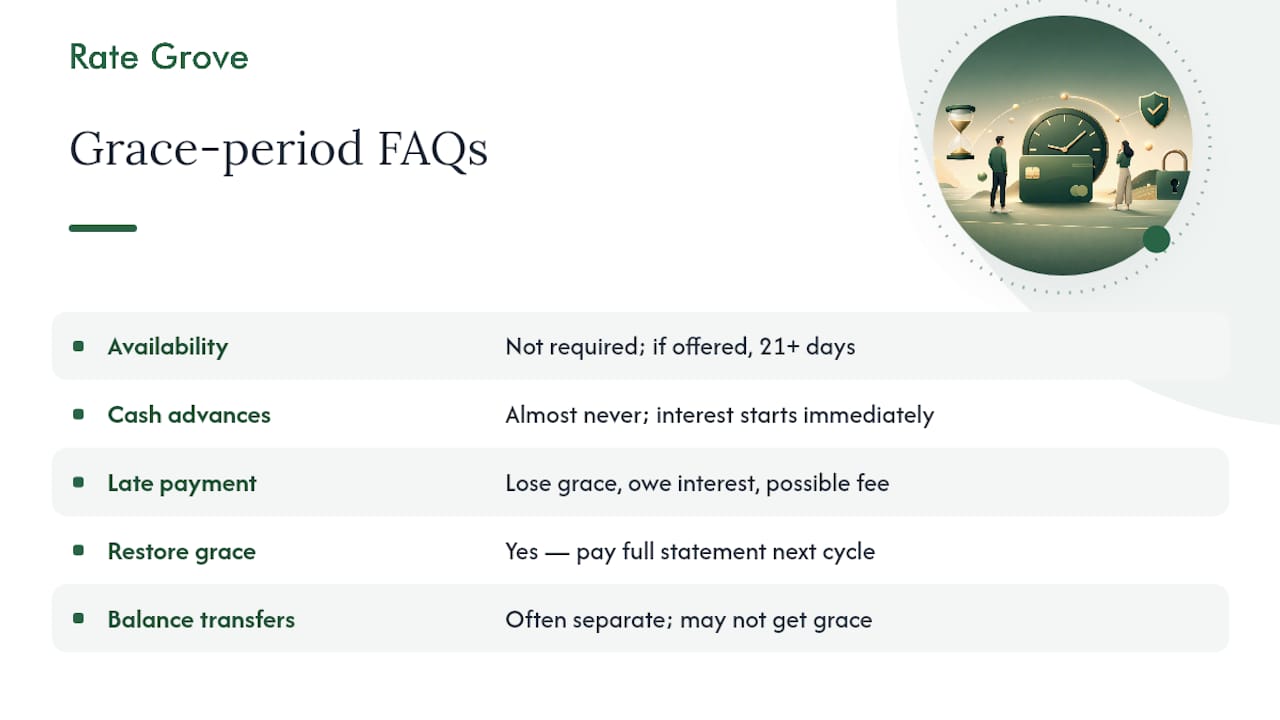
Does every credit card offer a grace period? No. Federal rules require at least 21 days between statement delivery and due date when a grace period is offered, but issuers aren’t legally required to offer one at all. Check your cardholder agreement to confirm.
Do cash advances get a grace period? Almost never. Interest on cash advances typically starts accruing the day you withdraw the money, with no interest-free window.
What happens if I pay a few days late? You’ll likely lose your grace period for that cycle, owe interest on the balance, and may face a late fee. If you’re within a few days, contact your issuer immediately since some will waive a first-time late fee, and paying quickly minimizes further interest and protects against credit-reporting risk after 30 days.
Can I get my grace period back after losing it? Yes, typically by paying your full statement balance again the next cycle. Most issuers restore the grace period once you’re caught up.
Does a balance transfer affect my grace period? Often yes. Many balance transfers are treated separately from purchases and may not carry the same interest-free treatment, so check your card’s specific terms before assuming otherwise.
This article is general information, not a substitute for advice from a qualified financial advisor. Consult a qualified financial professional about your own circumstances before acting on anything here.