

A callable CD is a bank-issued time deposit that pays a higher APY in exchange for the bank’s right to end the CD early. You get a better rate up front, but if the bank calls it, you’re stuck reinvesting your money at whatever rate is available then, which could be lower. Callable CDs are FDIC-insured just like traditional CDs, so your principal is never at risk. Your future interest is.
TL;DR:
- Callable CDs often have call protection periods of six months to two years, after which the bank can redeem the deposit on specific call dates.
- If called early, reinvesting at current market rates—often lower than the original yield—can significantly reduce your earnings compared to a non-callable CD.
- The typical APY premium for callable CDs ranges from 0.5% to 1.0% over similar non-callable options, justified by the bank’s right to call anytime after the protection period.
- Longer call protection periods, lower call premiums, and shorter deposit amounts make callable CDs more suitable for flexible, yield-seeking investors rather than conservative savers.
- FDIC or NCUA insurance protects principal regardless of call events, but brokered callable CDs may have different structures, and interest plus call premiums are taxed as ordinary income.
Table of Contents
- How Callable CDs Work: Call Dates, Call Protection, and Call Premiums
- What Happens to Your Money If the CD Gets Called
- Callable CD Pros and Cons: Who Should Actually Buy One
- Reading the Fine Print: Call Schedules and Non-Call Windows
- How to Decide If a Callable CD Fits Your Plan
- Is Your Money Safe? FDIC Coverage and Tax Reporting
- How Rate Grove Helps You Compare Callable CD Offers
- When a Callable CD Actually Makes Sense
- Compare Callable CD Rates Before You Commit
- Where to Verify the Details Yourself
- Sources
How Callable CDs Work: Call Dates, Call Protection, and Call Premiums
The mechanics come down to one thing: the bank, not you, controls when this deposit ends. A callable CD gives the issuing bank the right to redeem it before maturity, typically when market interest rates drop. If the bank can borrow or issue new deposits cheaper elsewhere, it has every incentive to call your CD and stop paying you that higher rate.
Every callable CD comes with a schedule that spells out exactly when the bank can act:
- Call protection period: a window at the start, often six months to two years, when the CD cannot be called under any circumstances.
- Call dates: specific dates after the protection period ends when the bank may redeem the CD, often quarterly or semiannually.
- Call premium: a bonus payment the bank sometimes adds if it calls the CD, meant to soften the blow of losing future interest.
- Maturity date: the final date, whether or not the CD was ever called along the way.
A traditional, non-callable CD has none of this. You lock in a rate, the bank locks in the term, and neither side can walk away early without triggering an early-withdrawal penalty on your end. With a callable CD, only you are locked in. The bank keeps an exit. That asymmetry is exactly why callable CDs pay more. Reviewing how rate lock language works on standard CDs makes the contrast easier to spot when you’re comparing offers side by side.
What Happens to Your Money If the CD Gets Called
Numbers make the trade-off real. Say you deposit $10,000 into a 3-year callable CD paying 5.00% APY, with six months of call protection and semiannual call dates after that.
- If held to maturity: $10,000 compounding at 5.00% APY for 3 years grows to roughly $11,576, assuming annual compounding.
- If called after 12 months: you’d have earned about $500 in interest, plus any stated call premium, and get your full $10,000 principal back.
- The reinvestment problem: if market rates have dropped to, say, 3.75% by the time you’re forced to reinvest, that same $10,000 now earns roughly $125 less per year than it would have under the original callable rate, and far less than a comparable non-callable CD locked at 5.00% for the full term would have paid.
The bank calls the CD precisely when reinvesting is worst for you. That’s not a coincidence. It’s the whole reason the option exists.
Callable CD Pros and Cons: Who Should Actually Buy One
Callable CDs aren’t inherently good or bad. They fit some savers and work against others.
The upside:
- Higher APY than comparable non-callable CDs, often by 0.5% to 1.0% according to industry commentary.
- Full FDIC or NCUA insurance coverage, same as any other deposit account, up to standard limits.
- Predictable worst-case outcome: you always get your principal and accrued interest back if called.
The downside:
- Reinvestment risk sits at the center of the product. Experts note the bank tends to call when market rates have fallen, leaving you to reinvest at a worse rate.
- You lose the upside of locking in today’s rate for the full term.
- The contract language, call schedules, and premium structures add real complexity compared to a plain CD.
Conservative savers who need dependable income for a fixed period usually do better with a traditional CD. Yield-seekers comfortable with uncertainty, and anyone building a CD ladder who can absorb one rung getting called early, tend to get more out of callable CDs.
Pro Tip: If you’re laddering CDs across multiple maturities, put your callable CDs in the shorter rungs. That way, if one gets called, you’re not scrambling to replace a large chunk of your long-term income plan.
Reading the Fine Print: Call Schedules and Non-Call Windows
Every callable CD disclosure uses fairly consistent language once you know what to look for.
- Search the disclosure for phrases like “callable after,” “call date,” “non-call period,” or “issuer’s option to redeem.”
- A typical non-call period runs several months from issuance, followed by recurring call windows at regular intervals.
- Call premium schedules usually decline over time. A bank might offer a premium in year one that shrinks or disappears entirely by year three, since SmartAsset notes the premium is meant to compensate you most when the call risk to your plans is highest.
If the disclosure doesn’t clearly state a call date schedule and premium structure, ask the issuer directly before depositing a dollar.
How to Decide If a Callable CD Fits Your Plan
Run through this checklist before you commit any money.
- Compare the APY premium. A 0.5% to 1.0% premium over a comparable non-callable CD is a reasonable baseline for taking on call risk. Anything less probably isn’t worth the uncertainty.
- Check the call protection length. Longer protection, 18 to 24 months or more, gives you more time to actually earn the higher rate before the bank can act.
- Look at the minimum deposit. Some callable CDs require higher minimums than standard CDs, which affects how much of your cash sits exposed to this risk.
- Ask the issuer directly what triggers a call decision and how often calls have historically happened on similar products.
- Build a reinvestment plan now, not after the call notice arrives. Laddering shorter callable CDs alongside longer non-callable ones, using a strategy like a CD ladder, keeps any single call from disrupting your whole plan.
Pro Tip: Before buying, write down what you’ll do with the cash if it gets called on day one after the protection period ends. If that scenario doesn’t sit fine with you, the CD isn’t worth it regardless of the rate.
Is Your Money Safe? FDIC Coverage and Tax Reporting
Callable CDs carry the same deposit insurance as any other CD. FDIC coverage protects your principal up to standard limits at member banks, and NCUA coverage applies at credit unions, so being called never puts your original deposit at risk.
A few things to watch beyond that baseline:
- Brokered callable CDs work differently from ones bought directly at a bank. Custody sits with a brokerage, resale on a secondary market is possible before maturity, and Vanguard’s guidance on brokered CDs is worth reviewing before buying through a brokerage account.
- Tax treatment is straightforward: both the interest you earn and any call premium you receive count as ordinary interest income, reported on Form 1099-INT for the year you received it.
- Confirm FDIC membership or NCUA charter status before depositing, especially with online-only banks. Freelancers and self-employed savers holding larger cash balances should also review how FDIC limits apply across accounts.
How Rate Grove Helps You Compare Callable CD Offers
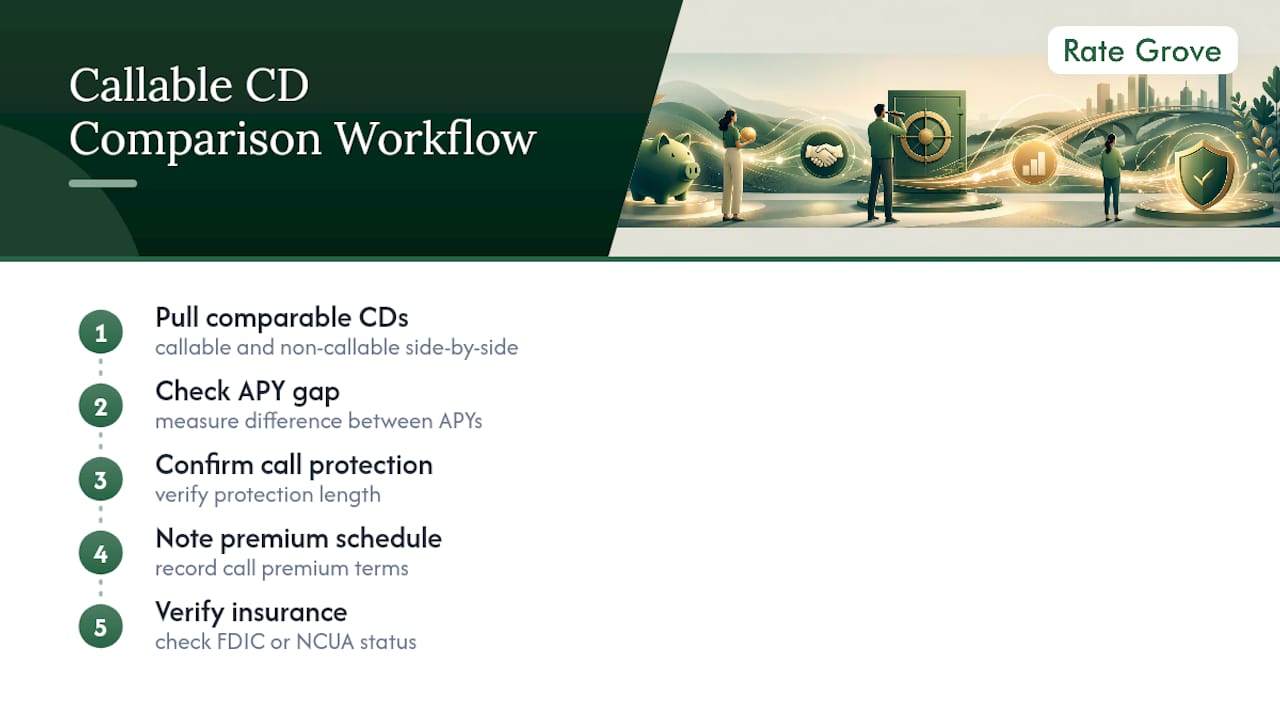
Rate Grove verifies APY, call protection windows, call premium terms, and FDIC or NCUA status directly against issuer and regulator data, so you’re not piecing together disclosure language from five different bank websites. A quick workflow: pull up comparable callable and non-callable CDs, check the APY gap, confirm the call protection length, then note the premium schedule. Our CD rate comparisons make that side-by-side check fast.
When a Callable CD Actually Makes Sense
If you’re a conservative saver who needs a predictable income stream for a fixed period, skip callable CDs and take a traditional CD’s guaranteed term instead. If you’re chasing yield and can handle the possibility of reinvesting at a lower rate later, a callable CD with strong call protection can be worth the trade. The two mistakes I see most often: ignoring the call protection length entirely, and assuming the higher rate is “free” money with no downside. It isn’t. Match the product to your tolerance for uncertainty, not just the number on the rate sheet.
— Mat C.
Compare Callable CD Rates Before You Commit
Some comparison sites pull verified rate, call protection, and insurance data straight from issuer and regulator sources, so you can see the real trade-off on a callable CD without digging through a dozen disclosure PDFs yourself.
Comparing offers takes just a few minutes: line up the APY premium against a comparable non-callable CD, check how long the call protection window runs, and confirm the call premium schedule before you decide. If the numbers line up with your reinvestment plan, you’re ready to move forward with confidence. Head to Rate Grove’s CD comparison tools to see current callable and non-callable rates side by side and pick the term that actually fits your goals.
Where to Verify the Details Yourself
For definitions and issuer rights, start with Investor.gov’s callable CD glossary. Confirm deposit insurance at FDIC.gov, and review broader disclosure rules through the SEC’s investor education resources.
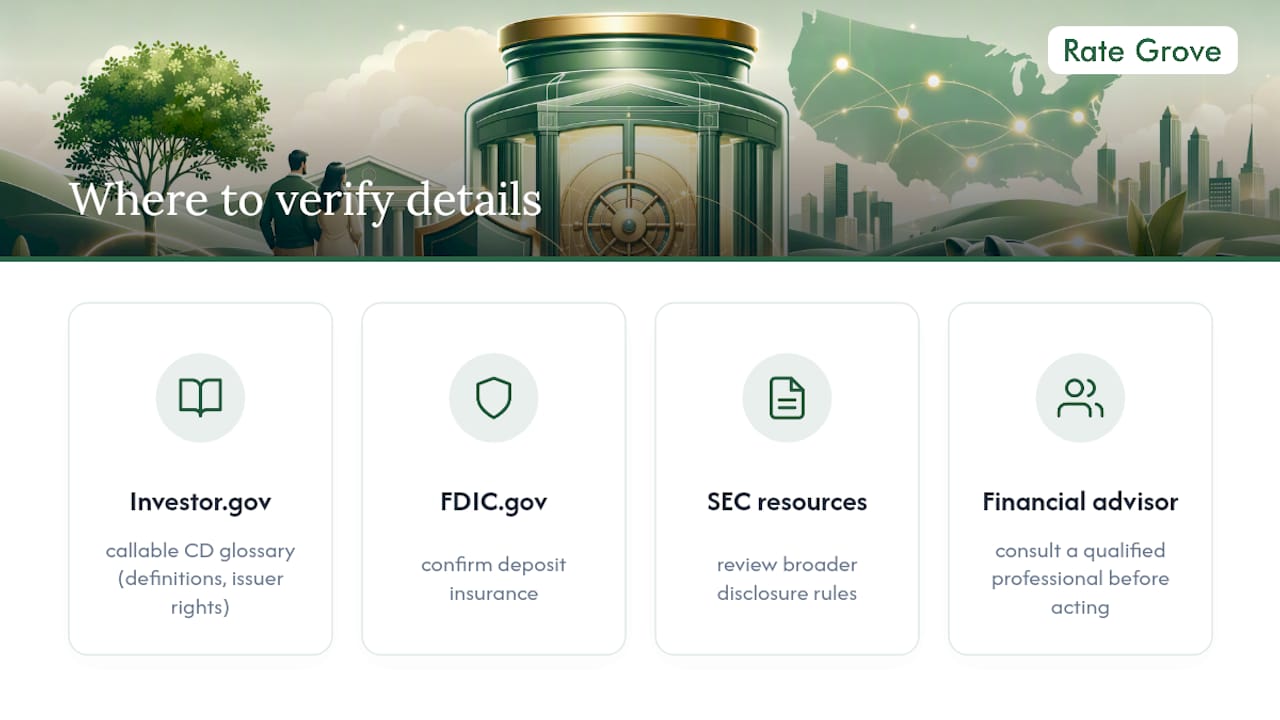
This article is general information, not a substitute for advice from a qualified financial advisor. Consult a qualified financial professional about your own circumstances before acting on anything here.