

Your credit card minimum payment is the smallest amount you can pay each month to avoid a late fee and keep your account in good standing. Issuers set it using a flat fee, a flat percentage, or an interest-plus-fees formula, whichever produces a higher number. Paying only that minimum keeps you current, but it barely touches your balance. If you can pay more, do it. Even $50 extra a month changes the math dramatically.
TL;DR:
- Most credit card minimum payments include interest, fees, or a fixed percentage, often resulting in slow debt reduction and higher long-term costs.
- Paying only the minimum can extend repayment over several years and add thousands of dollars in interest, especially with higher balances or interest rates.
- Increasing your monthly payment by even a small amount directs more funds toward reducing the principal and shortens the payoff period significantly.
- Layered calculation methods by issuers mean your minimum can vary month to month due to fees, penalties, or balance fluctuations.
- Using a fixed extra amount or payoff strategy like the avalanche or snowball can dramatically lower interest paid and accelerate debt clearance.
Table of Contents
How Issuers Calculate Your Credit Card Minimum Payment
There’s no single credit card minimum payment formula used across every issuer. Each card company sets its own rules, spelled out in your cardmember agreement, but most fall into one of three approaches.
- Flat fee method: You pay a set dollar amount, commonly $25 to $40, whenever your balance is small enough that a percentage calculation would fall below that floor.
- Flat percentage method: Your minimum equals a fixed slice of your balance, typically 1% to 4%, depending on the issuer.
- Interest-plus-percentage method: Your minimum equals a small percentage of the principal (often 1%) plus whatever interest and fees accrued that cycle.
Many issuers use a layered approach: they calculate the minimum both ways and charge whichever number is larger, then tack on any past-due amounts or installment-plan payments you’ve added to the card. That’s why your minimum can jump from $35 one month to $62 the next, even without a big purchase. A missed payment fee, a rate increase, or a “buy now, pay later” plan folded into your card balance can all shift the number.
Your card’s own statement or cardmember agreement is the only place with your actual formula. Two issuers can advertise “1% plus interest” and still land on different dollar amounts depending on how they round or layer fees.
Where to Find Your Minimum Payment
Your statement always lists the exact figure. Here’s where to look:
- Check the summary box on your paper or digital statement for a line labeled “Minimum Payment Due” next to “Payment Due Date.”
- Log into your online account and open the billing or payments section. Most issuers display the current minimum before you even select a payment amount.
- Call customer service if you can’t access your statement. The number is printed on the back of your card.
Every U.S. statement also carries a required minimum payment warning box. It shows roughly how many years it would take to pay off your balance at the minimum, and how much extra interest you’d pay along the way. It’s one of the more useful disclosures on the page, and most people skip right past it.
What Paying Only the Minimum Actually Costs You
Interest on a revolving balance compounds against whatever you still owe, so the slower you pay down principal, the more interest keeps piling on top of itself. That’s the mechanical reason minimum payments are expensive: you’re mostly paying interest, with only a sliver going toward the actual debt.
Statistic Callout: A commonly cited example puts this in real numbers: a $3,000 balance paid down only at the minimum can take years to clear and add well over a thousand dollars in extra interest compared to paying it off faster. Making only the minimum payment “will significantly lengthen the time it takes to repay debt and increase the amount of interest paid over time,” according to Experian.
Minimum payments do more than drain your wallet slowly. They also shape your credit profile in ways that aren’t obvious from the statement alone.
- Sticking to minimums keeps your balance high relative to your credit limit, which raises your credit utilization ratio, a major scoring factor.
- Your payment history stays clean as long as you pay on time, even at the minimum, which is why it “won’t hurt your credit” the way a missed payment would, per Investopedia.
- Falling short of even the minimum triggers a late fee, and issuers may also revoke a promotional 0% APR and apply a penalty APR that can run considerably higher than your standard rate.
- Payments 30 days or more late get reported to the credit bureaus and can knock down your score for years.
Faster Ways to Pay Down Your Balance
Paying the minimum isn’t a strategy. It’s what happens when you don’t have one. A few adjustments can shrink your payoff timeline dramatically without requiring a windfall.
- Add a fixed amount every month. Rounding your $67 minimum up to $100 doesn’t sound dramatic, but that extra $33 goes entirely to principal since the minimum already covers interest and fees.
- Split your payment across the billing cycle. Making two payments instead of one lowers your average daily balance, which shrinks the interest charged that period, especially useful if your issuer calculates interest daily.
- Pick a payoff method and stick with it. The avalanche method (attacking the highest-APR card first) saves the most money mathematically. The snowball method (smallest balance first) tends to keep people motivated longer. Neither works if you abandon it after two months.
- Consider a balance transfer card if your credit qualifies. A 0% promotional period can eliminate months of interest, but transfer fees (often 3% to 5%) and the requirement of good credit make this a poor fit for everyone carrying debt.
- Call your issuer before you miss a payment, not after. Hardship programs and temporary rate reductions exist, but they’re far easier to get proactively than as damage control.
- Automate slightly more than the minimum. Set your autopay at a fixed dollar figure above the stated minimum, so a bad month never turns into a missed payment.
Pro Tip: Set your autopay amount manually instead of selecting “minimum payment due” in your issuer’s app. A flat dollar figure you choose won’t fluctuate the way a formula-based minimum can, and it forces you to pay down principal every single cycle.
Understanding how credit card interest actually accrues day by day makes it obvious why these small changes add up faster than most people expect.
Two Payoff Scenarios Worth Comparing
Scenario A: A $3,000 balance paid at the minimum only, with no new purchases, can take several years to clear and rack up well over a thousand dollars in interest along the way, depending on your APR and how your issuer calculates the minimum.
Scenario B: The same $3,000 balance, same APR, but with an extra $100 tacked onto the minimum every month. The payoff timeline drops from years to a small fraction of that, and total interest paid falls sharply, often by hundreds of dollars.
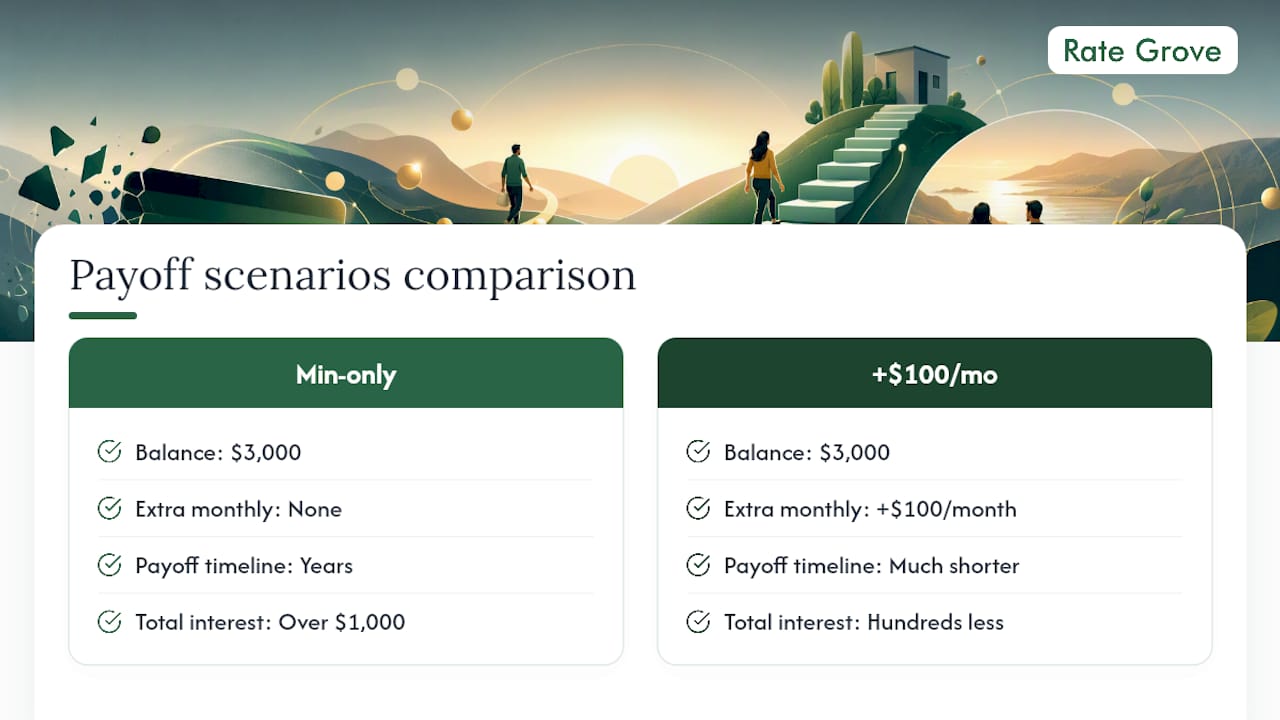
Both scenarios assume a fixed APR and no new charges added to the card, which rarely holds true in real life. For numbers based on your actual balance and rate, run them through a minimum payment calculator or a Rate Grove comparison tool built for exactly this kind of math.
Why Rate Grove Looks at Minimum Payments Differently
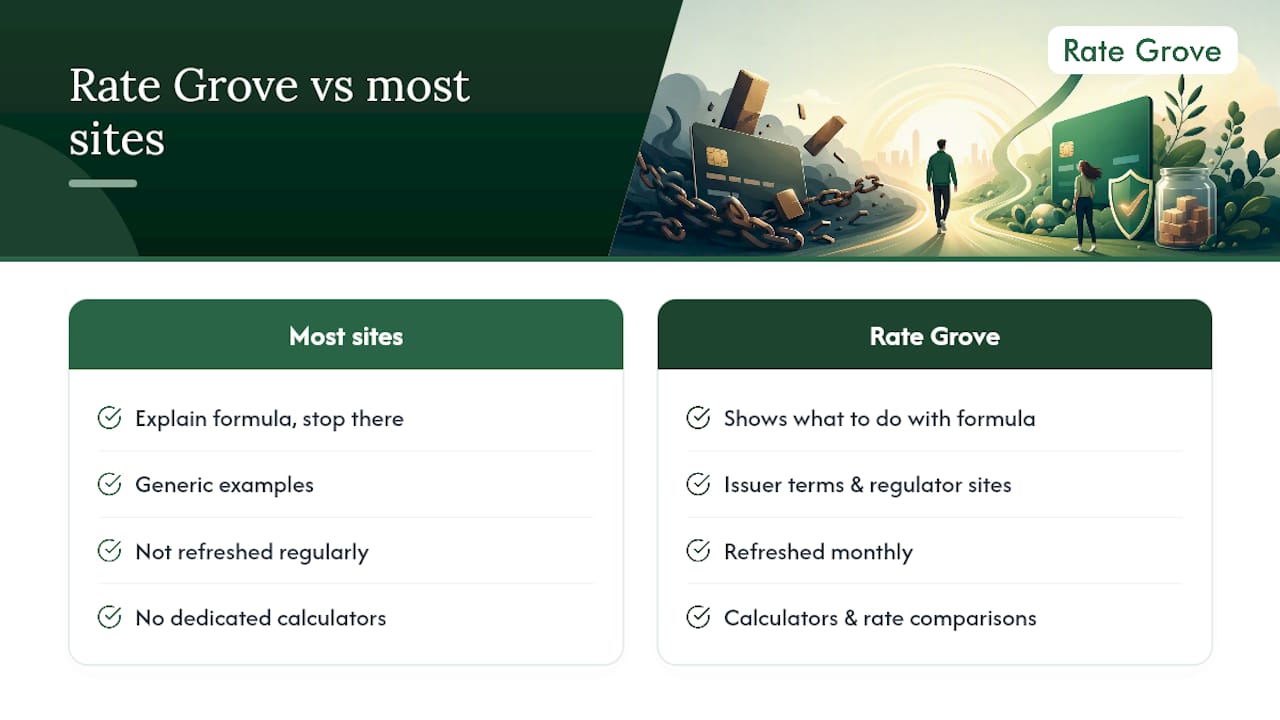
Most sites explain the credit card minimum payment formula and stop there. Rate Grove built its comparison tools around a different question: once you know the formula, what should you actually do with that information? Our guides pull directly from issuer terms and regulator sites, then get refreshed monthly so the numbers you’re reading haven’t gone stale by the time you act on them.
This piece was written by Mat C., who covers consumer credit and banking rate structures for Rate Grove, with a focus on translating cardmember agreement language into plain math readers can use. If you’re trying to figure out your own payoff timeline rather than a generic example, Rate Grove’s calculators and rate comparisons can help you see what an extra $50 or $100 a month actually saves you, based on your card’s real APR.
— Mat C.
Sources
- How is your credit card minimum payment calculated? | Experian
- Minimum monthly payment definition and details | Investopedia
- Debt
This article is general information, not a substitute for advice from a qualified financial advisor. Consult a qualified financial professional about your own circumstances before acting on anything here.