

Credit card interest is defined as a fee charged on any unpaid balance you carry beyond your due date, calculated daily using your card’s annual percentage rate (APR) and compounded over time. Understanding how credit card interest works is the difference between using a card as a free payment tool and paying hundreds of dollars in unnecessary fees each year. The APR is the annual rate that represents your total cost of credit. Most issuers divide that APR by 365 to get a daily rate, then apply it to your balance every single day. Pay your full balance by the due date, and you pay zero interest. Carry even a small balance, and the math starts working against you fast.
How is credit card interest calculated?
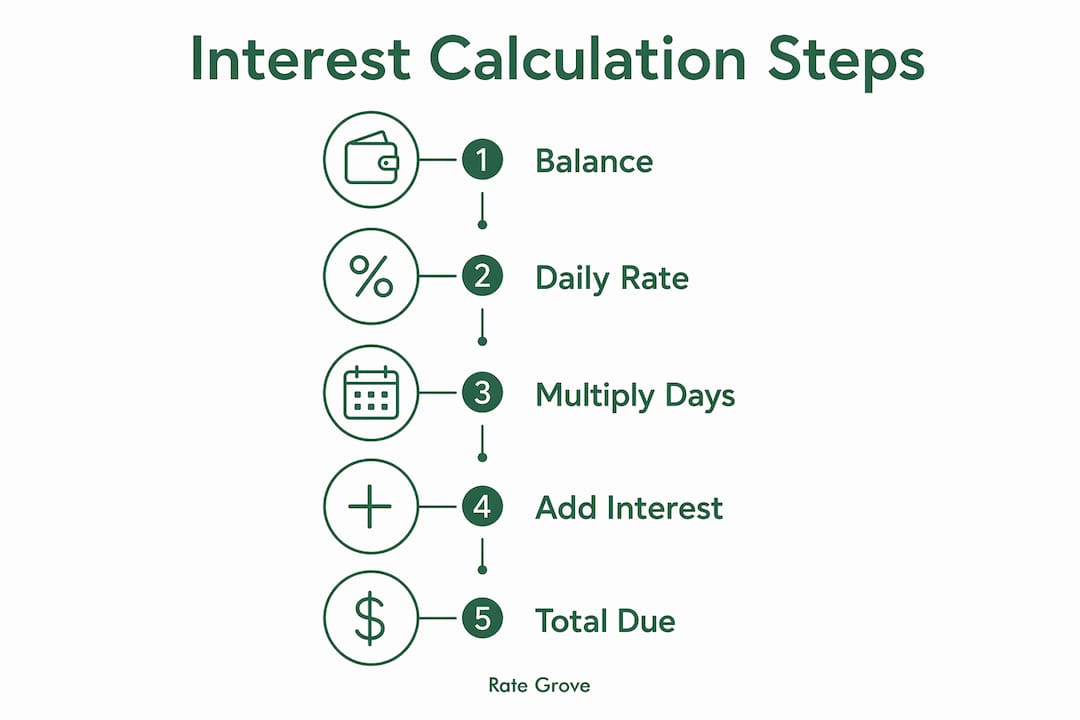
Credit card issuers calculate interest daily using the average daily balance method. The process has three steps.
- Find your daily periodic rate. Divide your APR by 365. A card with a 20% APR has a daily rate of approximately 0.055%.
- Calculate your average daily balance. Add up your balance for each day in the billing cycle, then divide by the number of days. This accounts for purchases and payments made throughout the month.
- Multiply and compound. Multiply the daily rate by the average daily balance. That result is added to your principal each day, so the next day’s interest is calculated on a slightly higher number.
Here is a concrete example. Say your average daily balance is $1,500 on a card with a 20% APR over a 30-day billing cycle. Your daily rate is 0.055%. Multiply $1,500 by 0.055% to get $0.83 in interest per day. Over 30 days, that is roughly $24.75 before compounding. With daily compounding, the actual total is slightly higher because each day’s interest is added to the principal before the next day’s calculation runs. This is why balances grow faster than most people expect.
| Variable | Example Value |
|---|---|
| APR | 20% |
| Daily periodic rate | 0.055% |
| Average daily balance | $1,500 |
| Billing cycle length | 30 days |
| Estimated monthly interest | ~$24.75 |
Pro Tip: Making a payment mid-cycle, not just at the due date, lowers your average daily balance. A lower average daily balance means less interest charged, even if your APR stays the same.
You can review how credit card fees vary by issuer to understand what drives the rates on your specific card.
What are the types of credit card interest charges?
Not all APRs on your card are the same. Most cards carry several distinct rates that apply in different situations.
- Purchase APR. This is the standard rate applied to everyday purchases. It only kicks in if you carry a balance past your due date. If you pay in full each month, this rate never costs you a cent.
- Cash advance APR. Cash advance rates are typically higher than purchase APRs, and there is no grace period. Interest starts accruing the moment you take out the cash.
- Balance transfer APR. This rate applies when you move debt from one card to another. Many issuers offer promotional 0% periods on balance transfers, but fees and conditions apply. Once the promotional window closes, the standard rate takes over.
- Penalty APR. Missing a payment or paying late can trigger a penalty APR, which is significantly higher than your regular rate. Issuers can apply this rate to your existing balance and all future purchases.
- Introductory APR. Some cards offer 0% APR for a set period on purchases, balance transfers, or both. This rate expires after the promotional window, so knowing the exact end date matters.
APRs on most cards are variable, meaning they move with the prime rate. When the Federal Reserve raises rates, your variable APR typically rises with it. Checking your APR comparison factors before applying for a card helps you avoid surprises later.
How do grace periods help you avoid interest?
A grace period is the interest-free window between the end of your billing cycle and your payment due date. It typically lasts around 25 days. Pay your full statement balance before that deadline, and you owe zero interest on purchases made during that cycle.
The grace period disappears the moment you carry a balance. Once you miss paying in full, interest begins accruing on new purchases from the transaction date, not the due date. This is a detail most cardholders miss. You can make a purchase today, and if you are carrying a balance from last month, interest on that new purchase starts immediately.

Restoring your grace period requires paying your full statement balance for two consecutive billing cycles. One full payment is not enough if you have already lost it.
Here is what to do to protect your grace period:
- Pay the full statement balance, not just the minimum, every month.
- Set your payment due date reminder at least five days early to account for processing time.
- Avoid cash advances entirely if you want to preserve your grace period on purchases.
- If you have lost your grace period, commit to two full payments in a row to get it back.
Pro Tip: Moving money from checking to savings and then scheduling your card payment from a dedicated account makes it easier to pay in full each month. A savings strategy that separates spending money from bill money reduces the chance of accidentally spending what you owe.
What are the best strategies to reduce credit card interest?
The single most effective way to avoid credit card interest charges is to pay your full statement balance every month. No balance, no interest. It is that direct. But when carrying a balance is unavoidable, these strategies reduce how much you pay.
Make multiple payments per cycle. Paying earlier and more often lowers your average daily balance, which directly reduces the interest calculated each day. A $200 payment on day 10 of a 30-day cycle saves more interest than the same $200 paid on day 29.
Use 0% introductory APR offers carefully. A 0% balance transfer or purchase APR can eliminate interest for 12–21 months on many cards. The key word is “carefully.” Know the exact end date. Know the balance transfer fee, which is typically 3%–5% of the transferred amount. And have a plan to pay off the balance before the promotional rate expires.
Avoid using credit cards as emergency funds. High interest rates make credit cards a costly source of emergency cash. Building a dedicated cash reserve in a high-yield savings account is a far cheaper safety net.
Set up automatic payments. Automatic full-balance payments prevent late fees and protect you from penalty APRs. A missed payment can trigger a rate increase that lasts for months.
Compare APRs before you apply. A card with a lower purchase APR costs you less if you ever carry a balance. Researching rates upfront is free. Paying a higher APR for years is not.
Pro Tip: If you already carry a balance, call your issuer and ask for a rate reduction. Issuers grant rate reductions more often than most cardholders realize, especially if you have a history of on-time payments.
Key Takeaways
Credit card interest compounds daily, meaning every day you carry a balance costs you more than the day before.
| Point | Details |
|---|---|
| Daily compounding grows debt fast | Interest is added to your principal each day, accelerating how quickly balances grow. |
| Grace period is your best tool | Paying the full statement balance by the due date eliminates all purchase interest charges. |
| Multiple APR types apply | Cash advances, balance transfers, and late payments each trigger different, often higher, rates. |
| Earlier payments cost less | Paying mid-cycle lowers your average daily balance and reduces total interest for that period. |
| Automatic payments protect you | Scheduling full payments prevents late fees and guards against penalty APR triggers. |
Why I think most people misunderstand credit card interest
People treat credit card interest as a vague penalty for being irresponsible. That framing is wrong, and it is costly. Credit card interest is a precise, daily math problem running in the background of every unpaid balance. Most cardholders I have spoken with over the years are shocked when they learn that carrying a balance means new purchases start accruing interest immediately, not at the next due date.
The minimum payment trap is the part that frustrates me most. Minimum payments are designed to keep you in debt longer. They cover just enough to satisfy the issuer while interest compounds on the rest. Minimum monthly payments prolong debt because the compounding interest outpaces the principal reduction. Paying even $50 above the minimum each month makes a measurable difference.
My honest recommendation: treat your credit card like a debit card with a 25-day float. Spend only what you have already budgeted. If you find yourself regularly carrying a balance and the interest feels unmanageable, a nonprofit credit counseling agency can help you build a repayment plan without judgment. The math is fixable. You just need to start.
— Mat C.
Rate Grove makes APR comparison straightforward
Knowing how credit card interest works is only half the equation. The other half is finding a card with an APR that fits your financial habits.
Rate Grove compares credit card APRs, fees, and terms side by side using verified data from issuers and regulators. Every guide is updated monthly, so the rates you see reflect what issuers are actually offering right now in 2026. Whether you are looking to lower your current rate, find a 0% introductory offer, or simply understand what you are paying, Rate Grove gives you the information in one place without the clutter. Visit Rate Grove to compare current credit card rates and make a more informed choice today.
FAQ
What is a daily periodic rate?
The daily periodic rate is your APR divided by 365. It is the rate applied to your balance each day to calculate interest charges.
Does credit card interest compound daily?
Yes. Credit card interest is compounded daily, meaning each day’s interest is added to the principal before the next day’s calculation runs.
How do I get my grace period back after carrying a balance?
You must pay your full statement balance for two consecutive billing cycles to restore your grace period after carrying a balance.
Why is cash advance APR higher than purchase APR?
Cash advance APRs are set higher by issuers and carry no grace period, so interest begins accruing immediately from the date of the transaction.
What triggers a penalty APR?
A late or missed payment typically triggers a penalty APR. This higher rate can apply to your existing balance and all future purchases, sometimes for six months or longer depending on the issuer’s terms.