

Bank and payment-fee transparency matters because opaque deductions quietly shrink your invoice before it ever reaches your account, and that undermines both pricing and cash-flow planning. When a $2,000 invoice arrives as $1,940, the gap didn’t vanish. It went to sending fees, correspondent banks, or a marked-up exchange rate nobody disclosed upfront.
The fix starts before you invoice, not after. Ask your client whether the payment will be sent gross or net of fees, and request an expected net amount in writing.
- Transparency prevents surprise deductions from eating into income you already budgeted
- It lets you price jobs accurately instead of guessing at a fee cushion
- It keeps tax reserves and cash-flow forecasts grounded in real numbers, not estimates
Tools like Rate Grove and standards bodies like the OECD, BIS, and ECB all point to the same conclusion: disclosure only helps when it’s clear enough to act on.
Key Takeaways
Bank fee transparency protects freelancer income by making net receipts predictable enough to price jobs accurately and plan taxes with confidence.
| Point | Details |
|---|---|
| Ask gross versus net upfront | Clarify with every client whether they cover fees or you absorb them before invoicing. |
| Watch the FX markup, not just fees | The spread between mid-market and offered rates is often the largest hidden cost. |
| Build a holdback buffer | Set aside 3 to 5% of each invoice estimate to absorb fee variance in bookkeeping. |
| Compare disclosures, not marketing | Use verified side-by-side comparisons to check FX source and net-amount clarity. |
| Add a fee-responsibility clause | Specify in contracts who covers sending and intermediary bank fees. |
Table of Contents
- Why Bank Transparency Matters for Freelancers in Practice
- The Less-Visible Costs That Reduce What You Receive
- How Opaque Fees Change Your Pricing and Long-Term Income
- Why Unclear Fees Disrupt Cash-Flow Planning
- What to Look for When Comparing Banks and Payment Platforms
- Tactical Ways to Reduce Hidden Fees and Protect Your Income
- How Rate Grove Helps You Evaluate Fee Transparency
- What the Research Actually Supports
- Sources
Why Bank Transparency Matters for Freelancers in Practice
Transparency isn’t just publishing a fee schedule somewhere on a website. It means a client, freelancer, or account holder can see, before money moves, roughly what will arrive and why. The OECD frames this well: disclosure only counts as transparent when the information is relevant and understandable enough for someone to actually assess risk and manage their cash flow. A 40-page terms document buried in fine print technically discloses fees. It doesn’t make anyone transparent in a useful sense.
Real transparency, for a freelancer receiving payments, usually includes four things:
- A total-cost estimate shown before the transfer completes, not buried in a statement afterward
- The exchange-rate source disclosed as a specific benchmark (mid-market rate versus a bank’s own rate)
- A warning when a payment might route through intermediary or correspondent banks that can deduct fees along the way
- A transaction-level breakdown on the statement itself, showing each fee by name and amount
Compare two payout screens. Only one lets you plan around it.
The Less-Visible Costs That Reduce What You Receive
International payments often pass through more institutions than freelancers expect, and each one can take a cut, according to Remitly’s breakdown of freelancer payment fees. Here’s where the money actually goes:
- Sending bank fees: charged by the client’s bank to originate the transfer, sometimes passed to you, sometimes absorbed by the client depending on the payment instructions chosen
- Receiving bank fees: your own bank may charge a flat fee for inbound wires, and some account types cap free transfers per month
- Intermediary or correspondent bank fees: when a wire crosses borders through multiple banking networks, each intermediary can quietly deduct a processing fee before the funds ever reach you
- Platform withdrawal fees: freelance marketplaces and payment apps often charge a fixed fee, a percentage, or both when you pull funds to your bank
- Exchange-rate markups: the gap between the mid-market rate and the rate your provider actually applies, often the single largest and least visible cost
That last one deserves attention. A provider advertising “no transfer fee” can still take 2 to 3% off the top through a marked-up exchange rate, and because there’s no line item called “FX fee,” it looks free. The ECB’s research on bank transparency found that transparent banks tend to face lower funding costs than opaque ones, a signal that disclosure pressure genuinely changes institutional behavior, not just customer perception.
How Opaque Fees Change Your Pricing and Long-Term Income
Run the math on a single invoice and the stakes become obvious. Say you invoice a client $3,000 for a project.
| Stage | Amount |
|---|---|
| Invoice total | 3,000 |
| Sending bank fee (client absorbed or not) | 15 |
| Intermediary/correspondent fee | 20 |
| Platform withdrawal fee (1.5%) | 45 |
| FX markup (2% against mid-market rate) | 60 |
| Net received | 2,860 |
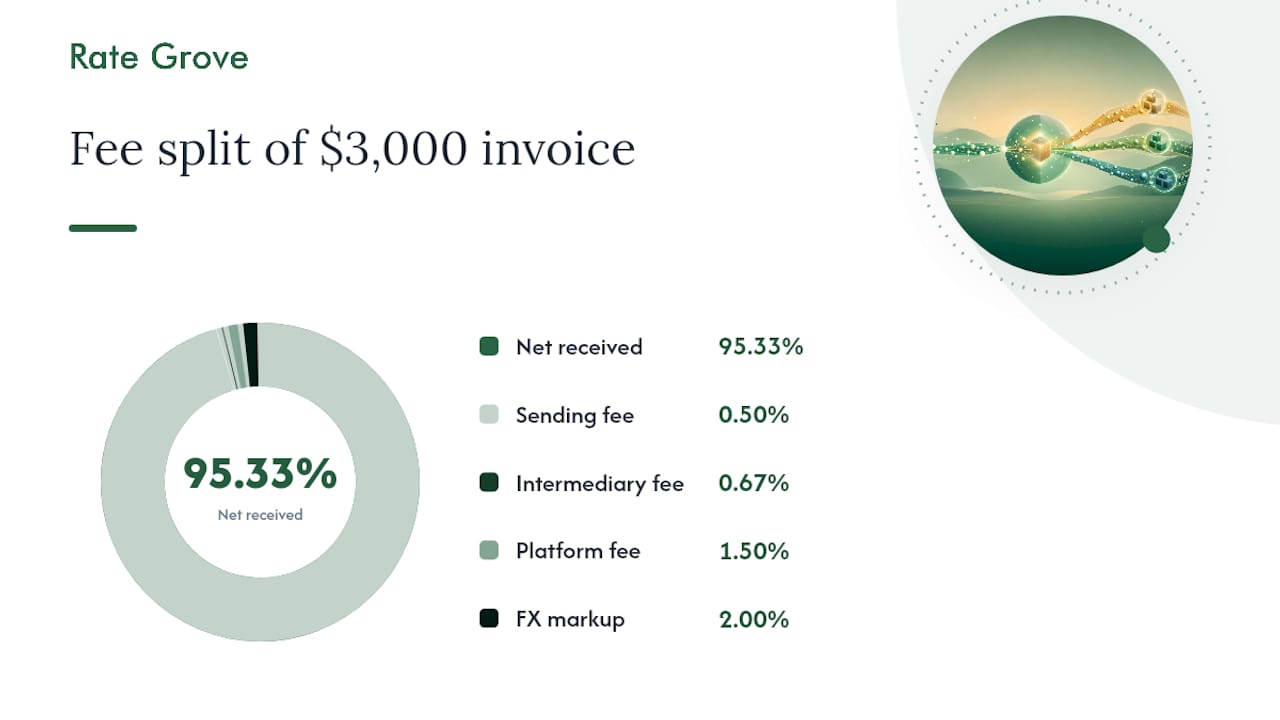
That’s a 4.7% loss on a single invoice, all from fees that rarely appear as a single clear number anywhere in the process. Multiply that across dozens of invoices a year and you’re looking at thousands of dollars that never made it into your pricing model, your tax reserve, or your savings account.
The compounding effect matters more than any single transaction. If you’re setting aside 25% of every invoice for taxes based on the gross amount, but the fees quietly reduce what actually lands, your bookkeeping and your bank balance stop matching. That mismatch tends to surface at the worst possible time, usually during quarterly estimated tax payments.
Pro Tip: Track your gross invoice amount against your actual net deposit for three months. If the gap exceeds 3%, you have a transparency problem worth switching providers over.
Why Unclear Fees Disrupt Cash-Flow Planning
Routing delays compound the fee problem. A payment that takes an extra two or three days to clear because it passed through a correspondent bank creates a timing gap between when you expect funds and when they actually land, which matters a great deal if you’re paying quarterly estimated taxes on a fixed schedule.

Unreliable net amounts also break monthly budgeting.
A few adjustments help:
- Build a holdback buffer of 3 to 5% into every invoice estimate to absorb fee variance
- Add a reconciliation note in your bookkeeping software flagging any invoice where gross and net differ by more than expected
- Tag each payment by provider so you can spot patterns across months rather than reacting invoice by invoice
What to Look for When Comparing Banks and Payment Platforms
Not every provider discloses fees the same way, and the differences matter more than most freelancers realize until they’ve been burned once. When evaluating a bank account or payment platform for cross-border work, prioritize these in order:
- Mid-market FX disclosure: the provider should show the mid-market exchange rate and its own markup separately, not blend them into one opaque number
- Net amount before you accept: look for a quote showing your expected net deposit, inclusive of likely intermediary fees, before you commit to the transfer
- Local receiving details: providers offering local account numbers in major currencies (USD, EUR, GBP) let clients pay you like a local, often avoiding international wire fees altogether
- Transaction-level statements: your monthly statement should itemize each fee by name, not lump everything into a single “service charge”
Rate Grove’s guide to reading bank fee disclosures walks through exactly what a clear fee schedule should include, which is a useful checklist to hold against any provider you’re considering.
Tactical Ways to Reduce Hidden Fees and Protect Your Income
You don’t need to accept fee unpredictability as a cost of doing business. A few contract and account changes cut most of it out.
- Add a clause specifying the client pays gross, with any bank fees on their end covered separately, such as: “Client agrees to remit the invoiced amount in full, with any sending or intermediary bank fees borne by Client.”
- Hold multi-currency balances when possible so you control the timing of conversion instead of being forced to convert immediately on receipt
- Batch smaller payments and convert during standard market hours, since weekend and after-hours conversions often carry wider spreads
- Request a transaction confirmation showing fees taken at each stage, and log the pattern over a few months to spot which providers cost you the most
Pro Tip: Ask new clients to test a small payment first. A $50 test invoice reveals a provider’s real fee structure faster than any advertised rate sheet.
Questions to Ask Before Accepting a Payment
Before you agree to payment terms with a new client or switch providers, get answers to these:
- Will the invoice be paid gross or net of fees, and if net, who covers the difference?
- Which payment method will be used, and could it route through an intermediary bank?
- Which exchange rate applies, and can you see the conversion quote before it’s finalized?
- Can the provider give a transaction-level confirmation showing fees deducted at each stage?
How Rate Grove Helps You Evaluate Fee Transparency
Rate Grove compares bank accounts, CDs, and credit cards side by side using verified data pulled directly from issuer and regulator sources, updated monthly. That matters here because spotting a transparent provider means comparing actual disclosures, not marketing copy.
A simple workflow: shortlist two or three candidate accounts, compare their fee disclosures and FX rate sources directly, then run a sample invoice through each to estimate your real net amount. For safety considerations alongside fee comparisons, Rate Grove’s guide to FDIC coverage for freelancers is worth reading before you commit funds to any new account.
- Compare fee schedules side by side instead of reading each provider’s terms in isolation
- Check FX rate disclosure quality as a filter, not an afterthought
- Revisit your comparison monthly, since rates and disclosure practices change
What the Research Actually Supports
The conventional advice on freelancer banking usually stops at “shop around for low fees,” which misses the point entirely. Fees aren’t the real problem. Unpredictability is.
What the regulator research actually supports is narrower and more useful than most freelancer banking guides admit: transparency only works when it’s relevant and readable, not just technically available. A 40-page disclosure buried in legal language satisfies a regulator’s checklist without helping anyone price a job correctly.
If you take one thing from this, prioritize the contract clause over the provider switch. Specifying gross payment in writing solves more fee surprises than hunting for a marginally cheaper bank. Fix the payment terms first, then compare accounts with a tool that shows real disclosures side by side.