

The single best CD approach for most freelancers is a short-to-medium ladder sized to cover 2–6 months of your operating reserve, paired with a fully liquid emergency fund you never touch. Move a portion of cleared surplus (not pending invoices) into a split across 6-, 9-, and 12-month CDs once your liquid cushion is funded.
Core elements to get right from the start:
- Size the ladder to your operating reserve, not your total savings
- Keep at least 3–6 months of expenses in a high-yield savings account or money market before buying any CD
- Confirm FDIC coverage and read the early-withdrawal penalty before opening
- Use cleared funds only — receivables are a pipeline, not guaranteed cash
Key Takeaways
A short-to-medium CD ladder sized to 2–6 months of your operating reserve, combined with a fully liquid emergency fund of 3–6 months of living expenses, is the most practical CD investment strategy for freelancers managing irregular income.
| Point | Details |
|---|---|
| Fund liquidity first | Keep 3–6 months of expenses liquid before placing any money in a CD. |
| Use cleared funds only | Buy CDs with cleared payments, never with outstanding receivables. |
| Set aside a substantial portion for taxes | Tax reserves should remain liquid; avoid locking them in a CD beyond upcoming tax deadlines. |
| Ladder for access windows | Stagger maturities (3, 6, 9, 12 months) so funds become available regularly. |
| Rate Grove for comparisons | Use Rate Grove’s monthly-updated guides to compare APY, penalties, and FDIC status side by side. |
Table of Contents
- Why CDs can improve your freelance cash flow and stability
- What CD strategy patterns work best for freelancers?
- How to map your monthly burn and invoice timing to a CD ladder
- Three freelancer scenarios showing how a CD ladder affects available cash
- What you should never lock into a CD
- Tax treatment, FDIC protection, and rate-lock risks to check first
- How to compare current CD offers before you commit
- Your step-by-step checklist to add CDs to your freelance plan today
- The trade-off most freelancers get wrong
- Rate Grove makes comparing CD rates fast and clear
- Sources
Why CDs can improve your freelance cash flow and stability
Freelancer cash flow management is harder than it looks. Revenue arrives in lumps, expenses run monthly, and the temptation to spend a big payment before the slow month hits is real. A certificate of deposit (CD) is a time-deposit account that pays a fixed annual percentage yield (APY) for a set term, typically from a few months up to several years. Because the rate is locked and the account is generally insured up to $250,000 per depositor per insured institution by federal insurance, CDs give you a risk-reduced yield on money you know you won’t need immediately.
The practical win for freelancers is yield plus friction. A CD earns more than a standard checking account, and the mild penalty for early withdrawal discourages impulsive spending of your reserve. Placed inside a multi-account banking setup — business collections, tax, reserve, and personal pay — CDs sit in the reserve bucket and work while you work.
A four-account system routes 25–40% of every payment to a tax account, funds a 3-to-6-month cash reserve, and only then moves surplus to higher-yield vehicles. CDs fit that last step. Interest earned is generally taxable in the year it is paid or credited, and your bank normally reports this using Form 1099-INT — factor that into your quarterly estimated tax payments.
Pro Tip: Use a no-penalty CD for any reserve money that might be needed unexpectedly. You get a higher yield than a savings account with no cost to exit early.
What CD strategy patterns work best for freelancers?
A CD ladder, a barbell, a no-penalty option, and a single-term hold each suit a different cash-flow profile. Here is how to choose.
CD ladder (recommended for most freelancers): you split your reserve across multiple CDs with staggered maturities — say, 3, 6, 9, and 12 months. Each rung matures in sequence, giving you regular access windows. Steady monthly billers and retainer-based freelancers benefit most because their inflows are predictable enough to time the rungs.

Barbell: you hold one short-term CD (3 months) and one longer-term CD (12–18 months), skipping the middle. This can push average yield higher, but you have fewer access points. It fits freelancers with large, infrequent project payments who can tolerate a longer wait between liquidity windows.
No-penalty CD: no early-withdrawal fee, so you can pull funds at any time after a short holding period (often 6–7 days). Yield is usually slightly below a comparable fixed-term CD, but the flexibility is worth it for high-variance earners or anyone in their first year of freelancing.
Single-term hold: one CD, one maturity date. Simple, but it concentrates your access risk. Only use this for a clearly defined surplus you know you won’t need until maturity.
- Ladder: best liquidity cadence, moderate yield, suits predictable billers
- Barbell: higher average yield, fewer access windows, suits project-based earners
- No-penalty: maximum flexibility, slightly lower yield, suits new or irregular earners
- Single-term: simplest to manage, highest access risk, suits defined-purpose savings
Pro Tip: Combine a 3-to-6-month liquid cash buffer in a high-yield savings account with a ladder that covers invoice gaps and quarterly tax timing. The buffer absorbs surprises; the ladder earns.
How to map your monthly burn and invoice timing to a CD ladder
Use this four-step method to size and schedule your ladder against real cash-flow inputs.
- Calculate your monthly burn. Add fixed expenses (rent, software, insurance) plus average variable costs. This is your floor — the number your reserve must cover.
- Set your reserve target. Multiply monthly burn by your target reserve months (3 is the minimum; 6 is safer for irregular earners). Budget to your minimum reliable month, not your average — that gap is your real risk.
- Decide ladder cadence. Map your invoice cycle. If clients pay net-30, your cash clears roughly 5–6 weeks after delivery. Build rungs that mature between expected slow periods, not during them.
- Allocate surplus to rungs. Only invest cleared funds — treat receivables as a pipeline. Once your liquid buffer is full, split surplus across rungs proportionally among 3-month, 6-month, 9-month, and 12-month CDs.
Sample sizing: Monthly burn of $4,000, 4-month reserve target = $16,000 reserve. Liquid buffer (high-yield savings): $8,000. Ladder total: $8,000.
- 3-month rung: $2,400
- 6-month rung: $2,400
- 9-month rung: $2,000
- 12-month rung: $1,200
When a rung matures, replenish it only after confirming your liquid buffer is still intact. Separating operating cash from investable surplus is what keeps this system from collapsing in a slow month.
Three freelancer scenarios showing how a CD ladder affects available cash
Scenario 1: Steady retainer freelancer ($5,000/month)
Monthly burn: $3,000. Reserve target: $18,000 (6 months). Liquid buffer: $9,000 in high-yield savings. Ladder: $9,000 split across 3-, 6-, 9-, and 12-month CDs. A rung matures every quarter, providing a predictable access window. At a 4.5% APY on the 12-month rung, the $2,250 invested there earns roughly $101 over the term — modest, but risk-free and better than leaving it in checking.
Scenario 2: Irregular project freelancer ($2,000–$7,000/month)
Monthly burn: $2,500. Reserve target: $10,000 (4 months). Because income swings widely, this freelancer keeps $7,500 liquid and places only $2,500 in a no-penalty CD. The no-penalty structure means funds are accessible within days if a project falls through. Yield is slightly lower than a fixed-term CD, but the flexibility prevents a forced early withdrawal and its penalty.
Scenario 3: High-variance feast-or-famine freelancer ($0–$12,000/month)
Monthly burn: $3,500. Reserve target: $21,000 (6 months). This freelancer builds the liquid buffer first — $10,500 in a high-yield savings account — before touching any CD. The remaining $10,500 goes into a simple two-rung ladder: $6,000 in a 6-month CD and $4,500 in a 12-month CD. No 3-month rung, because cash needs are covered by the buffer. The barbell structure pushes average yield higher without sacrificing the liquid safety net.
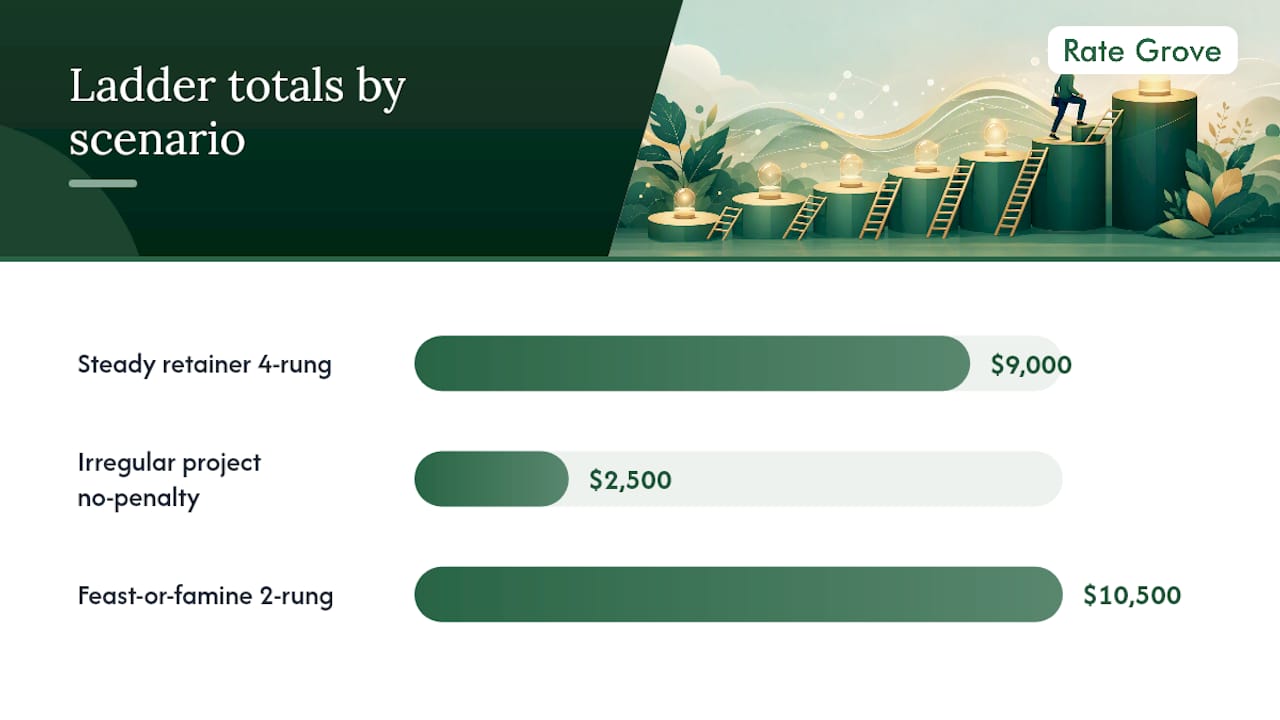
| Scenario | Liquid buffer | Ladder total | Structure |
|---|---|---|---|
| Steady retainer | $9,000 | $9,000 | 4-rung ladder |
| Irregular project | $7,500 | $2,500 | No-penalty CD |
| Feast-or-famine | $10,500 | $10,500 | 2-rung barbell |
What you should never lock into a CD
Never put your immediate emergency cash or quarterly tax reserves into a CD. Those two buckets must stay fully liquid at all times.
Keep these buckets out of CDs entirely:
- Emergency fund: 3–6 months of personal living expenses in a high-yield savings account or money market account. Fund this liquid cushion before placing any funds in a CD. This is separate from your operating reserve.
- Tax account: 25–40% of every payment, held liquid for April 15, June 15, September 15, and January 15 estimated tax deadlines. A CD that matures after a tax due date creates a real penalty risk.
- Next 30–90 days of operating expenses: keep this in checking or a high-yield savings account, not locked up.
For immediate liquidity, the best alternatives are high-yield savings accounts, money market accounts, and short-term Treasury bills (4-week or 13-week T-bills). Short-horizon money belongs in cash equivalents, not in instruments that penalize early exit. Stabilize reserves first, then automate investing — that sequencing is what cashflow-first investing is built on.
Pro Tip: Set a hard rule: your tax account and your 30-to-90-day operating reserve are never in a CD with a maturity beyond 30 days. Write it down. Revisit it every quarter.
Tax treatment, FDIC protection, and rate-lock risks to check first
Confirm FDIC coverage and understand the tax treatment before you open any CD. Interest is taxable as ordinary income in the year it is paid or credited, even if you do not withdraw it. Your bank issues a 1099-INT, which you report on your federal return.
FDIC coverage: $250,000 per depositor, per insured bank, per ownership category. If your total deposits at one institution exceed that threshold, split accounts across multiple FDIC-insured banks. Brokered CDs (purchased through a brokerage) may carry different coverage rules — verify before buying.
Early-withdrawal penalties reduce your effective yield and can eat into principal on short-term CDs. Common penalty structures range from 60 days of interest on a 6-month CD to 150 days or more on a 12-month CD, though terms vary by institution. Calculate your break-even horizon: if you might need the money before the penalty-adjusted yield turns positive, use a no-penalty CD or a high-yield savings account instead.
Rate-lock risk: when you open a fixed-rate CD, you lock in today’s APY. If rates rise after you buy, you miss the upside. A ladder partially hedges this — shorter rungs mature sooner and can be reinvested at new rates. Review fixed vs. variable CD types before committing to a long-term term.
- Callable CDs can be redeemed by the issuer before maturity — check the prospectus
- Brokered CDs trade on secondary markets; liquidity and pricing differ from bank CDs
- Always confirm the institution’s FDIC membership at fdic.gov before depositing
How to compare current CD offers before you commit
Lead with these contract terms every time you evaluate a CD offer:
- APY vs. nominal rate: APY accounts for compounding frequency; always compare APYs, not stated rates. A CD that compounds daily pays slightly more than one that compounds monthly at the same nominal rate.
- Early-withdrawal penalty: expressed in days of interest. Lower is better, but also check whether the penalty can cut into principal.
- Minimum deposit: ranges from $0 to $10,000+ depending on the institution.
- FDIC status: confirm the bank is FDIC-insured, not just affiliated with one.
- Compounding frequency: daily compounding produces the highest effective yield.
When using a rate-comparison tool, filter by term first, then minimum deposit, then FDIC status, and sort by APY after penalties. Favor institutions with transparent penalty schedules and monthly-updated rate guides — stale data leads to decisions based on rates that no longer exist. Online banks tend to offer higher APYs than traditional branches because their overhead is lower, which is worth knowing when you filter results.
Your step-by-step checklist to add CDs to your freelance plan today
Follow these six steps in a single session and your ladder will be live before the week ends.
- Calculate your monthly burn — add fixed and average variable expenses.
- Set your reserve target — multiply burn by your target months (3–6).
- Fund your liquid buffer first — move the buffer amount to a high-yield savings account before buying any CD.
- Place ladder rungs — use cleared funds only; split surplus across your chosen terms and amounts.
- Document maturity dates — record each CD’s maturity date, penalty terms, and renewal instructions in a simple spreadsheet or calendar.
- Automate allocations — set up automatic transfers from your business collections account to your tax, reserve, and personal pay accounts on every payment received.
Review the ladder every quarter. When a rung matures, decide whether to reinvest at current rates, extend the term, or redirect the funds based on your current cash-flow picture.
The trade-off most freelancers get wrong
Most freelancers who try a CD strategy make the same mistake: they size the ladder too aggressively and leave the liquid buffer underfunded. The appeal of a higher APY is real, but a CD that you crack open early because you underestimated a slow month costs you the penalty and the discipline.
Conservative sizing is not timid — it is accurate. If your income varies by more than 30% month to month, your liquid buffer should be closer to 5–6 months, and your ladder should hold only what you are genuinely confident you will not need. When invoices are stable and reserves are large, push more into longer rungs and capture the yield. When income is new or unpredictable, stay short and flexible. The ladder is a tool for surplus, not a substitute for a real emergency fund.
Rate Grove makes comparing CD rates fast and clear
Rate Grove gives you side-by-side comparisons of FDIC-backed CDs filtered by term, minimum deposit, and penalty structure — all based on verified data from issuer and regulator sites, updated monthly. You can sort by effective APY after penalties, which is the number that actually matters for your ladder math.
No stale rates, no hidden fee surprises. Rate Grove’s guides walk you through the contract terms to check, flag callable and brokered CDs, and show you how small APY differences compound across a multi-rung ladder. Visit Rate Grove to compare current CD rates and find the right terms for your freelance cash-flow plan today.
Sources
- Freelance: How to Set Your Rates & Manage Cash Flow 2026
- Asset Allocation Guide for Freelancers With Uneven Income
- Index Fund Investing for Freelancers: Cashflow-First Plan
- Smart Investing for the Self-Employed: A Simple, Repeatable Rule
- Cash Flow Management When You Have Irregular Income | Finntree Blog