

Keep most of your emergency fund in an FDIC or NCUA-insured high-yield savings account or money market account where you can reach it in a day or two. Put the remaining portion into a short CD ladder to pick up extra yield on money you won’t need immediately. Automate transfers into both, and confirm every account carries federal deposit insurance before you open it.
TL;DR:
- Keep most emergency funds in FDIC or NCUA-insured high-yield savings accounts or money market accounts with no fees and easy mobile access.
- Use a CD ladder with staggered maturities to earn higher fixed rates while maintaining some liquidity, but avoid early withdrawal penalties.
- Allocate 60% to 80% of your emergency fund based on income stability, with more liquidity for those with irregular income or supporting dependents.
- Spread large balances across multiple institutions or ownership types to ensure full FDIC or NCUA coverage during crises.
- Regularly review current rates and penalties using verified data to optimize safety and growth without sacrificing readiness.
Table of Contents
- Where to Keep Emergency Fund Money for Instant Access
- How a CD Ladder Stretches Your Emergency Fund Further
- How to Split Your Emergency Fund by Situation
- Insurance Coverage and the Mistakes That Cost You
- Setting Up and Maintaining Your Emergency Fund
- Tax Implications of Different Emergency Fund Vehicles
- Why This Split Works Better Than Chasing the Highest Rate
- Compare Verified Rates Before You Move Your Emergency Fund
- Sources
- FAQ
Where to Keep Emergency Fund Money for Instant Access
Your first stop should be a high-yield savings account. These accounts sit at online banks or the online arm of a traditional bank, and they typically pay several times the national average rate you’d get at a brick-and-mortar branch. Bankrate recommends high-yield savings or money market accounts specifically because they balance quick access with a competitive rate, and because FDIC or NCUA coverage protects your principal.
The catch: transfers between banks aren’t instant. Moving money from an online savings account to your checking account usually takes one to three business days, so this isn’t cash-in-hand money. It’s close enough for most emergencies, but not for a same-day car repair.
Money market accounts and cash-management accounts fill that gap. Many come with a debit card or check-writing privileges, which regular savings accounts don’t offer. Vanguard notes that cash-management accounts held at brokerages can offer solid accessibility and yield, though the insurance and liquidity terms differ from a bank account, so read the fine print before parking a large balance there.
When you’re comparing accounts, look for:
- No monthly maintenance fees or a simple way to waive them
- FDIC insurance (banks) or NCUA insurance (credit unions) clearly stated on the account page
- No minimum balance requirement that could trigger a fee if you draw the account down
- A mobile app that lets you check balances and transfer funds without calling customer service
A regular checking account works fine for the sliver of your fund you might need same-day, but it’s a poor home for the bulk of your savings. Checking accounts pay little to no interest, and keeping a large balance there makes it too easy to spend by accident. Our guide to high-yield savings account types breaks down the structural differences if you want to compare before opening one.
How a CD Ladder Stretches Your Emergency Fund Further
A CD ladder lets you earn a higher fixed rate than most savings accounts while keeping a portion of your money reachable on a rolling schedule. SmartAsset documents that typical ladders use three to five rungs with staggered maturity dates, so you’re never more than a few months from your next payout.
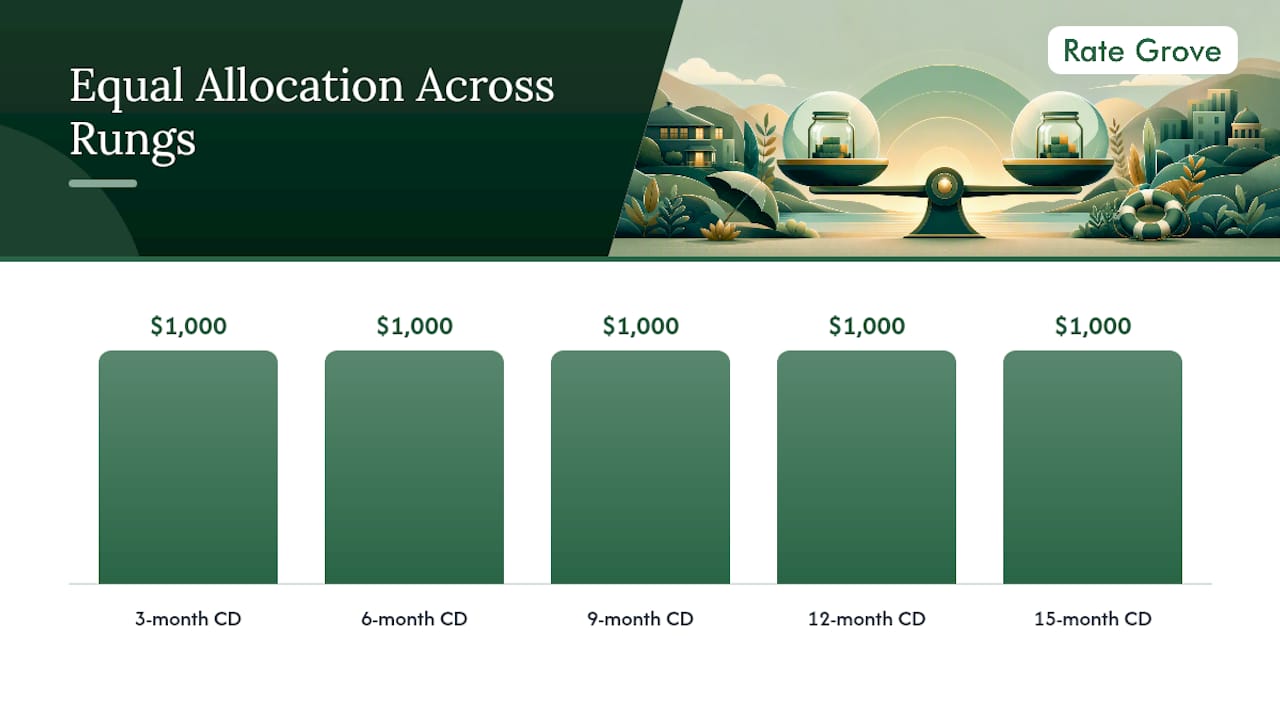
Here’s a basic five-rung setup for $5,000 of laddered savings:
- $1,000 in a 3-month CD
- $1,000 in a 6-month CD
- $1,000 in a 9-month CD
- $1,000 in a 12-month CD
- $1,000 in a 15-month CD
As each CD matures, you either spend it if an emergency hits or roll it into a new long rung to keep the ladder running. The risk is early-withdrawal penalties: pull money out before maturity and you’ll typically forfeit several months of interest, sometimes more depending on the term. That’s why experts recommend keeping a liquid reserve outside the ladder to cover anything that comes up before a rung matures.
Pro Tip: A CD ladder works best when rates are rising or holding steady, since later rungs get reinvested at whatever the current rate is. Our CD ladder strategy guide walks through timing your rungs around rate cycles.
How to Split Your Emergency Fund by Situation
There’s no single correct split. Fidelity suggests starting with at least $1,000 and building toward three to six months of essential expenses, but how you divide that between liquid and laddered accounts depends on your income stability.
- Salaried employee with stable income: Keep 60% in high-yield savings, 40% in a CD ladder. Your paycheck is predictable, so you can afford a bit less instant liquidity.
- Freelancer or irregular income: Keep 80% to 90% liquid. Income gaps happen without warning, and you don’t want penalty fees compounding a cash crunch.
- Dual-income household: A 50/50 split can work since two incomes lower the odds of a total income loss at once.
- High-cost region or single earner supporting dependents: Lean toward six months of expenses minimum, with at least 75% liquid, since replacing income takes longer and costs more to bridge.
Decide the split by asking one question: how fast could a real emergency force you to touch this money? The faster the answer, the more should stay liquid.
Insurance Coverage and the Mistakes That Cost You
FDIC insurance covers up to $250,000 per depositor, per bank, per ownership category; NCUA insurance offers the same protection at credit unions. If you’re holding more than that in one place, split it across ownership categories (individual, joint, trust) or across separate institutions to keep every dollar covered.
During a widespread crisis, like a regional bank failure or a natural disaster, transfers can slow down as banks manage surging request volume. That’s a real limit on “liquid” money, not a reason to abandon insured accounts, but a reason to keep a small cash buffer at home for true short-term gaps.
Common mistakes that turn emergency savings into a liability:
- Keeping the fund in a brokerage account invested in stocks, where a market downturn hits right when you need the cash
- Treating a 401(k) or IRA as backup savings, which triggers taxes and possibly penalties on withdrawal
- Holding large sums of physical cash at home, which earns nothing and isn’t insured against theft or fire
- Mixing emergency savings into your everyday checking account, where it’s one impulse purchase away from disappearing
Setting Up and Maintaining Your Emergency Fund
Getting the structure right matters less than actually maintaining it. Here’s how to set it up so it runs on autopilot:
- Open a dedicated high-yield savings account separate from your checking account. The Consumer Financial Protection Bureau specifically recommends this separation to reduce the temptation to dip into the fund for non-emergencies.
- Set up an automatic recurring transfer from checking on payday, even if it’s just $50.
- Once you’ve built a starter cushion, split new deposits between your liquid account and your CD ladder rungs.
- Track CD maturity dates on a calendar app or a simple spreadsheet so a rung never matures unnoticed and sits earning nothing.
Some banks let you create labeled sub-accounts or “buckets” within one savings account, which makes it easier to see your emergency money separately from a vacation fund or holiday savings, according to Fidelity.
Pro Tip: After any withdrawal, treat replenishment like a bill. Redirect your next one to two paychecks’ worth of “extra” spending money back into the fund until you’re back at your target balance. Our emergency fund best practices guide covers replenishment scheduling in more detail.
Tax Implications of Different Emergency Fund Vehicles
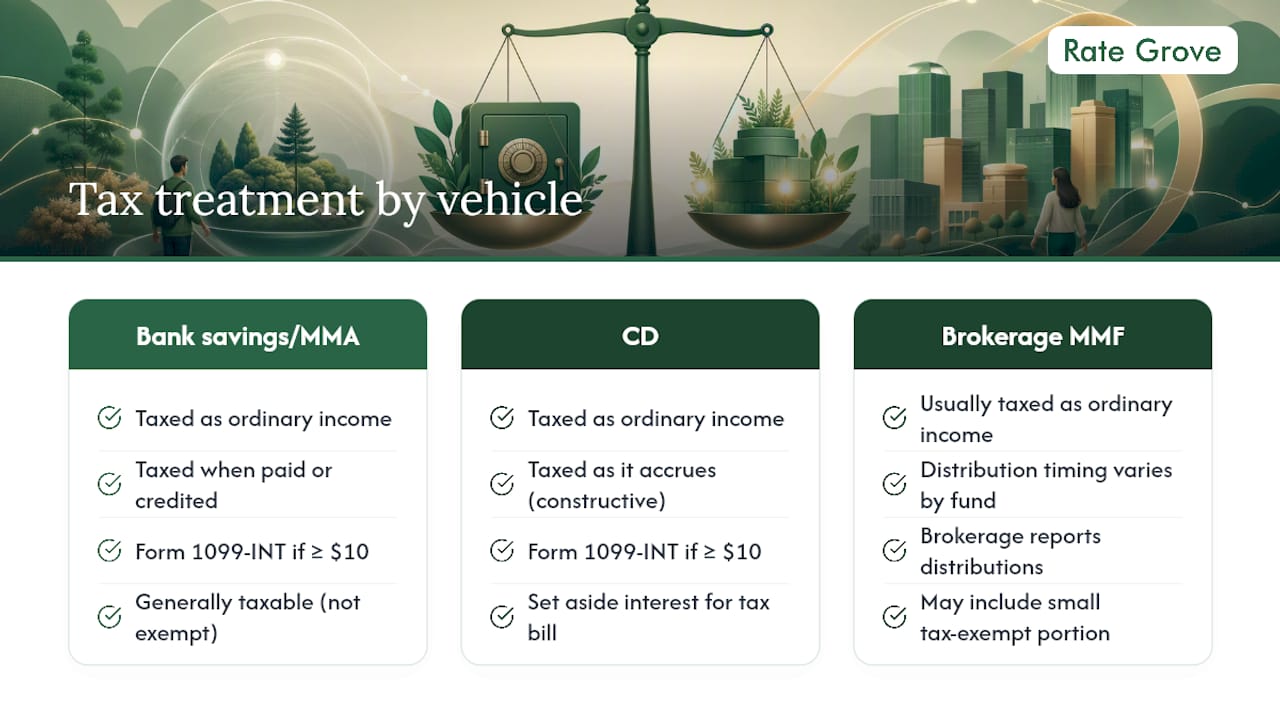
Interest earned on a high-yield savings account, money market account, or CD is taxed as ordinary income in the year it’s paid or credited, regardless of whether you withdraw it. Your bank sends a Form 1099-INT if you earn $10 or more in interest during the year, and you report that amount on your federal return.
CDs carry a wrinkle worth knowing: if you hold a CD that pays interest annually or at maturity, you generally owe tax on the interest as it accrues, not just when you cash it out, since the IRS treats CD interest as constructively received each year. That means a 12-month CD maturing in January still generates a tax obligation in the year the interest posts, even if you haven’t touched the money.
Money market mutual funds held at a brokerage, as opposed to bank money market accounts, may distribute income differently and sometimes include a small portion of tax-exempt interest if the fund holds municipal securities. That’s a niche case, but worth checking if you’re using a brokerage cash-management account instead of a bank account for part of your fund.
None of this changes where you should keep the money. Emergency savings shouldn’t be optimized for tax efficiency; they should be optimized for safety and access. But it does mean you should set aside a portion of the interest you earn, especially from CDs, to cover the tax bill it generates, so a “surprise” tax liability doesn’t become its own mini emergency.
Why This Split Works Better Than Chasing the Highest Rate
Most advice on emergency funds treats the decision as a single choice: pick the account with the best rate and put everything there. That’s backwards. Comparisons around verified data straight from issuer and regulator sites are important because the “best rate” often comes with strings, like withdrawal caps or promotional periods that expire, and readers deserve to see those tradeoffs before committing their safety net to one product.
The liquid-plus-ladder split exists because emergencies don’t follow a schedule, and neither should your access to cash. Verified, monthly-updated rate data lets you rebalance the split as your income or rates change, instead of locking into whatever account looked good the day you opened it. If you want to see how current high-yield rates and CD terms stack up against each other, using side-by-side comparisons built for that purpose is helpful.
— Mat C.
Compare Verified Rates Before You Move Your Emergency Fund
Picking between a high-yield savings account and a CD ladder gets a lot easier when you can see current rates side by side instead of hunting through a dozen bank websites. Verified rate and fee data pulled straight from issuer and regulator sites allow you to compare what’s actually available right now, not a promotional rate that expired last quarter.
If you’re setting up the liquid portion of your fund, start with Rate Grove’s high-yield savings account comparisons to find an insured account with no fees and a competitive rate. For the laddered portion, check current CD terms and penalty structures against Rate Grove’s CD early-withdrawal penalty breakdown before you lock in a rung. And if you’re documenting account access for a family member as part of your broader financial planning, a secure digital vault like My Affairs in Order can help keep those details organized outside your bank altogether. Head to Rate Grove’s rate comparison tool today to see where your money can earn more without giving up access.
This article is general information, not a substitute for advice from a qualified financial advisor. Consult a qualified financial professional about your own circumstances before acting on anything here.
Sources
FAQ
What happens if I withdraw from a CD early?
You’ll typically forfeit several months of interest as a penalty, and in some cases lose more depending on the CD’s term and the issuer’s specific penalty structure.
How do I make sure my accounts are fully FDIC or NCUA insured?
Confirm coverage stays under $250,000 per depositor, per institution, per ownership category, and spread larger balances across separate ownership categories or banks if needed.
Where should I never keep emergency savings?
Avoid retirement accounts, stock-heavy brokerage accounts, and large amounts of physical cash at home, since each one either penalizes early access, exposes you to market risk, or offers no insurance at all.
Is a money market account better than a high-yield savings account for emergency funds?
Neither is strictly better; money market accounts often add check-writing or debit access, while high-yield savings accounts sometimes pay a slightly higher rate, so compare current terms before choosing.