

Most big banks cap mobile check deposits somewhere between a few thousand dollars and ten thousand per day, while some credit unions allow much higher limits. Your real number, though, lives inside your banking app, not in any published chart, since banks personalize limits by account age, balance, and history. If a check is bigger than what your app allows, you still have options: an ATM, a branch teller, splitting the deposit, or asking the bank to raise your limit.
TL;DR:
- Most banks limit mobile check deposits between $2,000 and $10,000 daily, but some credit unions support deposits up to $100,000, depending on the institution.
- Your actual deposit limit varies based on account age, direct deposit enrollment, average balance, and transaction history, which the bank continually adjusts.
- For checks exceeding your mobile limit, options include deposit at a branch, ATM, splitting the deposit, or requesting a temporary limit increase, with some methods offering faster processing.
- The cutoff time for deposits generally falls between 9:00 PM and 11:00 PM local time, and funds are usually available the next business day for amounts under $275.
- Proper endorsement with “for mobile deposit only” and holding the physical check for a few weeks minimizes risk of disputes related to duplicate deposits.
Table of Contents
- Mobile Deposit Limits by Bank and Credit Union
- How Banks Set and Adjust Your Personal Limit
- Cutoff Times and When Your Money Actually Becomes Usable
- Finding Your Exact Limit Inside the App
- When a Check Is Bigger Than Your Mobile Limit
- Regulation CC and Why Your Endorsement Matters
- Rate Grove’s Take on Deposit Limits and Choosing an Account
- Compare Accounts by Deposit Rules, Not Just Rates
- Where to Verify These Figures Yourself
- Sources
- FAQ
Mobile Deposit Limits by Bank and Credit Union
Published limits swing wildly depending on where you bank, and the gap between the most conservative major bank and the most generous credit union is enormous. Figures range from about $2,000 a day at some big banks to $100,000 a day at certain credit unions, and that spread alone tells you why checking your own app matters more than memorizing a chart.
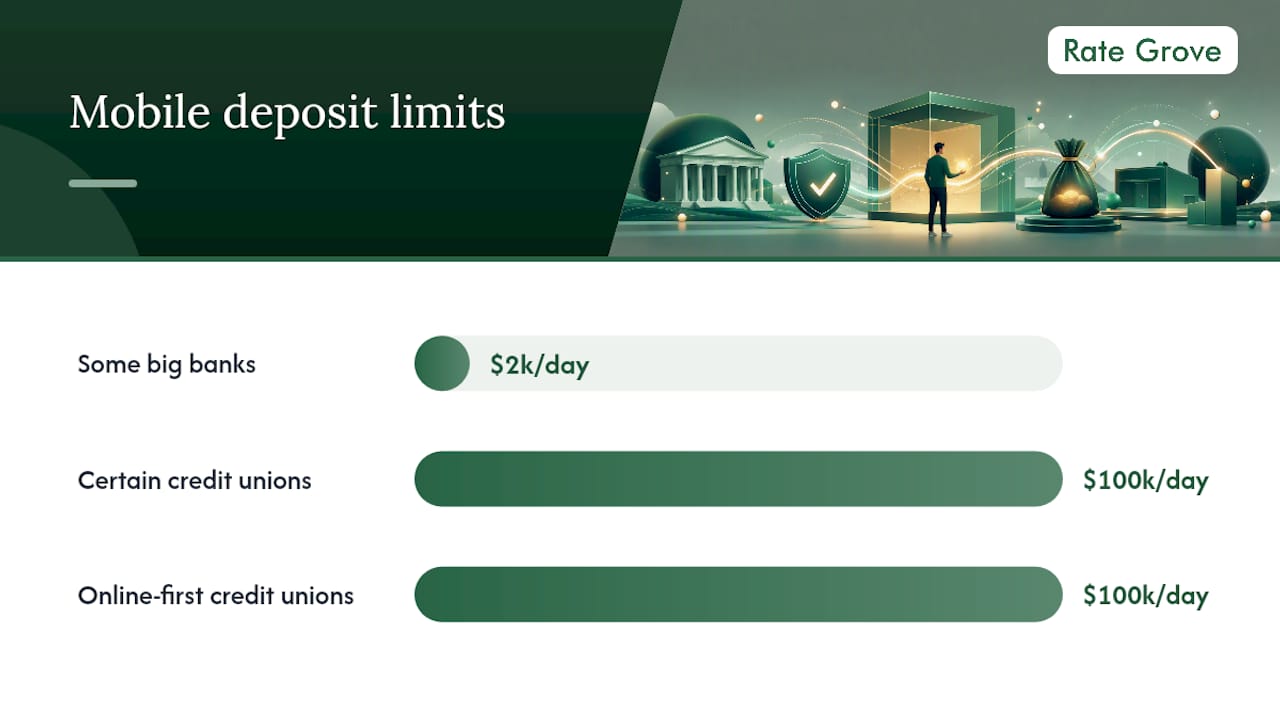
Treat every figure here as a starting point, not a guarantee. The bank’s app overrides the published number every time. Online-first credit unions like Alliant and Navy Federal tend to sit at the high end because mobile deposit is their primary deposit channel, not a backup to branches.
How Banks Set and Adjust Your Personal Limit
Your mobile deposit limit isn’t fixed. It’s a moving number tied to how the bank sees your account risk.
- Account age — brand-new accounts often start at low daily floors, sometimes as little as $50, before rising over 30 to 90 days.
- Direct deposit — enrolling your paycheck signals stability and often triggers an automatic limit increase.
- Average balance — accounts that keep higher running balances tend to get higher deposit ceilings.
- Transaction history — a longer track record of normal activity builds trust with the bank’s risk models.
- Fraud or risk flags — any prior disputes, returned checks, or suspicious activity can suppress your limit regardless of tenure.
U.S. Bank notes that accounts under 90 days frequently sit at the lowest tier, then climb in stages as the relationship matures.
Pro Tip: If you need a higher limit fast, set up direct deposit and let two or three paychecks land before you ask. Banks respond better to a visible pattern than to a phone call alone.
Cutoff Times and When Your Money Actually Becomes Usable
A cutoff time is the deadline that decides which business day your deposit counts toward. Miss it, and the deposit posts the next business day instead of today. Chase publishes specific cutoff windows for mobile deposits, and other banks set their own, commonly somewhere between 9:00 PM Pacific and 11:00 PM Eastern.
Availability rules layer on top of the cutoff:
- The first $275 of a deposit is often available the next business day under standard bank policy.
- Larger amounts can be held longer depending on the bank’s risk assessment and Regulation CC provisions.
- New accounts, unusually large deposits, or checks that look suspicious can all trigger extended holds.
Submitting early in the day, well before your bank’s stated cutoff, gives you the best shot at next-day availability on the bulk of the check.
Finding Your Exact Limit Inside the App
Your bank’s app will show you the number that actually governs your account, and it takes less than a minute to check.
- Open your banking app and tap the deposit or “mobile deposit” feature.
- Select the account you want to deposit into.
- Enter the check amount before confirming anything.
- Look for the limit that appears on screen, usually labeled as a daily limit, a weekly or rolling window, or a per-check cap.
- Note any cutoff time disclosure shown near the confirmation screen.
If the app doesn’t show a number, or the deposit gets rejected without explanation, update the app first. Old versions sometimes hide limit displays. If that doesn’t fix it, sign into online banking on a browser or call customer service directly, since phone reps can usually see the exact figure tied to your account.
When a Check Is Bigger Than Your Mobile Limit
A check that exceeds your mobile cap still has several practical paths to your account, each with its own tradeoffs.
- Branch teller — no practical ceiling on the deposit size, but you’re at the mercy of branch hours and lines.
- ATM deposit — often allows a higher limit than mobile, with fairly fast processing and no waiting for a teller.
- Split deposits — depositing part of the check today and part tomorrow can work around a daily cap, though it delays full availability.
- Mail deposit — the slowest option, and rarely worth it unless every other channel is unavailable.
You can also call and ask for a temporary limit increase, especially if you know a large check is coming. Banks typically want to see account history and may ask for the reason before approving it. Whatever method you use, hold onto the physical check until it fully clears, and mark it “deposited” so you don’t accidentally redeposit it somewhere else.
Regulation CC and Why Your Endorsement Matters
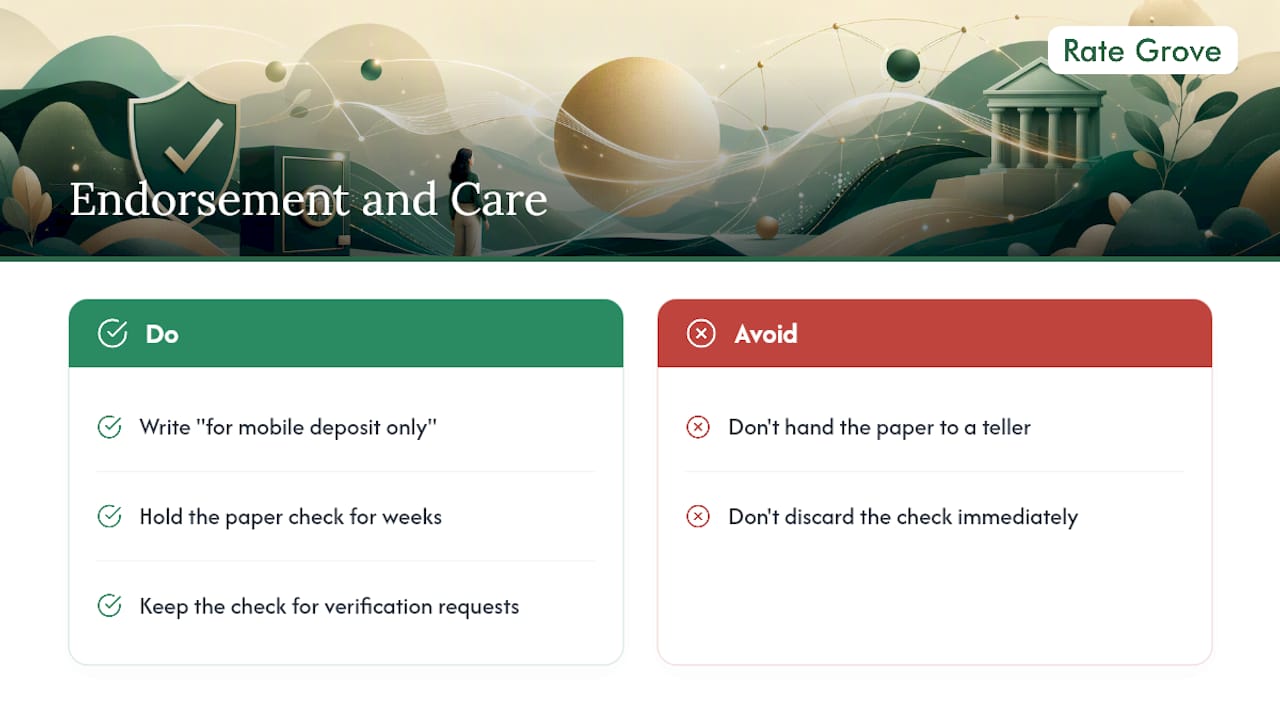
Federal rules under Regulation CC give banks a specific protection when a check gets deposited twice by mistake, once by mobile image and once as paper. Regulation CC’s endorsement guidance protects banks that require a restrictive indorsement like “for mobile deposit only,” shielding them from certain indemnity claims tied to duplicate items.
Picture two scenarios: a customer deposits a check by phone, then later hands the same paper check to a teller by accident. Or a customer writes “for mobile deposit only” on the back, and that exact wording later blocks a bank’s indemnity claim when the same check surfaces somewhere else. Both situations show why the words on the back of your check carry real weight.
The safest habit is simple: write “for mobile deposit only” on the endorsement line every time, and hold the paper check for a couple of weeks after the funds post. That single line of handwriting is often the difference between a clean deposit and a drawn-out dispute over who owes what to whom.
Keeping the check briefly also protects you if the bank ever asks you to resubmit or verify the image.
Rate Grove’s Take on Deposit Limits and Choosing an Account
If you regularly handle large checks, whether from freelance clients, real estate, or a small business, a low mobile deposit cap becomes a real bottleneck. That’s when the actual limit deserves as much weight as the interest rate when you pick an account.
Comparison tools can surface exactly this kind of detail, including deposit policies and availability rules side by side. Before you switch accounts chasing a higher limit, verify the number in your prospective bank’s app. Published figures are a starting point, never the final word.
— Mat C.
Compare Accounts by Deposit Rules, Not Just Rates
Chasing a better interest rate while ignoring a $2,000 mobile deposit cap is how freelancers and small-business owners end up stuck making branch runs every week. Some sites pull verified rate, fee, and policy data from issuer and regulator sources into one side-by-side view, updated monthly, so users aren’t piecing together a dozen bank help pages to find an account that actually fits how they bank.

If mobile deposit limits matter to your routine, filter your comparison specifically for deposit rules and higher mobile caps rather than APY alone. Start comparing accounts at Rate Grove and find one that matches how much you actually deposit, not just how much interest you earn.
Where to Verify These Figures Yourself
Confirm any limit directly through your bank’s own disclosures rather than relying on a secondhand chart.
- Bank help pages, like Wells Fargo’s mobile deposit FAQ, confirm how in-app limits are displayed.
- U.S. Bank’s mobile deposit page explains daily and weekly limit structures.
- Regulation CC commentary confirms the endorsement protections described above.
This article is general information, not a substitute for advice from a qualified financial advisor. Consult a qualified financial professional about your own circumstances before acting on anything here.
Sources
FAQ
Can I Mobile Deposit a $20,000 Check?
It depends entirely on your bank and account history. Some credit unions like Alliant or Navy Federal publish limits well above several thousand dollars, while several major banks cap daily mobile deposits closer to $2,500–$10,000, so check your app before assuming either way.
Can I Mobile Deposit a Check for $30,000?
Only a smaller group of banks and credit unions support a single mobile deposit that large, and it usually requires an established account with strong history. For most major banks, a check larger than typical daily limits will need a branch, ATM, or split deposit instead.
Can I Deposit a $50,000 Check Into My Bank Account?
You can deposit $50,000 into your account, but a $50,000 mobile check deposit exceeds most published limits, including many major banks. Some credit unions publish caps at or near that figure, but a branch or wire deposit is the more reliable route for an amount this size.
Can I Mobile Deposit $100,000?
A handful of banks and credit unions publish mobile deposit ceilings as high as $100,000 a day, but that sits at the extreme end of what’s available. For nearly everyone else, a check that large needs to go through a branch, since it exceeds even the most generous published mobile limits.
Why Does My Mobile Deposit Limit Keep Changing?
Your limit adjusts as your account history builds, and factors like direct deposit enrollment, average balance, and time since account opening all influence it. A limit that felt low in month one can rise significantly by month four without you doing anything but banking normally.