

A minimum balance fee is what your bank charges when your account dips below a set dollar amount, and the fastest fix is switching to an account with no minimum or turning on a waiver like direct deposit. Below, you’ll see exactly how banks calculate these thresholds, what they cost, and how to shut them off for good.
TL;DR:
- The cost of minimum balance fees can reach $180 annually if not waived, and maintaining idle cash to avoid fees can cost hundreds in lost interest.
- Using online banks with no minimum balance requirement or setting up direct deposit are the most reliable methods to avoid fees entirely.
- Terms for minimum balances and waivers change frequently, so always verify specific account rules with the bank’s Schedule of Fees before opening or switching accounts.
- Minimum balance fees do not impact credit scores; however, unpaid fees could lead to collections or negative reports in ChexSystems, affecting future account access.
Table of Contents
- What Are Minimum Balance Fees and How Do Banks Calculate Them?
- How Much Do Minimum Balance Fees Really Cost You?
- What Are the Best Ways to Avoid Minimum Balance Fees?
- How Do Chase, Bank of America, Wells Fargo, and Others Handle Minimums?
- How Do You Choose an Account That Minimizes These Fees?
- Do Minimum Balance Fees Affect Your Credit Score?
- How Have Minimum Balance Policies Changed Since the Pandemic?
- What Regulations Protect Consumers From Minimum Balance Fees?
- What Should You Actually Prioritize With Minimum Balance Fees?
- Find a No-Minimum Account Without the Guesswork
- Sources
What Are Minimum Balance Fees and How Do Banks Calculate Them?
A minimum balance fee gets charged when your account balance falls below a threshold the bank sets in your account agreement, usually resulting in a flat monthly maintenance fee of somewhere between $5 and $30. That’s different from a minimum opening deposit, which is a one-time amount you need to open the account and has nothing to do with ongoing charges.
Banks measure your balance three main ways, and the method matters more than most people realize:
- Minimum daily balance: your balance can’t drop below the threshold on any single day of the cycle, even for an hour.
- Average daily balance: the bank adds up your balance each day of the month and divides by the number of days, so a $50 balance for a week won’t sink you if the rest of the month runs higher.
- Combined/linked balance: the bank totals your checking, savings, and sometimes CDs together to hit the threshold.
Here’s a quick example. Say your bank requires a $1,500 minimum daily balance. If you drop to $1,200 for even one day, the fee triggers, no matter what your balance looked like the other 29 days. Under an average daily balance rule, that same dip might not matter at all if your monthly average still clears $1,500. According to Experian’s explainer on minimum balance requirements, these thresholds function as eligibility rules that offset the bank’s operating costs, and they can also mean losing your posted APY on interest-bearing accounts, not just a flat fee.
The consequences stack. You might face the monthly fee, forfeited interest for that cycle, and if the shortfall triggers an overdraft, an NSF fee on top of everything else. All of this should be spelled out in your account’s Schedule of Fees, which the CFPB requires banks to disclose when you open the account.
Pro Tip: Pull up your account’s Schedule of Fees and search for the phrase “balance calculation method.” If it’s not there, call the bank and ask directly. That one phrase tells you whether a bad day or a bad month is what actually costs you money.
How Much Do Minimum Balance Fees Really Cost You?
Most consumers won’t ever pay one. According to FDIC survey data, about 61.6% of banks don’t require any minimum balance for their most basic checking account, and another 8.1% waive it automatically with direct deposit. That means roughly 7 in 10 basic checking accounts carry no realistic minimum balance risk at all.
The FDIC reports that NSF fees typically are in the mid-20 dollar range, and where minimum-to-waive thresholds exist, a lower triple-digit figure is common. For basic checking, that $100 threshold is often the difference between paying $0 and paying $180 a year in maintenance fees alone.
Monthly maintenance fees on the accounts that do charge them typically run $5 to $30, and the balance required to waive that fee varies wildly depending on the account tier. A basic checking account might waive its fee at a relatively low minimum balance, while premium or private banking products may require significantly higher combined balances to waive fees.
Run the math on your own situation. A $12 monthly fee you can’t waive costs $144 a year, roughly the same as one bad NSF incident and a half. Meanwhile, parking $10,000 in a non-interest checking account just to dodge a fee has its own cost. At even a modest savings APY, that’s money that could be earning $300 to $400 a year elsewhere. The fee isn’t always the real expense. The idle cash is.

What Are the Best Ways to Avoid Minimum Balance Fees?
You have more leverage here than most bank disclosures let on. Waiver alternatives are usually more reliable than trying to keep a cushion of cash sitting idle, and CFPB guidance points to a handful of specific tactics worth prioritizing:
- Set up direct deposit. This is the single easiest waiver to activate, and many banks set the qualifying threshold under $500 in monthly deposits.
- Meet a qualifying transaction count. Some accounts waive the fee if you make a set number of debit card purchases or electronic transactions each cycle.
- Use a combined or linked balance. If your checking, savings, and CDs together clear the threshold, you may not need checking alone to carry the weight.
- Switch to an account built with no minimum. Many online banks now offer FDIC insured checking with $0 monthly fees and no minimum balance requirement, which sidesteps the whole problem.
- Ask about student or senior accounts. These often waive fees entirely regardless of balance, based purely on age or enrollment status.
- Automate transfers and set balance alerts. A recurring transfer that tops off your checking account before the cutoff date, paired with a text alert at a buffer amount like $150, catches most dips before they become fees.
Tactic 1 and tactic 4 are the most dependable because they don’t depend on your spending habits staying consistent month to month. Tactics 2 and 3 work well but are conditional on the bank’s specific rules, so read the fine print before counting on them.
Pro Tip: If you’re bouncing between multiple accounts trying to hit different minimums, that’s usually a sign you’re better off consolidating into one no-fee account. The mental overhead of tracking three thresholds often costs more time than the fees would cost in dollars.
How Do Chase, Bank of America, Wells Fargo, and Others Handle Minimums?
Terms shift often enough that you should always confirm details against the bank’s own Schedule of Fees before opening anything, but here’s how the balance rules typically shake out across major banks:
- Chase: Standard checking often charges a monthly fee waived by a daily balance minimum or a monthly direct deposit amount, using a minimum daily balance test.
- Bank of America: Uses combined balance waivers across checking, savings, and investment accounts, so linking accounts can clear the threshold even if checking alone falls short.
- Wells Fargo: Offers waiver paths through direct deposit, a minimum daily balance, or linked accounts, giving more flexibility than a single fixed threshold.
- Capital One: Its widely used checking product carries no monthly fee and no minimum balance requirement at all, removing the calculation entirely.
- Ally: An online only bank with no monthly maintenance fees and no minimum balance on its core checking account.
- Discover: Cashback checking carries no monthly fee and no minimum balance requirement, similar to Capital One’s approach.
The combined balance example is worth walking through. If a bank requires $10,000 combined to waive a $25 fee, and you carry $6,000 in checking plus $5,000 in a linked savings account, you clear the threshold at $11,000 total even though neither account alone would qualify. That’s the appeal of combined balance waivers for people who spread cash across multiple products rather than concentrating it in one place.
How Do You Choose an Account That Minimizes These Fees?
Start with accounts that charge no fee at all, then move to easy waivers, and treat combined balance flexibility as your fallback rather than your first choice. That order matters because it removes risk instead of managing it.
Run through this checklist before you open anything:
- What’s the balance test type? Minimum daily is stricter than average daily. Know which one applies before you assume you’re safe.
- What’s the exact waiver trigger? A direct deposit waiver of $300 a month is far easier to hit than a $10,000 balance requirement.
- What’s the NSF policy? Ask about fee amounts, grace periods, and how many times per day a fee can be charged.
- Does the account offer overdraft protection? A linked savings transfer can prevent a shortfall from ever becoming an NSF fee in the first place.
- Does the bank waive fees for students or seniors? If you qualify, this often beats chasing any balance-based waiver.
| Priority | Account type | Why it ranks here |
|---|---|---|
| 1 | No-minimum, no-fee checking | Removes the risk entirely, no ongoing tracking needed |
| 2 | Easy-waiver accounts (direct deposit) | Low effort, high reliability if income is stable |
| 3 | Combined/linked balance accounts | Flexible for savers with cash across multiple products |
Once you’ve cleared those questions, weigh tie-breakers like ATM network size, branch access, and whether the interest rate on offer justifies keeping a higher balance parked there instead of moving it into a dedicated savings account.
Do Minimum Balance Fees Affect Your Credit Score?
A minimum balance fee itself won’t touch your credit score. Checking and savings accounts aren’t reported to the three major credit bureaus the way credit cards and loans are, so a $12 monthly maintenance charge doesn’t show up on your credit report.
The indirect risk is where things get real. If you can’t pay a fee and the account balance goes negative, unpaid fees can eventually get sent to collections, and collection accounts absolutely do hit your credit report and your score. Some banks also report closed accounts with negative balances to ChexSystems, a specialty consumer reporting agency that other banks check before approving new account applications. That’s a separate system from your FICO score, but it can block you from opening a new checking or savings account elsewhere for years.
The bigger financial health cost is usually behavioral. Consumers who juggle multiple thresholds to avoid fees often keep more cash sitting in low-yield or non-interest checking accounts than they need to, which is money not compounding in a high-yield savings account or CD. That opportunity cost, spread out over several years, tends to outweigh the fees people were trying to dodge in the first place.
How Have Minimum Balance Policies Changed Since the Pandemic?
Fee structures shifted meaningfully after 2020, and the direction has mostly favored consumers. Several major banks eliminated NSF fees entirely or dropped them from around $35 down to $0 during that period, responding to regulatory pressure and public criticism over overdraft practices.
Online banks used that window to compete aggressively on the minimum balance front specifically. Digital-first checking products with no minimum balance and no monthly fee became far more common, pulling market share from traditional banks that still charged $10 to $15 a month unless you jumped through waiver hoops.
Traditional banks have responded by loosening waiver requirements rather than eliminating fees outright. Direct deposit thresholds have generally dropped, and combined balance calculations have expanded to include more account types, giving customers more paths to a waiver than they had a decade ago. The net effect: minimum balance fees haven’t disappeared, but avoiding them has gotten measurably easier, especially if you’re willing to consider an online-only option.
What Regulations Protect Consumers From Minimum Balance Fees?
Banks and credit unions are required to disclose maintenance fees and the exact conditions that waive them at the point you open an account, according to CFPB guidance. That disclosure typically lives in the Schedule of Fees, and it has to spell out the balance calculation method, the fee amount, and every way to waive it, not just the easiest one to advertise.
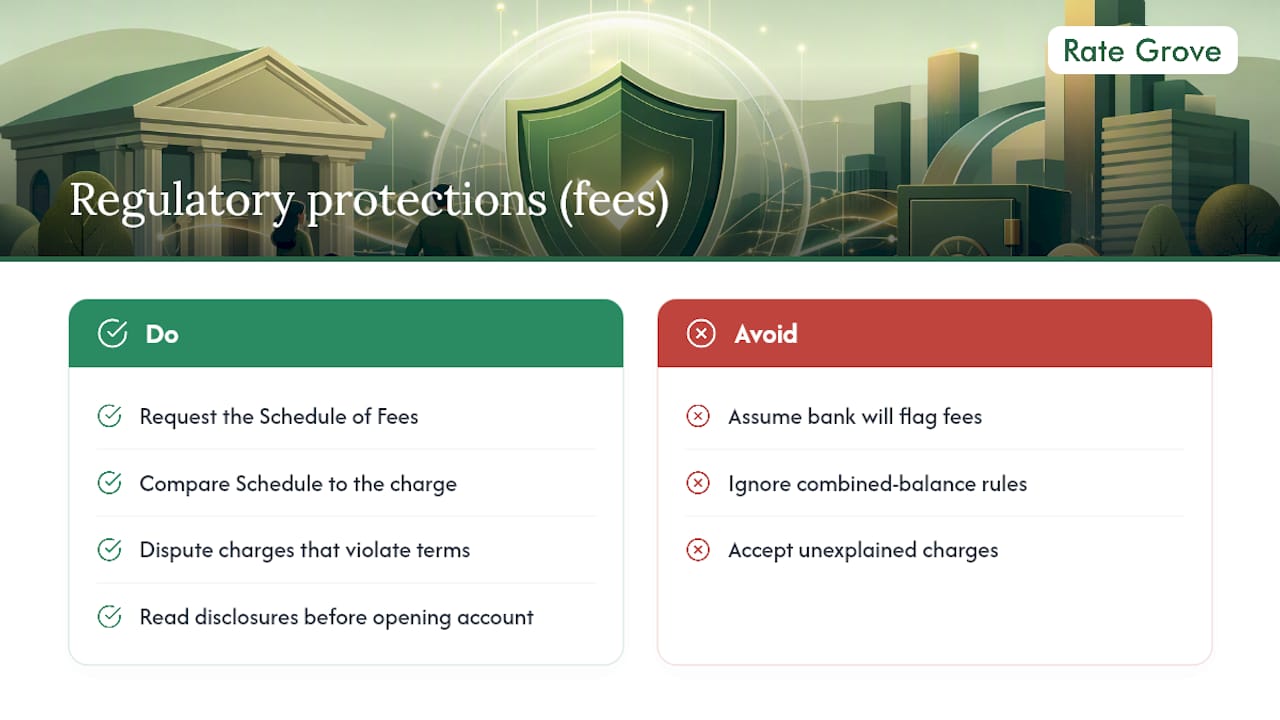
If you’re charged a fee you believe violates the terms you agreed to, the CFPB recommends first requesting the Schedule of Fees directly from your bank and comparing it against what actually got charged. Banks are obligated to apply their disclosed terms consistently, and errors do happen, particularly around combined balance calculations that span multiple account types.
These protections don’t cap how high a minimum balance fee can be or how high a threshold a bank can set. What they guarantee is transparency: you have the right to know the rules before you’re charged, and to dispute a charge that doesn’t match those rules. That’s a meaningfully different protection than a fee ceiling, and it puts the burden on you to actually read the disclosure rather than assuming the bank will flag it for you.
What Should You Actually Prioritize With Minimum Balance Fees?
If you take one thing from this, prioritize no-minimum accounts first and treat waiver-based accounts as a second-best option, not a compromise. The biggest mistake I see consumers make is parking cash they need for bills into a checking account purely to hit a balance threshold, then getting hit with an overdraft fee somewhere else because that cash wasn’t liquid when they needed it.
The second mistake is never actually reading the Schedule of Fees. People assume their balance test is average daily when it’s actually minimum daily, then get blindsided by a single bad day. Read the document once when you open the account. It takes five minutes and saves you from guessing later.
If you’re shopping around, use a tool like Rate Grove’s comparison pages to screen for no-minimum accounts before you even consider waiver terms. It’s a faster filter than reading ten separate disclosure pages.
— Mat C.
Find a No-Minimum Account Without the Guesswork
Rate Grove built its comparison tool specifically so you don’t have to cross-reference ten different Schedule of Fees documents to find an account that fits your cash flow. You can filter checking and savings accounts by “no minimum balance,” sort by easy waiver methods like direct deposit thresholds, and see the actual annual cost difference between accounts side by side, all based on verified issuer and regulator data updated monthly.
That side-by-side view matters more than it sounds like it should. Two accounts that look nearly identical on a bank’s homepage can differ by $150 or more a year once you factor in maintenance fees and lost interest from an unwaived minimum. Rate Grove pulls that comparison into one screen instead of ten browser tabs. If you’re ready to see which accounts actually fit your balance pattern, start comparing options on Rate Grove’s checking account tool and filter for no-minimum or easy-waiver accounts before you apply anywhere.
Sources
- Why am I being charged a monthly maintenance fee for my bank or credit union account? | CFPB
- FDIC deposit-products survey (chapter on products and services)
- What Is a Minimum Balance Requirement? - Experian
- A guide to checking account minimum balance requirements by bank | Yahoo Finance
- 8 Best Free Checking Accounts of August 2026 | CNBC Select
This article is general information, not a substitute for advice from a qualified financial advisor. Consult a qualified financial professional about your own circumstances before acting on anything here.