

The traps that hurt students most are high APRs paired with promo-rate cliffs, minimum-payment debt spirals, and college-sponsored cards that pay your school to market to you. If you’re carrying a balance right now, stop charging on that card today. Set autopay for at least the minimum, ideally the full statement balance, and pull your last three statements to check for fees you didn’t expect.
Three things to do before you read another word:
- Stop the bleeding. Don’t add new charges to a card you’re carrying a balance on.
- Automate your payment. Set autopay for the full balance if you can swing it, or the minimum as a floor.
- Audit your last statement. Look for late fees, cash-advance charges, or a jump from a promo APR to the standard rate.
The Consumer Financial Protection Bureau found that card issuers paid colleges and affiliated organizations over $18.6 million in 2023 alone to market financial products on campus. That money doesn’t come from nowhere. It usually comes from fees and rates that are worse than what you’d find comparing offers on your own, which is the entire reason regulators like the CFPB and protections under the CARD Act exist. Rate Grove built its comparison tools around that same idea: don’t take the campus table’s word for it, check the numbers yourself.
Key Takeaways
The three traps that damage student finances most are promo-rate cliffs, minimum-payment debt cycles, and college-sponsored cards that pay schools to market them.
| Point | Details |
|---|---|
| Stop the promo cliff | Pay off intro-rate balances before the standard APR kicks in, often 20% or higher. |
| Avoid minimum-payment traps | Pay more than the minimum each cycle to actually shrink the principal, not just interest. |
| Question campus-sponsored deals | Issuers paid colleges over $18.6 million in 2023 to market cards on campus. |
| Use CARD Act protections | Cosigner rules and marketing limits exist specifically to protect cardholders under 21. |
| Compare before you commit | Rate Grove’s monthly-updated comparisons check APRs and fees against issuer data before you apply. |
Table of Contents
- What Are the Most Common Student Credit Card Traps?
- How Do You Avoid or Fix These Credit Card Traps?
- What Legal Protections Exist for Student Cardholders?
- What Are Safer First-Card Options for Students?
- How Long Does It Take to Recover From Credit Card Mistakes?
- Which Student Credit Cards Compare Best on Rates and Rewards?
- What Daily Habits Actually Protect Your Credit Score?
- Compare Student Card Offers Before You Commit
- Frequently Asked Questions
- Sources
What Are the Most Common Student Credit Card Traps?
Every trap on this list follows the same pattern: something looks free or manageable at first, then the cost shows up later, usually buried in fine print you skimmed past during orientation week.
- High APR with a promo-to-regular cliff. A card advertising 0% for six months can jump to 24% or higher once the intro period ends, and that new rate applies to any balance you haven’t paid off.
- Minimum payments. Paying just the minimum keeps you technically current but barely touches the principal, and interest compounds on what’s left.
- Late fees and penalty APRs. One missed payment can trigger a penalty rate that sticks around for months, on top of a flat late fee.
- Cash advance fees. Withdrawing cash from a credit card usually costs a fee upfront plus interest that starts accruing immediately, with no grace period.
- Foreign transaction fees. Studying abroad or ordering from an overseas retailer can add 1% to 3% per purchase if your card charges this fee.
- Annual fees. Many student cards skip this, but some don’t, and it’s easy to miss when you’re comparing rewards instead of costs.
- Opening multiple accounts at once. Each application triggers a hard inquiry, and several in a short window signals risk to lenders.
- Being an authorized user without oversight. You get the credit history, but you also inherit the primary holder’s mistakes if they miss a payment.
- Inactivity closures. An unused card can get closed by the issuer, which shrinks your available credit and can spike your utilization ratio overnight.
- College-sponsored card conflicts. Some campus-marketed products carry worse terms than the open market because the school gets paid to promote them.
Here’s the part that catches most students off guard: a single missed payment can stay on your credit report for seven years, and carrying balances while making only minimum payments is one of the most common ways students end up trapped in years of repayment instead of building the credit history they wanted in the first place.
Pro Tip: Search your card’s terms document for the words “promotional” and “introductory.” Whatever rate follows one of those words is temporary, and the number right after it is what you’ll actually pay once the clock runs out.
How Do You Avoid or Fix These Credit Card Traps?
If you’re already in trouble, the sequence matters. Do these in order, the day you notice a problem:
- Stop using the card for new purchases until the balance is under control.
- Set autopay immediately, even if it’s just for the minimum, so nothing else gets added late.
- Call the issuer and ask about hardship programs, fee waivers, or a lower rate. This works more often than students expect, especially for a first-time late fee.
- Pull your credit reports from all three bureaus and check for errors or accounts you don’t recognize.
Different traps call for different fixes, and knowing which applies to your situation saves time.
| Trap | Immediate Fix | Prevention Going Forward |
|---|---|---|
| High APR / promo cliff | Pay off the balance before the intro period ends | Compare the ongoing APR before applying, not just the promo rate |
| Minimum-payment cycle | Pay more than the minimum, even $20 extra helps | Automate a payment above the minimum every cycle |
| Late fee / penalty APR | Call the issuer to request a one-time waiver | Set autopay for at least the minimum due date |
| Cash advance fees | Avoid future cash withdrawals on the card | Keep a small cash buffer in a checking account instead |
| Inactivity closure | Reactivate with a small purchase if flagged | Put one small recurring bill on the card and autopay it |
Copy this checklist into your phone’s notes app:
- Autopay set for full balance or minimum
- One recurring small charge active (streaming, phone bill)
- Credit reports checked for errors this semester
- Statement reviewed for fees before the due date
- No new card applications without comparing rates first
What Legal Protections Exist for Student Cardholders?
The CARD Act specifically restricts how issuers can market to you. If you’re under 21, an issuer generally can’t approve you without a cosigner unless you can show independent income to repay the debt, and on-campus marketing tactics are limited by the same law. Schools that partner with issuers are required to disclose those agreements publicly.
If a card or a campus-sponsored program treated you unfairly, here’s where to go:
- File a complaint with the CFPB if an issuer misrepresented terms or charged fees that weren’t disclosed.
- Dispute errors directly with the credit bureaus if you find inaccurate accounts or late payments that shouldn’t be there.
- Contact your financial aid office if the issue involves a campus-sponsored account or debit card tied to your student ID.
- Look for free credit counseling through a nonprofit agency before you consider anything that charges you upfront.
Before filing anything, gather your statements, the card’s terms and conditions, and any written correspondence with the issuer. Documentation moves complaints along faster than a phone call alone.
What Are Safer First-Card Options for Students?
Not every card carries the same risk, and some non-card options build credit just as effectively without the traps above.
- Secured cards. Require a deposit that becomes your credit limit, which caps your risk but still builds a normal credit history.
- Credit unions. Often offer lower APRs and more forgiving terms than big national issuers, plus staff who’ll actually explain the fine print.
- Authorized user status. Piggybacks on someone else’s good history, but a missed payment by the primary holder can hurt you too, so only do this with someone financially disciplined.
- Credit-builder loans. You “borrow” money that sits in a locked account while you make payments, then get access to it once it’s paid off.
When comparing your first card, check for no annual fee, a reasonable ongoing APR, clear reporting to all three credit bureaus, and a stated inactivity policy so you’re not surprised by a closure.
Pro Tip: Put one small recurring charge, like a $20 streaming subscription, on autopay for your new card. It keeps the account active and builds payment history without any risk of overspending.
How Long Does It Take to Recover From Credit Card Mistakes?
Recovery timelines depend heavily on what went wrong, but none of them are instant. A single late payment typically stays on your credit report for seven years, though its impact on your score fades well before that, usually within 12 to 24 months if you don’t repeat the mistake.
Maxed-out utilization recovers faster than late payments if you act quickly. Paying down a high balance can improve your score within one to two billing cycles, since utilization is recalculated every time the issuer reports to the bureaus. That’s the fastest lever most students have.
Debt built up through years of minimum payments is the slowest to unwind, not because of scoring mechanics but because of math. If you’ve let a balance grow while paying only the minimum, you may be paying mostly interest for a long stretch before the principal actually shrinks. This is where understanding how interest compounds changes your strategy: extra payments applied early in that cycle do more good than the same amount applied later.
The honest takeaway is that credit mistakes made at 19 don’t define your finances at 25, but they do shape the next few years of loan approvals, apartment applications, and interest rates you’ll be offered. Treat recovery as a project with a timeline, not a single fix.
Which Student Credit Cards Compare Best on Rates and Rewards?
Student cards vary more than most students assume, and the differences show up in three places: the ongoing APR after any promo period, the fee structure, and how quickly the card reports to credit bureaus.
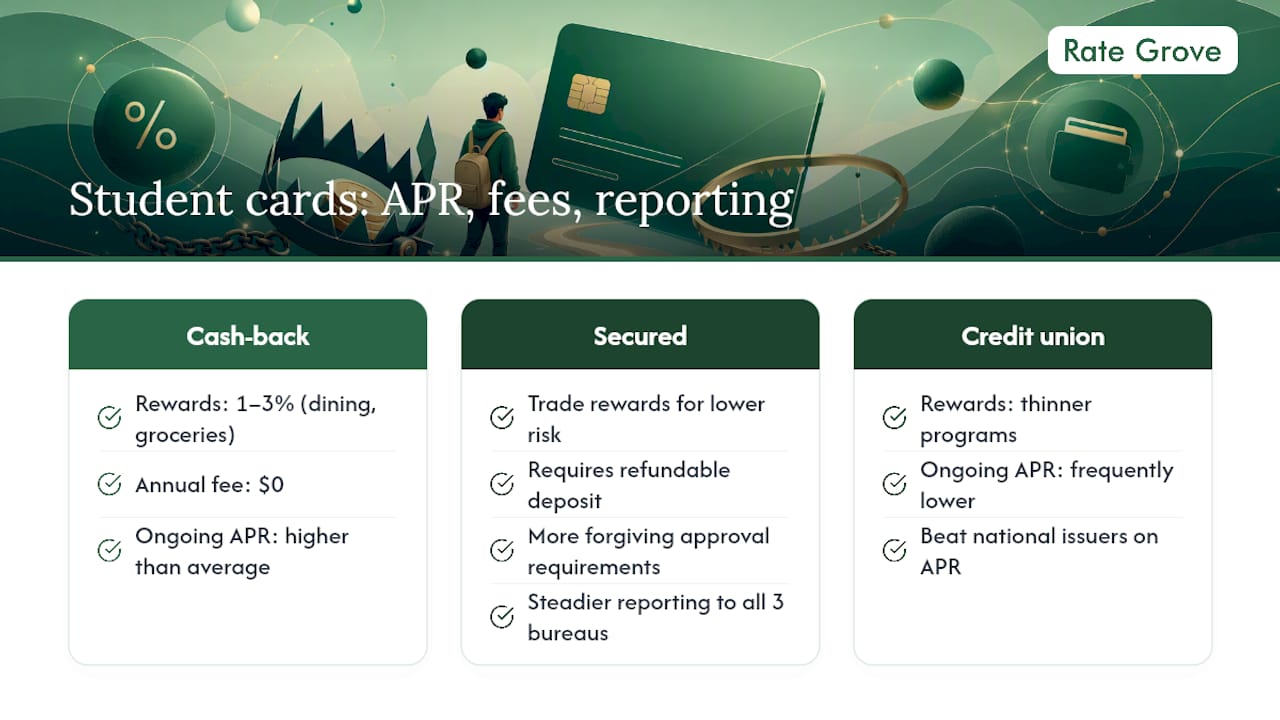
Cards aimed at students generally fall into a few categories. Cash-back student cards typically offer 1% to 3% back on categories like dining or groceries, with no annual fee, but ongoing APRs can run higher than average once introductory periods end. Secured student cards trade rewards for lower risk, requiring a refundable deposit but often carrying more forgiving approval requirements and steadier reporting to all three bureaus. Credit union student cards frequently beat national issuers on APR alone, sometimes by several percentage points, though they may offer thinner rewards programs.
The feature that matters most for someone building credit from zero isn’t the rewards rate. It’s whether the issuer reports to all three major bureaus, whether there’s a clear path to a credit limit increase after 6 to 12 months of on-time payments, and whether the annual fee is $0. A card with 2% cash back and a 26% ongoing APR is a worse deal for anyone who might carry a balance than a card with no rewards and an 18% APR. Comparing student card rates side by side, rather than picking based on a signup bonus, is what actually protects your wallet over four years of college.
What Daily Habits Actually Protect Your Credit Score?
Avoiding traps keeps you out of a hole. Building genuinely good credit takes a few habits beyond that.
Check your balance weekly, not just when the statement arrives. Most issuers have an app that shows your current balance and available credit in real time, and glancing at it weekly keeps spending visible instead of abstract.
Keep utilization under 30% of your limit, and under 10% if you’re aiming for a strong score. If your limit is $1,000, that means keeping your balance under $300 at any point the issuer reports, ideally under $100. Making multiple smaller payments during the billing cycle instead of one lump payment at the due date is a practical way to keep the reported balance low.

Budget with the 50/30/20 framework loosely in mind: essentials, wants, and savings or debt payoff. As a student, your version might be closer to 60/20/20 once you account for tuition-adjacent costs, but the discipline of assigning every dollar a job before you spend it is what prevents credit cards from becoming a gap-filler for a budget that doesn’t balance. A small emergency buffer in a separate savings account reduces the temptation to lean on a credit card when an unexpected expense hits.
Why Treat Your First Card Like a Tool, Not a Safety Net
Every trap in this article comes from the same root mistake: treating a credit card as extra money instead of a tool you’re borrowing against your future self. The students who come out of college with strong credit aren’t the ones who avoided cards entirely. They’re the ones who used one small recurring charge, paid it off every cycle, and never let a promotional rate catch them off guard. Compare your options the way you’d compare a lease, line by line, before you sign anything. Rate Grove’s comparison tools exist for exactly that kind of decision.
Compare Student Card Offers Before You Commit
Rate Grove gives you a side-by-side view of student card APRs, fees, and reporting practices, updated monthly and checked against issuer and regulator data rather than marketing copy. That matters most right after you’ve fixed an immediate problem: once your balance is under control and autopay is set, the next step is making sure your next card, or your current one at renewal, isn’t quietly costing you more than a comparable option down the street or at your credit union.
Rate Grove earns a commission if you apply through some of the links in our guides, which never affects which cards we rank higher. If you’re ready to see how your current card’s APR and fees stack up, start with Rate Grove’s student card comparison guide and check the numbers before you renew or apply anywhere else.
Frequently Asked Questions
What is the biggest credit card trap for students? The combination of a promotional APR that expires and minimum payments that barely touch the principal causes the most long-term damage, since both can quietly extend a balance for years.
Can a college-sponsored card really cost more than a regular card? Yes. The CFPB’s review found issuers pay colleges to market financial products, and those partnerships can lead to worse terms than what’s available comparing independently.
How fast can I recover from a late payment? The late payment itself can stay on your report for seven years, but its effect on your score typically fades within 12 to 24 months if you don’t repeat the mistake.
Is being an authorized user a good way to build credit? It can work well, but it carries risk. If the primary account holder misses a payment or runs up a high balance, your credit history takes the hit too.
Should I close a credit card I’m not using? Not automatically. Closing a card can raise your utilization ratio on your remaining accounts. A small recurring autopay charge is often a safer way to keep an unused card active.
This article is general information, not a substitute for advice from a qualified financial advisor. Consult a qualified financial professional about your own circumstances before acting on anything here.