

Use a sweep account for cash you might need today or tomorrow, and a money market fund for cash you can leave alone for weeks or months. The sweep keeps money instantly available at the cost of a lower yield and, if it’s the fund-based kind, no FDIC insurance. A money market fund usually pays more but takes a business day to sell and settle, and it’s covered by SIPC, not FDIC.
TL;DR:
- Most default sweep accounts pay very low yields, sometimes as little as 0.01% APY, which can be significantly outperformed by money market funds with rates near 4-5%.
- FDIC insurance covers up to $250,000 per deposit at one bank and only applies if cash is in an insured deposit account, while money market funds are protected by SIPC, which does not insure against investment losses.
- A money market fund typically takes a business day to sell shares and settle, making it less suitable for immediate cash needs compared to sweep accounts that provide instant access.
- For balances exceeding $250,000, spreading funds across multiple banks or using multi-bank sweep programs can expand FDIC coverage and reduce risk.
- Checking actual yields and account features regularly is crucial, as both sweep and money market fund rates change frequently and may include hidden fees that erode returns.
Table of Contents
- Sweep vs Money Market: What Each One Actually Is
- FDIC vs SIPC: What’s Actually Protected
- Why Money Market Funds Usually Pay More
- How Fast Can You Actually Get Your Cash?
- How to Choose the Right Cash Vehicle for You
- How Rate Grove Verifies These Rates
- A Final Word on Sweep vs Money Market
- Compare Your Sweep and Money Market Options With Rate Grove
- Sources
- FAQ
Sweep vs Money Market: What Each One Actually Is
A cash sweep isn’t a product. It’s a mechanism your brokerage or bank uses to move uninvested cash out of your account and into a designated holding spot overnight, so it isn’t just sitting idle. The SEC’s investor bulletin on cash sweep programs is blunt about this: the sweep is a process, not an asset class. Where that cash actually lands depends on your broker’s setup.
A money market fund (MMF), by contrast, is a registered investment company. It pools investor money and buys short-term debt, like Treasury bills or commercial paper, and tries to hold a stable $1 net asset value. It’s a security you own, not a bucket your cash falls into.
Here’s the twist that trips up a lot of account holders: your “sweep” might already be a money market fund.
- Some brokers default uninvested cash into a bank deposit sweep program spread across partner banks.
- Others use a proprietary or third-party MMF as the core position itself.
- A checklist for comparing the two starts with one question: is my broker’s default core already an MMF? If so, you’re not choosing between sweep and money market. You’re already in one.
Check your account statement or ask your broker directly. The label “sweep” tells you nothing about what’s underneath it.
FDIC vs SIPC: What’s Actually Protected
Here’s the number that matters most: FDIC deposit insurance covers up to $250,000 per depositor, per bank, for each ownership category — and it only applies when your sweep cash actually lands in a bank deposit account.
Bank-based sweep programs typically qualify for that FDIC coverage, since the cash is sitting in an insured deposit account at a partner bank. Money market funds don’t. They’re securities, and securities aren’t FDIC insured no matter how stable or conservative they look. If you hold an MMF through a brokerage, you’re protected by SIPC instead, and SIPC works differently. It steps in if your brokerage fails and your assets go missing or get frozen. SIPC coverage tops out at $500,000 total, including $250,000 for cash, but it does not reimburse you if your MMF loses value from a bad market. SIPC replaces missing assets; it doesn’t insure against investment risk.
That distinction catches people off guard, especially those who assume any money sitting at a big-name brokerage is automatically as safe as a bank account.
If you’re carrying a balance well above $250,000, a few practical moves help close the gap. Spreading deposits across multiple banks keeps each one under the insured limit. Some brokers also offer multi-bank sweep networks, or deposit programs that expand your effective FDIC coverage well past the standard cap for large balances. Reading the fund’s prospectus before committing to an MMF tells you exactly what it invests in and how it behaved during past rate stress.
Why Money Market Funds Usually Pay More
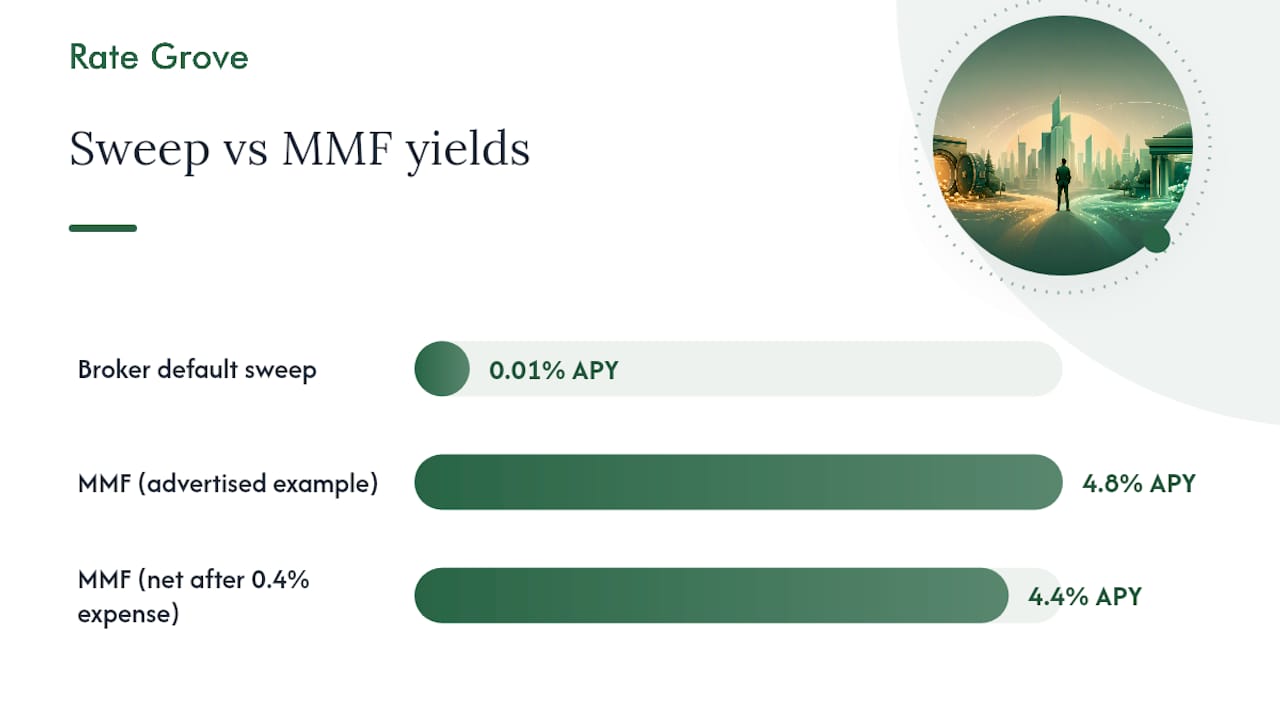
Default sweep yields can be shockingly low. Some brokers pay as little as 0.01% APY on uninvested cash sitting in their default sweep, according to SEC guidance on cash sweep yields. Money market funds, meanwhile, tend to track short-term interest rates much more closely, and recent short-term rate conditions have pushed MMF and high-yield savings returns toward the 4% to 5% range at various points.
That gap is the whole reason this comparison exists. But gross yield isn’t net yield.
- Every MMF carries an expense ratio, a small annual percentage deducted from your return before you see a dime.
- Some sweep programs charge their own fees, either flat monthly charges or a percentage of your swept balance, and those fees can quietly erode any yield advantage.
- A fund advertising 4.8% with a 0.4% expense ratio nets you roughly 4.4%, before any account-level fees.
To compare fairly, use this: Net Yield = Advertised APY − Expense Ratio − Any Sweep or Account Fees. Run both options through that formula before assuming the higher advertised number wins.
Pro Tip: Call your broker and ask point-blank whether your sweep yield is quoted gross or net of program fees. Some brokers bury a percentage-based fee in the fine print that never shows up in the advertised rate.
How Fast Can You Actually Get Your Cash?
Sweep cash is already cash. It’s available the moment you need it, whether you’re covering a trade, a withdrawal, or a margin call. A money market fund isn’t sitting there ready to spend; you have to sell shares first, and that sale typically settles the same or next business day, per research comparing sweep and MMF access speed.
That one-day gap matters more than it sounds like it should, especially if you trade actively or need funds for a time-sensitive payment.
Broker behavior varies a lot here, so don’t assume yours works like your neighbor’s brokerage:
- Some brokers automatically liquidate MMF shares to cover a trade or withdrawal, treating the fund almost like cash.
- Others require you to manually sell shares first, then wait for settlement before the money is usable.
- A few set minimum balance requirements on MMF core positions that don’t apply to bank sweeps.
- Ask your broker directly: does my core position auto-liquidate for trades? Is there a minimum? What happens if I need cash the same day I place a sell order?
Get those answers in writing or from a support rep before you assume your MMF behaves like instant cash. It usually doesn’t.
How to Choose the Right Cash Vehicle for You
Match the vehicle to your timeline, then double check the fine print. Here’s the sequence worth running through, in order:
- Decide your liquidity horizon. Same-day access, a few days, a few weeks, or genuinely idle cash you won’t touch for months.
- Check your current core position. Log into your account and find out what your sweep actually pays right now, and confirm whether it’s a bank deposit or an MMF already.
- Weigh your protection exposure. If your balance is near or above $250,000, decide whether you need FDIC vs SIPC coverage clarified further or whether spreading funds across accounts makes more sense.
- Compute net yield. Apply the formula from the section above to both options before moving a dollar.
| Your situation | Better fit | Why |
|---|---|---|
| Need cash within a day or two | Sweep account | Instant availability, no sell/settlement lag |
| Idle cash, no near-term need | Money market fund | Higher yield tends to outweigh the settlement delay |
| Balance well above $250,000 | Multi-bank sweep or spread deposits | Expands effective FDIC coverage |
| Active trader | Sweep or auto-liquidating MMF core | Avoid manual sell delays before trades |
A practical middle path many investors use: keep a sweep buffer sized to your typical monthly spending or trading needs, then move everything past that buffer into a higher-yield MMF. Set a calendar reminder every quarter to re-check both rates, since sweep and MMF yields move independently and a rate that looked competitive in January can lag badly by summer.
How Rate Grove Verifies These Rates
Sweep and MMF yields shift constantly, and the number your broker advertised last quarter may already be stale. Rate Grove checks current account rates directly against issuer and regulator sources every month, rather than relying on outdated aggregator data.
That process looks like this:
- Pulling current APYs directly from issuing bank rate pages and fund fact sheets, not third-party estimates.
- Cross-referencing FDIC and SIPC coverage claims against official FDIC insurance rules and fund prospectuses before publishing any comparison.
- Rebuilding side-by-side comparisons monthly, so the yield and fee figures you see match what the issuer is actually offering today.
For a deeper look at how different money market account structures stack up, that guide breaks down the operational side in more detail than this comparison covers.
A Final Word on Sweep vs Money Market
Stick to the timeline rule: same-day needs stay in the sweep, idle cash moves to the MMF. Most retail investors overthink this decision when the real risk sits elsewhere, in balances that exceed FDIC limits or in brokers whose “sweep” is secretly an uninsured fund. Large balances and institutional accounts deserve a closer look at multi-bank programs before defaulting to either option.
— Mat C.
Compare Your Sweep and Money Market Options With Rate Grove
Most people never actually check what their sweep account pays until a rate hike makes the gap impossible to ignore.

If you’ve read this far, you already know the next move: pull up your account statement, find your current sweep or core APY, and check it against what’s actually available right now. Rate Grove’s side-by-side comparison tools let you weigh sweep yields, money market rates, and FDIC coverage details in one place, without digging through a dozen prospectuses yourself. Start there before you decide whether to move a single dollar.
This article is general information, not a substitute for advice from a qualified financial advisor. Consult a qualified financial professional about your own circumstances before acting on anything here.
Sources
FAQ
What Is the Downside of a Sweep Account?
The main downside is yield. Default sweep rates can sit as low as 0.01% APY, and if your sweep uses a money market fund rather than a bank deposit, it isn’t FDIC insured. Some sweep programs also carry flat or percentage-based fees that quietly cut into whatever return you do earn.
Where Do Millionaires Keep Money if FDIC Only Insures $250,000?
Large balances typically get spread across multiple banks, each staying under the $250,000 per depositor limit, or placed in multi-bank sweep networks that expand effective FDIC coverage across several partner institutions. Institutional cash management programs designed for treasurers can push coverage well beyond the standard single-bank cap.
How Much Will $100,000 Make in a Money Market Account?
It depends entirely on the current rate and the fund’s expense ratio, since short-term rates move and MMF yields track them. Recent conditions have pushed some money market and high-yield savings rates toward the 4% to 5% range, but you need to subtract the fund’s expense ratio to see your actual net return.
Is There a Better Option Than a Low-Yield Default Sweep Fund?
Often, yes. Compare the net yield after fees using current verified rates before assuming your default option is your best one.
Is a Money Market Fund Better Than a Sweep Account?
It depends on your timeline, not a blanket ranking. A money market fund usually wins on yield for idle cash, while a sweep wins on instant access and, when it’s bank-based, FDIC protection that an MMF simply doesn’t carry.