

A money market account (MMA) is a federally insured deposit account that combines the interest-earning potential of a savings account with the transactional features of a checking account. Knowing how to choose between money market accounts means weighing interest rates, fees, minimum balance requirements, and access features against your actual savings goals. The national average MMA rate sits at just 0.61% APY, while top-tier accounts currently pay between 3.50% and 4.00% APY. That gap is too large to ignore. Rate Grove breaks down exactly what separates a good MMA from a great one.
What are the key features to compare in money market accounts?
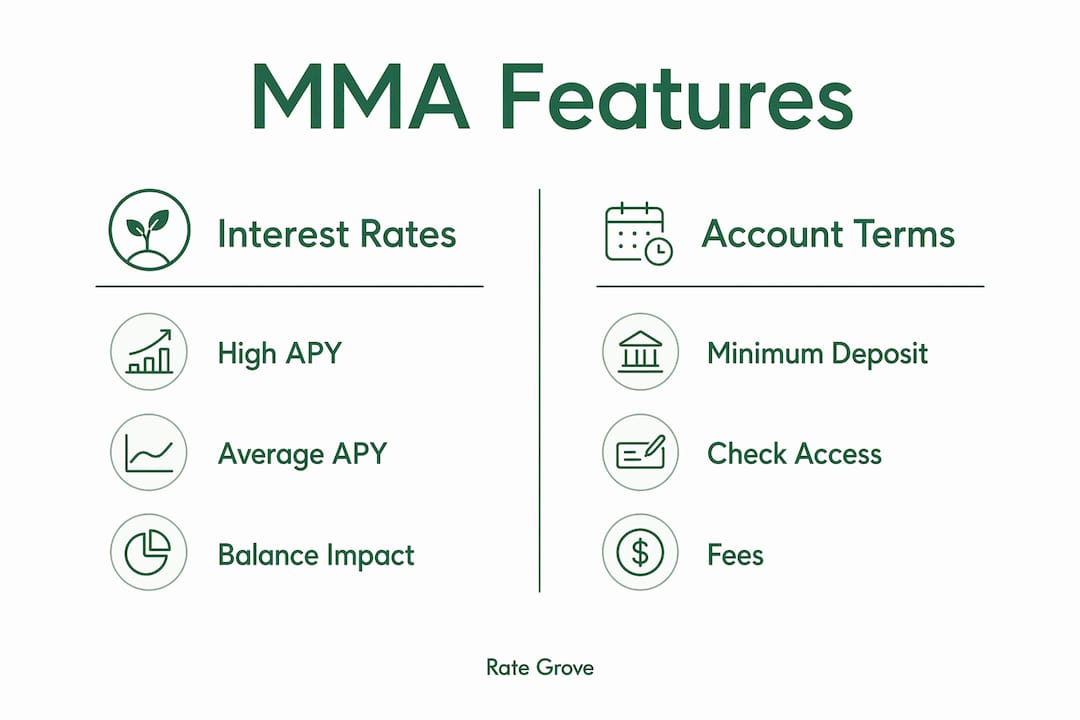
The most important money market account features to compare are the annual percentage yield (APY), minimum balance requirements, fee structure, and account access methods. Getting these four factors right determines whether your account earns meaningfully or quietly drains your savings.
Interest rates and APY
The rate gap between accounts is significant. The national average is 0.61% APY, but competitive MMAs pay up to 4.00% APY. That difference on a $20,000 balance equals roughly $678 more per year at the higher rate. Most MMAs use variable rates, meaning your yield can change without notice. Tiered rate structures are also common, where larger balances unlock higher APYs.

Access and transactional features
MMAs typically offer check-writing privileges and debit cards, which high-yield savings accounts (HYSAs) do not. This distinction matters when you need to pay a contractor, cover an emergency car repair, or manage a predictable monthly expense directly from your savings. The check-writing and debit access in MMAs makes them more flexible than HYSAs for short-term cash management.
Federal insurance protection
FDIC or NCUA insurance protects MMA deposits up to $250,000 per depositor. This separates bank and credit union MMAs from money market mutual funds, which carry no federal deposit insurance. Always confirm your account carries this protection before depositing.
Here is a quick comparison of core MMA features to evaluate:
| Feature | What to look for |
|---|---|
| APY | 3.50%–4.00% at competitive institutions |
| Minimum opening deposit | $0–$2,500 depending on the institution |
| Monthly maintenance fee | $0 with balance requirements met |
| Check-writing access | Available at most banks and credit unions |
| Federal insurance | FDIC (banks) or NCUA (credit unions) |
Pro Tip: Compare the APY on balances you can actually maintain. A 4.00% rate that requires a $25,000 minimum is irrelevant if your balance stays at $5,000.
How do fees and balance requirements affect your net return?
Fees are the silent killer of MMA earnings. A monthly maintenance fee of $12 on an account earning $15 per month in interest leaves you with almost nothing. Understanding the full cost structure before opening an account is the single most important step in any money market account comparison.
-
Identify the monthly maintenance fee. Most banks charge $10–$25 per month unless you maintain a minimum balance. Confirm the exact threshold and whether it applies to the average daily balance or the end-of-month balance.
-
Calculate the fee-adjusted yield. Subtract annual fees from projected annual interest. An account paying 3.80% APY with a $120 annual fee on a $5,000 balance nets you $70, not $190.
-
Watch for tiered rate traps. Some accounts advertise a top-tier APY that only applies to balances above $50,000. Read the full rate schedule, not just the headline number.
-
Check for excess withdrawal fees. Even though federal Regulation D withdrawal limits were suspended, many banks still charge fees for excessive MMA transactions. These fees can add up quickly if you use the account like a checking account.
-
Read the account disclosures. Promotional rates often revert to lower ongoing rates after an introductory period. Promotional APYs can be misleading if you focus only on the advertised rate without checking the long-term yield.
Failing to meet minimum balance requirements can trigger fees and even account closure. That outcome damages your financial record and eliminates the earnings you were counting on. The total cost of ownership, including fees and minimums, matters far more than the APY alone.
Pro Tip: Use Rate Grove’s fee impact guide to see exactly how small monthly charges compound into major losses over a year.
What access and liquidity features should you consider?
Liquidity is the defining practical difference between MMAs and other savings vehicles. An MMA lets you write checks, use a debit card, and access funds at an ATM. A certificate of deposit (CD) locks your money for a fixed term. A HYSA requires a transfer that takes one to three business days. Your intended use for the funds should drive your account choice.
- Check-writing privileges let you pay bills or vendors directly from your savings balance, which is useful for irregular but predictable expenses.
- Debit card access provides immediate point-of-sale spending, though frequent use can trigger excess transaction fees.
- ATM access gives you cash without a bank transfer, which matters during emergencies when time is critical.
- Withdrawal limits still exist at most institutions. Despite the suspension of federal Regulation D, banks impose internal withdrawal caps to discourage excessive transactions.
The behavioral dimension of access is worth considering. Financial planners note that accounts with more friction, meaning fewer easy ways to spend, help savers preserve emergency funds. A HYSA with no debit card creates a small but meaningful barrier to impulse spending.
“Experts recommend choosing account types primarily based on intended cash use rather than just the APY, emphasizing liquidity needs versus fund growth. The right account is the one that matches how you actually plan to use the money.”
For emergency funds, the best approach is often a split. Keep one to two months of expenses in an MMA for fast access, and park the rest in a HYSA where the transfer friction protects the balance. Rate Grove’s guide on high-yield savings account types explains how these two account types complement each other.
How do you strategically select a money market account for your goals?
Choosing the right MMA is a five-step process. Skipping any step leads to either leaving money on the table or picking an account that does not fit your actual behavior.
-
Define your savings goal and timeline. An emergency fund needs fast access. A down payment fund needs high yield and minimal temptation to spend. A bill-payment buffer needs check-writing access. Each goal points to different account features.
-
Assess your realistic balance. The best money market accounts pay near 4% APY, but many require minimum balances of $1,000 to $10,000 to avoid fees. Know your average balance before comparing rates.
-
Compare total cost, not just APY. Use a bank account comparison checklist that includes APY, monthly fees, minimum balance thresholds, and excess withdrawal fees side by side.
-
Consider a two-tier strategy. Savvy savers split funds across an MMA and a HYSA to balance quick access with spending discipline. The MMA holds the working balance for known upcoming payments. The HYSA holds the bulk of emergency savings.
-
Monitor rates quarterly. MMA rates are variable and tied to Federal Reserve policy. When short-term Treasury yields shift, MMA rates follow. Set a calendar reminder to review why savings rates differ and compare offers every three months.
Here is a decision framework based on common savings scenarios:
| Savings goal | Recommended account type | Key feature to prioritize |
|---|---|---|
| Emergency fund (1–2 months) | MMA | Debit card and ATM access |
| Emergency fund (3–6 months) | HYSA or MMA + HYSA split | High APY, low fees |
| Short-term bill payments | MMA | Check-writing privileges |
| Down payment savings | HYSA or CD | Highest available APY |
| Investment diversification | MMA + CD ladder | Liquidity plus locked-in yield |
My take on picking the right money market account
My take on picking the right money market account
The most common mistake I see is choosing an MMA based on the headline APY and nothing else. A 4.00% rate looks great until you realize the account requires a $25,000 minimum, charges $15 per month if you dip below it, and limits you to six withdrawals before hitting fees. At that point, the real yield is far lower than advertised.
The behavioral finance angle is the part most articles skip. Access friction is a feature, not a bug. If your emergency fund is in an MMA with a debit card, you will spend it on things that are not emergencies. I have seen this happen repeatedly. The accounts that preserve savings best are the ones that make spending slightly inconvenient.
My honest recommendation is to use the two-tier approach. Put one to two months of expenses in an MMA for genuine emergencies and known upcoming costs. Put the rest in a HYSA where the transfer delay acts as a speed bump. You still earn a competitive rate on both, but the structure protects the bulk of your savings from easy access.
Review your accounts every quarter. Rates move, promotional periods end, and fee structures change. An account that was the best option in january may be mediocre by july. Staying current is not optional if you want your savings to work as hard as possible.
— Mat C.
Rate Grove makes money market account comparison straightforward
Finding the best MMA for your situation does not require hours of research across dozens of bank websites. Rate Grove pulls verified APY and fee data from issuer and regulator sources, then presents it in a clear side-by-side format.
Whether you are comparing money market accounts, high-yield savings accounts, or CD rates, Rate Grove updates its guides monthly so you always see current offers. You can compare rates and fees across account types in one place, without sorting through outdated information or fine print buried in bank disclosures. If you want to maximize your savings contributions this year, Rate Grove’s 2026 savings guide is a practical next step.
Key takeaways
The most effective way to choose a money market account is to evaluate APY, fees, minimum balance requirements, and access features together, not in isolation.
| Point | Details |
|---|---|
| Rate gap is significant | Top MMAs pay up to 4.00% APY versus a 0.61% national average. |
| Fees erode real returns | Monthly maintenance fees can eliminate most or all of your interest earnings. |
| Access drives account fit | Choose MMA for transactional access or HYSA for spending friction and fund preservation. |
| Two-tier strategy works | Split funds between an MMA and a HYSA to balance liquidity with savings discipline. |
| Review accounts quarterly | Variable rates and promotional periods mean the best account today may not be best in six months. |
FAQ
What is a money market account?
A money market account is a federally insured deposit account that earns interest and typically offers check-writing and debit card access. It combines features of savings and checking accounts, with FDIC or NCUA insurance protecting deposits up to $250,000.
How do I compare money market account rates effectively?
Compare the APY at your actual expected balance, not just the advertised top rate. Factor in monthly fees and minimum balance requirements to calculate your true net yield.
Are money market accounts better than high-yield savings accounts?
MMAs offer more transactional access through checks and debit cards, while HYSAs typically create more friction that protects savings from impulse spending. The better choice depends on how you plan to use the funds.
What happens if I fall below the minimum balance in an MMA?
Falling below the minimum balance usually triggers a monthly maintenance fee and can put the account at risk of closure, which directly reduces your net earnings and disrupts your savings plan.
How often do money market account rates change?
MMA rates are variable and can change at any time, often in response to Federal Reserve rate decisions. Reviewing your account’s APY every quarter helps you stay competitive and switch accounts if a better option becomes available.