

Fixed-rate and variable-rate CDs are two distinct types of certificates of deposit that differ primarily in how their interest rates behave over the life of the term. Understanding the difference between fixed vs variable rate CD types is the first step toward choosing the right savings vehicle for your goals. Fixed-rate CDs lock in a guaranteed yield from day one. Variable-rate CDs tie your earnings to a market benchmark, which means your return can rise or fall. Both are insured by the FDIC or NCUA, so your principal is protected either way.
1. What are fixed vs variable rate CD types?
A certificate of deposit (CD) is a time deposit you open with a bank or credit union for a set term, agreeing not to withdraw the funds until maturity. Fixed-rate CDs provide a locked-in, guaranteed interest rate for that entire term, so your yield never changes regardless of what the Federal Reserve does. Variable-rate CDs, by contrast, have interest rates that fluctuate during the term based on a benchmark such as the Federal Funds Rate. That single structural difference shapes every other aspect of how these products perform.
The core trade-off is certainty versus potential upside. Fixed-rate CDs suit savers who want to know exactly what they will earn. Variable-rate CDs suit savers who believe rates will rise and want their CD yield to follow.

2. Key features and benefits of fixed-rate CDs
Fixed-rate CDs are the most straightforward savings product in banking. You deposit a sum, agree to a term (commonly 3 months to 5 years), and receive a guaranteed rate at maturity. The rate does not move, even if the Federal Reserve cuts rates the following week.
Fixed-rate CD advantages at a glance:
- Predictable returns. You know your exact yield before you open the account.
- Capital preservation. Your principal is protected and your interest is guaranteed.
- Ideal for goals with deadlines. Saving for a down payment in 18 months? A fixed-rate CD matches that timeline precisely.
- Better in falling rate environments. If rates drop after you open the CD, you keep earning the higher locked-in rate.
- Low complexity. No need to monitor benchmarks or reset schedules.
Fixed-rate CDs are best for conservative savers who prioritize stability over growth potential. They work especially well when you expect rates to stay flat or decline. The main limitation is liquidity. Early withdrawal penalties apply to both fixed and variable-rate CDs, and those penalties can reduce your principal or accrued interest if you exit early. That makes fixed-rate CDs a poor fit for funds you might need before the term ends.
Pro Tip: If you need some liquidity, consider a no-penalty CD variant, which lets you withdraw without a fee after a short initial holding period. Rates are typically lower, but the flexibility can be worth it.
3. Understanding variable-rate CDs: structure, advantages, and risks
Variable-rate CDs are time deposits where the interest rate resets periodically based on a market benchmark. The Federal Funds Rate is the most common reference point, though some institutions use the prime rate or Treasury yields. When the benchmark rises, your CD rate rises. When it falls, your rate falls with it.
Variable-rate CD benefits and risks:
- Upside potential. If rates climb during your term, your yield increases without opening a new account.
- Benchmark dependency. Your actual return depends on which benchmark the bank uses and how aggressively it moves.
- Margin impact. Variable-rate CD yields depend heavily on the margin applied by the institution and reset frequency. A low margin means you capture less of each rate increase.
- Look-back lag. Variable-rate CDs have a look-back or lag effect, so rate adjustments may lag behind market benchmark changes. Your CD yield adjusts only at preset intervals, not instantly.
- Penalties still apply. Variable-rate CDs are still time deposits with penalties. They are not as liquid as savings accounts, contrary to common perception.
The reset frequency matters more than most savers realize. Some banks adjust rates monthly, others quarterly or less frequently. A quarterly reset in a rapidly rising rate environment means you miss weeks of higher earnings. Always ask the institution how often the rate resets before you commit.
Pro Tip: Ask for the margin percentage and reset schedule in writing before opening a variable-rate CD. Two CDs tied to the same benchmark can deliver very different yields depending on those two numbers.
4. Fixed vs variable rate CDs: side-by-side comparison
Choosing between these two CD types comes down to five criteria: rate behavior, risk, liquidity, return potential, and the market environment you expect.
| Criteria | Fixed-rate CD | Variable-rate CD |
|---|---|---|
| Interest rate behavior | Locked in for the full term | Resets periodically with benchmark |
| Return predictability | Guaranteed at opening | Uncertain; depends on rate moves |
| Risk level | Very low | Low to moderate |
| Best market condition | Flat or falling rates | Rising rate environment |
| Ideal saver profile | Conservative, goal-focused | Growth-oriented, rate-aware |
| Liquidity | Limited; early withdrawal penalties apply | Limited; same penalties apply |
The table makes one thing clear: neither type is universally better. A fixed-rate CD opened in a high-rate environment locks in strong yields for years. A variable-rate CD opened at the start of a rate-hiking cycle can outperform a fixed product over the same term. The right choice depends on timing and your personal risk tolerance.
5. Strategies for choosing between fixed and variable rate CDs
Picking the right CD type is not just about the rate on offer today. It requires thinking about your financial goals, your timeline, and where interest rates are likely to go.
-
Assess your risk tolerance honestly. Investors often misjudge their risk tolerance with variable-rate CDs, especially the opportunity cost if rates do not rise as expected. Ask yourself: can you accept a lower return than a fixed CD would have paid?
-
Use a CD ladder for fixed-rate products. A laddered strategy using multiple fixed-rate CDs of different terms can balance liquidity and yield more predictably than a single variable-rate CD. Open CDs maturing at 6 months, 1 year, 2 years, and 3 years simultaneously. As each matures, reinvest at current rates.
-
Match the CD type to your rate outlook. If the Federal Reserve is signaling rate hikes, a variable-rate CD lets you benefit without locking into today’s lower fixed rate. If rates are at a peak or falling, a fixed-rate CD captures the high yield before it disappears.
-
Check the terms before you sign. Read the penalty schedule, the margin, and the reset frequency. The variety of CD terms available (1 to 5 years) lets savers titrate risk and timing, making laddering a flexible approach tailored to individual goals.
-
Monitor rates at renewal. When a CD matures, the rate environment may have shifted. Do not auto-renew without comparing current offers. Rate Grove updates its CD rate comparisons monthly so you always see verified, current data.
-
Split your deposit between both types. You do not have to choose one exclusively. Putting half your savings in a fixed-rate CD and half in a variable-rate CD hedges against both falling and rising rate scenarios.
-
Factor in your savings account as a baseline. A high-yield savings account offers full liquidity with competitive rates. If the CD rate premium over your savings account is small, the liquidity trade-off may not be worth it.
6. Common misconceptions about fixed and variable rate CDs
Several widespread misunderstandings lead savers to make poor CD decisions.
- “Variable-rate CDs are basically liquid.” They are not. Early withdrawals incur penalties that may offset variable-rate gains. Treat them as locked funds for the full term.
- “My variable CD will immediately reflect rate hikes.” The look-back period means your yield adjusts on a delay. In a fast-moving rate environment, that lag costs real money.
- “The margin doesn’t matter much.” It matters enormously. Banks have discretionary power over the margin added to benchmarks in variable CDs. A 0.25% margin difference compounds significantly over a multi-year term.
- “Fixed-rate CDs always underperform in rising markets.” A fixed CD opened at a rate peak outperforms a variable CD that starts low and rises slowly due to lag and margin drag.
- “All CD penalties are the same.” Penalty structures vary widely by institution. Always read the fee disclosure before opening any CD.
Key takeaways
Fixed-rate CDs deliver guaranteed returns ideal for stable or falling rate environments, while variable-rate CDs offer growth potential in rising rate markets but carry yield uncertainty driven by margin, reset frequency, and benchmark lag.
| Point | Details |
|---|---|
| Fixed-rate CDs guarantee your yield | Your rate locks in at opening and never changes, regardless of market moves. |
| Variable-rate CDs follow benchmarks | Yields reset periodically based on rates like the Federal Funds Rate, with lag. |
| Margin and reset frequency matter | Low margins or infrequent resets can significantly reduce variable CD earnings. |
| Laddering fixed CDs balances risk | Staggered maturities give you reinvestment flexibility without variable-rate uncertainty. |
| Penalties apply to both types | Neither CD type is liquid; early withdrawal costs can wipe out rate gains. |
My take on mixing fixed and variable CDs
I have watched savers make the same mistake repeatedly: they open a variable-rate CD expecting to ride a rate-hiking cycle, then discover the margin and reset lag ate most of their expected gains. The product sounded right. The execution was off because they did not read the fine print on reset frequency.
My honest view is that most savers are better served by a fixed-rate CD ladder as their core strategy. The predictability is genuinely valuable, not just psychologically. When you know exactly what a CD will pay, you can plan around it. Variable-rate CDs work best as a satellite position, maybe 20–30% of your total CD allocation, opened specifically when rate hikes are already underway and the benchmark is moving fast enough to outpace the lag.
The other thing I would push back on is the idea that you need to pick one type and stick with it. Your savings strategy should reflect the rate environment you are actually in, not the one you wish you were in. Review your CD holdings every time one matures. If the rate picture has shifted, your allocation should shift too. Staying flexible is the real edge most savers leave on the table.
— Mat C.
Finding the best CD rates with Rate Grove
Rate Grove makes it straightforward to compare current fixed and variable CD rates side by side, all sourced from verified issuer and regulator data.
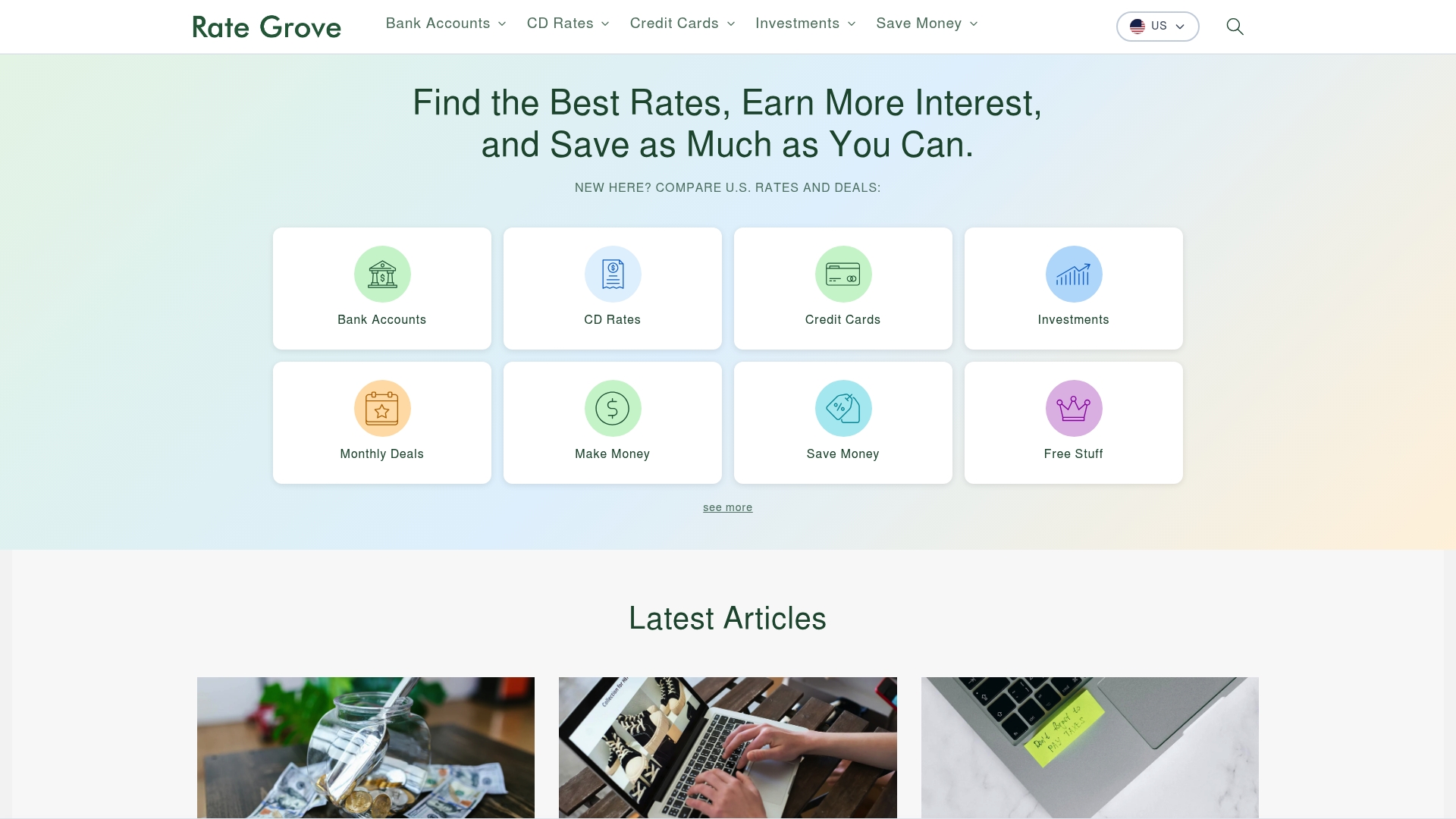
You can filter by term length, rate type, and institution to find the product that fits your timeline and risk tolerance. Every listing shows the rate, term, penalty structure, and key tradeoffs in one place, so you are not hunting across multiple bank websites. Rate Grove updates its CD data monthly, which means you always see current offers rather than stale figures. Visit Rate Grove to compare CD rates and find the fixed or variable CD that matches your 2026 savings goals.
FAQ
What is the main difference between fixed and variable rate CDs?
A fixed-rate CD locks in your interest rate for the full term, while a variable-rate CD resets periodically based on a market benchmark like the Federal Funds Rate. Fixed-rate CDs offer guaranteed returns; variable-rate CDs offer potential upside if rates rise.
Are variable-rate CDs safer than savings accounts?
Variable-rate CDs carry the same FDIC or NCUA insurance as savings accounts, so your principal is equally protected. However, variable CDs are far less liquid because early withdrawal penalties apply, unlike most savings accounts.
When does a fixed-rate CD outperform a variable-rate CD?
A fixed-rate CD outperforms when rates are at a peak or falling, because you lock in the high rate before it drops. Variable-rate CDs outperform when rates are rising steadily and the reset frequency is high enough to capture those gains quickly.
What is a CD ladder and how does it help?
A CD ladder splits your savings across multiple CDs with staggered maturity dates, such as 6 months, 1 year, and 2 years. This gives you regular access to maturing funds for reinvestment while still earning higher rates than a standard savings account.
Can I lose money in a variable-rate CD?
You cannot lose principal in a variable-rate CD as long as you hold it to maturity and the institution is FDIC or NCUA insured. However, withdrawing early triggers penalties that can reduce your accrued interest or, in some cases, cut into your principal.