

Credit bureaus are private, for-profit companies that collect consumer financial data and sell it as credit reports and scores to lenders, landlords, employers, and other permitted users. The three major nationwide bureaus are Equifax, Experian, and TransUnion. As a consumer, your most important moves are simple: check your reports regularly, dispute any errors you find, and freeze your credit if you suspect fraud.
Table of Contents
- What data credit bureaus collect and where it comes from
- How Equifax, Experian, and TransUnion compare for consumers
- How lenders and other permitted users use your credit report
- Why your credit report or score can differ between bureaus
- Your rights under the FCRA and how to dispute errors
- How to get your free credit reports
- How long items typically stay on your credit report
- Protecting yourself with credit freezes, fraud alerts, and identity-theft steps
- Key Takeaways
- Why your credit report deserves more attention than you give it
- Useful sources and where to learn more
What data credit bureaus collect and where it comes from
Credit bureaus build your file from two main streams: data sent by furnishers and data pulled from public records.
Furnishers are the lenders, credit card issuers, collection agencies, and other creditors that report your account activity, usually through monthly electronic feeds. What they send typically includes:
- Trade lines: account type (mortgage, auto, credit card), credit limit or loan amount, current balance, and full payment history
- Personal identifying information: name, address history, date of birth, and Social Security number
- Collection accounts: debts sold or assigned to third-party collectors
- Public records: bankruptcies and, in some cases, civil judgments
Reporting to the bureaus is voluntary. Furnishers are not required to submit data to all three bureaus, which is why your files at Equifax, Experian, and TransUnion can look different from day one.
Beyond the Big Three, hundreds of specialty consumer reporting companies track niche data: rental payment history, utility accounts, telecom records, and check-writing behavior. Those files rarely appear on your standard credit report, but they can affect decisions like apartment applications or new utility accounts.
Pro Tip: If you pay rent on time, ask your landlord or property manager whether they report to a rent-reporting service. Some bureaus and specialty agencies accept this data, and it can add positive history to your file.
How Equifax, Experian, and TransUnion compare for consumers
Each bureau is a separate company with its own database, its own consumer portal, and its own set of products. They do the same core job, but the details differ.

| Feature | Equifax | Experian | TransUnion |
|---|---|---|---|
| Free annual report | Via AnnualCreditReport.gov | Via AnnualCreditReport.gov | Via AnnualCreditReport.gov |
| Bureau portal access | equifax.com | experian.com | transunion.com |
| Free credit score | Available through portal | Available through portal | Available through portal |
| Credit monitoring | Paid and free tiers | Paid and free tiers | Paid and free tiers |
| Credit freeze | Free, online/phone/mail | Free, online/phone/mail | Free, online/phone/mail |
| Fraud alert placement | Free, notifies all three | Free, notifies all three | Free, notifies all three |
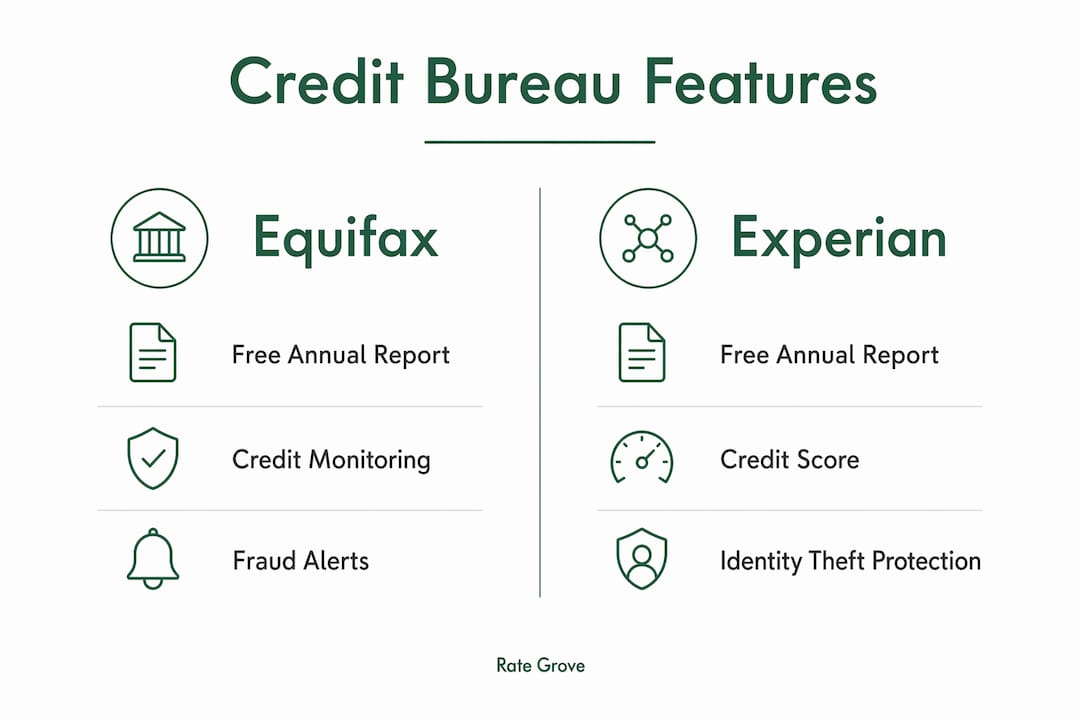
All three bureaus sell additional services directly to consumers, including credit monitoring and identity-theft protection products. These are optional. Your free annual report from each bureau is the baseline you should always start with.
Key things to know about each bureau:
- Equifax is headquartered in Atlanta and is one of the oldest U.S. credit reporting agencies. Its consumer portal lets you lock your Equifax file separately from a full freeze.
- Experian offers a free FICO Score through its portal, which is useful since FICO is the score most lenders actually pull.
- TransUnion provides a VantageScore through its portal and has a strong consumer dispute interface online.
How lenders and other permitted users use your credit report
Lenders do not just glance at your score and move on. They pull your full report, review specific accounts, and apply their own internal criteria on top of whatever score the bureau returns. Bureaus provide the data; lenders make the decision.
Common uses of credit reports and scores include:
- Loan approval and pricing: Mortgage lenders, auto lenders, and card issuers use your report to decide whether to approve you and at what interest rate. A stronger file typically means a lower rate. You can see how this plays out in practice with Rate Grove’s guide on credit score impact on applications.
- Account monitoring: Existing creditors can pull your report periodically to adjust credit limits or flag risk, even without a new application.
- Prescreened offers: Bureaus supply lenders with lists of consumers who meet certain criteria, which is why you receive pre-approved card offers in the mail.
- Insurance underwriting: Many auto and homeowners insurers use credit-based insurance scores derived from bureau data to set premiums.
- Tenant screening: Landlords routinely pull reports to evaluate rental applicants.
- Employment screening: Employers may review a modified version of your report with your written consent, typically for roles involving financial responsibility.
Under the Fair Credit Reporting Act (FCRA), bureaus can only release your report for a permissible purpose. That list covers credit applications, existing creditor reviews, landlord checks, and employer requests with written consent. Anyone pulling your report without a permissible purpose is violating federal law.
Why your credit report or score can differ between bureaus

Seeing a different score at each bureau is not a sign something is wrong. It is normal, and there are clear reasons for it.
The most fundamental cause: each bureau maintains its own independent database and receives data from different furnishers at different times. A lender might report to Equifax and TransUnion but skip Experian entirely. That account simply will not exist in your Experian file.
Timing adds another layer. Furnishers typically update bureaus once a month, but not always on the same date. If you paid down a large balance last week, one bureau might already reflect it while the other two still show the old number.
Scoring models compound the difference. FICO and VantageScore are the two dominant models, and each has multiple versions. A lender pulling your Experian FICO 8 score and your TransUnion VantageScore 3.0 is essentially running two different calculations on two different data sets.
Variation in credit scores across bureaus is expected and normal. The same consumer can have meaningfully different scores at each bureau simply because the underlying data sets are not identical. Checking all three reports gives you the full picture.
Pro Tip: When you apply for a mortgage, lenders typically pull all three bureau scores and use the middle score for qualification. Knowing your scores at all three bureaus before you apply gives you no surprises at the closing table.
Your rights under the FCRA and how to dispute errors
You have the right to dispute inaccurate information on your credit report, and bureaus are legally required to investigate. Here is how to do it, step by step.
- Get your report. Order your free reports at AnnualCreditReport.gov. Review all three, since an error at one bureau may not appear at the others.
- Identify the error. Common errors include accounts that are not yours, incorrect payment statuses, duplicate accounts, and outdated personal information.
- Submit a dispute to the bureau. You can dispute online through each bureau’s portal, by mail, or by phone. Include your name, account details, a clear description of the error, and copies of any supporting documents.
- Dispute with the furnisher too. Under the FCRA’s furnisher accuracy rules, you can also contact the lender or creditor that reported the incorrect data directly. Disputing at both ends tends to produce faster results.
- Track the timeline. Bureaus generally have 30 days to investigate and respond. Keep copies of everything you send.
- Escalate if needed. If the bureau closes your dispute without fixing the error, you can file a complaint with the Consumer Financial Protection Bureau (CFPB) or the Federal Trade Commission (FTC). You also have the right to add a 100-word consumer statement to your file explaining your side of the dispute.
Key timeline: Bureaus typically must complete their investigation within 30 days of receiving your dispute (45 days if you submitted additional information). If they cannot verify the disputed item, they must remove it.
How to get your free credit reports
The fastest, most reliable route is AnnualCreditReport.gov, the only federally authorized site for free reports from all three bureaus. You can order online, by phone at 1-877-322-8228, or by mailing a request form.
Beyond the standard free annual access, you are entitled to a free report in additional situations:
- You were denied credit, insurance, or employment based on your report (within 60 days of the denial notice)
- You are unemployed and plan to apply for work within 60 days
- You are on public assistance
- You believe your file contains errors due to fraud
- You are on active military duty
Pro Tip: Instead of pulling all three reports at once, consider spacing them out every four months. That way you get a free check-in on your credit file three times a year without paying for monitoring.
Each bureau also lets you access your report directly through its own portal. Federal Reserve guidance recommends ordering all three at once when you want a complete snapshot, such as before a major loan application.
How long items typically stay on your credit report
Most negative items follow a seven-year clock from the date of first delinquency. Here is how the common categories break down:
- Late payments: 7 years from the date of the missed payment
- Collection accounts: 7 years from the original delinquency date, even if the debt is sold to a new collector
- Charge-offs: 7 years from the date of first delinquency on the original account
- Foreclosures: 7 years from the date of first delinquency leading to the foreclosure
- Chapter 13 bankruptcy: 7 years from the filing date
- Chapter 7 bankruptcy: 10 years from the filing date
- Positive accounts (paid on time, closed): Can remain up to 10 years after the account closes, which is actually good for your score
A few important exceptions: some unpaid tax liens and civil judgments may stay longer depending on state law and when they were filed. Identity-theft markers and fraud alerts you place yourself are not negative items and do not follow the same removal schedule.
Exact removal timing can vary slightly because of how individual bureaus process end-of-reporting-period dates. If an item is past its legal reporting period and still appears, you can dispute it directly with the bureau for removal.
Protecting yourself with credit freezes, fraud alerts, and identity-theft steps
A credit freeze is the strongest protection available. It blocks most new creditors from accessing your file, which makes it very difficult for someone to open a new account in your name. Fraud alerts are a lighter-touch option that instructs lenders to take extra steps to verify your identity before extending credit.
To place a credit freeze:
- Contact each bureau separately: Equifax, Experian, and TransUnion all offer free freezes online, by phone, or by mail
- You will need your name, address, Social Security number, and date of birth
- You will receive a PIN or confirmation code; save it to unfreeze later
- Freezes stay in place until you lift them; there is no expiration
To place a fraud alert:
- Contact any one of the three bureaus; that bureau is required to notify the other two
- An initial fraud alert lasts one year; an extended alert (for confirmed identity theft) lasts seven years
- Active-duty military can place a one-year active-duty alert
If you are already a victim of identity theft, work through this checklist:
- Report the theft to the FTC at IdentityTheft.gov to generate an official recovery plan
- File a police report with your local law enforcement
- Place an extended fraud alert or freeze at all three bureaus
- Dispute any fraudulent accounts or inquiries on your reports
- Alert your existing creditors and banks directly
- Consider enrolling in a credit monitoring service to catch new activity quickly
Lifting a freeze is straightforward. Contact each bureau online or by phone, provide your PIN or verification details, and specify whether you want a permanent lift or a temporary one for a set number of days.
Key Takeaways
Credit bureaus are private companies that collect and sell your financial data, and staying on top of your reports at all three bureaus is the single most effective step you can take to protect your credit and your identity.
| Point | Details |
|---|---|
| Check all three reports | Pull free reports from Equifax, Experian, and TransUnion at AnnualCreditReport.gov. |
| Dispute errors promptly | Bureaus must investigate within 30 days; dispute with both the bureau and the furnisher. |
| Use freezes for strong protection | A free credit freeze at all three bureaus blocks most unauthorized new accounts. |
| Scores differ by design | FICO and VantageScore use different models on different data sets, so variation is normal. |
| Know your key resources | AnnualCreditReport.gov, the CFPB, and the FTC are your go-to authorities for reports, disputes, and complaints. |
Why your credit report deserves more attention than you give it
Most people check their credit score occasionally and call it done. That misses the point. The score is a summary; the report is the actual record. Errors in the report, whether a misreported late payment, an account that belongs to someone else, or a collection that should have aged off, directly affect the rates and terms you are offered on every financial product you apply for.
The credit reporting system is largely invisible until something goes wrong. Lenders, landlords, and insurers are making decisions about you based on data you have never reviewed, compiled by companies you never chose to work with. That is not a reason to feel powerless. The FCRA gives you real tools: free access to your reports, a clear dispute process, and the ability to freeze your file at no cost. Rate Grove’s guides on how credit scores are calculated and credit card APR factors can help you connect the dots between your report and the rates you actually get.
The consumers who benefit most from the credit system are not the ones with the highest scores. They are the ones who actively monitor their files, catch errors early, and understand what each bureau is actually reporting. Treat your credit report like a financial document worth reviewing, because that is exactly what it is.
Useful sources and where to learn more
These are the primary U.S. government and regulatory resources for credit reporting information. Each one is free, authoritative, and directly relevant to the topics covered above.
- AnnualCreditReport.gov: The only federally authorized site to request your free annual credit reports from Equifax, Experian, and TransUnion. Start here.
- Consumer Financial Protection Bureau (CFPB): Publishes plain-language guides on credit reports, scores, and disputes. Also accepts consumer complaints about bureaus and furnishers.
- Federal Trade Commission (FTC): Provides consumer guidance on the FCRA, identity theft, and your rights when credit information is used against you.
- Federal Reserve — Credit Reports and Scores brochure: A concise, readable overview of how the credit reporting system works and what consumers can do.
- IdentityTheft.gov: The FTC’s dedicated identity-theft recovery site, with a personalized recovery plan and dispute letter templates.
This article is general consumer information, not legal or financial advice. For your specific situation, verify current rules directly with the CFPB, FTC, or a qualified financial professional.