

Round-up savings accounts round each debit or credit card purchase up to the next whole dollar and move that spare change into savings, according to Experian. For beginners who struggle to save consistently, it’s a genuinely useful, hands-off habit builder. Just check where the money lands and whether any fees eat into the benefit before you enroll.
TL;DR:
- Most programs batch transfers once round-ups reach $5, with some offering nightly or same-day movements, affecting liquidity and timing.
- Bank-based round-ups are usually free, deposit into insured accounts, and only support debit cards, while fintech apps may invest the spare change and charge monthly fees.
- Typical annual savings range from $100 to $600 depending on card use frequency, but any growth depends on whether funds sit in low-interest accounts or get invested.
- Interest earned on savings is taxable if over $10 annually, and invested round-ups may incur capital gains or dividend taxes, complicating tax reporting.
- Combining passive round-ups with fixed monthly transfers and awareness of fee and insurance details maximizes efficiency and safety.
Table of Contents
- How Round-Up Savings Accounts Work
- Who Offers Round-Up Features: Banks, Credit Unions, and Apps
- Are Round-Up Savings Worth It? Weighing the Pros and Cons
- How to Choose and Set Up a Round-Up Account
- What Spare Change Actually Adds Up To
- Tax Implications and Reporting for Round-Up Savings
- Round-Up Savings vs. Other Automatic Saving Methods
- Does Round-Up Saving Change How You Spend?
- Keeping Your Linked Accounts and Cards Secure
- Rate Grove’s Take on Round-Up Savings Accounts
- Where to Verify Round-Up Account Details
- Sources
How Round-Up Savings Accounts Work
The math behind round-up savings accounts is simple: buy a coffee for $4.35, and the account rounds up to $5.00, setting aside $0.65. Do that across multiple purchases, and the spare change adds up without you lifting a finger.
Where things get less simple is timing and destination, and that’s where providers genuinely differ.
- Transfer timing. Most programs batch your round-ups and move them once they hit a threshold, commonly $5, rather than transferring after every single purchase. A few accounts tied to a linked checking account owned by the provider allow faster or same-day movement, but that’s the exception, not the rule, according to Acorns’ own support documentation.
- Destination. Your spare change might land in a standard bank savings account, a high-yield savings account, a taxable brokerage account, or even get routed to charity, depending on the provider.
- Card type. Bank-based round-up features usually work only with linked debit cards. Fintech apps often support both debit and credit cards, which widens how much spare change you can capture.
Knowing these mechanics matters because a program that batches transfers weekly behaves very differently from one that moves money nightly, even if the rounding math is identical.
Who Offers Round-Up Features: Banks, Credit Unions, and Apps
Round-up savings features come from three distinct types of providers, and each comes with a different tradeoff between simplicity, cost, and growth potential.
- Banks and credit unions. These programs are typically free, tied directly to your debit card, and deposit funds into an insured savings account. UT Federal Credit Union’s U Save Round-Up account is a solid U.S. example: spare change moves into a dedicated savings account that can carry its own stated APY. Security Savings Bank runs a similar Security RoundUp program built around the same no-fee, debit-linked model.
- Fintech apps. Apps like Acorns let you link both debit and credit cards, then invest the accumulated round-ups once they reach the $5 threshold rather than parking them in a savings account. That growth potential comes with a monthly subscription fee, which changes the math for smaller savers.
- Hybrid explainers. Companies like SoFi offer their own round-up tools and educational content distinguishing insured savings-based programs from invested ones, which is a useful frame for comparing any provider you’re considering.
If your goal is building the habit of saving with zero risk, a bank or credit union program is the more straightforward pick. If you’re comfortable with market exposure and want your spare change working harder over time, an investing app fits better, so long as the subscription fee doesn’t outweigh what you’re actually saving.
Are Round-Up Savings Worth It? Weighing the Pros and Cons
Round-up savings accounts solve a real problem: most people intend to save but never get around to moving money manually. The feature removes that friction entirely, which Experian notes is often the actual value, separate from the dollar amounts involved.
- Pro: zero-effort consistency. Once enrolled, the saving happens automatically with every purchase, no willpower required.
- Pro: works passively alongside your existing spending. You don’t need to change how you shop or budget to see results.
- Con: the totals are modest. Round-ups alone rarely fund a real emergency cushion fast, since most people generate only a few dollars a week.
- Con: subscription fees can cancel the benefit. A $3 monthly fee on an app generating $8 in spare change is barely worth enrolling in.
A quick way to judge any program: estimate your monthly round-up total from a typical week of spending, multiply by twelve, and compare that annualized figure against any subscription cost, following common recommendations, an approach Experian recommends for evaluating net benefit.
Pro Tip: Pair your round-up account with one fixed manual transfer each month, even $25. The round-ups build the habit; the manual transfer builds the balance.
How to Choose and Set Up a Round-Up Account
Before enrolling in any round-up savings strategy, run through a short checklist to avoid picking a program that costs more than it saves you.
- Confirm the destination. Is spare change going into an FDIC-insured savings account, an NCUA-insured credit union account, or a taxable investment account? These carry very different risk profiles.
- Check the APY. Some credit union round-up accounts, like UT Federal Credit Union’s, offer a stated rate on the dedicated savings account, while others pay nothing extra.
- Read the fee disclosure. Bank-based programs are usually free. Fintech apps often charge a flat monthly subscription regardless of your balance.
- Verify card compatibility. Debit-only programs limit how much spare change you generate compared to apps that also round up credit card purchases.
- Understand transfer cadence. Know whether your provider moves money nightly, weekly, or only once round-ups hit a batching threshold.
- Confirm access rules. Some savings destinations allow instant withdrawal; others (especially investment accounts) may take a few business days to liquidate.
Enrollment itself is usually painless. In online banking, look for a “savings features” or “round-up” toggle under account settings. In apps, it’s typically under a dedicated Round-Ups menu where you link your cards and set your multiplier.
Statistic Callout: Batching is the default behavior for most third-party round-up apps: transfers execute only after round-ups reach a set threshold, commonly $5, or on a scheduled cadence, rather than after each individual purchase, according to Acorns’ support documentation. That means your “available” round-up balance may lag a few days behind what you’ve actually spent.
Watch for red flags: vague fee language, no clear disclosure of where funds are held, or a support page that dodges questions about deposit insurance. Confirm insurance status against official FDIC records before you link a card. And review our savings account fee checklist to spot hidden costs in any account you’re considering.
What Spare Change Actually Adds Up To
Round-up totals depend heavily on how often you swipe a card. A light user making 10 debit purchases a week generates roughly $2 to $4 weekly in spare change, or somewhere around $100 to $200 a year. A moderate user swiping 20 times a week might see $200 to $400 annually. A heavy user running most daily spending through cards, including bills and groceries, can realistically clear $400 to $600 a year.
Statistic Callout: Whether that money sits in a standard savings account paying close to nothing, a high-yield savings account, or gets invested through a program like Acorns changes the outcome significantly over time, even though the round-up mechanics stay identical.
- Standard savings: spare change barely grows beyond what you deposit.
- High-yield savings: the same balance earns meaningfully more interest, explored in our guide to high-yield savings account types.
- Invested round-ups: potential for growth, but with market risk and no FDIC protection.
Combine moderate round-ups with one $30 monthly transfer, and a $500 emergency starter fund is realistically reachable within 10 to 14 months.
Tax Implications and Reporting for Round-Up Savings
Round-up transfers themselves aren’t taxable. You’re just moving your own money from checking to savings, so there’s no income event when the round-up happens.
What is taxable is any interest your round-up savings account earns. If your bank or credit union pays interest on the balance, and that interest totals $10 or more in a year, the institution issues a Form 1099-INT, and you report that interest as income on your federal return. This applies the same way it would to interest earned in any ordinary savings account.
If your spare change is invested rather than saved, like through Acorns’ Round-Ups feature, the tax picture shifts. Selling invested shares can trigger capital gains or losses, and any dividends paid within the account are typically taxable in the year received, even if you don’t withdraw the money. Investment-based round-up accounts usually send a consolidated 1099 covering dividends, interest, and any sales activity.
Withdrawals from a standard savings-based round-up account carry no special tax treatment beyond the interest already reported. Pulling money out doesn’t create a taxable event; only the interest earned along the way does. If you’re unsure whether your round-up destination is a savings account or an investment account, that distinction is exactly what determines your tax paperwork, so it’s worth confirming with your provider directly.
Round-Up Savings vs. Other Automatic Saving Methods
Round-ups aren’t the only way to automate saving, and they’re not always the most effective one for reaching a specific dollar goal by a specific date.
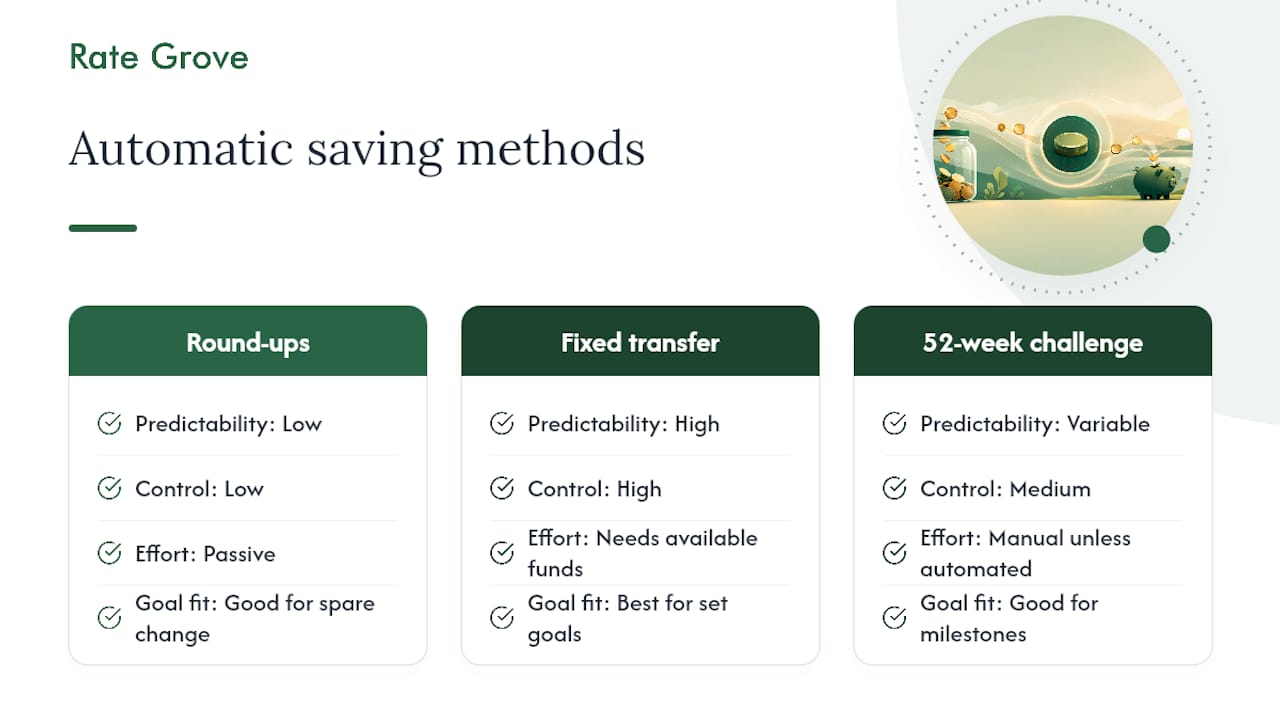
Fixed automatic transfers move a set amount, say $50, from checking to savings on a schedule you choose, typically each payday. Unlike round-ups, the amount is predictable and entirely within your control, which makes fixed transfers better suited to funding a defined goal like a $1,000 emergency fund by year’s end. The tradeoff is that fixed transfers require you to actually have that $50 available, whereas round-ups only ever pull spare change you likely wouldn’t have noticed spending.
Savings challenges, like the classic 52-week challenge where you save an increasing amount each week, build discipline through visible milestones but require you to remember to make each deposit manually unless you automate it separately.
The strongest approach usually isn’t choosing one method. It’s layering them: round-ups handle the passive, invisible savings, a fixed transfer guarantees a baseline amount every month, and an occasional challenge adds motivation during a specific stretch. Our guide on moving money from checking to savings strategically walks through how to combine these without overcomplicating your budget.
Does Round-Up Saving Change How You Spend?
Round-up savings accounts are designed to be invisible, and for most people, that’s exactly the point. You don’t feel the $0.65 taken from a $4.35 purchase the way you’d feel a manual $50 transfer, which is precisely why the habit sticks.
That invisibility cuts both ways, though. Because round-ups don’t show up as a distinct budget line, some people lose track of how much they’re actually saving, or mistakenly assume their checking balance reflects more spending power than it does. If your checking account runs close to $0, small round-up debits can occasionally tip you toward an overdraft you didn’t see coming.
On the positive side, round-ups can quietly nudge spending behavior over time. Watching a savings balance climb, even by small amounts, tends to reinforce saving as a default rather than an afterthought. Some users report becoming more conscious of discretionary purchases once they see round-ups accumulating, even though the mechanism itself doesn’t require any behavior change to function. The net effect for most beginners is a mild, positive shift in savings awareness with minimal disruption to daily spending.
Keeping Your Linked Accounts and Cards Secure
Enrolling in round-up savings almost always means giving a bank, credit union, or app read or transfer access to a checking account or card. That access is generally safe when you’re working with an established, insured institution, but it’s worth understanding what you’re authorizing.
Bank and credit union round-up programs typically operate entirely within their own systems, since your checking and savings accounts already sit with the same institution. Fintech apps are different: they connect to your external bank account through a linking process, often using a third-party aggregator, which means you’re extending trust to an additional company beyond your bank.
Before linking anything, confirm the app uses encrypted, read-only connections rather than storing your actual bank login credentials. Enable two-factor authentication wherever it’s offered, and review permissions periodically, since some apps request broader account access than the round-up feature actually needs. For general guidance on moving money safely between linked accounts, this explainer on safe money transfers covers practices worth following regardless of which provider you choose.

Also check whether the provider discloses its data-sharing practices, particularly if round-ups are handled by an investment platform rather than your bank directly. Confirm deposit insurance status before you link a debit card. If a provider’s disclosures don’t clearly state whether funds are FDIC or NCUA insured, that’s a sign to ask more questions before enrolling.
Rate Grove’s Take on Round-Up Savings Accounts
Rate Grove checks round-up features the same way we check any savings product: monthly, against issuer and regulator disclosures, not marketing pages. That means confirming whether a program deposits your spare change into an FDIC or NCUA insured account or routes it into an investment custodian instead, since that distinction changes both your risk and your tax paperwork.
Our comparison tools let you filter savings accounts by APY, fees, and insurance status side by side, so you’re not stuck reading a dozen separate disclosure pages to find a round-up program that actually fits your goals. If you’re weighing a bank-based option against a fintech app, start there before you link a single card.
— Mat C.
Where to Verify Round-Up Account Details
- FDIC — confirm deposit insurance on bank-based round-up accounts.
- NCUA / MyCreditUnion.gov — confirm insurance for credit union round-up programs.
- Experian’s round-up savings explainer and SoFi’s round-up guide for plain-language mechanics.
- Acorns’ Round-Ups® page for a fintech-based example.
- Rate Grove to compare savings accounts by APY, fees, and insurance status.
This article is general information, not a substitute for advice from a qualified financial advisor. Consult a qualified financial professional about your own circumstances before acting on anything here.