

Pick I Bonds when inflation protection and shielding interest from state tax matter most. Pick CDs when you need to invest more than $10,000 a year, want a guaranteed fixed rate you can count on, or need a specific maturity date for a near-term goal. The two products solve different problems, and the right answer usually depends on how much you’re saving and how soon you’ll need it.
Here’s what actually decides the choice:
- Rate structure: I Bonds pay a composite rate (fixed rate plus inflation rate) that resets every six months through TreasuryDirect; CDs lock in one fixed APY for the entire term.
- Purchase limits: I Bonds cap electronic purchases at $10,000 per Social Security Number per year; CDs have no federal limit, though FDIC insurance caps how much is protected per bank.
- Liquidity: I Bonds can’t be touched for 12 months and carry a penalty through year five; CD penalties vary but hit immediately if you break the term early.
If inflation protection or state-tax savings is your priority, buy up to the I Bond limit first, then park any excess in CDs or a CD ladder for guaranteed, predictable returns.
Key Takeaways
The right choice between an I Bond and a CD comes down to your savings amount, your time horizon, and whether inflation protection or a guaranteed fixed rate matters more to you.
| Point | Details |
|---|---|
| Check the purchase cap | I Bonds max out at $10,000 electronically per Social Security Number each year. |
| Expect a 12-month lockup | I Bonds cannot be redeemed at all during the first year after purchase. |
| Compare after-tax yield | I Bond interest skips state and local tax; CD interest is taxable everywhere. |
| Match term to timeline | Use CD ladders for known dates like tuition; use I Bonds for long-term inflation protection. |
| Shop CDs before committing | Rate Grove compares verified CD APYs and FDIC/NCUA status side by side to help you find the strongest fixed rate for your term. |
Table of Contents
- I Bonds vs CDs: A Side-by-Side Comparison
- How Does the I Bond Rate Actually Work?
- What Makes a CD Different From an I Bond?
- Which One Wins on Taxes and Safety?
- How Liquid Is Your Money, Really?
- Which Product Fits Your Situation?
- How Do You Buy Each One?
- How We Verified These Rates and Rules
- A Straight Take on Combining Both
- Compare CD Rates Before You Lock One In
- Frequently Asked Questions
- Sources
I Bonds vs CDs: A Side-by-Side Comparison
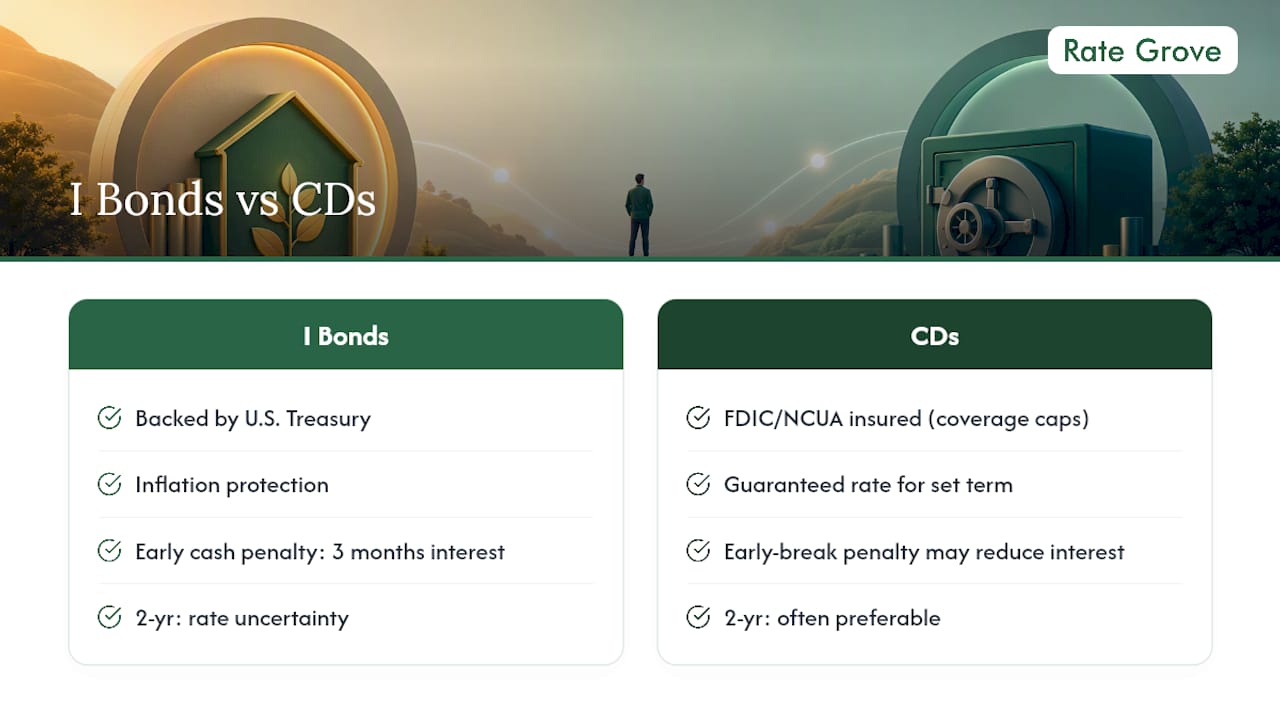
| Dimension | I Bonds | CDs |
|---|---|---|
| Interest structure | Composite rate: fixed + inflation, resets every 6 months | Fixed APY for the full term |
| Rate predictability | Low after the first 6 months; depends on future CPI | High; rate is locked at purchase |
| Purchase limits | $10,000 electronic annual limit per SSN | No federal cap; FDIC insures up to applicable limits per bank |
| Liquidity/penalties | Locked 12 months; lose 3 months’ interest if cashed before 5 years | Early withdrawal usually costs several months of interest |
| Safety/guarantor | U.S. Treasury | FDIC or NCUA insurance |
| Tax treatment | Exempt from state/local tax; federal tax deferrable | Fully taxable at federal, state, and local levels |
| Where to buy | TreasuryDirect only | Banks, credit unions, brokerages |
| Best for | Inflation protection, tax-sensitive savers, long horizons | Large sums, fixed terms, predictable planning |
Pro Tip: If you’re sitting on more cash than the I Bond limit allows, don’t force it all into one bucket. Buy your $10,000 in I Bonds each year, then build a CD ladder with the rest so you’re not relying on a single rate bet.
How Does the I Bond Rate Actually Work?
I Bonds earn a composite rate built from two pieces: a fixed rate that stays with the bond for its full 30-year life, and an inflation rate tied to CPI that resets every May 1 and November 1. Interest compounds semiannually, so each new six-month rate applies to a slightly larger balance than the last.
You buy I Bonds electronically through TreasuryDirect, and the annual limit is $10,000 per Social Security Number. There’s no minimum denomination barrier to worry about since purchases can be made in any amount up to a cent.
Redemption comes with real strings attached. You can’t cash out during the first 12 months at all, and if you redeem anytime in the first five years, you forfeit the last three months of interest.
The tradeoff in plain numbers: hold for a year minimum, and expect to give up three months of earnings if you need the cash before year five.
- Pro: Inflation-adjusted return that historically keeps pace with rising prices.
- Pro: Interest exempt from state and local tax, which matters a lot in high-tax states.
- Con: Annual purchase cap makes I Bonds useless for parking large windfalls.
- Con: You can’t access the money at all for a full year.
What Makes a CD Different From an I Bond?
A certificate of deposit is a time deposit issued by a bank or credit union that pays a fixed rate for a set term, with an early-withdrawal penalty built in if you break the agreement.
CDs come in more flavors than most savers realize:
- Standard-term CDs: Fixed APY for a set period, typically 3 to 60 months.
- No-penalty CDs: Slightly lower rate in exchange for the right to withdraw early without a fee.
- Brokered CDs: Purchased through a brokerage account, giving access to rates from banks nationwide in one place.
- Jumbo CDs: Require a larger minimum deposit, often $100,000, sometimes with a modest rate bump.
CDs held at a bank are protected by FDIC deposit insurance up to the applicable limits per depositor, per institution, per ownership category. Credit union deposits get comparable protection through the NCUA. That coverage cap is the reason savers with six-figure balances often split money across multiple institutions instead of stacking it all in one CD.
Term length shapes both your rate and your flexibility. A 3-month CD gives you quick access but usually a lower yield; a 60-month CD often pays more but locks your cash away far longer.

Which One Wins on Taxes and Safety?
The tax gap between these two products is bigger than most people expect:
- I Bond interest is exempt from state and local income tax, and you can defer federal tax until you redeem the bond or it matures. Certain education expenses may qualify for an additional federal exclusion.
- CD interest is taxable at the federal, state, and local level every year it’s earned, whether you touch the money or not.
For a saver in a high-tax state, that state exemption can make an I Bond’s after-tax yield beat a CD paying a similar headline rate.
On safety, both products are about as solid as fixed income gets. I Bonds carry the full backing of the U.S. Treasury. CDs rely on FDIC or NCUA insurance, which protects your principal and accrued interest only up to the coverage limit per bank, per ownership category, so large deposits need to be spread across institutions to stay fully insured.
How Liquid Is Your Money, Really?
Access to cash is where these two products diverge the most:
- Months 0 to 12: I Bonds cannot be redeemed at all, no exceptions.
- Months 13 to 60: I Bonds are redeemable but you lose the last three months of interest.
- After 5 years: I Bonds redeem with no penalty at all.
- CDs, any term: Early withdrawal typically costs several months of interest, and the exact penalty depends on the institution and term length.
Break a 5-year CD in year one, and depending on the bank’s penalty schedule, you could lose enough interest to dip into your original principal. Brokered CDs add another wrinkle: selling one before maturity means selling on the secondary market, where price depends on where rates have moved since you bought.
Pro Tip: If you think you might need part of your money early, skip the long-term CD altogether. A no-penalty CD or a short ladder gives you flexibility without giving up much yield.
Which Product Fits Your Situation?
- Saving for college in 3 to 5 years: A CD ladder matching your timeline gives predictable, guaranteed growth without the I Bond’s 12-month lockup risk.
- Parking $100,000 for two years: CDs win by default since I Bonds cap you at $10,000 annually per SSN; a brokered CD or jumbo CD handles scale better.
- Protecting purchasing power during high inflation: I Bonds are built for exactly this, since the inflation component can outpace fixed-rate products when CPI runs hot.
- Building a laddered income stream: Combine both. Max out I Bonds annually for the tax-free layer, then ladder CDs across 1, 2, and 3-year terms for the rest.
Quick after-tax math: a 4.5% CD in a state with a 6% income tax rate nets roughly 4.23% after state tax. An I Bond earning the same 4.5% composite rate keeps the full 4.5% since it’s state-tax exempt, a gap that widens further in states with even higher rates.
How Do You Buy Each One?
Buying I Bonds:
- Create a free account on TreasuryDirect.
- Link your bank account for funding.
- Buy any amount up to the $10,000 annual cap, ideally right after a May 1 or November 1 rate announcement so you know your fixed rate up front.
Shopping for CDs:
- Compare APY, term length, and early-withdrawal penalty across institutions.
- Confirm FDIC or NCUA coverage before depositing.
- Consider a brokered CD if you’re placing a large sum across multiple issuers.
Check live I Bond rates directly on TreasuryDirect, and compare current CD APYs through Rate Grove or another rate aggregator before locking in a term.
How We Verified These Rates and Rules
Rate Grove cross-checked every rule in this comparison against TreasuryDirect, FDIC.gov, and Investor.gov, the primary sources that govern I Bond and CD terms. Rates and program rules were snapshotted as of early 2026. Because I Bond composite rates reset every May 1 and November 1, always confirm the current rate on TreasuryDirect before buying.
A Straight Take on Combining Both
Maxing out I Bonds before touching CDs isn’t a controversial move, it’s just math: the state-tax exemption and inflation protection are hard to beat for the first $10,000. Beyond that cap, CDs do the heavy lifting.
Warning: Don’t assume the fixed rate you locked in on May 1 will still look good by November. Check TreasuryDirect’s rate announcements twice a year so you’re not caught off guard.
Compare CD Rates Before You Lock One In
Once you’ve maxed out your I Bond allocation for the year, the next decision is where to put the rest, and that’s where rate shopping actually pays off. Rate Grove’s CD comparison pulls verified APYs, terms, and FDIC or NCUA status side by side, so you’re not digging through a dozen bank websites to find the best fixed rate for your term.
This isn’t a sales pitch dressed up as advice; Rate Grove earns a commission when readers open accounts through some of the partners listed, and that’s disclosed plainly on every page. What you get in exchange is a faster way to see which institution actually pays the most for your term and deposit size, verified against issuer and regulator data rather than stale marketing copy. Head to Rate Grove’s CD rate comparison to see current APYs across terms and confirm deposit insurance status before you commit a dollar.
Frequently Asked Questions
Are CDs safer than I Bonds? Both are considered extremely safe. I Bonds are backed by the U.S. Treasury with no coverage limit, while CDs rely on FDIC or NCUA insurance that caps protection per depositor, per bank. For amounts within FDIC limits, the two are comparably secure.
What’s the best investment: I Bonds or CDs? Neither wins universally. I Bonds are stronger for inflation protection and tax-sensitive savers investing $10,000 or less annually; CDs work better for larger sums or when you need a guaranteed rate for a specific date.
Can I lose money with an I Bond or a CD? You won’t lose principal with either if held to term, but redeeming an I Bond before five years costs three months of interest, and breaking a CD early can cost enough interest to eat into principal depending on the penalty.
How do I bonds compare to certificates of deposit for a two-year goal? For a two-year goal, a CD often makes more sense since I Bonds carry rate uncertainty after the first six months and a stricter early-redemption penalty structure within that window.
Can I buy I Bonds and CDs at the same time? Yes, and many savers do exactly that: maxing out the $10,000 annual I Bond limit for the tax and inflation benefits, then placing additional savings into CDs for guaranteed returns on larger balances.
This article is general information, not a substitute for advice from a qualified financial advisor. Consult a qualified financial professional about your own circumstances before acting on anything here.