

The standard FDIC insurance limit is $250,000 per depositor, per insured bank, per ownership category. If you have more than that at one bank, you can often expand your coverage well beyond $250,000 by spreading funds across ownership categories, using separately chartered banks, or setting up a trust account correctly. The EDIE calculator can confirm your exact coverage in minutes, and it’s worth running today if your balance is anywhere near that line.
TL;DR:
- Combining multiple accounts owned by the same person at one bank does not increase FDIC coverage beyond $250,000 per ownership category.
- Using ownership categories like joint accounts, retirement accounts, and trusts can effectively maximize insured funds beyond the basic limit.
- Proper record-keeping, account titling, and verifying ownership details ensure accurate calculation of insured deposits using the EDIE tool.
- FDIC insurance does not cover investments or financial products like stocks, bonds, annuities, or crypto assets held through banks.
Table of Contents
- What the FDIC Insurance Limits Actually Mean
- Ownership Categories: Where Real Coverage Gets Created
- Trust Accounts and the 2024 Rule Change You Need to Know
- How to Protect Deposits Above $250,000
- What FDIC Insurance Does Not Cover
- How to Check Your Coverage Right Now
- Quick Checklist: Protect Your Deposits in Under 10 Minutes
- The Perspective Most Depositors Miss
- Compare FDIC-Insured Accounts Without the Guesswork
- Sources
- FAQ
What the FDIC Insurance Limits Actually Mean
That $250,000 figure isn’t a per-account number. It’s a per-depositor, per-bank, per-ownership-category number, which is why two people can hold the same amount of money at the same bank and end up with completely different coverage.
Here’s how the FDIC calculates it: if you have a checking account and a savings account, both titled solely in your name, at the same bank, the FDIC adds them together. Combined, they’re capped at $250,000. Open a third solo account at that same bank, and it still gets folded into the same $250,000 bucket.
Coverage includes your principal plus any interest earned up to the date the bank closes, so you’re not shortchanged by timing. And you never have to sign up for this protection. Deposit insurance is automatic the moment you open an account at an FDIC-insured institution. No application, no fee, no fine print to initial.
Ownership Categories: Where Real Coverage Gets Created
Ownership categories are the mechanism that lets you legitimately hold more than $250,000 at one bank and still have every dollar insured. Each category is treated as a separate depositor for insurance purposes, so the limits stack instead of overlapping.
The main categories the FDIC recognizes include:
- Single accounts: owned by one person, no beneficiaries. Capped at $250,000 total across all your solo accounts at that bank.
- Joint accounts: owned by two or more people with equal rights. Each co-owner gets $250,000 of coverage on the joint balance.
- Certain retirement accounts (including traditional and Roth IRAs): insured separately from your regular deposits, up to $250,000.
- Revocable trust accounts: covered under a formula tied to the number of beneficiaries (more on that below).
- Corporate, partnership, and unincorporated association accounts: insured up to $250,000 per entity, separate from the owners’ personal accounts.
- Government accounts: covered under their own rules, often with higher limits for public deposits.
- Employee benefit plan accounts: insured based on each participant’s vested interest.
A single person with a $250,000 checking account and a $250,000 IRA at the same bank has $500,000 fully insured, because retirement accounts sit in their own category. But renaming an account “vacation fund” or “emergency savings” does nothing. The FDIC looks at legal ownership and titling on the bank’s own records, not the nickname on your online banking dashboard.
Trust Accounts and the 2024 Rule Change You Need to Know
Trust accounts use a formula, not a flat number: multiply the number of owners by the number of eligible beneficiaries, then multiply by $250,000. That’s how a modest household trust can end up covering seven figures at a single bank.
But there’s a ceiling. Since April 1, 2024, trust owners with five or more beneficiaries are capped at $1,250,000 per owner, no matter how many additional beneficiaries get named. Before that date, the math scaled with no upper bound, so a trust with ten beneficiaries could theoretically claim $2.5 million in coverage. Not anymore.

Here’s the formula in action. One owner names three eligible beneficiaries on a revocable trust account: 1 owner × 3 beneficiaries × $250,000 = $750,000 in coverage, no cap issue since it’s under five beneficiaries.
Two pitfalls trip people up constantly. First, duplicate beneficiaries named across multiple trust documents at the same bank can get counted only once, not stacked. Second, missing or outdated beneficiary records at the bank mean the FDIC has no way to verify who’s covered, which can delay or shrink a payout after a bank failure.
How to Protect Deposits Above $250,000
Expanding coverage is straightforward once you know the mechanics. It just takes some organization and a few honest conversations with your bank.
- Inventory everything first. List every account, the exact legal titling, every beneficiary name, and the current balance. Sloppy records are the number one reason depositors lose track of what’s actually covered.
- Run EDIE with real numbers. Plug in your account titles, ownership categories, and beneficiary details exactly as they appear on your bank’s records, not from memory.
- Restructure if you’re over the line. If EDIE shows uninsured funds, open accounts in a different ownership category (like moving cash into a jointly titled account) or move the excess to a separately chartered FDIC-insured bank.
Timing matters more than people expect. If you’re retitling accounts or opening new ones, confirm the changes have posted with your bank before you consider the coverage gap closed.
Pro Tip: Keep a dated printout or screenshot of your EDIE results alongside your account statements. If your bank ever fails, having your own coverage calculation on hand speeds up the claims conversation considerably.
For larger estates or business structures, a quick conversation with a tax or estate attorney before you restructure accounts can save you from a titling mistake that undoes the coverage you were trying to build.
What FDIC Insurance Does Not Cover
FDIC insurance protects deposits. It does not protect investments, even when a bank sells them to you across the same lobby counter where you opened your savings account.
Products explicitly excluded from coverage include:
- Stocks, bonds, and mutual funds
- Annuities
- Life insurance policies
- Municipal securities
- Safe-deposit box contents (theft or damage isn’t an FDIC matter)
- Crypto assets held through a bank’s platform
The distinction comes down to risk. A savings account is a deposit with a guaranteed return of your principal. A mutual fund sold at the same branch is an investment that can lose value, and no federal deposit insurance program covers that downside. If you hold brokerage investments, look into whether they’re protected by SIPC, or ask your insurer directly about coverage on annuities and life policies. Those are separate systems with separate rules.
How to Check Your Coverage Right Now
You can confirm your exact coverage in less than fifteen minutes, and there’s no reason to guess when the tools are free and official.
Start with EDIE. Gather your account titles exactly as they appear on statements, any beneficiary names on trust or retirement accounts, and current balances. Enter each account under the correct ownership category, and EDIE will show you precisely how much of your money is insured and how much, if any, sits exposed.
Next, confirm your institution is actually FDIC-insured using BankFind, the FDIC’s searchable database of insured banks. Look for the official FDIC sign posted at teller windows or on the bank’s website footer. If you’d rather talk to a person, call 1-877-ASK-FDIC.
Once you’ve confirmed coverage, save a copy of your EDIE results and note the date. Update it any time you open an account, add a beneficiary, or move a large sum.
Quick Checklist: Protect Your Deposits in Under 10 Minutes
Run through this before you assume your money is fully covered:
- Run EDIE with accurate titles, ownership categories, and beneficiary names.
- Confirm your bank’s FDIC status through BankFind and look for the official FDIC signage.
- If EDIE flags uninsured funds, split the balance across ownership categories or move it to a separately chartered insured bank.
- Document every account title and beneficiary designation, and store that record somewhere you’ll actually find it again.
The math adds up faster than most people expect. A single person with a solo checking account, a jointly titled savings account with a spouse, and a Roth IRA can insure well over $700,000 at one bank without touching a second institution, simply because each category gets its own $250,000 allotment.
The Perspective Most Depositors Miss
Most advice on FDIC coverage stops at “the limit is $250,000,” as if that’s the whole story. It isn’t. The real skill here isn’t memorizing a number. It’s understanding that the FDIC insures legal ownership structures, not your intentions or your account nicknames.
I’d argue the biggest blind spot for depositors isn’t ignorance of the $250,000 figure. It’s overconfidence about how their money is actually titled. People assume that because they opened five different savings accounts with different purposes in mind, they’ve automatically diversified their coverage. They haven’t. The bank’s system sees five accounts owned by one person in the same category, and the FDIC adds them together like a single ledger line.
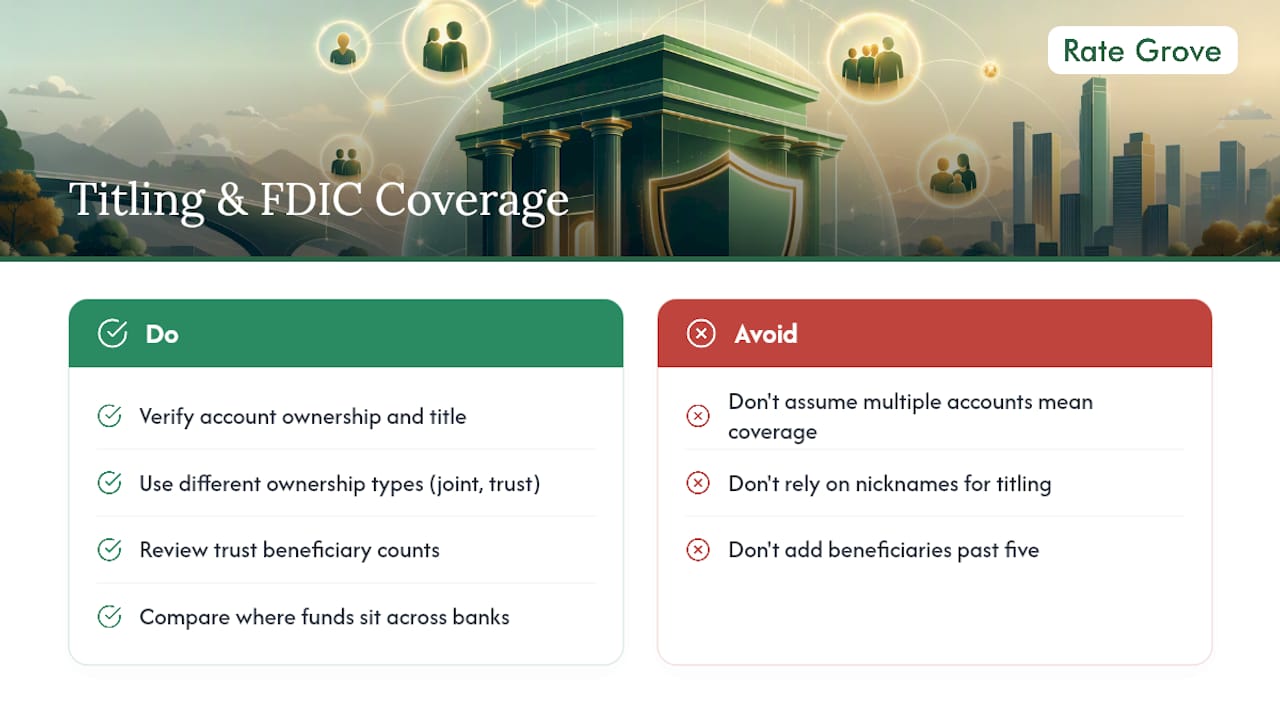
The 2024 trust rule change matters more than it’s gotten credit for, too. Naming a sixth or seventh beneficiary on a trust used to genuinely expand your insured total. Now it doesn’t, once you cross five names. That’s a real planning shift for anyone using trusts as a coverage-stretching tool, and it means the old advice to “just add more beneficiaries” is outdated.
We spend a lot of time helping people compare where their money actually sits, because the account you choose and how you title it both matter. Our guide on FDIC coverage for freelancers and our breakdown of NCUA versus FDIC protection both dig into scenarios this article doesn’t have room for.
— Mat C.
Compare FDIC-Insured Accounts Without the Guesswork
EDIE tells you how much of your money is insured. It won’t tell you which bank actually pays a competitive rate on the balance you’re trying to protect, and that’s the gap Rate Grove fills. We put side-by-side comparisons of rates, fees, and account terms in front of you, all pulled from verified issuer and regulator data, so splitting your deposits across banks doesn’t mean settling for a mediocre rate at the second one.

If your EDIE results show funds outside standard limits, that’s your cue to open an account at another insured bank instead of leaving cash sitting uninsured. Before you do, check Rate Grove’s account comparisons to see which banks currently offer the strongest rates on savings, CDs, and money market accounts. Our multi-account banking guide walks through how to structure accounts across institutions without losing track of what’s covered where.
This article is general information, not a substitute for advice from a qualified financial advisor. Consult a qualified financial professional about your own circumstances before acting on anything here.
Sources
FAQ
Is It Safe to Have More Than $250,000 in One Bank?
Yes, as long as the amount above $250,000 falls into a different ownership category, like a jointly titled account or a properly structured trust, since each category carries its own separate insurance limit.
Can I Be FDIC Insured With $1,000,000?
Yes. A revocable trust with one owner and five or more eligible beneficiaries is capped at $1,250,000 in coverage at a single bank under the April 1, 2024 trust rule. Combining ownership categories or using multiple banks can expand coverage further.
Is It Safe to Have $500,000 in One Bank?
It can be, if the funds are split across two qualifying ownership categories, such as $250,000 in a single account and $250,000 in a jointly owned account, each insured separately.
How Do I Insure $2 Million in the Bank?
Spread the balance across multiple ownership categories, a trust structured under the FDIC’s beneficiary formula, and separately chartered FDIC-insured banks, then confirm the exact breakdown using EDIE before you move a dollar.