

FDIC deposit insurance protects your deposited business and personal cash dollar-for-dollar up to the Standard Maximum Deposit Insurance Amount (SMDIA) of $250,000 per depositor, per insured bank, per ownership category, if an insured bank fails. That single rule is the foundation of freelance financial protection in the U.S. Here is what you need to do right now:
- Confirm your bank is FDIC-insured at BankFind Suite before depositing large sums.
- Use EDIE, the FDIC’s Electronic Deposit Insurance Estimator, to calculate exactly how much of your balance is covered across all your accounts.
- Split funds or change ownership categories if any single bank holds more than $250,000 of your money in the same category.
$250,000 is the SMDIA — the maximum the FDIC will pay per depositor, per insured bank, per ownership category if a bank closes.
Key Takeaways
FDIC deposit insurance covers your bank deposits up to $250,000 per depositor, per insured bank, per ownership category, and freelancers who use multiple banks and ownership categories can protect significantly more.
| Point | Details |
|---|---|
| SMDIA is $250,000 | Coverage applies per depositor, per insured bank, per ownership category — not as a flat total across all banks. |
| Use EDIE to verify | Run the FDIC’s free EDIE calculator whenever your balance at one bank approaches $200,000. |
| Ownership categories expand coverage | Single, joint, retirement, and business accounts each carry a separate $250,000 limit at the same bank. |
| Non-deposit products are not covered | Stocks, mutual funds, crypto, and annuities held at a bank are not FDIC-insured — only deposit accounts are. |
| Rate Grove simplifies account comparison | Rate Grove’s side-by-side tools help you find FDIC-insured high-yield savings and checking accounts to build a protected multi-bank setup. |
Table of Contents
- How do the benefits of FDIC coverage work for freelancers?
- What does FDIC cover, and what trips up freelancers?
- Why ownership categories can multiply your FDIC protection
- Practical ways to protect more than $250,000 as a freelancer
- How to calculate your FDIC coverage using EDIE
- What happens to your money if your bank fails?
- How to confirm a bank is FDIC-insured before you deposit
- Why I treat FDIC coverage as an operational control, not a one-time checkbox
- Rate Grove helps you find the right FDIC-insured accounts fast
- Sources
How do the benefits of FDIC coverage work for freelancers?
The Federal Deposit Insurance Corporation is an independent U.S. government agency. Its backing carries the full faith and credit of the United States government, which means your insured deposits are guaranteed by the federal government itself, not just by the bank holding your money.
When a bank fails and regulators close it, the FDIC steps in as receiver. It pays insured depositors dollar-for-dollar up to the SMDIA, covering both principal and accrued interest through the date of the bank’s closing. Per the Your Insured Deposits guide, that limit is $250,000 per depositor, per insured bank, per ownership category.
The phrase “per insured bank” is where freelancers gain real flexibility. Two CDs totaling $400,000 split evenly between two separate FDIC-insured banks are fully covered: $200,000 at Bank A and $200,000 at Bank B. Put both CDs at the same bank under the same ownership category and only $250,000 is insured. The remaining $150,000 sits unprotected.
Coverage includes principal plus accrued interest through the bank’s closing date — not just the balance you deposited.
That distinction matters for freelancers who park tax reserves in certificates of deposit. The interest you have earned but not yet received is also insured, up to the limit.
What does FDIC cover, and what trips up freelancers?
FDIC deposit insurance covers specific deposit products held at insured institutions. Knowing the line between covered and non-covered is one of the most practical freelancer banking tips you can carry.
Covered deposit products:
- Checking accounts
- Savings accounts
- Money market deposit accounts (MMDAs)
- Certificates of deposit (CDs)
- Negotiable Order of Withdrawal (NOW) accounts
Not covered — and this is where freelancers often get caught:
- Stocks, bonds, and mutual funds
- Cryptocurrency assets
- Annuities and life insurance policies
- Safe-deposit box contents
- Brokerage sweep accounts that move into non-deposit investment products
The FDIC’s financial products not insured page catalogs every non-deposit product clearly. A common freelancer scenario: you hold a client retainer in a checking account (covered) and also keep a brokerage account at the same bank where idle cash sweeps into a money market fund (not covered). The fund is a security, not a deposit, and the FDIC does not protect it.
One more thing to understand: FDIC insurance protects your deposits at the bank level. If you use a fintech app that holds your money at a partner bank, the FDIC sticker on the app does not automatically protect you from the fintech’s own operational failures. The underlying insured bank is what matters, not the app sitting on top of it.
Why ownership categories can multiply your FDIC protection
The FDIC does not just look at your name. It aggregates all deposits you hold in the same ownership category at the same bank and applies the $250,000 limit to that total. Change the ownership category, and you get a separate $250,000 limit. The Employee’s Guide to Deposit Insurance references 12 C.F.R. Part 330 and lists 12 recognized ownership categories.
For a typical freelancer, the most relevant categories are:
- Single/individual accounts — accounts titled in your name alone
- Joint accounts — accounts with two or more co-owners (each co-owner gets $250,000 of coverage on their share)
- Certain retirement accounts — IRAs and other qualifying retirement deposits at an insured bank
- Business/organization accounts — accounts held by a corporation, LLC, partnership, or unincorporated association engaged in an independent activity
Sole proprietor vs. LLC: a real difference
A sole proprietor with a DBA (doing business as) name does not automatically get a separate business ownership category. The FDIC treats those funds as single-account deposits under your personal name. An LLC, by contrast, can qualify for the business/organization category, giving you a separate $250,000 limit on top of your personal accounts.

The catch: the LLC must be a validly formed entity engaged in an independent activity. A shell entity created solely to manufacture extra FDIC coverage does not qualify. The business must have genuine operational purpose.
Pro Tip: Title your accounts correctly from day one. An LLC account titled in your personal name instead of the entity’s legal name may be treated as a single-account deposit, collapsing your separate coverage. Check account titles and beneficiary designations at least once a year.
Practical ways to protect more than $250,000 as a freelancer
Most freelancers do not need to protect $250,000 at any single moment, but tax reserves, project retainers, and operating cash can stack up fast. Here are concrete tactics to keep your money covered.
Step-by-step tactics
- Spread balances across multiple FDIC-insured banks. Each bank gives you a fresh $250,000 limit per ownership category. A freelancer with $350,000 in operating cash can keep $250,000 at Bank A and $100,000 at Bank B, fully covered.
- Use joint accounts where appropriate. Adding a spouse or business partner as a co-owner on a joint account gives each co-owner up to $250,000 of coverage on their share, effectively doubling the insured amount at one bank.
- Open a properly structured business account if you have an LLC. Meet the independent-activity requirement, title the account in the entity’s legal name, and you gain a separate $250,000 limit on top of your personal accounts.
- Consider an insured cash sweep (ICS) program. Some banks and credit unions offer ICS, which automatically distributes your deposits across multiple FDIC-insured institutions behind a single account portal. This can extend coverage well beyond $250,000 without you managing multiple logins. The tradeoff: a fintech middleware layer adds operational complexity, and FDIC insurance protects against bank failure, not against a fintech service outage that locks your access.
Three worked examples
- Example A — Solo freelancer with $300,000: Keep $250,000 in a checking account at Bank A (single-account category, fully covered). Move the remaining $50,000 to a high-yield savings account at Bank B (also fully covered). Total insured: $300,000.
- Example B — Freelancer with an LLC: Personal checking at Bank A holds $200,000 (single-account category). LLC operating account at Bank A holds $150,000 (business/organization category). Both are fully covered at the same bank because they sit in different ownership categories.
- Example C — Tax reserve strategy: Deposit operating cash in a fee-free checking account at your primary bank. Park your quarterly tax reserve in a separate high-yield savings account at a second FDIC-insured bank. You earn more interest on idle reserves and stay within coverage limits at both institutions.
Pro Tip: Keep at least one backup account at a different bank with enough to cover two weeks of operating expenses. If your primary bank experiences a disruption, you can keep paying vendors and contractors without waiting for FDIC resolution.
A multi-account banking strategy does not have to be complicated. The goal is simple separation: operating cash, tax reserves, and emergency funds each at a different insured institution.
How to calculate your FDIC coverage using EDIE
The EDIE calculator is the FDIC’s official tool for depositors to calculate coverage across accounts, banks, and ownership categories. It takes about five minutes to run a full picture of your insured balances.
How to use EDIE:
- Go to edie.fdic.gov and select “Start EDIE.”
- Enter the bank name and confirm it is FDIC-insured.
- Add each account: select the account type (checking, savings, CD, etc.), the ownership category (single, joint, retirement, business), and the current balance.
- Repeat for each bank where you hold deposits.
- Review the summary — EDIE shows how much of each account is insured and how much, if any, exceeds the limit.
Worked example 1: multiple single-name accounts at one bank
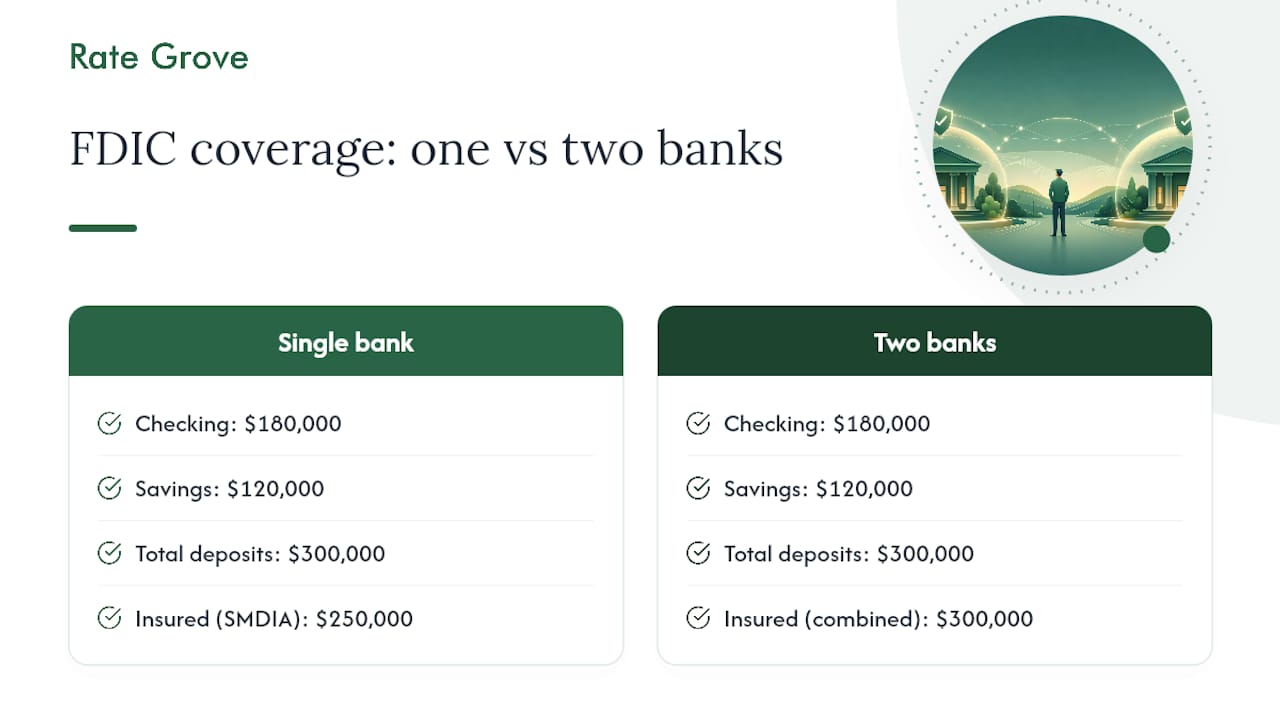
You have a checking account ($180,000) and a savings account ($120,000) at the same bank, both in your name alone. EDIE aggregates them: $300,000 in the single-account category at one bank. The SMDIA is $250,000, so $50,000 is uninsured. Moving $50,000 to a second FDIC-insured bank fixes this entirely.
Worked example 2: accounts across two banks
You have $200,000 in a checking account at Bank A and a $150,000 CD at Bank B, both single-name. EDIE treats each bank separately. Bank A: $200,000 insured (under the $250,000 limit). Bank B: $150,000 insured (also under the limit). Total insured: $350,000. No gap.
Save or print your EDIE output and store it with your financial records. If your account structure changes, run EDIE again. If EDIE cannot match your specific account structure, call 1-877-ASK-FDIC (1-877-275-3342) for direct assistance.
What happens to your money if your bank fails?
Bank failures are rare, but they do happen. Knowing the FDIC’s process keeps you from panicking and helps you plan for continuity.
When federal or state regulators close an insured bank, the FDIC takes over as receiver. The standard resolution method is a purchase-and-assumption transaction: another bank acquires the failed bank’s deposits and assets. In most cases, you regain access to your insured funds by the next business day, often through the acquiring bank.
What to expect:
- The FDIC notifies depositors by mail and posts information on its website.
- Insured deposits (up to $250,000 per category) are available quickly, typically within one business day.
- Coverage includes principal plus accrued interest through the closing date.
- Uninsured amounts above the SMDIA become claims against the receivership and may be partially recovered over time, but there is no guarantee.
Freelancer action checklist before a failure ever happens:
- Maintain at least one backup account at a separate FDIC-insured bank with enough to cover two weeks of expenses.
- Keep records of all account titles, ownership categories, and balances.
- Have contingency plans for payroll and vendor payments if your primary account is temporarily inaccessible.
- Know your FDIC contact: 1-877-ASK-FDIC or visit fdic.gov for current bank-failure information.
The key risk for freelancers is not losing insured funds. It is the gap between a bank closing and when you can access your money. A backup account eliminates that gap.
How to confirm a bank is FDIC-insured before you deposit
Not every financial institution is FDIC-insured, and not every app that claims FDIC protection is straightforward about which bank actually holds your money.
The BankFind Suite is the FDIC’s official lookup tool. Enter the bank’s name or certificate number and confirm it appears as an active insured depository institution. This takes under a minute and is the single most reliable verification step.
What to check on a bank’s website or account disclosures:
- The official FDIC logo with the institution’s name
- The FDIC certificate number (usually in the “About” or legal disclosures section)
- The insured institution’s legal name matches the entity holding your deposit
Watch out for fintech layers. Many popular freelancer banking apps hold your deposits at a partner bank, not directly. The app may display an FDIC badge, but you need to confirm the name of the underlying insured depository institution. If the app’s terms of service do not clearly name the FDIC-insured bank, ask before depositing. Use the bank account comparison checklist to evaluate any account’s FDIC details before you commit.
Quick check: Search the bank’s legal name in BankFind Suite. If it does not appear as an active insured institution, your deposits there are not FDIC-protected.
Why I treat FDIC coverage as an operational control, not a one-time checkbox
Most freelancers check their FDIC coverage once, when they open an account, and never revisit it. That is the wrong approach. Your balances change every month. A big project payment, a tax reserve build-up, or a new LLC account can push you over the $250,000 limit without you noticing.
The smarter habit is to treat FDIC coverage like a quarterly business review item. Run EDIE whenever your total bank balance at any single institution approaches $200,000. Keep a simple spreadsheet: bank name, account type, ownership category, current balance, insured amount. Update it when you open a new account or receive a large payment.
Tax reserve separation is the single most underrated freelancer banking move. Keeping your quarterly tax reserve at a separate FDIC-insured bank does two things: it keeps the money out of reach when you are tempted to spend it, and it gives you a second insured institution automatically. Pair that with a high-yield savings account and your idle reserves earn more while staying fully protected.
The freelancers who get caught by bank failures or coverage gaps are almost always the ones who assumed their setup was fine. A 15-minute EDIE session once a quarter is the cheapest insurance review you will ever do.
Rate Grove helps you find the right FDIC-insured accounts fast
Finding FDIC-insured accounts with the best rates should not take hours of research across a dozen bank websites. Rate Grove’s comparison tools pull verified rate and fee data from issuers and regulators so you can see high-yield savings accounts, CDs, and checking options side by side, including FDIC details, in one place.
For freelancers building a multi-bank setup, Rate Grove makes it straightforward to compare accounts for your operating cash, your tax reserve, and your emergency fund at a glance. Monthly-updated guides mean you are always working with current rates, not figures from six months ago. Whether you are looking for the best CD rate for a short-term reserve or a fee-free checking account for daily operations, Rate Grove gives you the side-by-side view you need to decide quickly and confidently.
Visit Rate Grove to compare FDIC-insured accounts and find the rates that fit your freelance setup. Rate Grove is an informational and comparison service; always confirm account details directly with the issuing institution before opening.
Sources
These are the primary references for deposit insurance questions. Use them directly; they are the legal and regulatory standard.
When to call vs. when to read: For straightforward coverage questions, EDIE and the Your Insured Deposits brochure answer most scenarios. For complex account structures, multiple entities, or trust accounts, call 1-877-ASK-FDIC (1-877-275-3342) directly. For tax, legal, or entity-formation questions related to your banking structure, consult a qualified financial or legal advisor. FDIC materials are the primary regulatory reference for deposit insurance, but they do not substitute for professional advice on your specific situation.
This article is general information, not professional financial or legal advice. Confirm current coverage rules and account details with FDIC.gov or a qualified advisor before making banking decisions.
This article is general information, not a substitute for advice from a qualified financial advisor. Consult a qualified financial professional about your own circumstances before acting on anything here.