

A bank account comparison checklist is a structured evaluation tool that helps you identify accounts with the best combination of fees, interest rates, accessibility, and perks for your personal financial goals. Switching to the right account can save you $100 to $250 annually in fees alone, and on a $10,000 balance, choosing a high-yield savings account over a traditional bank can add $400 to $500 in annual interest. FDIC and NCUA insurance, APY rates, and fee structures are the three pillars every side-by-side bank account comparison must cover. This guide gives you a practical, step-by-step checklist to compare checking accounts, evaluate features, and switch banks without losing a dollar in the process.
1. What are the must-have criteria on a bank account comparison checklist?
A complete bank account comparison checklist covers seven core categories. Miss any one of them and you risk paying fees or earning less than you should.
- Monthly maintenance fees. Many banks waive these if you meet a minimum balance or set up direct deposit. Always confirm the exact waiver conditions before opening an account.
- APY on checking and savings. Traditional banks often pay near zero. Online banks frequently offer rates that are meaningfully higher. Check whether the advertised rate is a teaser or sustained rate, since some high-yield offers revert after 3–6 months.
- FDIC or NCUA insurance. FDIC and NCUA coverage protects deposits up to $250,000 per depositor per institution. Verify this before depositing a single dollar.
- ATM access and fees. A bank with a small ATM network can cost you $3 to $5 per out-of-network withdrawal. Look for accounts that reimburse ATM fees or belong to large surcharge-free networks like Allpoint or MoneyPass.
- Minimum balance requirements. Some accounts charge fees or reduce your APY if your balance drops below a threshold. Know the floor before you commit.
- Sign-up bonuses. Banks regularly offer $100 to $300 in new customer bonuses with qualifying direct deposits, and some high-balance bonuses reach $500 or more. Read the fine print on qualifying periods and deposit minimums.
- Overdraft and transaction fees. Overdraft fees average around $35 per incident at many traditional banks. Look for accounts with overdraft protection, grace periods, or no overdraft fees at all.
Pro Tip: Before you compare a single rate, write down your top three priorities. Fee-free ATM access, mobile app quality, and APY are the most common starting points. Ranking your priorities first makes every other comparison faster and more accurate.
2. How do different bank account features impact your financial growth?

Features beyond the basic fee structure shape how convenient and profitable your account actually is day to day. A bank that looks great on paper can frustrate you if its app crashes every time you need to transfer funds.
Mobile and online banking
A strong mobile app lets you deposit checks, transfer money, and pay bills without visiting a branch. Look for biometric login, real-time transaction alerts, and Zelle integration. If a bank’s app has consistently poor ratings in the App Store or Google Play, treat that as a red flag.
Branch and ATM network
Online banks typically offer higher APYs but have no physical branches. Brick-and-mortar banks offer in-person service but often pay lower rates. Your choice depends on how often you deposit cash or need face-to-face help. If you deposit cash regularly, a bank without branch access will create friction.
Cash deposit options
Not all banks accept cash deposits easily. Some online banks partner with retail locations like Walgreens or CVS for cash deposits, though fees may apply. Confirm the process and any associated costs before switching.
Customer service quality
Phone, chat, and in-branch support hours vary widely. A bank that only offers email support with 48-hour response times is a poor fit if you travel frequently or manage time-sensitive transactions.
Introductory versus sustainable APYs
Advertised APYs sometimes require high minimum balances or drop sharply after an introductory period of 3–6 months. Always ask: what is the ongoing rate after the promotional period ends? That number is the one that actually matters for long-term savings growth.
Direct deposit and automatic payment compatibility
Confirm that your new bank supports direct deposit from your employer’s payroll system. Also verify that recurring payments like rent, utilities, and subscriptions can link to the new account without delays.
3. How to compare personal bank accounts side by side
Organizing your comparison in a table prevents you from holding conflicting details in your head at once. A simple grid with your top three to five accounts across the top and your checklist criteria down the left side makes the differences obvious.
| Criteria | Account A | Account B | Account C |
|---|---|---|---|
| Monthly fee | $0 | $12 (waivable) | $0 |
| APY (savings) | 4.50% | 0.01% | 4.75% |
| ATM network | Allpoint (55,000+) | Proprietary (2,000) | MoneyPass (40,000+) |
| FDIC insured | Yes | Yes | Yes |
| Sign-up bonus | $200 | $300 | None |
| Overdraft fee | $0 | $35 | $0 |
| Mobile app rating | 4.8 stars | 3.9 stars | 4.6 stars |
Once you fill in the table, score each account against your personal priority list. If fee-free ATM access is your top priority, Account A or C wins immediately. If the sign-up bonus matters most, Account B’s $300 offer deserves a closer look despite its monthly fee.
Rate your criteria by weight, not just presence. An account that waives its monthly fee only if you maintain a $5,000 minimum balance is not truly free for most people. Understanding bank fee disclosures in detail prevents this kind of surprise.
Revisit your comparison table every 12 months. Banks adjust rates and fee structures regularly, and the account that was best in january may not be best by october.
Pro Tip: Save your completed comparison table as a PDF or spreadsheet. When you revisit it next year, you will have a baseline to measure changes against, rather than starting from scratch.
4. What steps should you take when switching banks?
How bank switching works is simpler than most people expect, but the order of steps matters. Skipping one can cause a missed payment or a bounced direct deposit.
- Gather your documents. Opening a new bank account requires a government-issued ID, your Social Security number, and proof of address. Having these ready means opening an account online takes 5–15 minutes.
- Open the new account and fund it. Most banks require an initial deposit of $25 to $100. Transfer enough to meet any minimum balance requirement and avoid early fees.
- List every automatic payment and direct deposit. Go through three months of bank statements. Write down every recurring charge: subscriptions, insurance, utilities, loan payments, and gym memberships.
- Update your direct deposit. Contact your employer’s payroll department and provide the new routing and account numbers. Allow one to two pay cycles for the change to take effect.
- Redirect automatic payments. Update each biller with your new account details. Do this before your next billing cycle to avoid failed payments.
- Maintain a 2–4 week overlap period. Keep your old account funded during this window to cover any payments that still process through the old account. This is the step most people skip, and it is the one that causes the most problems.
- Confirm all transactions have migrated. After one full pay cycle with no activity on the old account, you are ready to close it.
- Close the old account. Account closure is free at virtually all US banks. Call or visit a branch, request written confirmation of the closure, and keep that document for at least one year.
5. What hybrid banking strategies optimize convenience and savings?
The best bank account setup for most people is not a single account. There is no legal limit on the number of bank accounts you can hold, and using multiple accounts strategically gives you both access and growth.
A practical hybrid approach looks like this:
- Use a local brick-and-mortar bank or credit union for your primary checking account. This gives you easy cash deposits, in-person support, and a familiar ATM network.
- Hold your savings at an online bank with a high-yield savings account. Online banks consistently offer higher APYs because they carry lower overhead costs. The difference in savings rates between banks can be substantial over a 12-month period.
- Avoid fees by meeting each account’s waiver conditions separately. A direct deposit at your checking account and a minimum balance at your savings account can eliminate fees at both institutions simultaneously.
- Personalize based on your actual banking habits. If you rarely use cash, a fully online setup may work better. If you travel internationally, prioritize accounts with no foreign transaction fees and global ATM reimbursements.
The hidden cost of loyalty is real. Staying with one bank out of habit often means paying fees and earning lower interest than you would elsewhere. Regular comparison guards against that drift.
Key takeaways
A bank account comparison checklist covering fees, APY, FDIC insurance, ATM access, and switching steps is the most direct path to maximizing your savings and minimizing unnecessary costs in 2026.
| Point | Details |
|---|---|
| Verify FDIC or NCUA insurance first | Deposits are protected up to $250,000 per depositor per institution. |
| Compare sustained APYs, not teaser rates | Some advertised rates drop after 3–6 months; confirm the ongoing rate. |
| Use a side-by-side table | A comparison grid makes fee and feature differences immediately visible. |
| Maintain a 2–4 week overlap when switching | Keep your old account funded to prevent missed payments during migration. |
| Stack accounts for best results | Combine a local checking account with an online high-yield savings account. |
What I’ve learned from comparing bank accounts the hard way
The first time I switched banks, I closed my old account two days after opening the new one. A gym membership I had forgotten about tried to bill the closed account the following week. The resulting late fee cost more than a full month of the savings I was chasing. That experience taught me that the switching process is where most people lose money, not in the account selection itself.
The second thing I have learned is that most people compare accounts in the wrong order. They look at APY first, then fees. The smarter sequence is to verify FDIC or NCUA insurance, then eliminate accounts with unavoidable fees, then compare APYs among the survivors. Skipping the insurance check is rare but costly when it matters.
The third insight is about teaser rates. Banks advertise their highest possible rate, which often requires a minimum balance of $10,000 or more, or expires after six months. I now treat any advertised APY as a ceiling, not a floor, until I read the full terms.
Finally, revisit your accounts every year. Banks change their fee structures quietly. An account that was free in january can start charging $8 a month by july if you miss a policy update buried in an email. Set a calendar reminder and spend 20 minutes each year running your accounts through the same checklist you used to pick them.
— Mat C.
Rate Grove makes bank account comparison faster
Comparing bank accounts across multiple institutions takes time, especially when fee disclosures are buried in dense PDFs and rates change monthly. Rate Grove pulls verified data from issuer and regulator sites and presents it in a clean, side-by-side format so you can see fees, APYs, and bonuses without digging through fine print.
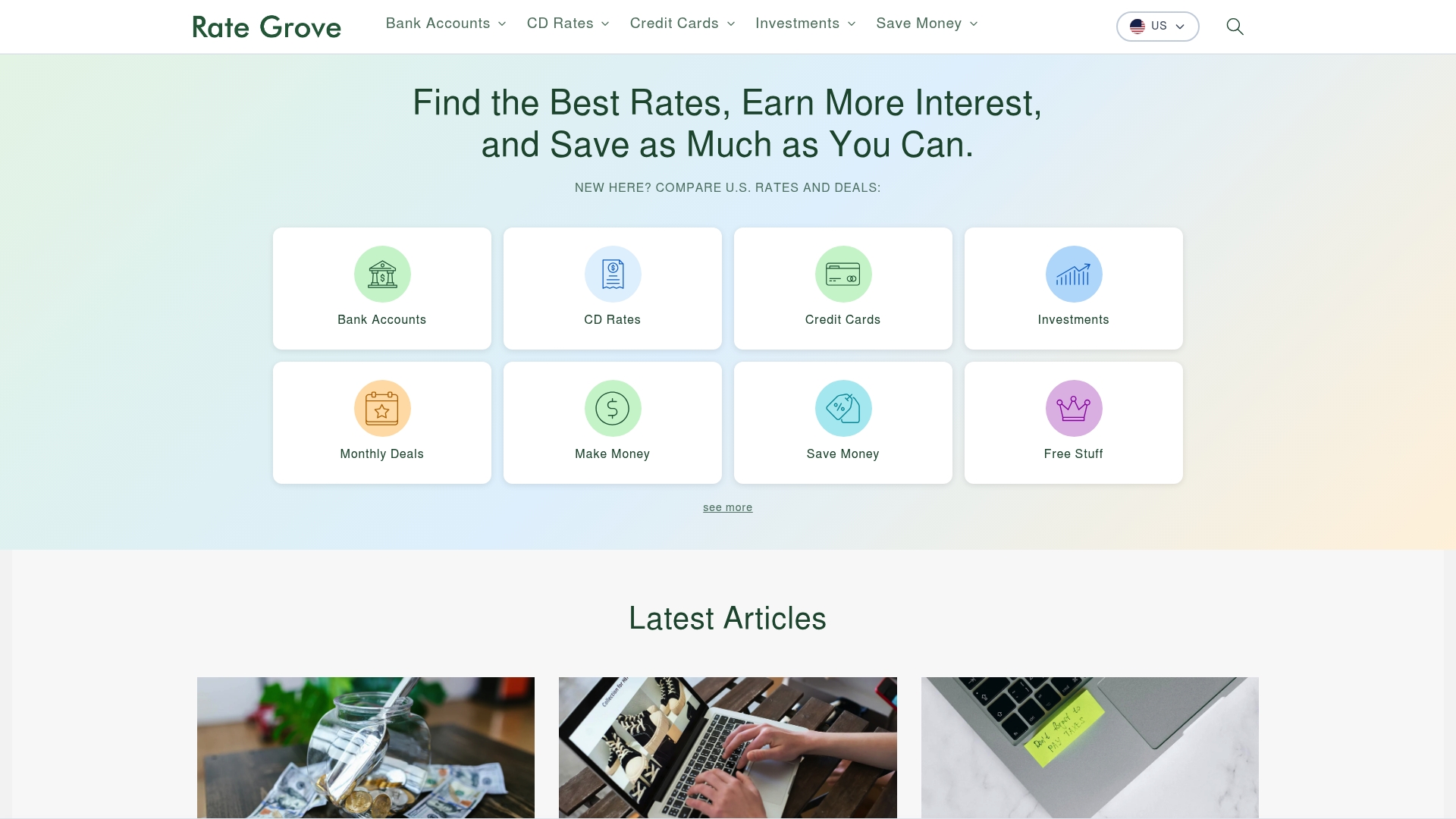
Whether you are looking to compare bank accounts and CD rates or evaluate credit card options alongside your banking setup, Rate Grove updates its guides monthly so the numbers you see reflect current offers. You get the full picture in one place, without the outdated information that makes most financial comparison sites frustrating to use.
FAQ
What is a bank account comparison checklist?
A bank account comparison checklist is a structured list of criteria, including fees, APY, FDIC insurance, ATM access, and overdraft policies, used to evaluate and rank bank accounts before opening one.
How much can switching banks actually save you?
Switching to a no-fee checking account saves $100 to $250 annually in fees, and choosing a high-yield savings account over a traditional bank can add $400 to $500 in annual interest on a $10,000 balance.
How long does it take to switch banks?
Opening a new account takes 5–15 minutes online. Fully migrating direct deposits and automatic payments takes 2–4 weeks, which is why maintaining an overlap period with your old account is critical.
Is it safe to have accounts at multiple banks?
Yes. There is no legal limit on the number of bank accounts you can hold. Each account at a separate FDIC or NCUA insured institution is protected up to $250,000, so stacking accounts does not reduce your coverage.
What documents do I need to open a new bank account?
Most banks require a government-issued ID, your Social Security number, and proof of address. Some accounts also require an initial deposit of $25 to $100 to activate the account.