

Online banks pay more interest on savings accounts because their operating costs run roughly 60% lower than those of traditional brick-and-mortar banks. That cost gap is the single biggest reason why online banks pay more, and it directly funds the higher annual percentage yields (APYs) you see advertised. The FDIC national average savings rate sits at just 0.38%, yet top online accounts offer APYs up to 5.00%. That is roughly 13 times the national average. If you have been leaving money in a traditional savings account, understanding this gap is the first step toward doing something about it.
Why online banks pay more: the overhead cost advantage
Online banks carry far less overhead than traditional banks. No physical branches means no rent, no utilities, and no large branch staff. A regional bank with 200 locations pays for every one of those spaces every single month. An online bank pays none of that.

Digital platforms also scale more efficiently. One well-built mobile app can serve millions of customers with a fraction of the employees a branch network requires. That difference in staffing and infrastructure is where the savings come from.
Those savings from lower overhead do not disappear into profit. Online banks reinvest them into higher deposit rates to attract customers. The result is a direct transfer of operational efficiency to your savings balance.
- No branch network: Eliminates rent, utilities, and in-person staffing costs across hundreds of locations.
- Leaner workforce: Fewer employees needed when most transactions happen through an app or website.
- Lower marketing spend: High APYs serve as the primary customer acquisition tool, replacing expensive ad campaigns.
- Faster technology updates: Digital infrastructure costs less to maintain and upgrade than physical banking systems.
Pro Tip: When you compare two savings accounts with similar features, check the APY first. A 60% cost advantage at the bank level often translates directly into a noticeably higher rate for you.
What are “sticky deposits” and why do traditional banks pay less?
“Sticky deposits” is the industry term for money that customers leave in an account for years without moving it. Traditional banks have enormous pools of sticky deposits built on decades of brand recognition and customer inertia. That stability removes the competitive pressure to offer higher rates.
Large traditional banks do not compete aggressively on interest rates because they do not need to. Their deposit base is already secure. Raising rates would cost them money without necessarily gaining new customers.
Their profit model also works differently. Traditional banks earn revenue from fees, loan spreads, wealth management, and business services. Savings interest is just one small piece of a much larger picture. Paying you more on deposits actually compresses their margins without a clear business benefit.
| Factor | Traditional banks | Online banks |
|---|---|---|
| Deposit strategy | Rely on loyalty and inertia | Compete actively on APY |
| Branch network | Hundreds to thousands of locations | None or very few |
| Primary revenue | Fees, loans, services | Interest spread, lending |
| Rate incentive | Low, deposits already stable | High, rates attract new deposits |
| Customer acquisition | Brand and location | High APY as marketing tool |
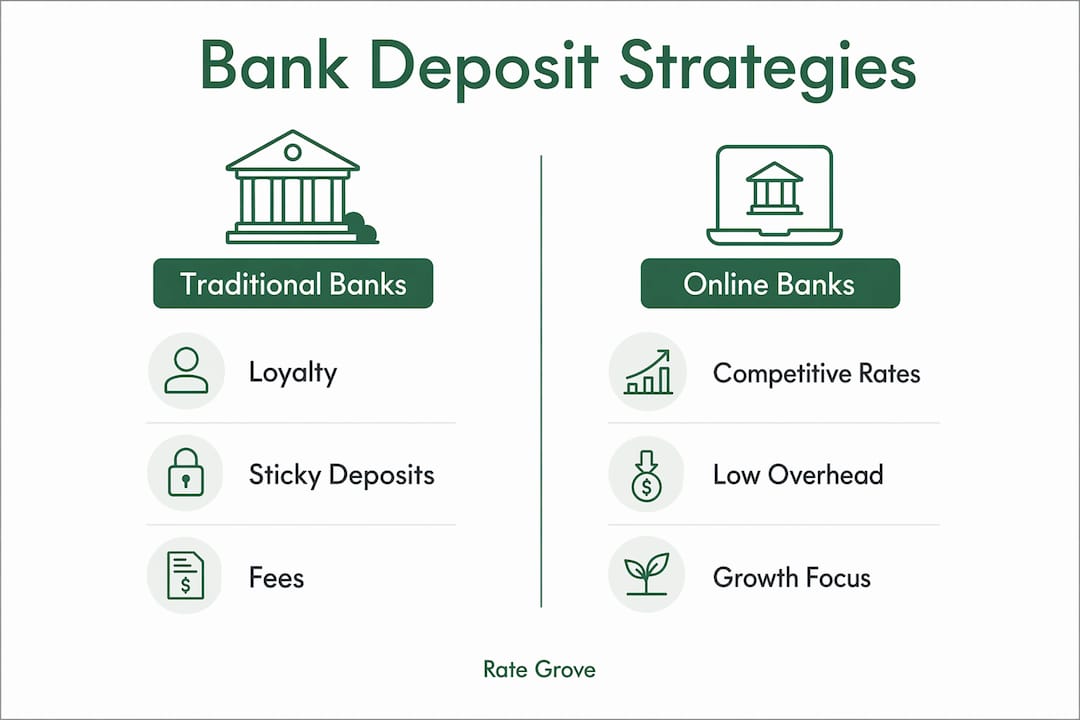
Traditional megabanks also view high-yield savings accounts as liabilities. Paying high interest compresses profit margins. For a bank already sitting on billions in stable deposits, there is simply no financial reason to raise rates.
Pro Tip: Check your current savings account APY right now. If it is below 1%, you are likely sitting in a sticky deposit account at a traditional bank. Moving that money could mean hundreds of dollars more per year.
How do online banks use high rates as a growth strategy?
High APYs are the primary marketing tool for online banks. Instead of spending on branch buildouts or television ads, online banks attract deposits by offering rates that are hard to ignore. That strategy works because savers actively search for the best returns.
Here is why this matters for the bank’s business model:
- Deposits fund loans. Every dollar you deposit gives the bank capital to lend out at higher rates. The interest spread between what they pay you and what borrowers pay them is how online banks profit.
- Higher rates attract more deposits. A competitive APY brings in new customers who might otherwise stay at a traditional bank. More deposits mean more lending capacity.
- Digital acquisition is cheap. Signing up a new customer online costs a fraction of what a branch interaction costs. That efficiency makes high APYs financially sustainable.
- Rates build trust quickly. A new online bank with no brand history can establish credibility fast by offering a top-tier rate. It signals financial health and confidence.
One important nuance: many online banks advertise high APYs that apply only to part of the account balance. Tiered rates and eligibility conditions are common. Some accounts require a minimum direct deposit, a minimum balance, or a set number of monthly debit card transactions to unlock the top rate.
A saver with $10,000 moving from a 0.01% APY to a 5% APY account earns $500 in annual interest instead of $1. That is a real, tangible difference. But only if the account terms actually apply to your balance and usage pattern.
Pro Tip: Before opening an account for its advertised rate, read the eligibility requirements carefully. Some promotional rates apply only to balances under $5,000 or require specific monthly activity. Understanding introductory rate conditions can save you from a disappointing first statement.
What are the trade-offs of banking online for higher rates?
Higher rates come with real trade-offs. Knowing them upfront helps you decide whether an online bank fits your situation or whether a hybrid approach makes more sense.
The key trade-offs to weigh include:
- No in-person support: If you prefer face-to-face help for complex transactions, online banks fall short. Customer service is phone, chat, or email only.
- Cash deposits are difficult: Most online banks do not accept cash deposits directly. You typically need to transfer funds from another account or use a partner ATM network.
- Technology dependence: If the app goes down or you lose internet access, you cannot access your account. Traditional banks offer branch fallback.
- Fewer product options: Some online banks specialize in savings and checking only. If you need a mortgage, auto loan, or business account, you may need a separate institution.
- Learning curve: Switching banks takes effort. Setting up direct deposits, updating autopay, and transferring balances all take time.
The security picture is actually strong. FDIC insurance covers deposits up to $250,000 per depositor, per institution, regardless of whether the bank is online or traditional. Online banks also offer 24/7 account access, real-time alerts, and strong encryption standards.
A hybrid approach works well for many savers. Keep a checking account at a traditional bank for cash handling and in-person needs. Park your savings at an online bank for the higher yield. You get the best of both without sacrificing convenience.
How can you maximize savings growth by comparing online bank rates?
Regularly monitoring APYs is the single most effective habit for growing your savings. Rates change frequently, especially when the Federal Reserve adjusts its benchmark rate. An account that paid 5.00% last year may pay 4.25% today.
| APY | Annual earnings on $10,000 | Annual earnings on $25,000 |
|---|---|---|
| 0.38% (FDIC average) | $38 | $95 |
| 2.00% | $200 | $500 |
| 4.00% | $400 | $1,000 |
| 5.00% | $500 | $1,250 |
The table above shows why comparing savings rates matters. The difference between the FDIC average and a top online rate on a $25,000 balance is over $1,150 per year. That is money left on the table if you do not shop around.
Watch for fees too. A high APY account with a monthly maintenance fee can easily erase the rate advantage. Understanding how fees drain savings on smaller balances is just as important as chasing the top rate. Also check minimum balance requirements and withdrawal limits, since some accounts restrict how often you can move money out each month.
Key Takeaways
Online banks consistently offer higher savings rates than traditional banks because their lower operating costs free up capital that goes directly into your APY.
| Point | Details |
|---|---|
| Overhead drives the rate gap | Online banks operate at roughly 60% lower cost, funding higher APYs for savers. |
| Sticky deposits explain traditional banks | Customer inertia removes competitive pressure, so traditional banks have no reason to raise rates. |
| High APYs are a growth tool | Online banks use attractive rates to build deposit bases and fund their lending operations. |
| Read the fine print | Tiered rates and eligibility conditions can limit which balance earns the advertised APY. |
| Comparison shopping pays off | Moving $25,000 from the FDIC average rate to a top online rate can add over $1,150 per year. |
The rate gap is bigger than most savers realize
I have spent years watching people leave significant money on the table simply because switching banks feels like a hassle. The math is not complicated, but the inertia is real. A $10,000 balance earning 0.38% generates $38 a year. The same balance at 5.00% generates $500. That is not a rounding error. That is a meaningful difference in your financial life.
What surprises most people is that the higher rate does not come with more risk. FDIC insurance applies equally to online and traditional banks. The online bank is not doing anything exotic with your money. It is simply operating more efficiently and passing those savings to you instead of spending them on marble lobbies and branch managers.
My honest view is that traditional banks will continue to lose ground on savings rates. Younger savers are comfortable banking entirely on their phones. As that demographic grows, the competitive pressure on traditional banks will increase. Some large banks have already launched online-only sub-brands specifically to compete on APY without cannibalizing their branch business.
The practical advice is simple. Check your current rate today. If it is below 1%, compare your options. The types of high-yield accounts available in 2026 give you real choices at every balance level. Do not let inertia cost you hundreds of dollars a year.
— Mat C.
Rate Grove makes it easy to compare online bank rates
Finding the best savings rate used to mean visiting a dozen bank websites and manually tracking APYs, fees, and terms. Rate Grove cuts that process down to minutes.
Rate Grove compares bank account rates, CDs, and credit cards side by side, pulling verified data directly from issuer and regulator sources. Every listing shows APY, fees, minimum balance requirements, and key trade-offs in one place. The guides are updated monthly, so you are always looking at current rates, not last quarter’s numbers. Whether you are parking an emergency fund or building long-term savings, Rate Grove gives you the information to choose with confidence.
FAQ
Why do online banks offer higher interest rates?
Online banks carry roughly 60% lower operating costs than traditional banks, with no branch network to fund. Those savings are passed directly to customers through higher APYs on savings accounts.
Are online bank savings accounts FDIC insured?
Yes. FDIC insurance covers deposits up to $250,000 per depositor, per institution, at both online and traditional banks. Your money carries the same federal protection regardless of where you bank.
What is a “sticky deposit” in banking?
A sticky deposit is money that customers leave in an account for years without moving it. Traditional banks rely on this loyalty and inertia, which removes their incentive to compete on interest rates.
Do all online banks pay the same high rates?
No. Rates vary significantly between online banks, and many use tiered structures where the top APY applies only to balances below a certain threshold or requires specific account activity each month.
How often should I compare savings account rates?
Checking rates every three to six months is a practical habit. The Federal Reserve adjusts its benchmark rate periodically, and online bank APYs often shift within weeks of those changes.