

Bank account fee disclosures are official documents that list every charge a bank can apply to your account, from monthly maintenance fees to wire transfer costs. Reading bank account fee disclosures carefully is the single most effective way to avoid surprise charges and keep more of your money. Most consumers skip these documents entirely. That habit costs real money. The average monthly maintenance fee for checking accounts is $13.51, and out-of-network ATM fees average $4.64 per transaction. Knowing where to look and what to look for puts you in control before you sign anything.
What are the common bank account fees in disclosures?
Bank account fees fall into six main categories, and each one appears in your fee disclosure under a specific name. Understanding these categories is the foundation of bank account fees explained simply.
The most common fees you will find are:
- Monthly maintenance fee (also called a “Monthly Service Charge”): averages $13.51 per month; often waivable with a minimum balance or direct deposit
- Overdraft fee: averages $26.77 per occurrence; can trigger multiple times in one day if several transactions post while your balance is negative
- NSF (Non-Sufficient Funds) fee: averages $16.82 per rejected transaction; charged when a payment is declined rather than covered
- Out-of-network ATM fee: averages $4.64 per withdrawal; your bank charges this on top of any fee the ATM owner charges
- Wire transfer fee: $25–$30 for domestic transfers, $50 for international transfers
- Inactivity fee: charged after a set period of no transactions, often 6–12 months with no activity
The Schumer Box is a standardized fee summary table that banks must include in account disclosures. It highlights the most important fees and annual percentage rates in one place. Think of it as the nutrition label for your bank account. You can scan it in under two minutes to get a clear picture of headline costs.
One critical detail: disclosures use inconsistent fee labels across institutions. “Monthly Service Charge” at Chase may be the same fee as “Maintenance Fee” at a credit union. Always read the description, not just the label, to confirm you are comparing the same charge.

| Fee Type | Typical Amount | Common Waiver Condition |
|---|---|---|
| Monthly maintenance | $13.51/month | Min. balance or direct deposit |
| Overdraft | $26.77/occurrence | Opt-out of overdraft coverage |
| NSF | $16.82/occurrence | Keep buffer balance |
| Out-of-network ATM | $4.64/transaction | Use in-network ATMs |
| Domestic wire transfer | $25–$30 | Use ACH transfer instead |
| Inactivity | Varies | Make one transaction per period |
How do you read and interpret a bank fee disclosure?
The right time to read a fee disclosure is before you open an account, not after your first surprise charge. Federal law requires banks to provide fee disclosures before account opening, and annual reviews of your fee schedule are recommended, typically updated in january.
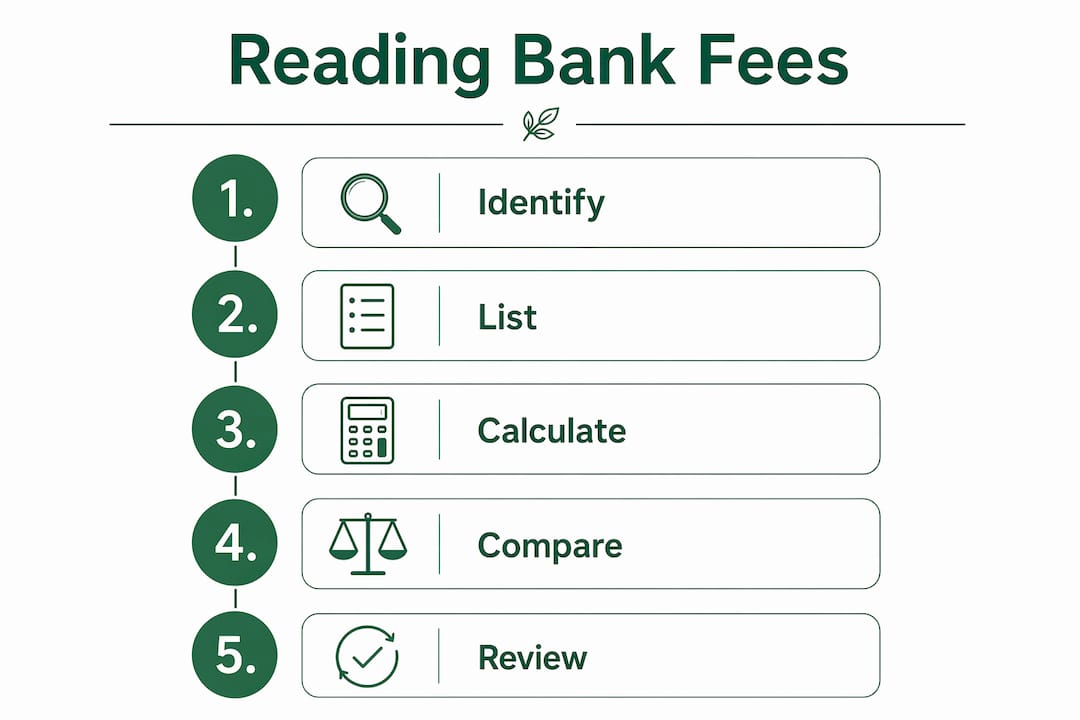
Follow these steps to read any bank fee disclosure clearly:
- Get the right documents. Request the full fee schedule, the account agreement, and any welcome packet. Online banks post these as PDFs on their websites.
- Find the Schumer Box first. This table gives you the headline fees in one view. Use it to screen accounts quickly before reading the full document.
- Read every footnote. Fee triggers are often buried in footnotes marked with asterisks or daggers. A fee listed as “$0” in the main table may have a footnote that adds conditions.
- Flag conditional language. Watch for the words “if,” “unless,” “up to,” and “when.” These words signal that a fee only applies under specific conditions. For example, “no fee if you maintain a $1,500 minimum balance” means the fee is very real if your balance drops.
- Map waivers to your habits. A waiver requiring $500 in monthly direct deposits is only useful if you actually receive direct deposits. Match each waiver condition to your real banking behavior.
- Check the fee change section. Banks must give 30–45 days notice before changing fees. Confirm how your bank delivers these notices, whether by mail, email, or app notification, and make sure you will actually see them.
- Review your monthly statements. Cross-reference any charges on your statement against the fee schedule to catch unauthorized or unexpected fees early.
Pro Tip: Build a simple spreadsheet with two columns: “Fee Name” and “Monthly Estimate.” Fill it in based on your actual habits. If you use out-of-network ATMs twice a month, enter $9.28. This gives you a true monthly cost figure you can compare across banks.
How do you compare bank fee disclosures across banks?
Comparing fee disclosures across institutions requires more than glancing at the monthly fee. The monthly maintenance charge is often the smallest part of your total annual cost.
Annualizing your fees is the most accurate way to see what an account actually costs. Multiply your monthly maintenance fee by 12, then add your estimated overdraft, ATM, and wire fees for the year. A “free” checking account with a $4.64 ATM fee used four times a month costs you $222.72 per year in ATM fees alone.
Pro Tip: When you have done the math and know your true annual cost at your current bank, call customer service and ask directly if any fees can be waived. Banks regularly waive fees for customers who ask, especially if you have been with them for more than a year.
Use this checklist when comparing two or more accounts side by side:
| Fee Category | Bank A | Bank B | Notes |
|---|---|---|---|
| Monthly maintenance | $12.00 | $0 | Bank B requires $500 direct deposit |
| Overdraft fee | $35.00 | $25.00 | Bank A allows opt-out |
| Out-of-network ATM | $3.00 | $4.64 | Check your ATM usage frequency |
| Domestic wire | $25.00 | $30.00 | Use ACH if wire is rare |
| Inactivity fee | $10.00 | None | Only relevant if account goes dormant |
| Estimated annual cost | $144+ | $55.68+ | Based on typical usage |
A personalized fee matrix aligned to your actual behavior is the most effective tool for minimizing bank fees. Generic comparisons that only look at the monthly fee miss the fees that hit hardest for your specific habits.
What mistakes do consumers make when reading fee disclosures?
Most consumers miss conditional fee triggers buried in fine print and footnotes. These triggers are where the real cost of an account hides.
The most common mistakes to avoid:
- Assuming “free” means no fees. “Free” accounts almost always carry conditional waivers. Miss the minimum balance by one dollar and the monthly fee applies in full.
- Skipping footnotes. Fee tables often show the best-case number. The footnote tells you when that number changes.
- Ignoring fee change notices. Banks send these by mail or email with 30–45 days notice. Missing one means a fee increase catches you off guard.
- Matching fees by label instead of description. “Service charge” and “maintenance fee” can mean the same thing at different banks. Read the description to confirm.
- Not verifying unfamiliar charges. If a charge on your statement does not match your fee schedule, call your bank immediately. Errors and unauthorized fees do occur.
- Overlooking overdraft stacking. Overdraft fees can trigger multiple times in a single day if several transactions post while your balance is negative. One low-balance day can cost $80 or more.
Pro Tip: Set up low-balance alerts in your bank’s mobile app. Most major banks, including Bank of America, Wells Fargo, and Chase, let you trigger a push notification when your balance drops below a threshold you set. This one habit prevents most overdraft and NSF fees.
Key Takeaways
Reading bank fee disclosures carefully before opening an account, and reviewing them annually, is the most direct way to eliminate surprise charges and reduce your total banking cost.
| Point | Details |
|---|---|
| Start with the Schumer Box | This standardized table shows headline fees in one view and is the fastest screening tool. |
| Annualize all fees | Multiply monthly fees by 12 and add usage-based fees to see your true yearly cost. |
| Read conditional language | Words like “if,” “unless,” and “up to” signal fee triggers that apply to your real habits. |
| Compare descriptions, not labels | “Monthly Service Charge” and “Maintenance Fee” can be the same fee at different banks. |
| Track fee change notices | Banks give 30–45 days notice before raising fees; missing these notices leads to surprise charges. |
Why fee disclosures deserve more of your attention
Most people treat fee disclosures the way they treat software terms of service: scroll to the bottom and click accept. I get it. These documents are dense, the font is small, and the language is designed by lawyers, not consumers. But the cost of skipping them is concrete and measurable.
I have seen accounts marketed as “free checking” that quietly charge $10 per month after 12 months of inactivity. I have watched people pay $4.64 per ATM withdrawal four times a week without realizing they were spending over $960 a year on a fee that a simple bank switch would eliminate. The disclosure told them everything. They just never read it.
The complexity of these documents can feel like a wall. Once you know the structure, though, it becomes a checklist. Find the Schumer Box. Flag the conditional language. Build your spreadsheet. That process takes 20 minutes the first time and five minutes every year after that. The payoff is knowing exactly what your bank charges you and why. That knowledge also gives you real leverage when you call to negotiate a waiver.
My honest advice: download your current bank’s fee schedule today, not when you notice a charge you do not recognize. Set a calendar reminder every january to check for updates. Pair that habit with low-balance alerts on your phone. These three steps cost nothing and protect you from the fees that quietly drain accounts year after year.
— Mat C.
Rategrove makes bank fee comparison straightforward
Comparing fee disclosures across multiple banks on your own takes time. Rategrove cuts that work down significantly by pulling verified fee data from issuer and regulator sites and presenting it in a single, side-by-side view.
You can use Rategrove’s comparison tools to review checking accounts, savings accounts, and CDs with their full fee schedules displayed together. The data is updated monthly, so you are always looking at current numbers rather than outdated figures. If you want to find a low-fee account without spending an afternoon reading individual bank disclosures, Rategrove gives you a faster path to the same answer.
FAQ
What is a Schumer Box in a bank disclosure?
A Schumer Box is a standardized summary table that banks must include in account disclosures, listing key fees and rates in a consistent format. It is the fastest way to identify headline fees like overdraft charges, monthly maintenance costs, and ATM fees.
How often should I review my bank’s fee schedule?
Review your fee schedule at least once a year, ideally in january when most banks update their disclosures. Also review it any time you receive a fee change notice from your bank.
What does “conditional fee waiver” mean?
A conditional fee waiver means a fee is dropped only if you meet a specific requirement, such as maintaining a minimum balance or receiving a direct deposit. Missing that condition means the full fee applies.
How do I find hidden fees in a bank disclosure?
Read every footnote attached to fee tables and search the full account agreement for the words “if,” “unless,” and “up to.” These words almost always signal a fee trigger that does not appear in the main fee table.
Can I negotiate bank fees after reading my disclosure?
Yes. Knowing the exact fee names and amounts from your disclosure gives you a factual basis to request waivers. Banks regularly waive fees for customers who ask, particularly long-term account holders with good standing.