

There is no longer a federal cap forcing banks to limit savings withdrawals to six per month. The Federal Reserve deleted that numeric requirement from Regulation D back in 2020, but your bank is still free to set its own withdrawal limit rules and charge fees if you exceed them. Your account’s deposit agreement, not the old federal rule, now decides what happens if you move money too often.
TL;DR:
- Most banks can now set their own rules for monthly savings withdrawals, with many still enforcing limits similar to the old six-per-month federal cap.
- Transactions that count toward your withdrawal limit typically include online transfers, ACH bill payments, automatic debits, overdraft transfers, and phone requests, but in-branch and ATM withdrawals may or may not be included depending on the bank.
- If you exceed your bank’s internal transfer policy, you may face fees, account reclassification, or even account closure, with some banks reporting violations to consumer screening services.
- Large cash withdrawals over $10,000 trigger routine reporting to FinCEN but do not violate federal rules and are fully legal.
- Always review your bank’s deposit agreement directly to understand its specific restrictions and avoid unnecessary fees or account reclassification.
Table of Contents
- Savings Withdrawal Limits: What Changed and When
- Which Transactions Count Toward Your Withdrawal Limit
- How Banks Enforce Savings Account Restrictions Today
- What Happens If You Exceed Your Bank’s Savings Withdrawal Limits
- Where to Check Your Deposit Agreement and Avoid Fees
- Joint Accounts, ATM Limits, and Dormant Savings Rules
- How Rate Grove Verified These Facts
- Matching Your Account to How You Actually Use Money
- Compare Savings Accounts Without the Restrictive Fine Print
- Sources
- FAQ
Savings Withdrawal Limits: What Changed and When
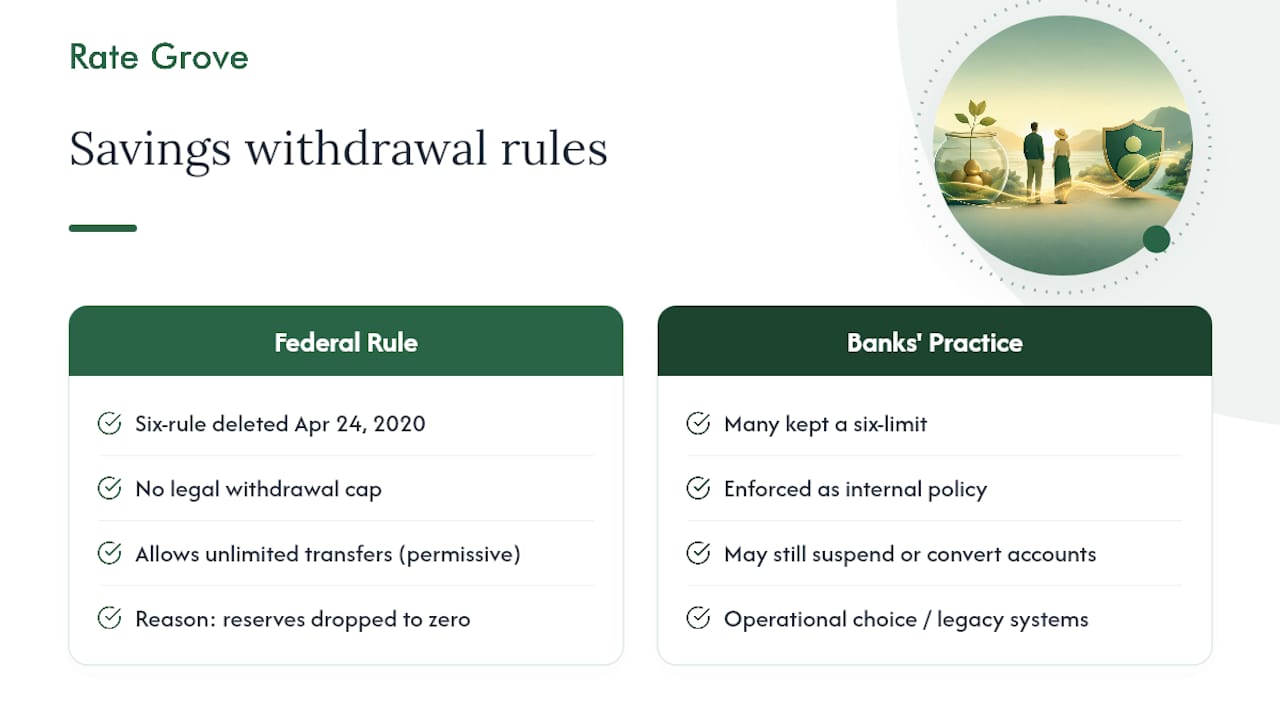
The Federal Reserve deleted the six-transfer rule through an interim final rule that took effect on April 24, 2020. For decades, Regulation D capped “convenient” transfers and withdrawals from savings accounts at six per statement cycle. That number is gone from the federal rulebook.
The Fed made the move because it had just dropped reserve requirements to zero, which removed the original reason for limiting savings withdrawals in the first place. Regulators also wanted people to move money freely during the early disruptions of the COVID-19 pandemic, when access to cash mattered more than usual.
Here’s the part most people miss: the rule change is permissive, not mandatory. According to the Federal Reserve’s own FAQ on savings deposits, banks are now allowed to permit unlimited transfers, but nothing forces them to. Most deposit agreements still include what regulators call a “reservation of right,” language that lets a bank suspend withdrawals or convert your account if you go over its internal limit.
Statistic Callout: The six-withdrawal rule was deleted outright from the federal code in April 2020, but many banks kept the old number as their own house policy anyway.
That’s the gap consumers keep tripping over. Federal law stopped requiring the limit, but plenty of institutions decided six was still the right number for their own systems and simply reclassified it as a bank policy instead of a legal mandate.
Which Transactions Count Toward Your Withdrawal Limit
Banks that still enforce a monthly cap generally count what regulators call “convenient” transfers, the kind you can initiate without walking into a branch. These are the transactions most likely to count against how many withdrawals from savings you’re allowed:
- Online or mobile transfers moving money from savings to checking
- ACH bill payments set up directly from the savings account
- Preauthorized or automatic recurring debits
- Overdraft-protection transfers that pull from savings to cover a checking shortfall
- Transfers you request by phone with a bank representative
- Checks or debit card payments made directly against the savings balance
In-branch teller withdrawals and ATM withdrawals were traditionally exempt from this count, since they required you to show up in person or use a bank-owned machine. That exemption is not universal anymore. Some institutions now count ATM withdrawals toward the same limit, so don’t assume a trip to the machine is automatically free from the count.
One more detail catches joint account holders off guard: the limit applies to the account, not to each person on it. If you and a spouse each make three transfers in the same month, that’s six combined, not six apiece.

Pro Tip: Call your bank and ask directly whether ATM withdrawals and teller visits count toward your savings limit. Policies vary enough that assuming the old rules still apply can cost you a fee.
How Banks Enforce Savings Account Restrictions Today
Bank withdrawal policies now vary more than they ever did under the old federal rule, and that variation is exactly where consumers get caught off guard. Some banks removed limits entirely. Others kept the six-per-cycle structure and just relabeled it as their own policy rather than a regulatory one.
Statistic Callout: Reporting from LegalClarity shows a clear pattern: traditional brick-and-mortar banks often keep the six-per-month cap, while online banks and credit unions are more likely to loosen or drop it after the 2020 change.
Fees for going over the limit typically show up on your statement under labels like “excess withdrawal fee,” “excessive-use fee,” or occasionally still “Reg D fee” even though the regulation itself no longer requires the restriction. The CFPB confirms that banks can legally charge for these transactions, and that repeated violations can lead to more than just a fee.
Monitoring approaches differ by institution too:
- Some banks block the transaction outright the moment you’d exceed your limit, so the transfer never processes
- Others allow the transaction through and flag it afterward, sending a warning notice before anything escalates
- A smaller group tracks patterns over several months before taking any action at all
The typical escalation path runs from a fee, to a warning letter, to reclassifying your savings account as a checking account (which usually kills your interest rate), and in persistent cases, to closing the account altogether. None of this is federally mandated. It’s simply how each bank chose to handle a rule the government no longer requires them to enforce.
What Happens If You Exceed Your Bank’s Savings Withdrawal Limits
Going over your bank’s internal cap rarely triggers anything dramatic on the first offense, but the costs and risks build if it becomes a pattern. Here’s the typical sequence:
- A per-transaction fee hits your statement. These usually run a flat dollar amount per excess withdrawal, and they stack if you go over more than once in the same cycle.
- Your account may get converted to checking. Many banks reserve the right to reclassify a savings account that repeatedly exceeds its transfer limit, which usually means losing your APY.
- Closure becomes possible. Persistent violations can lead a bank to close the account, and in rarer cases that history gets reported to consumer screening services like ChexSystems or Early Warning Services, which can complicate opening new accounts elsewhere.
Separately, if you withdraw more than $10,000 in cash in a single business day, your bank files a Currency Transaction Report with FinCEN. That’s routine paperwork required for large cash movements, not a penalty and not related to Regulation D enforcement at all.
Pro Tip: If you get hit with an excess withdrawal fee, call customer service before accepting it. Many banks will waive a first-time fee, especially for long-standing customers or automatic overdraft transfers you didn’t realize counted.
Where to Check Your Deposit Agreement and Avoid Fees
Your deposit agreement, sometimes bundled with a Truth in Savings disclosure, is the definitive source for your bank’s exact rules. You can usually find it three ways: in your online banking portal under “account disclosures,” as a PDF you received when you opened the account, or by calling customer service and asking them to send you a current copy.
Once you know your bank’s actual policy, a few habits keep you well clear of any fee:
- Batch your transfers. Instead of moving money three separate times in a week, combine it into one transfer.
- Fund checking once a month for bills. A single scheduled transfer covering the month’s expenses beats several smaller ones.
- Use the branch or ATM when your bank exempts those methods. Confirm first, since some institutions now count them.
- Review your overdraft protection settings. Automatic transfers to cover a checking shortfall often count as withdrawals without you realizing it.
- Consider switching banks if flexibility matters more than habit. Online banks and credit unions are statistically more likely to have dropped the old six-transfer cap entirely.
Track your transactions across the statement cycle, not just the calendar month. Banks vary in how they timestamp transfers, and a payment posted near the end of one cycle can occasionally roll into the next, which throws off your own count if you’re keeping tabs manually.
Pro Tip: Rate Grove’s savings account fee checklist walks through exactly what to look for in a deposit agreement before you open or switch accounts.
Joint Accounts, ATM Limits, and Dormant Savings Rules
A few edge cases trip up even careful savers. Joint accounts count withdrawals against the account total, not per person, and FDIC joint-insurance coverage assumes equal ownership between co-owners unless your bank’s records say otherwise.
ATM daily withdrawal limits are a completely separate rule from savings account restrictions. A daily cash limit, often set between $500 and a few thousand dollars depending on the bank, governs how much cash you can pull in 24 hours. It has nothing to do with how many transfers you’re allowed in a statement cycle. Rate Grove’s guide to ATM withdrawal limits breaks down typical caps by bank.
A few other things worth knowing:
- Mobile check deposits placed on hold don’t count as withdrawals; holds only affect when funds become available, not your transfer count.
- Most states consider a savings account dormant after three to five years of no activity, after which unclaimed funds can be turned over to the state.
- A single small transaction, even a few dollars, typically resets the dormancy clock and keeps your account active.
How Rate Grove Verified These Facts
Every figure and rule in this guide traces back to a primary source, not a secondhand summary. We checked the Federal Register’s Regulation D notice, the Federal Reserve’s supervisory Q&A, the CFPB’s consumer guidance, and FinCEN’s cash-reporting rules directly against what banks currently publish in their own disclosures.
Rate Grove keeps this kind of guide updated monthly against issuer and regulator sites, since bank withdrawal policies shift more often than most consumers expect. A few places to go next:
- Compare accounts with different withdrawal flexibility using our bank account comparison checklist
- Weigh a money market account against a standard savings account with our money market comparison guide
- Check mobile deposit timing rules that can affect your available balance in our mobile deposit limits guide
Matching Your Account to How You Actually Use Money
Most people pick a savings account for the interest rate and never think about the withdrawal policy until they get hit with a fee. That’s backwards. If you move money often, prioritize an account with flexible transfer rules over an extra tenth of a percent in APY.
Online high-yield accounts tend to have looser transfer policies than older brick-and-mortar banks, partly because they built their systems after the 2020 rule change rather than around it. Before you switch anything, run your specific habits, how often you transfer, whether you use ATMs, whether you have a joint account, through a real comparison rather than guessing.
— Mat C.
Compare Savings Accounts Without the Restrictive Fine Print
Digging through a dozen deposit agreements to find one bank that won’t nickel-and-dime you for moving your own money is exactly the kind of tedious research Rate Grove exists to cut short. Rate Grove pulls verified rates, fees, and policy details straight from issuer and regulator sites, then lays them side by side so you can see which accounts still cap withdrawals and which ones dropped the old six-transfer habit for good.

If flexibility matters more to you than a fraction of a percent in yield, run a quick comparison on Rate Grove using your own criteria: how often you transfer, whether you use ATMs regularly, and how much APY you’re willing to trade for fewer restrictions. It takes a few minutes and saves you from finding out about a bank’s real policy the hard way, after the fee already posted.
Sources
For anyone who wants to read the primary sources directly rather than take a summary at face value, four are worth keeping handy: the Federal Register’s Regulation D notice, the Federal Reserve’s savings deposit FAQ, the CFPB’s guidance on savings account fees, and FinCEN’s currency transaction reporting rules. Each one answers a different piece of the puzzle, from what changed federally to what your bank can still legally do.
This article is general information, not a substitute for advice from a qualified financial advisor. Consult a qualified financial professional about your own circumstances before acting on anything here.
- Regulation D: Reserve Requirements of Depository Institutions — Federal Register (2020)
- Savings deposits: Frequently asked questions — Federal Reserve
- Why am I being charged for transactions in my savings account? — CFPB
- How Many Withdrawals From Savings Per Month Are Allowed? — LegalClarity
- Questions and answers about Regulation D — Federal Reserve
FAQ
How Much Can I Withdraw From Savings Without It Being Reported?
Cash withdrawals over $10,000 in a single business day trigger a Currency Transaction Report to FinCEN, which your bank files automatically. This is routine paperwork required for large cash transactions, not a sign of suspicion or wrongdoing.
Are There New Bank Withdrawal Rules Starting in 2026?
No new federal rule takes effect in 2026. The major change already happened when the Fed deleted the six-transfer requirement from Regulation D in 2020; any limits you see today come from individual bank policy, not new federal law.
Can I Withdraw $10,000 From My Savings Account?
Yes, withdrawing $10,000 from savings is fully legal. Your bank will file a routine Currency Transaction Report if the amount is in cash, but there’s no restriction preventing the withdrawal itself.
How Much Money Can You Pull Out of a U.S. Bank at Once?
There’s no federal dollar cap on a single withdrawal, though your specific bank may set daily ATM limits or require advance notice for very large cash withdrawals. Check your deposit agreement or compare account policies for your bank’s exact threshold.
Does the Six-Withdrawal Rule Still Exist Anywhere?
Not as federal law, but many traditional banks kept it as their own internal policy after the 2020 rule change. Always check your deposit agreement since the rule now varies entirely by institution.