

For safety and predictable access to cash, a CD ladder usually wins; for higher yield and more flexibility, a bond ladder often comes out ahead. The one-line reason: CDs give you FDIC insurance and a fixed return, while bonds carry market-price risk but pay more for taking it on.
TL;DR:
- CD ladders offer FDIC insurance up to $250,000 and predictable returns but penalize early withdrawals and may lag in interest rate rises.
- Bond ladders, especially with Treasuries, municipal, or corporate bonds, provide higher yields, more liquidity, and potential tax advantages but carry issuer default risk and trading costs.
- Rising interest rates cause bond prices to fall and CD rates to remain fixed, making bonds more advantageous if sold early during rate hikes, while CDs benefit from falling rates.
- For short-term needs within one to three years, CDs or short-term Treasuries are safer bets, while longer-term bonds suit larger portfolios aiming for income over years.
- Always check current rates before building a ladder, considering penalties, callable bonds, and trading costs to optimize returns and minimize risk.
Table of Contents
- CD Ladder vs Bond Ladder: How Each One Actually Works
- CD Ladder vs Bond Ladder: Key Differences at a Glance
- Pros and Cons of CD Ladders
- Pros and Cons of Bond Ladders
- How Rising and Falling Rates Hit Each Ladder Differently
- Tax and Insurance Details Worth Checking First
- How to Choose Between a CD Ladder and a Bond Ladder
- Worked Examples: Building a 5-Rung Ladder of Each
- Combining Ladders and Considering Alternatives
- Why Trust This Guide
- A Practical Take on Choosing Your Ladder
- Check Current CD Rates Before You Build Your Ladder
- Sources
CD Ladder vs Bond Ladder: How Each One Actually Works
A CD ladder splits your cash across several certificates of deposit that mature on staggered dates, so a chunk of money becomes available every few months instead of all at once. You open the CDs at a bank or credit union, each one covered by FDIC insurance up to $250,000 per depositor, per bank, per ownership category. Pull money out before maturity and you’ll usually eat an early withdrawal penalty, typically a few months of interest.
A bond ladder does the same staggering trick with individual bonds instead of deposits. Each bond has a coupon (the interest rate), a maturity date, and sometimes a call feature that lets the issuer repay you early if rates drop. You can build a ladder from Treasury bonds, municipal bonds, or corporate bonds, each with its own risk and tax profile. Treasuries can be bought directly through TreasuryDirect or through a brokerage account; munis and corporates generally require a broker.
Both strategies rely on the same mechanic: staggered maturities mean you’re never locked into one interest-rate environment for your entire pool of money. As each rung matures, you decide whether to spend the cash or reinvest it, ideally at whatever rate looks best at that moment.

CD Ladder vs Bond Ladder: Key Differences at a Glance
The gap between these two strategies comes down to who’s holding the risk and how you get paid for it.
- Insurance and credit risk: CDs are protected by FDIC insurance up to $250,000 per ownership category; bonds depend on the issuer’s ability to pay, though Treasuries carry the backing of the U.S. government.
- Liquidity: Breaking a CD early means a penalty, usually a fixed number of months’ interest. Selling a bond before maturity means taking whatever the secondary market offers that day, which can be more or less than what you paid.
- Yield potential: Bonds, especially corporate and municipal issues, often pay more than CDs of similar maturity because you’re absorbing more risk. Terms on both typically range from short-term to longer durations, with 1 to 5 year ladders being common for individual investors.
- Tax treatment: CD interest is taxed as ordinary income at the federal and state level. Treasury interest skips state and local tax. Municipal bond interest often skips federal tax, and sometimes state tax too, depending on where you live and where the bond was issued.
- Administrative load: CDs are set and mostly forgotten. Bonds require more tracking, especially if they’re callable or if you’re managing a mix of issuers.
None of these differences make one option universally better. They just point to different jobs. A CD ladder is a savings tool wearing an investment costume; a bond ladder is closer to a real fixed-income portfolio.
Pros and Cons of CD Ladders
CD ladders earn their reputation as the boring, reliable option, and that’s precisely the point for money you can’t afford to lose.
- Full FDIC protection. Every dollar up to $250,000 per bank, per ownership category, is insured, so principal loss isn’t a real risk with a CD ladder.
- Predictable math. You know exactly what each CD pays on the day you open it. No surprises, no price swings.
- Good fit for near-term goals. A down payment fund, a tax bill you’re saving for, or an emergency cushion all suit the fixed timeline of a CD ladder.
- Penalties bite. Breaking a rung early typically costs several months of interest, sometimes more on longer-term CDs.
- Rates can lag. Promotional CD rates at one bank might beat your existing ladder, but moving money means paperwork and possibly a penalty.
- Requires upkeep. Missing a maturity date means your CD can auto-renew into a mediocre rate.
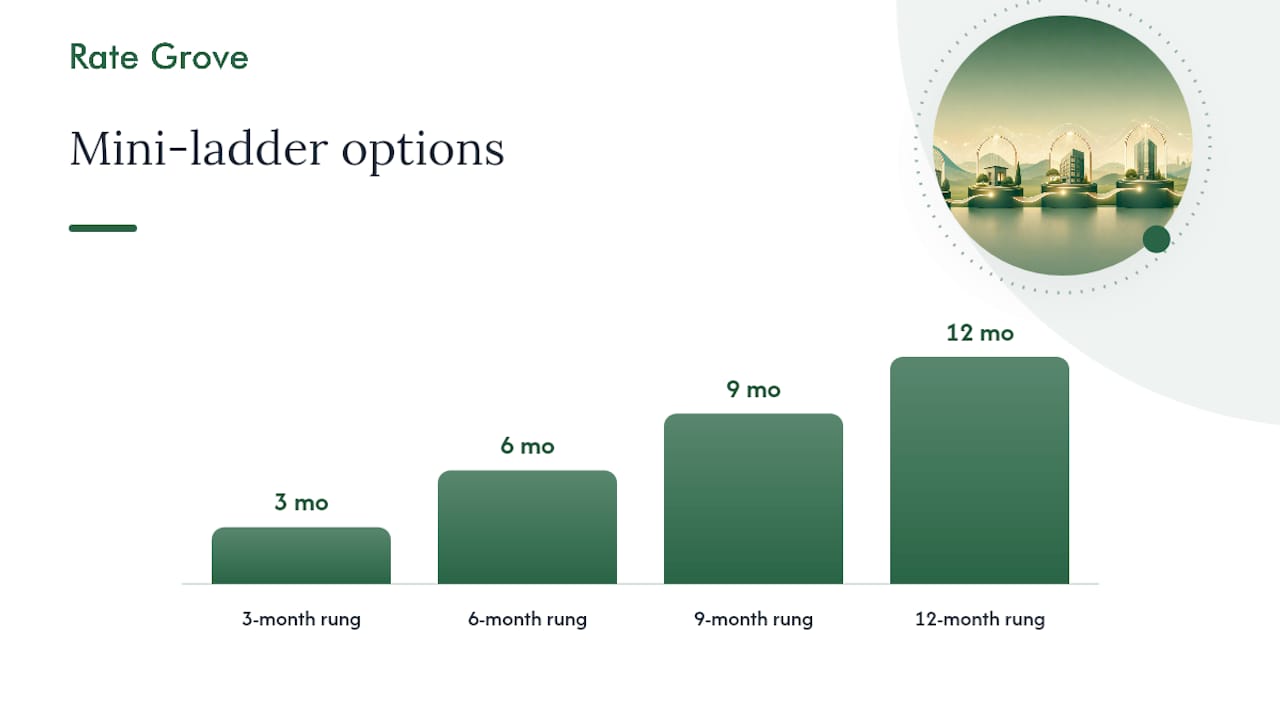
Variants exist to soften these drawbacks. Mini-ladders with 3, 6, 9, and 12 month rungs work well when liquidity matters more than yield, and no-penalty or bump-up CDs trade a bit of rate for flexibility if you’re nervous about locking in too long. A guide on fixed vs. variable rate CD types breaks down how those variants actually behave.
Pro Tip: If you’re building your first ladder, start with a mini-ladder of 3 to 4 rungs before committing to a 5 year spread. It’s easier to judge your own comfort with locked-up cash in small doses than to guess up front.
Pros and Cons of Bond Ladders
Bond ladders trade some of that CD-level safety for room to maneuver and, often, a better payout.
- You can sell before maturity. Treasuries and investment-grade bonds trade on a secondary market, so you’re not stuck if your plans change, though you’ll take whatever price the market offers that day.
- Access to tax-advantaged instruments. Municipal bonds can skip federal income tax, and Treasury Inflation-Protected Securities (TIPS) adjust their principal with inflation, something no CD does.
- Higher yield ceiling. Corporate bonds in particular can pay meaningfully more than CDs of the same term, since you’re accepting default risk the bank doesn’t ask you to take.
- Default risk is real for corporates. A CD is backed by deposit insurance; a corporate bond is only as good as the company issuing it.
- Trading costs add up. Buying and selling individual bonds through a broker often involves markups or commissions that eat into your return.
- Call risk cuts your best rungs short. A callable bond can get redeemed early by the issuer right when rates drop, which is exactly when you don’t want your money back.
Most individual ladders lean on Treasuries for the base and add municipal or high-grade corporate bonds for yield, an approach Bogleheads recommends for investors who want diversification without excessive credit risk.
How Rising and Falling Rates Hit Each Ladder Differently
CDs and bonds respond to rate changes in almost opposite ways, and understanding that difference is the whole point of laddering in the first place.
A CD’s rate is locked the day you open it and stays fixed until maturity, no matter what the Federal Reserve does in the meantime. If rates rise, you don’t benefit until that rung matures and you reinvest at the new, higher rate. If rates fall, you’re stuck with your old (better) rate until maturity, which works in your favor.
Bonds move the opposite direction on paper value, even though the coupon itself doesn’t change. When rates rise, existing bond prices fall, because new bonds offer better yields and nobody wants your old, lower-paying one at face value. When rates fall, existing bond prices rise, since your fixed coupon now looks attractive compared to what’s newly available. This is why yield to maturity and current yield can diverge sharply from the coupon rate printed on the bond.
Picture two savers in 2024 who each locked in five-year products at 4%. By late 2025, if new rates dropped to 3%, the CD holder is stuck earning 4% until maturity (a win), while the bond holder’s bond price rose because that 4% coupon is now more valuable than what’s newly issued. Sell the bond early in that scenario and you’d likely profit. Sell a CD early and you’d just pay a penalty.
Tax and Insurance Details Worth Checking First
FDIC insurance covers CDs up to $250,000 per depositor, per bank, per ownership category, and NCUA offers equivalent coverage at credit unions. Bonds held at a brokerage aren’t insured the same way; SIPC protects against brokerage failure, not against a bond losing value or an issuer defaulting.
Tax treatment splits three ways. Treasury interest skips state and local tax but is federally taxable. Municipal bond interest is often exempt from federal tax, and sometimes state tax if you live where the bond was issued. Corporate bond interest, like CD interest, is taxed as ordinary income at every level. TIPS add a wrinkle: their principal adjusts with inflation, and that adjustment is taxable in the year it happens, even though you don’t receive the cash until maturity. For a ladder large enough to matter, talk to a tax professional before you build it.
How to Choose Between a CD Ladder and a Bond Ladder
Run through this checklist before committing money to either structure:
- Time horizon. Money needed within 1 to 3 years generally belongs in a CD ladder or short Treasury ladder, not longer bonds.
- Liquidity needs. If you might need to break a rung early, favor CDs with shorter penalty windows or Treasuries, which you can sell on the secondary market.
- Risk tolerance. If seeing account values fluctuate would tempt you to sell at the wrong time, CDs remove that temptation entirely.
- Tax situation. High earners in high-tax states often benefit more from municipal bonds than from CD interest taxed at full ordinary rates.
- Portfolio size. Smaller pools of cash usually favor the simplicity of CD ladders; larger portfolios can absorb the extra work of diversifying across bond issuers.
Before opening anything, ask your bank or broker three questions: how long is the early withdrawal penalty window, is the bond callable and under what conditions, and what commission or spread applies to each trade. Watch for red flags like early withdrawal penalties stretching past 12 months’ interest, wide bid-ask spreads on thinly traded bonds, or a ladder stacked with callable bonds that could all get redeemed at once. A breakdown of CD ladder strategy walks through spacing examples for both emergency-fund and income-focused ladders.
Worked Examples: Building a 5-Rung Ladder of Each
Numbers make this concrete. Here’s how a $25,000 pool might split across five rungs, for illustration only, not a rate quote:
- CD ladder: Put $5,000 into each of a 1, 2, 3, 4, and 5 year CD. As the 1 year CD matures, reinvest it into a new 5 year CD, keeping the ladder rolling and always leaving one rung a year from cash.
- Treasury bond ladder: Buy $5,000 in Treasury notes at each of the same five maturities through TreasuryDirect or a brokerage, timed around the published auction schedule so you’re not stuck waiting weeks between purchases.
- Reinvestment effect: If rates climb from 4% to 5% by the time your first rung matures, your average portfolio yield rises as each maturing rung gets reinvested higher. If rates fall instead, your average yield drifts down more slowly than it would with a single lump-sum CD or bond, because only one-fifth of your money resets each year.
Combining Ladders and Considering Alternatives
Plenty of investors run both: a CD ladder for the cash they might need within a year or two, and a bond ladder for the portion meant to generate income over a longer stretch. It’s more moving parts to track, but it spreads risk across two very different safety nets. If managing two ladders sounds like more than you want, short-term bond funds, money market funds, and Series I Savings Bonds (with their own rules on rate resets and early redemption) can approximate similar goals with less hands-on maintenance. A comparison of I Bonds vs. CDs covers where that alternative fits.
Why Trust This Guide
CD, savings, and bank account rates are compared using verified data pulled directly from issuer and regulator sources, with guides updated monthly and fact-checked against current terms. This piece draws on definitions and mechanics from the FDIC, TreasuryDirect, Investopedia, and Bogleheads, cross-checked against Rate Grove’s own rate tracking to keep the numbers grounded in what banks and brokers are actually offering.
A Practical Take on Choosing Your Ladder
Most readers overthink this decision. If the money has a job within the next two or three years, a CD ladder removes the guesswork and the anxiety of watching prices move. Larger portfolios built for years of income are where bond ladders start to earn their complexity, particularly once munis and TIPS enter the mix. The two aren’t rivals so much as tools for different jobs, and plenty of savers eventually run both, one for safety, one for yield.
— Mat C.
Check Current CD Rates Before You Build Your Ladder
Rates move fast, and the number you saw quoted last month may not be the number a bank offers you today. Verified, side-by-side rate data from banks and credit unions across the country is pulled together so you can compare CD terms and penalty structures in one place instead of hunting through a dozen bank websites.

Before you lock a single dollar into a rung, check where CD rates actually stand right now using Rate Grove’s CD strategy for irregular cash flow guide, or browse current offers directly to see which bank’s terms fit the ladder you’re planning. A five-minute comparison now can mean a meaningfully better rate locked in for the next several years.