

Your credit utilization ratio for students is the percentage of your available revolving credit you’re actually using, and the recommended target is below 30%, with lower values, ideally under 10%, helping build a strong score faster. This single number carries more weight in your credit file than almost anything else you control as a new borrower, because amounts owed makes up a huge chunk of how scoring models judge you. Track it against your card’s statement close date, not just your bank balance, and you’ll avoid the most common trap that trips up first-time cardholders.
- Formula: revolving balances ÷ revolving credit limits × 100
- Target: under 30% always, under 10% if you want faster score gains
- Timing matters: what gets reported is usually your statement balance, not what you owe today
Key Takeaways
| Point | Details |
|---|---|
| Know the formula | Divide revolving balances by revolving limits, then multiply by 100, for both single cards and your total. |
| Aim for under 30% | Under 10% works faster, but occasional higher months won’t derail you if payments stay on time. |
| Pay before statement close | Issuers typically report your statement balance, so paying early lowers what gets reported that cycle. |
| Avoid closing old cards | Closing an account cuts your available credit and can shorten your credit history. |
| Compare cards before applying | Rate Grove shows student card limits, fees, and issuer reporting side by side to help you pick a card suited to low utilization. |
Table of Contents
- Understanding Credit Utilization Ratio for Students and Its Score Impact
- How to Calculate Utilization With Real Student Examples
- What Counts as Good Credit Practices for College Students
- Practical Ways to Lower Your Utilization Right Now
- Common Utilization Mistakes That Quietly Hurt Students
- Checking Your Reported Balances and Fixing Errors
- Why Small Habits Beat Big Hacks
- Find a Student Card That Works With Your Habits, Not Against Them
- Sources
Understanding Credit Utilization Ratio for Students and Its Score Impact
Credit utilization only applies to revolving credit, meaning credit cards and lines of credit you can carry a balance on and pay down repeatedly. It does not include installment loans like student loans or car loans, which have fixed payments and a set end date. If you have a $500 limit and carry a $150 balance, your utilization on that card is 30%.
This matters because amounts owed accounts for roughly 30% of many scoring models, while payment history sits around 35%. Those two categories together decide the majority of your score, which is why a single missed payment or a maxed-out card can do outsized damage compared to older, thicker credit files.
If you’ve only had a credit card for six months, your file is thin. Scoring models have less history to average out a bad month, so a spike in utilization can move your score faster than it would for someone with a decade of credit behind them.
That’s the trade-off of being new to credit: your habits show up loud and clear, for better or worse.
How to Calculate Utilization With Real Student Examples
Utilization gets measured two ways: per card and across all your cards combined. Both matter, and lenders look at both.
- Per-account formula: balance on one card ÷ that card’s limit × 100
- Total utilization formula: sum of all card balances ÷ sum of all card limits × 100
- Example one: $300 limit, $90 balance = 30% utilization
- Example two: $500 limit, $50 balance = 10% utilization
- Example three: $1,000 limit across two cards, $280 total balance = 28% utilization
The balance that counts is usually whatever appears on your statement the day it closes, not your live account balance. If you charge $400 to a $500 limit but pay it off two days after your statement cuts, the issuer already reported 80% utilization to the bureaus. That reported figure sits on your report until the next statement closes, regardless of how quickly you pay it off afterward.
What Counts as Good Credit Practices for College Students
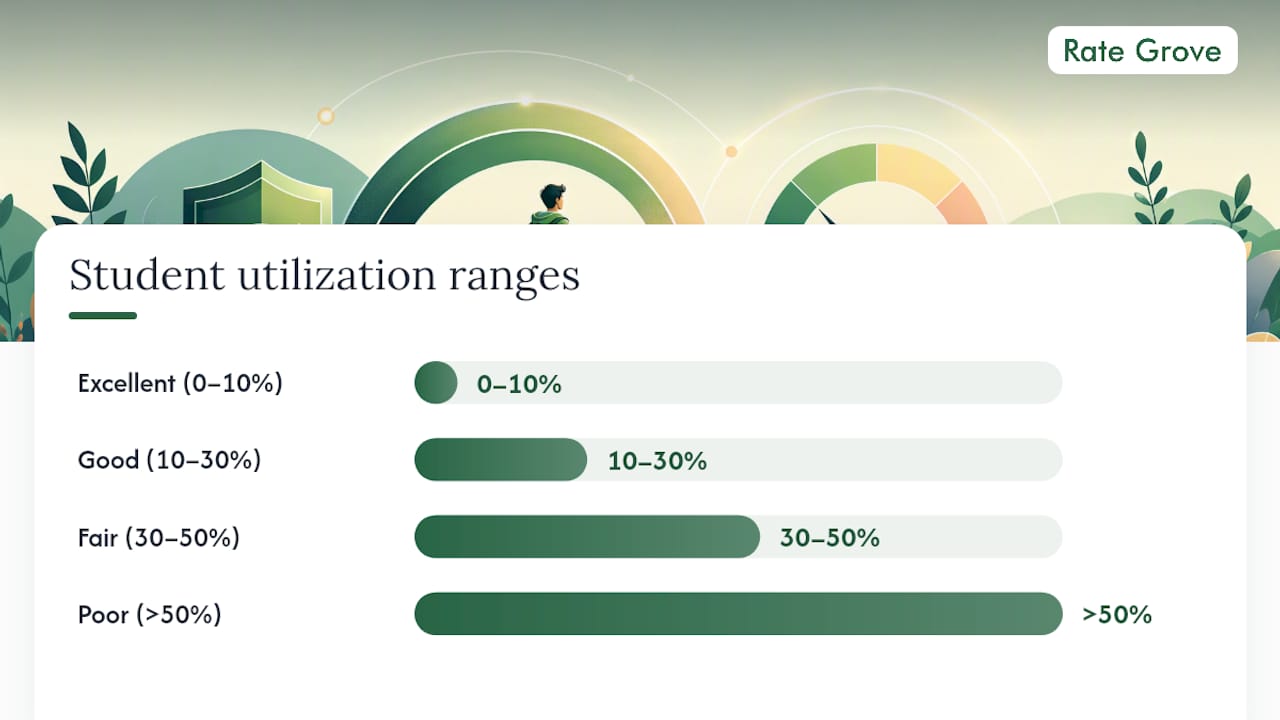
Under 30% keeps your utilization from actively hurting your score. Under 10% is where most credit educators say you’ll see the fastest gains, especially if you’re stacking that habit on top of on-time payments every month.
Zero percent utilization isn’t the goal, though. A card that shows no activity at all gives scoring models nothing to evaluate, and some models actually reward a small, consistently paid balance over a completely dormant card. The better approach:
- Use your card for small, planned purchases you’d make anyway (gas, a streaming subscription, groceries)
- Pay it off in full before or right at the statement close date
- Keep total utilization under 10% if you’re actively trying to raise your score before a big application (an apartment lease, an auto loan)
- Don’t sweat occasional months in the 15% to 25% range if you’re paying on time and building history
The real balancing act is building a track record of reliability while keeping the numbers low, not chasing a perfect zero.
Practical Ways to Lower Your Utilization Right Now
Small, repeatable habits beat one-time fixes. Here’s what actually moves the needle:
- Pay before your statement closes, not just before the due date. Your due date and your statement close date are different, and issuers typically report the statement balance to the bureaus. Paying a few days before that closing date is the single highest-leverage habit for keeping reported utilization low.
- Split payments across the month. Instead of one lump payment, pay in two or three smaller chunks as you spend. This keeps your running balance low all month, which matters if your issuer reports mid-cycle for any reason.
- Pay in full to skip interest entirely. Carrying a balance past your due date triggers interest charges that compound the problem, since you’re now paying to keep utilization high.
- Ask for a credit limit increase every six to twelve months, if your income supports it. A higher limit with the same spending automatically lowers your utilization percentage. Call your issuer, confirm it won’t trigger a hard inquiry if that’s a concern, and ask directly.
- Consider authorized-user status on a parent’s older card. This can add limit and history to your file, but confirm with the primary cardholder that their utilization on that card stays low and that the issuer reports authorized-user activity to all three bureaus.
- Don’t close your oldest card once you upgrade. Closing an account removes that limit from your total available credit and can shorten your average account age, both of which push utilization up and can lower your score.
Pro Tip: Set a recurring calendar reminder two days before your statement close date. It takes ten seconds to check your balance and pay it down, and it’s the one habit that consistently keeps your reported utilization where you want it.
Common Utilization Mistakes That Quietly Hurt Students
A few avoidable habits account for most of the utilization problems students run into.
- Paying after the statement closes instead of before it. Your on-time payment still counts for payment history, but the high balance already got reported for that cycle.
- Closing a card the moment you get a better one. This drops your available credit and can shrink your average account age overnight.
- Relying on one low-limit card for everything. A single $300 limit gets maxed out fast, while spreading spending (or getting a limit increase) keeps the ratio manageable.
- Never checking your credit report. Errors happen, and an incorrectly reported balance can inflate your utilization without you ever knowing why your score dropped.
Checking Your Reported Balances and Fixing Errors
You’re entitled to a free credit report from all three major bureaus at AnnualCreditReport.com, the only site authorized by federal law for this. Pull all three, not just one, since issuers don’t always report to every bureau.
- Compare the balance on your report against your most recent statement balance for each card
- If the numbers don’t match, contact your issuer first to confirm what they actually reported
- File a dispute directly with the bureau showing the error if your issuer confirms a reporting mistake
- Use a reputable monitoring app or your card issuer’s own free score-tracking tool to catch changes between report pulls
Checking regularly also helps you understand how credit bureaus differ in what they collect and report, which explains why your score can vary slightly from one bureau to the next.
Why Small Habits Beat Big Hacks

Every “credit hack” you’ll see online eventually boils down to the same two things: pay on time, and pay before your statement closes. Rate Grove built its comparison guides around that reality, because verified, current data beats clever tricks that stop working the moment issuers change their reporting practices.
The habit of tracking your statement date, month after month, will outperform any one-time maneuver. Consistency compounds here the same way it does with your GPA.
— Mat C.
Find a Student Card That Works With Your Habits, Not Against Them
Some students try to fix utilization by hunting for limit increases alone, while others lean on authorized-user status or a secured card. Each route works, but the card you start with often determines how hard you have to work at the rest. Rate Grove compares student credit cards side by side, including starting limits, annual fees, APRs, and how each issuer actually reports to the bureaus, so you’re not guessing which card will make low utilization easier to maintain.
Compare current student card offers at Rate Grove before you apply, so the card you choose is already working in your favor.