

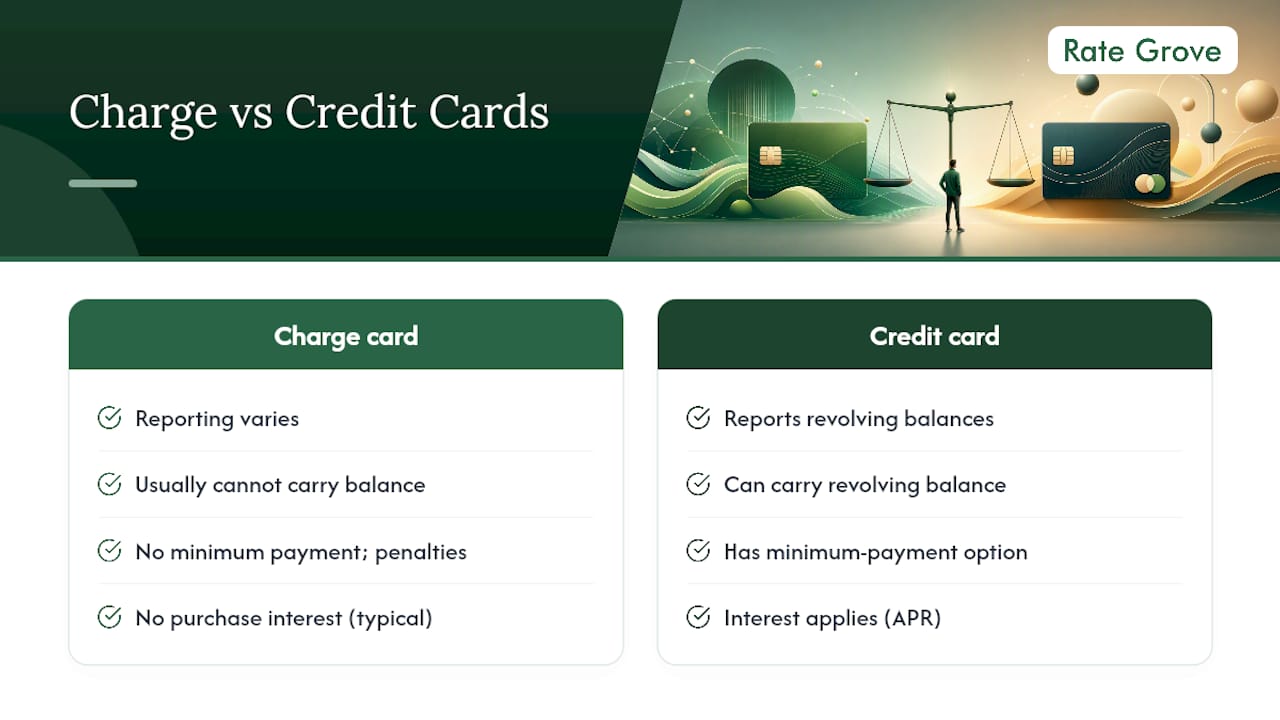
Charge cards require you to pay your full statement balance every billing cycle, with no exceptions. Credit cards let you carry a balance month to month and pay interest on what you don’t pay off. If you always pay in full and want higher (often uncapped) spending power, a charge card can work well. If you occasionally need to spread a payment out or want to avoid steep annual fees, a credit card is the safer fit.
Quick takeaway: The deciding factor almost always comes down to two things:
- Can you pay the full balance every single month, without fail?
- Do you value flexibility (credit cards) more than spending power and premium perks (charge cards)?
Key Takeaways
Charge cards demand full payment every cycle with flexible limits, while credit cards let you revolve a balance at the cost of ongoing interest.
| Point | Details |
|---|---|
| Full payment is mandatory | Charge cards require the entire statement balance paid each cycle, with no minimum-payment option. |
| Credit cards revolve, at a cost | Carrying a balance triggers APR charges once the grace period ends. |
| Limits work differently | Charge cards often skip a preset limit, evaluating purchases individually instead. |
| Utilization impact varies | Charge card balances may not count toward utilization the way revolving credit does. |
| Fine print matters most | Always confirm fee schedules, reporting practices, and any pay-over-time features before applying. |
Table of Contents
- How Charge Cards Work
- How Credit Cards Work
- Charge Cards vs Credit Cards at a Glance
- Pros and Cons of Each Card Type
- Fees, Penalties, and Credit Score Effects
- How to Choose Between a Charge Card and a Credit Card
- Are Charge Cards Still Available in the U.S.?
- Rate Grove’s Verification Checklist Before You Apply
- A Practical Read on Which Card Actually Fits
- Frequently Asked Questions
- Sources
How Charge Cards Work
The rule with a charge card is simple and unbending: you owe the full statement balance by the due date, every cycle. There’s no minimum payment option. Miss that deadline and you’re not just looking at a late fee. Many issuers can restrict further spending, and repeated missed payments can lead to account closure. This structure exists by design. Charge cards were built around the idea of a “pay in full” habit, which is also why issuers can extend high, flexible purchasing power to cardholders.
That flexibility shows up as “no preset spending limit,” a phrase you’ll see on charge card marketing. It doesn’t mean unlimited spending. Issuers still evaluate each purchase in real time against your income, payment history, and spending patterns, according to Experian. A $10,000 purchase might clear fine one month and get flagged the next if your spending behavior looks unusual.
Fee structures on charge cards tend to run higher, particularly annual fees, since many are positioned as premium products with travel perks, concierge services, and rich rewards programs.
- Full statement balance due each cycle, no minimum payment option
- No preset spending limit, but purchases are still evaluated case by case
- Typically higher annual fees, plus possible late fees and returned-payment fees
- Rewards often skew toward premium travel and lifestyle perks
Pro Tip: Before applying, read the cardmember agreement for any optional “pay over time” or installment feature. Some modern charge cards let you revolve a portion of eligible purchases if you opt in, which blends charge-card and credit-card behavior in one product.
How Credit Cards Work
Credit cards operate on revolving credit: you can carry a balance from month to month and pay interest, called APR, on whatever you don’t pay off. Instead of a full-balance requirement, you get a minimum payment, usually a small percentage of what you owe.
Most credit cards also include a grace period, the window between your statement closing date and your due date, during which no interest accrues if you pay your full balance. Pay only the minimum, and interest starts compounding on the remaining balance immediately at the next cycle. That’s where costs escalate quickly, especially with common fee triggers like balance transfers, cash advances, and late payments layered on top.
Average credit card interest rates have run well into the double digits in recent years, based on data tracked by the Federal Reserve. Carrying even a modest balance at those rates for a year can add up to real money in interest alone.
- Revolving balance with a minimum monthly payment requirement
- APR applies to any balance not paid off within the grace period
- Common fee triggers: balance transfers, cash advances, late payments
- Billing cycle length and minimum-payment formulas directly affect how fast you pay off debt and how much interest you pay
The math here matters more than most people assume. A card with a higher minimum-payment percentage actually helps you long term, even though it feels worse on your monthly statement, because it chips away at principal faster.
Charge Cards vs Credit Cards at a Glance
| Comparison Dimension | Charge Cards | Credit Cards |
|---|---|---|
| Required monthly payment | Full statement balance | Minimum payment allowed |
| Ability to carry a balance | No, except opt-in pay-over-time features | Yes, revolving with interest |
| Credit limit behavior | Often no preset limit; spending evaluated per purchase | Fixed credit limit set at approval |
| Typical fees | Higher annual fees common | Wide range, from no-fee to premium tiers |
| Acceptance | Accepted almost everywhere major networks are used | Accepted almost everywhere major networks are used |
| Credit-score/reporting effect | May not count toward utilization the same way | Directly affects credit-utilization ratio |
| Typical target user | Frequent spenders who pay in full | Consumers who want flexibility or are building credit |
A few things jump out once you see these side by side:
- The full-payment requirement is the single biggest functional difference, and it drives nearly every other distinction on this list.
- Charge cards sidestep traditional credit-utilization math because many lack a preset limit, according to Equifax.
- Acceptance is rarely a dealbreaker for either type since both ride on major payment networks.
- Fee structures diverge the most at the premium end, where charge cards often justify a higher annual fee with richer rewards.
Pros and Cons of Each Card Type
Charge cards reward discipline. If you’re a high spender who always pays in full, the lack of a preset limit means large purchases (a home renovation, a business expense, a once-in-a-lifetime trip) don’t bump against an artificial ceiling. Rewards programs on premium charge cards also tend to be generous. The tradeoffs: you must pay in full every cycle, annual fees run higher, and charge cards are simply rarer, which narrows your options.
Credit cards win on flexibility and availability. You’ll find no-fee and low-fee credit cards at nearly every issuer, and the ability to carry a balance occasionally, without penalty beyond interest, gives you breathing room during a tight month. The downside is that interest charges on a carried balance add up fast, and your utilization ratio (how much of your limit you’re using) directly affects your credit score.
- Charge card pros: flexible approvals for big purchases, premium rewards, potentially lighter utilization impact
- Charge card cons: mandatory full payment, higher fees, fewer issuer options
- Credit card pros: revolving flexibility, broad availability, many no-fee choices
- Credit card cons: interest costs on carried balances, utilization affects your score
Eligibility for both leans toward good to excellent credit, though charge cards, particularly premium ones, often expect a stronger income and payment history given the full-payment obligation.
Fees, Penalties, and Credit Score Effects
Both card types can carry annual fees, late fees, and returned-payment fees, but charge cards lean toward the higher end of annual pricing given their premium positioning. Credit cards add interest as an ongoing cost whenever a balance carries past the grace period, plus fees tied to balance transfers, cash advances, and overlimit spending on cards that still enforce a hard limit.

Reporting to credit bureaus is where the two diverge in a way many people miss. Charge card balances, especially on cards without a preset limit, may not factor into your credit-utilization ratio the same way a revolving balance does, per Equifax. Credit card balances count directly, so running a card close to its limit, even briefly, can dent your score before you’ve paid a dollar in interest.
Average credit card APRs tracked by the Federal Reserve have stayed in double-digit territory in recent years, underscoring how expensive a carried balance can get compared to a charge card’s full-payment model.
- Missed payments on either card type get reported to the bureaus and can significantly damage your score
- Charge cards can restrict spending or close accounts after repeated missed full payments
- Credit cards escalate cost through interest, not just penalty fees, when balances go unpaid
- Utilization ratio only applies meaningfully to revolving credit lines
Understanding how credit scores are calculated helps explain why utilization carries so much weight for credit card holders specifically.
How to Choose Between a Charge Card and a Credit Card
Start by being honest about your payment habits. If you’ve carried a balance more than once or twice in the past year, a charge card’s full-payment rule could put you at real risk of fees and account restrictions. If you consistently pay in full, the choice becomes more about fees, rewards, and spending flexibility.
Run through this checklist before applying:
- Estimate your average monthly balance and whether you could pay it off in full every cycle
- Compare the annual fee against the rewards you’d realistically use
- Confirm whether the card offers any optional pay-over-time or installment feature
- Check how late fees are calculated and at what point they kick in
- Ask how the issuer reports your balance to the credit bureaus
Search the issuer’s cardmember agreement and FAQ page for answers to specific questions: “Is there an optional pay-over-time feature?” “How are late fees applied?” “How is my balance reported to Experian, Equifax, and TransUnion?” These details rarely make it into marketing copy, so it’s worth digging into the fine print, per CFPB guidance.
For a deeper look at how issuers set pricing, Rate Grove’s guide on why credit card fees vary breaks down the mechanics behind annual and late fees, and what credit card comparison actually means walks through how to weigh tradeoffs systematically.
Are Charge Cards Still Available in the U.S.?
Yes, charge cards still exist, though they’re a smaller slice of the market than they used to be. American Express remains the most recognized issuer of charge-card-style products in the United States, and both Citi and Chase publish educational material distinguishing the two formats, even though most of their own consumer cards are revolving credit products.
Acceptance for charge cards runs on the same major payment networks as credit cards, so day-to-day usability rarely differs. The gap shows up more in issuer availability than merchant coverage. If you’re exploring options, check issuer pages directly for current terms, since annual fees and reward structures on premium charge cards change more frequently than standard credit card offers.
Rate Grove’s Verification Checklist Before You Apply
Before signing up for either card type, verify these details directly on the issuer’s page, not from a summary or a friend’s recommendation:
- The exact payment due-date window and grace period length
- The late-fee schedule and what triggers it
- Whether an optional pay-over-time or installment program exists, and if enrollment is automatic or opt-in
- How the issuer reports your balance to credit bureaus
- Merchant acceptance notes for international travel, if relevant
- Reward redemption terms and any expiration rules
Pro Tip: Watch for installment programs that require separate enrollment for each purchase. Assuming a charge card automatically lets you revolve a balance, when it actually requires you to opt in per transaction, is a common and costly misunderstanding.
Rate Grove’s editorial team, including contributor Mat C., builds these checklists from verified issuer and regulator data, updated monthly to reflect current terms.
A Practical Read on Which Card Actually Fits
Most people overthink this decision. If you’re a high spender who never carries a balance, a charge card’s lack of a preset limit is a genuine advantage, and the annual fee often pays for itself in rewards. If your spending fluctuates or you sometimes need a month to catch up, a credit card’s revolving structure is the safer, less punishing choice. Rate Grove’s mission is helping you see that tradeoff clearly, without the marketing gloss, so the decision fits how you actually spend, not how issuers want you to spend.
Frequently Asked Questions
Is a charge card better than a credit card for building credit? It depends on your habits. Credit cards report revolving balances that factor into utilization, a major scoring component, while charge cards may report differently since many lack a preset limit.
Can you carry a balance on a charge card? Generally no, unless the card includes an optional pay-over-time or installment feature that you specifically enroll in, per Experian.
What happens if I can’t pay my charge card in full? You risk late fees, spending restrictions, and possible account closure. Charge cards don’t offer a minimum-payment fallback the way credit cards do.
Do charge cards have interest rates? Not on standard purchases, since the model assumes full payment. Optional pay-over-time features may carry their own interest terms, so check the issuer agreement.
Which is easier to qualify for, a charge card or a credit card? Credit cards generally have more accessible options across credit tiers. Charge cards, especially premium ones like those from American Express, typically expect stronger income and payment history.
This article is general information, not a substitute for advice from a qualified financial advisor. Consult a qualified financial professional about your own circumstances before acting on anything here.