

Yes, almost every traditional CD charges an early withdrawal penalty, and it usually costs you somewhere between 60 and 365 days of interest depending on the term you signed up for. Federal rules only guarantee a minimum penalty of seven days’ simple interest if you cash out within six days of opening the account. Beyond that floor, your bank sets the terms, and in some cases the penalty can wipe out your earned interest and dip into the principal you deposited.
TL;DR:
- Penalties for early CD withdrawal typically range from 60 to 365 days of interest, with longer terms carrying steeper fees.
- Federal law guarantees a minimum penalty of seven days’ simple interest if exiting within the first six days, but banks set the rest of the terms.
- Withdrawing early can cost more than earned interest, especially for longer-term CDs, potentially depleting principal if interest doesn’t cover the penalty.
- Choosing no-penalty or laddered CDs can help avoid or mitigate penalties, but requires careful planning around liquidity needs.
- Tax deductions are often available to offset early withdrawal penalties, but interest from the CD remains taxable regardless of those penalties.
Table of Contents
- What Is a CD Early Withdrawal Penalty, Exactly?
- How Do Banks Calculate the Early Withdrawal Penalty?
- What Does an Early Withdrawal Actually Cost You?
- When Does Breaking a CD Actually Make Sense?
- How Can You Avoid or Reduce the Penalty?
- Are CD Early Withdrawal Penalties Tax Deductible?
- How Do You Check Your Own Penalty Terms?
- Rate Grove’s Take: APY Isn’t the Whole Story
- Compare CD Rates and Penalty Terms Before You Commit
- Where to Verify These Numbers Yourself
- Sources
What Is a CD Early Withdrawal Penalty, Exactly?
A certificate of deposit works like a handshake deal: you promise to leave your money untouched for a set term, and the bank rewards that commitment with a fixed rate that’s usually higher than a regular savings account. Pull your money out before the term ends, and you break that promise. The penalty is the bank’s way of recovering the cost of funding your CD and discouraging early exits that would mess with its own lending plans.
Not every CD locks you in the same way. A few product types give you more breathing room:
- No-penalty CDs let you withdraw early with zero fee, usually in exchange for a lower APY.
- Liquid CDs work similarly, often allowing one penalty-free withdrawal after a short waiting period.
- Bump-up CDs let you request a rate increase during the term but still charge the standard penalty for early withdrawal of principal.
Reading the fine print before you deposit tells you exactly which flavor of CD you’re signing up for.
How Do Banks Calculate the Early Withdrawal Penalty?
Most banks use one of two formulas: a set number of days’ interest or a set number of months’ interest, applied to the amount you’re withdrawing. A days-based penalty might read “180 days of simple interest,” calculated as your withdrawal amount times your annual rate divided by 365, times 180. A months-based penalty works the same way but multiplies by your monthly rate.
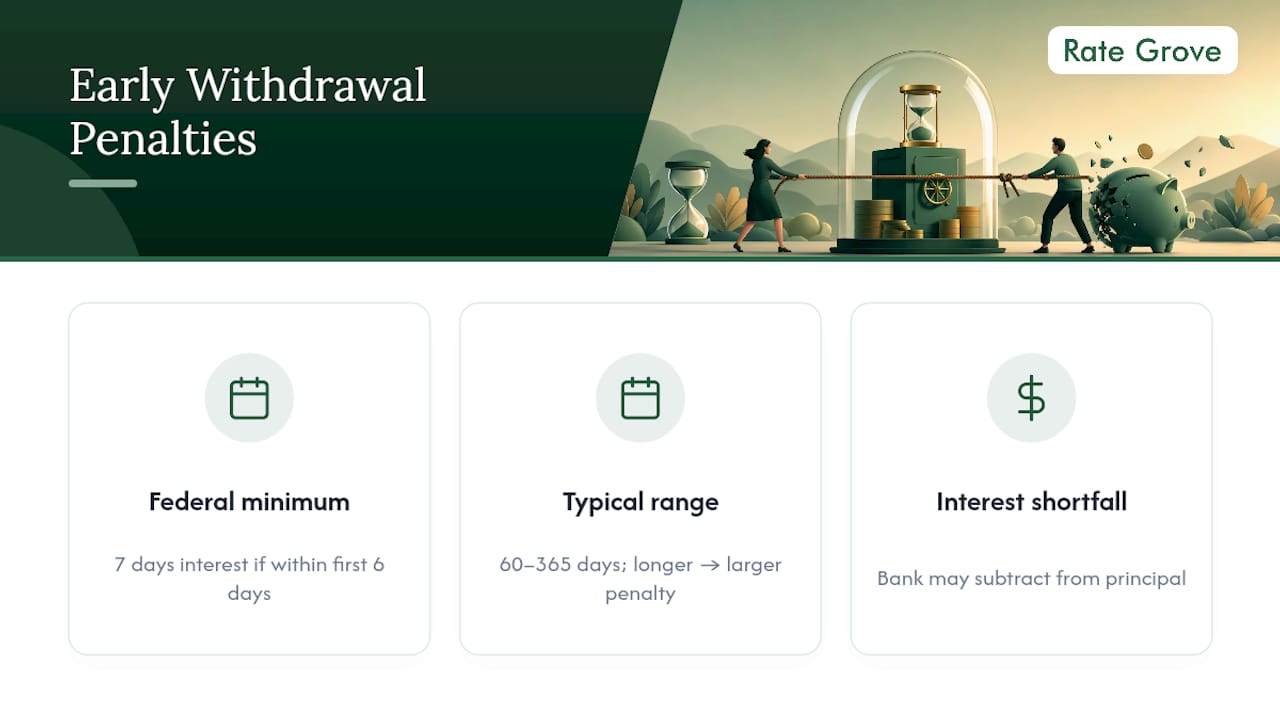
The one rule with no wiggle room comes from federal law: Regulation DD, also known as Truth in Savings, requires a minimum penalty of seven days’ simple interest if you withdraw within the first six days after funding the account. Past that six-day window, there’s no federal cap, so your bank’s disclosure is the only place that matters.
Statistic to remember: Typical U.S. penalties run from about 60 days to 365 days of interest depending on the term length, with longer CDs carrying the steepest fees. If your accrued interest doesn’t cover the penalty, the bank can subtract the shortfall directly from your principal.
What Does an Early Withdrawal Actually Cost You?
Numbers make this real. Here’s how the math plays out for three common CD terms:
- 6-month CD, $10,000 at 4.50% APY, 90-day penalty. Daily interest equals roughly $1.23, so the penalty runs about $111. Withdraw after four months and you’d have earned around $148 in interest. You keep about $37, but you’ve paid for the privilege of early access.
- 1-year CD, $15,000 at 4.75% APY, 180-day penalty. The penalty totals around $351. Pull the money out after just two months, and your accrued interest ($117) doesn’t even cover it. The bank takes the remaining $234 from your principal.
- 5-year CD, $25,000 at 4.25% APY, 365-day penalty. A full year of interest comes to roughly $1,063. If you withdraw in year one, you lose every dollar of interest earned plus additional principal to close the gap.
Pro Tip: Don’t do this math in your head. Plug your APY, term, and penalty terms into a free online CD calculator or a basic spreadsheet formula, and you’ll see the exact break-even point in seconds instead of guessing.
When Does Breaking a CD Actually Make Sense?
Paying a penalty isn’t automatically a bad move. It’s a bad move only when the math doesn’t work in your favor. The break-even framework is simple: compare the dollar cost of the penalty against what you gain by moving the money, either through a higher-yield replacement or by avoiding a costlier expense.
A few scenarios where breaking early is often the smarter play:
- You need the cash for a genuine emergency and the alternative is high-interest credit card debt.
- Rates have jumped enough that a new CD’s yield, after subtracting the penalty, still beats staying put.
- You’re carrying variable-rate debt whose interest cost outpaces what the CD is earning you.
One insight worth internalizing: penalties exist structurally to discourage withdrawals, not to generate profit for the bank, which means the decision should be a cold calculation, not an emotional one triggered by market headlines or short-term panic.
How Can You Avoid or Reduce the Penalty?
You have more control here than most people realize. A few practical moves:
- Choose a no-penalty CD when you’re not sure you’ll need liquidity, accepting a slightly lower APY in exchange for flexibility.
- Build a CD ladder by splitting funds across staggered maturities, so a portion of your money always comes free without a fee. A CD barbell strategy, which pairs short and long terms instead of even spacing, works well if you want liquidity now and higher yield later without the middle rungs.
- Ask about a hardship waiver. Some banks will reduce or waive penalties for documented emergencies, though this isn’t guaranteed.
- Withdraw only interest, if your CD allows it, rather than touching principal.
- Park new savings in a high-yield savings account or money market account instead of locking funds into a CD you might need soon.
Pro Tip: If you’re weighing whether to break a CD to pay down debt, run the numbers through a payment calculator first. It’s a fast way to see whether the interest you’d save on debt actually beats the penalty you’d pay.
Are CD Early Withdrawal Penalties Tax Deductible?
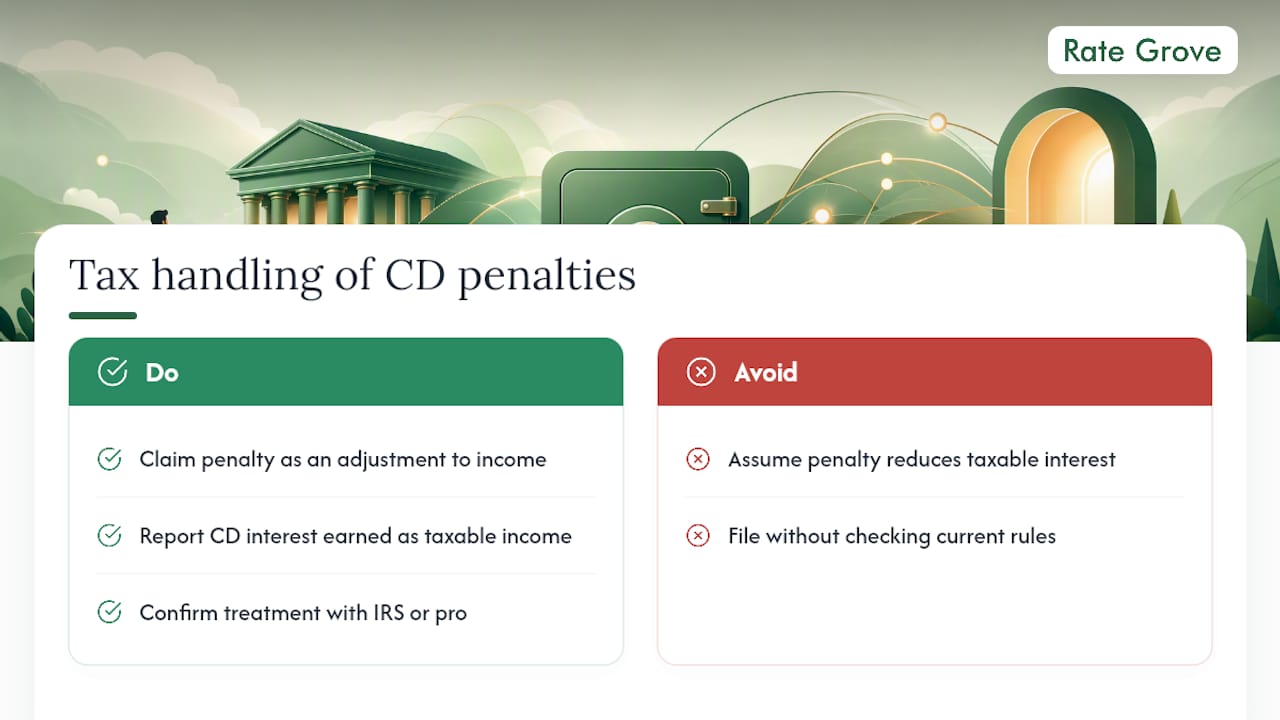
Often, yes. Early withdrawal penalties are typically deductible as an adjustment to income on your federal tax return, which lowers your adjusted gross income rather than your taxable interest directly.
Worth remembering: the interest your CD earned before you withdrew is still taxable, even if the bank later clawed part of it back as a penalty. The two are treated as separate line items. Because tax rules shift and your personal situation matters, confirm the exact treatment with a tax professional or the IRS before you file.
How Do You Check Your Own Penalty Terms?
Every CD comes with a disclosure required under Regulation DD, often called the Truth in Savings disclosure. That document, not a bank’s marketing page, is the final word on your penalty terms.
Here’s how to work through it:
- Locate your account agreement or disclosure statement, either in your welcome packet or online banking portal.
- Find the early withdrawal penalty clause. It should state whether the penalty is calculated in days or months of interest.
- Note your APY, term length, deposit date, and the exact withdrawal amount you’re considering.
- Run the calculation using the days or months formula on the amount you plan to withdraw, not necessarily your full balance.
- Call customer service to confirm the number before you submit a withdrawal request. Disclosure language can be dense, and a five-minute call saves you from a costly misread.
Rate Grove’s Take: APY Isn’t the Whole Story
Chasing the highest APY without checking the penalty terms is one of the most common mistakes CD shoppers make. A CD paying an extra quarter-point but carrying a 365-day penalty can cost you more than a slightly lower-rate CD with a 90-day penalty, if there’s any chance you’ll need the cash early.
Rates and penalty terms should be checked monthly, directly from issuer and regulator disclosures, to ensure comparison of real numbers instead of stale marketing copy. Before you open a new CD or consider breaking one you already own, run the comparison. The penalty terms deserve just as much scrutiny as the headline rate.
— Mat C.
Compare CD Rates and Penalty Terms Before You Commit
Consumers can benefit from side-by-side views of APYs, penalty terms, and fine print pulled straight from issuer and regulator sources, updated regularly to avoid working off outdated numbers.

If you’re building a CD ladder to avoid future penalties altogether, Rate Grove’s step-by-step ladder guide walks through how to structure maturities around your own cash flow needs. And if you’re still deciding which CD type fits your situation, the breakdown of fixed versus variable rate CDs covers the trade-offs in plain terms. Head to the Rate Grove comparison tool and check current APYs and penalty terms side by side before you lock in your next CD.
Where to Verify These Numbers Yourself
For the legal minimum penalty rule, check HelpWithMyBank.gov, which explains Regulation DD in plain language. The FDIC covers deposit protections and consumer disclosures. Use any standard interest calculator to double-check your bank’s math against your own.
This article is general information, not a substitute for advice from a qualified financial advisor. Consult a qualified financial professional about your own circumstances before acting on anything here.