

Most U.S. banks cap standard checking accounts at $300 to $1,500 in ATM cash per day, with premium or business accounts often reaching $2,000 to $5,000. If your everyday limit falls short of what you need today, the fastest fix is calling your bank for a temporary increase or walking into a branch for a teller withdrawal, which doesn’t count against your ATM cap at all.
TL;DR:
- Standard ATM withdrawal limits usually range from $300 to $1,000 per day, but premium accounts can allow up to $5,000 daily.
- Limits are set mainly for security reasons and depend on account type, banking history, and institution policies, not ATM machines.
- You can often increase your limit temporarily or permanently through bank requests, teller withdrawals, or by using alternatives like cash back or wire transfers.
- ATM limits reset on different schedules, either daily at midnight or based on a rolling 24-hour window, affecting withdrawal timing.
- Checking your specific limit requires logging into your bank’s app, online banking, or calling customer service, as published ranges are approximate.
Table of Contents
- How Much Can You Withdraw From an ATM in the U.S.?
- Why Banks Set ATM Withdrawal Limits
- How to Find Your Personal ATM Withdrawal Limit
- How to Increase ATM Access and Alternatives When You Need More Cash
- When Does Your Daily ATM Limit Reset?
- What to Do If Your Withdrawal Gets Declined
- How Rate Grove Helps You Compare Accounts With Better Limits
- A Few Defaults Worth Building Into Your Routine
- Compare Accounts Before Your Next Big Withdrawal
- Where to Verify Your Bank’s Exact Rules
- Sources
How Much Can You Withdraw From an ATM in the U.S.?
Your actual atm withdrawal limits depend almost entirely on account type and how long you’ve banked with that institution. Published ranges from major banks and financial sites show standard checking accounts typically topping out between $300 and $1,000 per day, while premium checking, private banking, or business accounts can climb to $2,000 or even $5,000.
It helps to separate two numbers that get confused constantly: the ATM limit per transaction and your daily cash withdrawal limit. Some machines cap a single transaction at $500 even if your daily allowance is $1,000, which forces multiple withdrawals to reach your full cap.
Here’s how that plays out in practice:
- A $500 morning withdrawal plus a $300 evening withdrawal uses $800 of a $1,000 daily limit, leaving $200 until the reset.
- A premium account with a $3,000 cap could pull $1,000 three separate times before hitting the wall.
- Two withdrawals at two different banks’ ATMs still count against the same daily total, since the limit is tied to your account, not the machine.
Bank atm limits reset on a schedule set by your institution, not by the machine you’re standing at, which is worth remembering before you assume a decline means something’s wrong with your card.
Why Banks Set ATM Withdrawal Limits
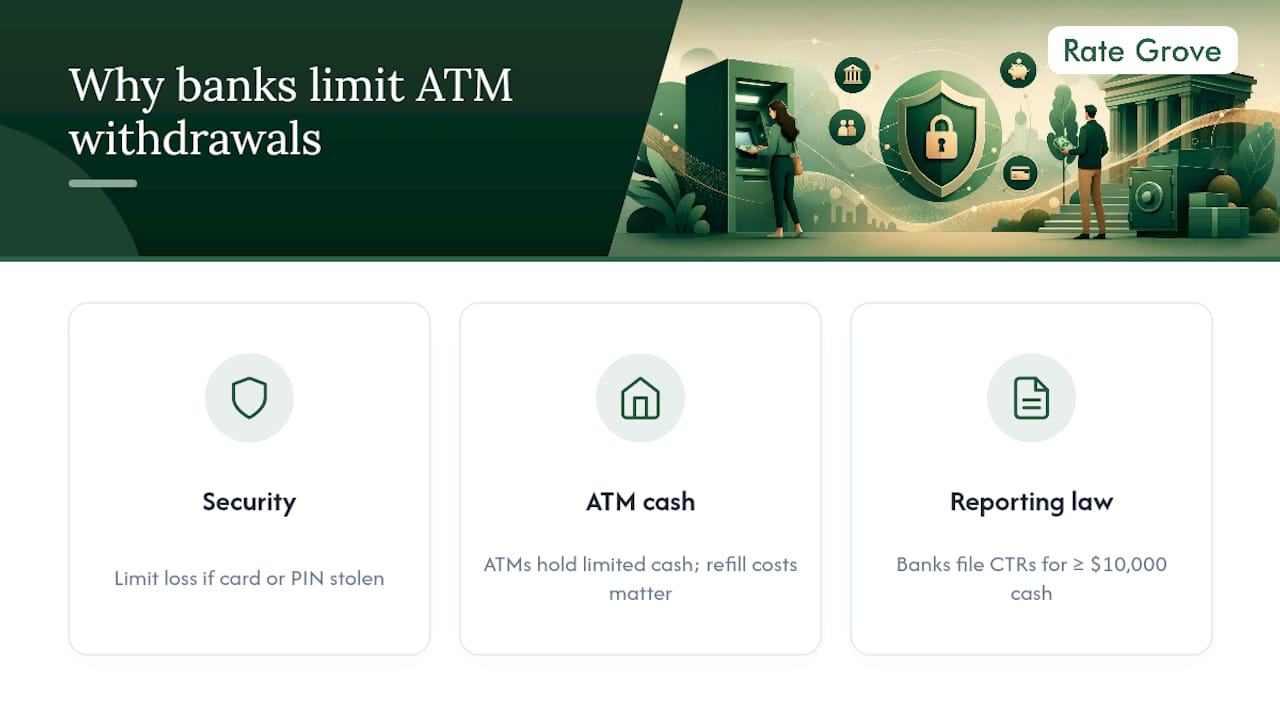
Banks cap daily ATM cash withdrawal limits mainly to limit the damage if your card or PIN gets stolen. Chase explains it plainly: the limit exists as a security measure, separate from your debit purchase limit, which is often higher because purchases carry different fraud protections.
There’s also a physical constraint most people never think about: ATMs only hold so much cash, and operators have to balance replenishment costs against customer demand. A machine that lets everyone pull $5,000 a day runs dry fast.
Federal law requires banks to file a Currency Transaction Report for any cash transaction of $10,000 or more. That threshold doesn’t set your ATM cap directly, but it shapes how banks monitor large cash movement and influences how conservative their default limits tend to be.
How to Find Your Personal ATM Withdrawal Limit
Nobody should guess their own limit. Three ways to confirm it, in order of speed:
- Open your bank’s mobile app and look under card controls, account settings, or “manage limits.” Most major banks display your current daily cap right there.
- Log into online banking on a desktop if the app doesn’t show it. Some institutions bury this under debit card management rather than account settings.
- Call customer service if neither shows a number. Expect identity verification questions, and expect the answer to depend on your account type, how long you’ve held it, and your average balance.
U.S. News notes that this is the most reliable way to get an exact figure, since published ranges are averages, not guarantees.
How to Increase ATM Access and Alternatives When You Need More Cash
If you need more than your daily cap allows, you have two paths: raise the limit or route around it entirely.
Requesting a bank-side increase usually works one of two ways. A temporary increase through the app, phone, or a branch visit is meant for one-off needs, like a big purchase or a trip, and Capital One’s process treats approval as discretionary based on your account standing. A permanent increase to increase bank transfer limit or your ATM cap for good typically requires a longer relationship with the bank, a healthy balance history, or an account upgrade.
When you can’t wait on approval, alternatives often beat the ATM entirely:
- Teller withdrawals bypass the ATM cap completely since you’re pulling straight from your account balance in person.
- Cash back at checkout usually counts toward your purchase limit, which tends to run higher than your ATM limit.
- Writing a check to cash works at your own branch without touching ATM rules at all.
- Same-day ACH or wire transfers move larger sums bank-to-bank; Same Day ACH per-payment limits are increasing to $10 million in 2027, useful context if you’re moving money rather than pulling cash.
Pro Tip: If you’re facing a real emergency and none of these work fast enough, a credit card cash advance is available almost everywhere, but the fees and interest can be brutal. Check the actual cost before you use one.
Before assuming you need a permanent bump, consider whether your account’s monthly fee structure already ties into a tier that offers higher limits automatically.
When Does Your Daily ATM Limit Reset?
This trips up more people than any other part of the system. Some banks reset your daily ATM cash withdrawal limit at midnight Eastern Time. Others use a rolling 24-hour window measured from your last withdrawal, which Wells Fargo confirms varies by institution.
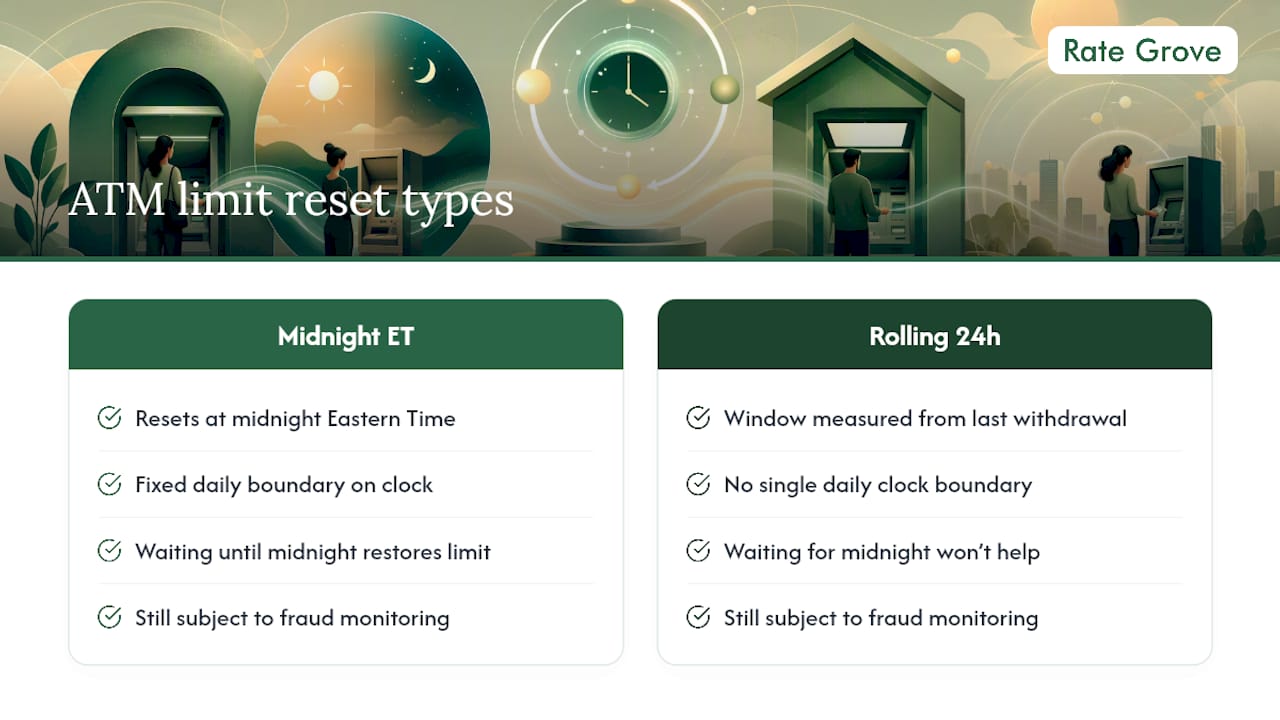
That difference matters if you’re withdrawing near a reset boundary, since a rolling window means you can’t just wait for the clock to strike midnight. Unusual ATM locations, especially while traveling internationally, can also trigger fraud monitoring that temporarily reduces or blocks access. Before a trip, confirm your limit and let your bank know where you’re headed.
What to Do If Your Withdrawal Gets Declined
A declined withdrawal isn’t always about your limit. Work through this quickly:
- Check your available balance for pending holds that reduce what’s actually accessible, then try a smaller amount.
- Call customer service with your ID and account number ready, and ask directly for a temporary lift or teller assistance.
- Use a fast workaround: cash back at a nearby store, a transfer to a linked account, or a quick branch visit.
Most declines resolve within minutes once you know which of these three is the actual cause.
How Rate Grove Helps You Compare Accounts With Better Limits
Not every checking account treats cash access the same way, and that’s exactly where side-by-side comparison earns its keep. We maintain monthly-updated, fact-checked comparisons of U.S. bank accounts that break down fees, ATM access, and foreign ATM fee policies in one place, verified against issuer and regulator sources.
If ATM limits and out-of-network fees are deciding factors in your next account switch, that comparison view saves you from digging through a dozen bank websites yourself. Our bank account comparison checklist walks through exactly what to check before you commit to a new account.
A Few Defaults Worth Building Into Your Routine
Check your limit before a trip or a large cash need, not after you’re standing at a machine that just declined you. For anything above your ATM cap, a teller withdrawal beats waiting on a temporary increase to process. And if fees or limits are the reason you’re shopping for a new account, run the comparison before you apply anywhere.
— Mat C.
Compare Accounts Before Your Next Big Withdrawal
If your current bank’s limits or fees keep getting in your way, switching accounts is often the more permanent fix, and our comparison service is built to make that comparison fast instead of frustrating. Rather than digging through a dozen bank websites for ATM policies and fee schedules, you can see fees, rates, and ATM access side by side, pulled from verified issuer and regulator data and refreshed monthly.

Some readers just need a temporary bump from their current bank. Others discover their account has been undercutting them on ATM access or foreign transaction fees for years. If cash access matters to how you bank day to day, run your current account against alternatives on Rate Grove’s comparison tool before your next big cash need catches you off guard. Rate Grove operates as a comparison service and may earn a commission when you open an account through a partner link.
Where to Verify Your Bank’s Exact Rules
- Chase’s ATM withdrawal limit page confirms limits are a security measure separate from purchase limits.
- Wells Fargo Stories explains reset timing differences and the $10,000 reporting threshold.
- U.S. News banking coverage outlines typical limit ranges across major banks.
Your own bank’s help page always has the final word on your specific account.
This article is general information, not a substitute for advice from a qualified financial advisor. Consult a qualified financial professional about your own circumstances before acting on anything here.