

Series I savings bonds win when you want an inflation hedge, tax deferral, and you’re investing $10,000 or less per year. CDs win when you need predictable returns, want to deposit a large lump sum, or need your money back sooner than five years. The two deciding constraints are the I bond’s $10,000 annual cap and its 12-month lock, versus a CD’s unlimited deposit size and FDIC coverage. The rest of this guide breaks down rates, taxes, and liquidity so you can build a plan around both.
TL;DR:
- I bonds are limited to $10,000 per person annually and have a 12-month lock, making them unsuitable for large lump sums or short-term needs.
- CDs have no purchase limit and offer fixed rates for terms ranging from three months to five years, with FDIC insurance covering up to $250,000 per account.
- The tax advantage of I bonds, including federal tax deferral and state tax exemption, can significantly improve after-tax returns for high-tax-state residents.
- Early redemption penalties vary: I bonds forfeit three months’ interest if cashed before five years, while CDs typically penalize one to twelve months of interest depending on the term.
- Combining maximum I bond purchases annually with laddered CDs provides a flexible, tax-efficient strategy for different savings timelines and amounts.
Table of Contents
- Savings Bonds vs CDs at a Glance
- How CDs Work
- How Series I Savings Bonds Work
- Tax Treatment and Purchase Limits Side by Side
- Liquidity, Penalties, and Laddering Tactics
- Which One Should You Choose?
- Why Rate Grove’s Comparisons Matter Here
- Savings Bonds vs CDs: Which Low-Risk Option Fits Your Timeline?
- Compare Current CD Rates Before You Commit
- Sources
- FAQ
Savings Bonds vs CDs at a Glance
The fastest way to see the tradeoff is side by side. I bonds adjust with inflation and defer taxes; CDs lock in a known rate and let you park as much cash as you want.
| Feature | Series I Savings Bonds | CDs |
|---|---|---|
| Rate setting | Fixed rate at purchase + inflation component, reset every six months | Fixed APY set for the entire term |
| Tax treatment | Federal tax deferred until redemption; exempt from state and local tax | Taxed annually as ordinary income, federal and state/local |
| Liquidity | Locked for 12 months; forfeit 3 months’ interest if cashed before 5 years | Early-withdrawal penalty, often months of interest; no-penalty CDs available |
| Purchase limit | $10,000 per person, per year (electronic) | No statutory limit |
| Safety | Backed by the U.S. government | FDIC insured up to $250,000 per depositor, per bank, per ownership category |
| Best for | Long-term inflation protection, tax-sensitive savers | Predictable short-to-medium-term goals, large deposits |
A few things stand out once you line these up:
- Nobody can put more than $10,000 a year into I bonds electronically, so CDs are the only option for large lump sums.
- I bonds usually beat CDs after tax for savers in high-income-tax states, even at similar headline rates.
- CDs give you more control over term length, from three months to five years or longer.
- Combining both is common: max out the I bond cap annually, then ladder CDs for everything else.
The $10,000 annual cap and the $250,000 FDIC insurance ceiling are the two numbers that shape almost every decision in this comparison.
How CDs Work
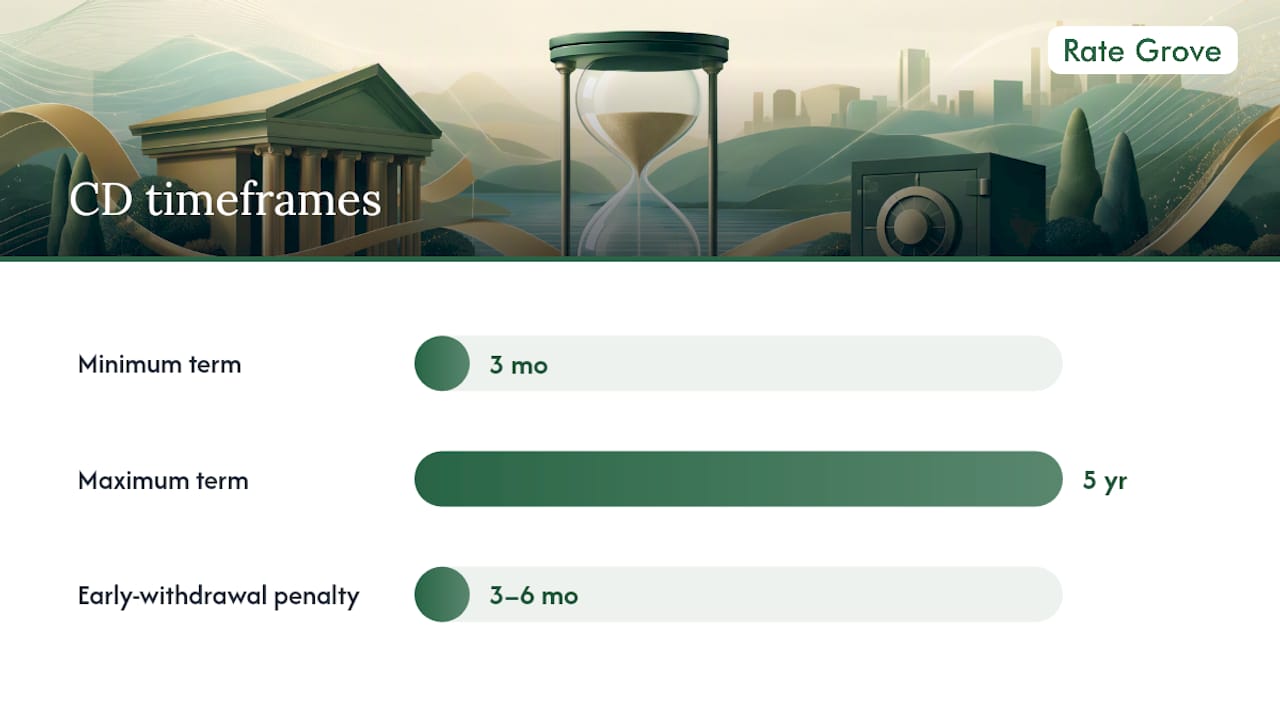
A certificate of deposit is a time deposit offered by a bank or credit union. You agree to leave your money in for a set term, usually anywhere from three months to five years, and the institution pays you a fixed annual percentage yield for that entire period. The rate is locked the day you open the account, so a CD you buy today keeps paying the same APY regardless of what the Federal Reserve does next.
That predictability is the whole appeal. You know exactly what you’ll have at maturity, down to the dollar, assuming you don’t touch it early. Charles Schwab notes that CDs typically carry early-withdrawal penalties measured in months of forfeited interest, though many banks now offer no-penalty CD variants that trade a slightly lower rate for full flexibility.
CDs opened at an FDIC-member bank are insured up to $250,000 per depositor, per institution, per ownership category. That coverage is why CDs remain one of the most trusted places to park cash you can’t afford to lose.
A few practical notes worth knowing before you shop:
- Brokered CDs, sold through investment accounts, can sometimes be resold on a secondary market, but pricing there fluctuates with interest rates.
- Interest compounding frequency varies by bank. Daily or monthly compounding on the same nominal rate produces a slightly higher effective yield than annual compounding.
- Spreading large sums across multiple banks keeps you fully covered when a balance exceeds the $250,000 insurance limit.
Pro Tip: If you’re not sure when you’ll need the cash, a no-penalty CD is usually worth the small rate haircut. Losing three to six months of interest on a standard CD can wipe out most of the advantage a slightly higher rate gave you.
How Series I Savings Bonds Work
Series I savings bonds are purchased directly from the U.S. Treasury through TreasuryDirect, with no bank or broker in between. You buy them electronically, and paper I bonds are no longer available except through IRS tax refunds in limited cases.
The rate is where I bonds get interesting. Each bond carries a fixed rate locked in at the time of purchase, plus an inflation-adjusted rate that resets every six months based on the Consumer Price Index. The two combine into a composite rate, and interest compounds semiannually, meaning your accrued interest itself starts earning interest twice a year rather than once.
That structure makes I bonds a direct inflation hedge in a way a CD simply can’t match. A CD locks in today’s rate no matter what happens to prices over the term. An I bond’s return moves with inflation, for better or worse, every six months.
The catch is the ceiling. You can only buy $10,000 per person per calendar year electronically, and bonds mature after 30 years if left untouched. Redemption rules matter just as much as the rate:
- You cannot cash an I bond during the first 12 months after purchase.
- Redeem between one and five years, and you forfeit the last three months of interest as a penalty.
- After five years, you can redeem penalty free at any time before the 30-year maturity.
The $10,000 cap and the six-month rate reset are the two figures every I bond buyer needs to internalize before deciding how much to commit each year.
Tax Treatment and Purchase Limits Side by Side
Taxes are where the gap between these two instruments widens the most, and it’s the part most comparisons skip. TreasuryDirect confirms that I bond interest is exempt from state and local income tax entirely, and federal tax can be deferred all the way until you redeem the bond or it matures. CD interest gets no such treatment: banks report it annually on a 1099-INT, and you owe federal, state, and local tax on it the year it’s earned, whether you touch the money or not.
That difference compounds over time in a literal sense. Deferring federal tax on an I bond for a decade means your money grows tax-free in the interim, rather than losing a slice to the IRS every April.
The state exemption matters most if you live somewhere with a meaningful income tax. An investor in California or New York can end up with a noticeably better after-tax return on an I bond than on a CD paying a similar headline rate, simply because state taxes never touch the bond. In a state with no income tax, that advantage shrinks, and the comparison comes down more to rate and liquidity.
- Some I bond interest can be excluded from federal tax entirely when used for qualified higher education expenses, subject to income limits and other eligibility rules.
- I bonds are capped at $10,000 per person annually; CDs have no cap, which makes CDs the practical choice once you’re investing beyond five figures.
- If you’re deciding between the two for a large tax-advantaged position, reading a dedicated comparison before committing funds can clarify which side of the cap you’ll land on.
Liquidity, Penalties, and Laddering Tactics
Access to your money is the practical constraint that trips up the most savers, and it works differently for each instrument. Here’s how the two compare when you actually need the cash back early:
- I bonds lock for 12 months, no exceptions. You cannot redeem an I bond in the first year under any circumstance, so never put money there that you might need within twelve months.
- Redeeming an I bond between year one and year five costs three months of interest. After five years, that penalty disappears entirely and you can cash out anytime before the 30-year maturity.
- CD penalties vary by bank and term, but commonly run from one to twelve months of interest depending on the term length and the specific penalty schedule your bank sets.
- No-penalty CDs trade a lower rate for full access, useful when you’re not certain how long you can commit the money.
- Brokered CDs can sometimes be sold on a secondary market before maturity, but you’re at the mercy of prevailing rates. If rates rose since you bought, you’ll likely sell at a discount.
Laddering solves a lot of this friction for CDs. Splitting a lump sum across three, six, twelve, and eighteen-month CDs staggers your access points so you’re never fully locked out. I bonds don’t ladder the same way since the 12-month floor is fixed, but you can still buy across multiple years to stagger your five-year penalty-free dates.
Pro Tip: Keep at least three to six months of expenses in a liquid account, not an I bond. The 12-month lock has no exceptions, even for emergencies, so treat I bond money as untouchable cash for at least a year.
Which One Should You Choose?
Run through these five questions before committing money to either instrument:
- What’s your timeline? Money you need within a year belongs nowhere near an I bond. Money you won’t touch for five-plus years is exactly what I bonds are built for.
- How much are you investing? Anything beyond $10,000 per person per year automatically needs a CD, or another vehicle, once the I bond cap is hit.
- How worried are you about inflation? If you think inflation will run hot, the I bond’s semiannual rate reset protects you in a way a fixed CD rate cannot.
- What’s your state tax bracket? High state income tax makes I bonds more attractive after tax, even at an identical nominal rate.
- Do you need FDIC coverage above $250,000? If so, spread deposits across multiple insured banks rather than assuming one account covers it all.
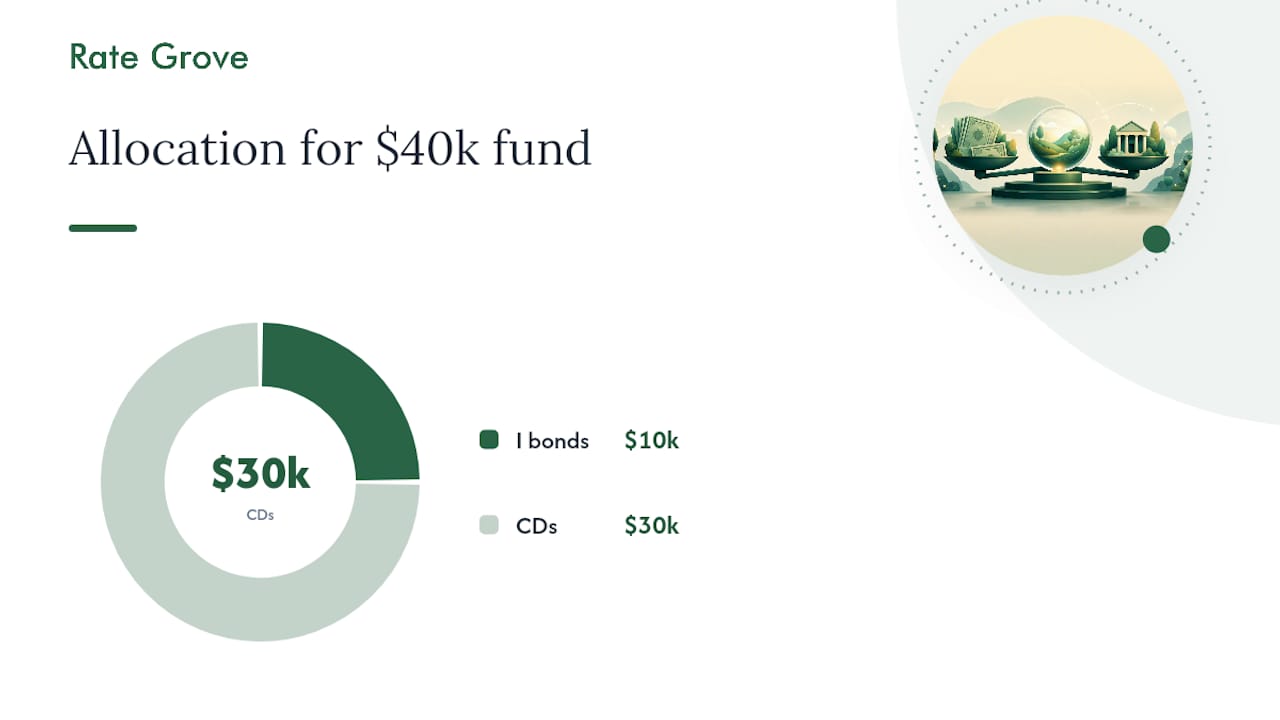
A few common cases play out predictably. A saver setting aside a 3-year house down payment fund with $40,000 in hand should put $10,000 into I bonds for the tax deferral, then ladder the remaining $30,000 across CDs matching the purchase timeline. Someone building a 10-year emergency inflation hedge with modest annual contributions should favor I bonds every year up to the cap, letting the tax deferral and inflation adjustment compound over the following decade.
The strongest approach for most people isn’t picking one instrument; incorporating estate planning resources like a secure digital vault for estate planning can help integrate these financial tools into your overall family financial plan. It’s buying the I bond maximum annually as a standing habit, then routing every additional dollar of safe money into CDs sized and timed to when you’ll actually need it.
Why Rate Grove’s Comparisons Matter Here
CD rates shift constantly and outdated numbers lead to bad decisions. Guides including a dedicated I bonds vs CDs breakdown walk through the tradeoffs covered here with more worked scenarios.
A few resources worth bookmarking as you move from research to action:
- The I bonds vs CDs guide for a deeper walk-through of timeline-based decisions.
- The CD early withdrawal penalty breakdown for calculating exact penalty costs by term.
- The fixed vs variable rate CD guide for understanding which CD structure fits your liquidity needs.
Savings Bonds vs CDs: Which Low-Risk Option Fits Your Timeline?
The conventional advice treats this as a binary choice, and that’s the biggest mistake I see savers make. Most articles push you toward one instrument based on whichever has the flashier headline rate that month. That framing ignores the actual constraint that matters most: the $10,000 annual cap on I bonds makes them a supplement, not a replacement, for most people’s savings strategy.
What gets underrated is the tax angle. Savers fixate on the composite rate and completely overlook that a state tax exemption can swing the real, after-tax comparison by a meaningful margin, especially for anyone in a high-tax state. Meanwhile, CDs get dismissed as boring, when their real advantage is capacity. You can’t retire on $10,000 a year of I bond purchases, but you can absolutely park a six-figure emergency fund across FDIC-insured CDs without thinking twice about the ceiling.
My honest read: buy the I bond max every year as a standing habit, then stop debating and let CDs handle everything else. The decision only feels complicated when you try to make one instrument do both jobs.
— Mat C.
Compare Current CD Rates Before You Commit
Once you know how much is going into CDs, the next step is finding a rate that actually beats inflation after tax, and that’s harder than it sounds when every bank advertises a different APY for a different term. Rate Grove pulls verified rates straight from issuer and FDIC data and lines them up side by side, so you’re not stuck comparing five browser tabs to find the best current yield.
Rate Grove updates its comparisons monthly, which matters because a CD rate that looked competitive in January can fall behind by March. The site also flags which accounts carry no-penalty terms, a detail easy to miss when you’re scanning a bank’s own marketing page. If you’ve settled on how much to keep in CDs after reading through the I bond cap and tax rules above, check current CD rates on Rate Grove before you lock in a term, and confirm the bank you choose carries full FDIC coverage for your balance.
This article is general information, not a substitute for advice from a qualified financial advisor. Consult a qualified financial professional about your own circumstances before acting on anything here.
Sources
FAQ
Can You Cash an I Bond Right After Buying It?
No. I bonds carry a mandatory 12-month holding period, and redeeming between year one and year five forfeits the last three months of interest.
How Much Interest Will a $100,000 CD Earn in a Year?
It depends entirely on the APY offered, since rates vary by bank and term. A CD at a given fixed APY compounds according to that bank’s schedule, so check a current, verified rate before estimating your return based on the specific APY.
Are Savings Bonds Taxed Like CD Interest?
No. Savings bond interest is exempt from state and local income tax and federal tax can be deferred until redemption, while CD interest is taxed annually at all levels the year it’s earned.
What Did Warren Buffett Say About Bonds?
Buffett has long favored equities over bonds for long-term wealth building, generally viewing bonds as a lower-return, capital-preservation tool rather than a growth vehicle, though he has praised Treasury securities for their safety during uncertain periods.
Which Instrument Is Better for a Large Lump Sum?
CDs, since I bonds cap purchases at $10,000 per person per year electronically, while CDs carry no purchase limit and remain FDIC insured up to $250,000 per depositor, per bank.