

For most couples sharing rent, utilities, or a mortgage, a joint account makes daily money management easier and is worth opening. The catch: it also means equal liability for overdrafts and debts, and either owner can withdraw or drain the funds without the other’s consent. If you can’t yet say yes to both trust and shared financial goals, a blended approach is generally recommended over a fully joint account.
TL;DR:
- A joint account simplifies household expenses and provides clear spending visibility but exposes both owners to shared liability and privacy risks.
- It is advisable to open a blended account structure, keeping personal accounts for discretionary spending and using a joint account strictly for shared bills.
- Federal guidance states that joint account funds are protected by FDIC insurance based on each owner’s contribution, and withdrawals are generally not considered unauthorized.
- A joint account does not affect credit scores unless linked to a credit product like overdraft protection, where unpaid balances could reflect on both owners.
- Couples should carefully evaluate trust, debt exposure, and relationship stability before opening a joint account, and consider using comparison tools to find the best account features.
Table of Contents
- Joint Account Pros and Cons: How Shared Accounts Simplify Daily Finances
- Cons: Liability, Privacy Loss, and Real Risks Couples See
- How to Decide: A Checklist and the Blended Account Alternative
- Setting Up the Account: Ownership Type, Insurance, and Documentation
- What the Guidance Actually Says About Protecting Shared Funds
- Does a Joint Account Affect Your Credit Score?
- Tax Implications: Who Reports the Interest and When Gift Tax Applies
- How a Joint Account Can Affect Financial Aid or Benefits Eligibility
- Joint Accounts vs. Authorized User Cards and Shared Payment Apps
- When I’d Recommend a Joint Account, and When I Wouldn’t
- How Rate Grove Helps You Compare Accounts Before You Commit
- Sources
- FAQ
Joint Account Pros and Cons: How Shared Accounts Simplify Daily Finances
A joint account puts both names on the same pool of money, with equal access and equal responsibility for whatever happens in it. Bank educational resources describe this as the defining feature of a joint bank account: both owners can deposit, withdraw, and spend without asking permission. That single fact drives almost every benefit and every drawback you’ll read about in joint account pros and cons discussions, so it’s worth understanding before you compare features or interest rates.
The upside shows up fastest in the mundane parts of running a household together.
- No more transfer juggling. Rent, utilities, and streaming subscriptions get paid straight from one account instead of you Venmo-ing your partner every month.
- One clear picture of spending. You see exactly where the money goes, which makes budgeting conversations less guesswork and more fact-based.
- Built-in continuity. If one partner is hospitalized or traveling, the other can still pay bills and access cash without a legal workaround.
- Occasional fee perks. Combined balances sometimes clear minimum-balance thresholds that waive monthly fees or unlock better savings rates.
Research on couples’ financial habits backs up the transparency angle. A Kellogg Insight review of joint accounts found that couples who pool their money deliberately tend to report better financial transparency and fewer money-related conflicts than those who keep everything separate without a plan.
Pro Tip: Before you merge accounts, run a one-month trial where you both log every joint expense in a shared note or app. It surfaces spending habits neither of you may have admitted to out loud.
Cons: Liability, Privacy Loss, and Real Risks Couples See
The same equal access that makes a joint account convenient is exactly what makes it risky. Every owner can move money without the other’s approval, and every owner is on the hook for whatever the account owes, even charges they didn’t personally make.
- Shared liability for overdrafts and fees. If your partner overdraws the account buying concert tickets, you’re both responsible for repaying it.
- Exposure to a partner’s debts. Creditors or courts can sometimes reach into a joint account to satisfy a judgment or garnishment against just one owner, depending on state law and the type of debt.
- Breakup complications. Closing a joint account or dividing the balance typically requires both signatures, which can stall things badly if a relationship ends on bad terms.
- Loss of financial privacy. Every transaction is visible to the other owner, which can feel invasive if one partner wants to keep some spending private, like a gift purchase.
- Financial abuse risk. In controlling relationships, a joint account can become a tool for monitoring or restricting a partner’s spending.
When a co-owner withdraws money without permission and disappears with it, the remedy is often limited. Consumer Financial Protection Bureau guidance on joint account withdrawal disputes makes clear that because both owners have full legal access, a bank generally won’t treat the withdrawal as unauthorized, even if it feels that way to the person left with nothing.
How to Decide: A Checklist and the Blended Account Alternative
Before you sign anything, run through a short checklist with your partner. It won’t give you a legal verdict, but it will surface the real friction points before they become expensive ones.
- How often do you share expenses? Weekly grocery runs and a joint lease argue for a joint account; occasional shared trips don’t.
- How much do you trust each other’s spending habits? Be honest here. A joint account amplifies whatever trust level already exists.
- What’s your individual debt exposure? If one partner has collections, judgments, or a bankruptcy risk, a joint account puts shared funds within reach of those creditors.
- Do you have an estate plan? Survivorship rules determine who gets the money if one owner dies, so this matters more than most couples think going in.
- How much emergency access do you each need? If one partner travels for work or has health issues, a joint account solves access problems that individual accounts can’t.
If the answers are mixed, the blended strategy solves most of the problem without the full exposure. Open one joint account strictly for agreed shared bills, keep individual accounts for discretionary spending, and set a simple rule for contributions, like splitting by income percentage rather than a flat 50/50 split. A guide to a multi-account banking strategy walks through how to structure the “yours, mine, and ours” split in practice.
Pro Tip: Ask your partner directly: “What happens to this account if we break up?” If either of you hesitates or avoids the question, that’s your signal to consult a lawyer before opening anything jointly.
Setting Up the Account: Ownership Type, Insurance, and Documentation
How you title the account matters as much as which bank you choose. Most joint accounts default to “joint tenants with right of survivorship,” meaning the surviving owner automatically inherits the balance without probate. Some states offer alternative ownership structures with different rules, so ask your bank to spell out exactly what you’re signing.
Deposit insurance works differently for joint accounts than for individual ones. FDIC guidance on joint account insurance explains that joint accounts are insured separately from each owner’s individual accounts, based on each co-owner’s share, up to the standard coverage limit per institution. You can model your exact coverage using the FDIC’s EDIE calculator before you commit funds.
| Protection step | What it does |
|---|---|
| Enable transaction alerts | Flags withdrawals or transfers above a threshold you set |
| Request paper or digital receipts | Creates a record for disputes |
| Review authorized signer settings | Confirms who can add or remove account access |
| Add transfer-on-death designation | Clarifies asset transfer outside survivorship default |
If you spot unauthorized activity, contact your bank immediately and file a written dispute; CFPB guidance on joint accounts after death also outlines what a surviving owner should expect banks to require before releasing full account control.
What the Guidance Actually Says About Protecting Shared Funds
Federal guidance on joint accounts is more specific than most banking marketing material lets on, and it’s worth reading directly rather than trusting a summary.
- FDIC coverage rules calculate insurance per co-owner, not per account, so a joint account with two owners can carry more combined protection than either owner’s individual account.
- CFPB dispute guidance confirms that equal access cuts both ways: a bank generally can’t reverse a withdrawal just because one owner disagreed with it after the fact.
- Financial planners quoted in bank commentary consistently point to the blended approach as the practical middle ground, not a compromise for people who “can’t fully commit.”
Wells Fargo’s own commentary on couples and money notes that a joint account for shared bills paired with individual accounts for personal spending gives couples transparency where it matters and autonomy where they need it.
Before opening anything, run this quick Rate Grove verification checklist: confirm the fee schedule in writing, verify FDIC or NCUA coverage on the institution’s own site, ask specifically about survivorship language, and test the mobile app’s alert and permission settings before you fund the account.
Does a Joint Account Affect Your Credit Score?
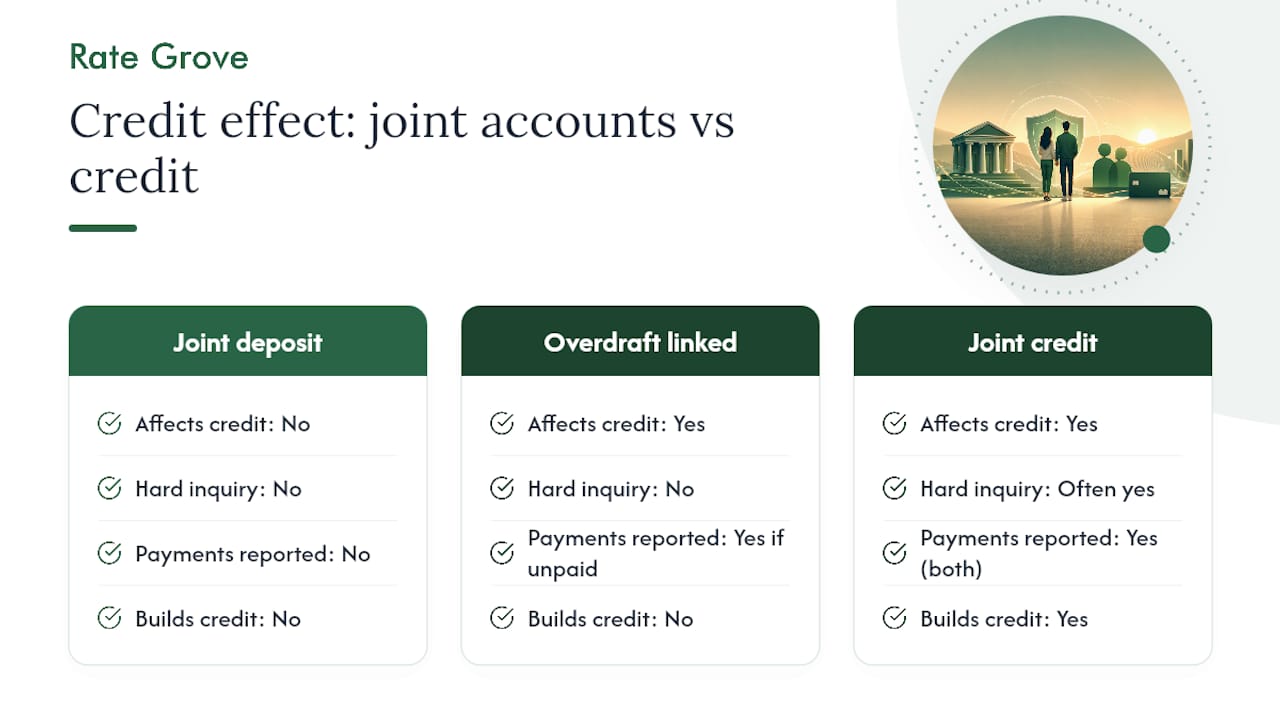
A standard joint checking or savings account has no direct effect on your credit score. Credit bureaus track credit accounts, like loans and credit cards, not deposit accounts, so opening a joint checking account together doesn’t create a shared credit file or a hard inquiry on either partner’s report.
Where it gets more complicated is if the joint account is linked to an overdraft line of credit or overdraft protection tied to a credit product. In that case, missed payments or an unpaid negative balance sent to collections can appear on both owners’ credit reports, since both are legally liable for the debt. This is different from a joint loan or joint credit card, where both names are on a credit account from day one and both credit histories are affected by every payment, on time or late.
If you’re deciding between a joint bank account and a shared credit product to build joint credit history, know that a checking or savings account won’t do that job. Couples looking to build credit together typically need an actual joint loan, a joint credit card, or one partner adding the other as an authorized user, which is a separate decision from whether to share a bank account at all.
Tax Implications: Who Reports the Interest and When Gift Tax Applies
Interest earned in a joint account is generally taxable, and the IRS default rule attributes that income based on each owner’s contribution to the account, though many couples simply split it evenly or report it under one Social Security number by informal agreement with the bank. The bank typically issues a single Form 1099-INT under the primary account holder’s tax ID, so you’ll want to agree in advance on how to divide that income if you file taxes separately.
Gift tax rarely comes into play for everyday joint accounts between spouses or partners, since adding money to a jointly owned account you both have equal access to generally isn’t treated as a completed gift the way an outright transfer would be. It becomes more relevant if one owner deposits a large sum and the other withdraws it for personal use well beyond what would be considered shared household spending, since that pattern can start to look like a gift for tax purposes. If you’re combining significant assets, not just paychecks and bill money, a tax professional can confirm how your specific situation is treated.
How a Joint Account Can Affect Financial Aid or Benefits Eligibility
Joint accounts can complicate eligibility for need-based financial aid or means-tested government benefits, because the full balance is often counted as an asset for both owners, not split proportionally. For a college student applying for financial aid through the FAFSA, a joint account with a parent can inflate the reported asset total even if the student only uses a small portion of the funds, potentially reducing aid eligibility.
The same principle applies to programs like Medicaid or Supplemental Security Income, which have strict asset limits. A joint account with an aging parent or family member, opened for convenience in paying bills, can push that person over an asset threshold and jeopardize benefits they otherwise qualify for. If eligibility for aid or benefits is a live concern for your family, it’s worth exploring alternatives like a power of attorney or an authorized signer arrangement, which grant bill-paying access without adding a co-owner to the account title.
Joint Accounts vs. Authorized User Cards and Shared Payment Apps
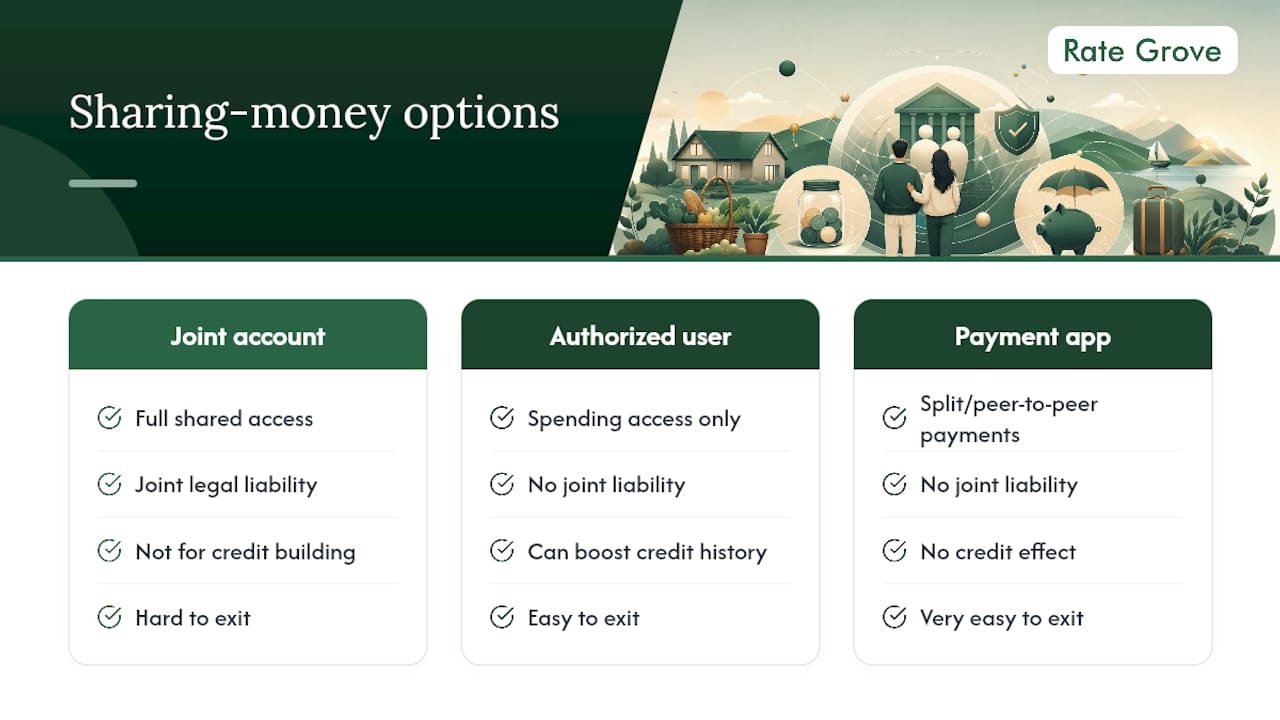
A joint account isn’t the only way to share money with a partner, and it’s not always the right tool. Comparing it against the alternatives clarifies what you actually need.
Adding your partner as an authorized user on a credit card gives them spending access without joint liability for the full account. In most cases, the primary cardholder remains solely responsible for the debt, and the authorized user’s credit history may benefit from the primary holder’s good payment record without carrying legal responsibility for the balance. This works well for couples who want shared spending power without merging deposit accounts.
Shared wallet apps like split-payment or peer-to-peer transfer tools handle one-off or recurring reimbursements, like splitting a dinner bill or a shared subscription, without linking your actual bank accounts. They’re lightweight and easy to exit, but they don’t offer the automatic bill-pay convenience or survivorship protections a joint account provides.
A joint account remains the strongest option when you need full, ongoing shared access to the same pool of money, like a household budget both partners draw from constantly. For narrower needs, like occasional splitting or building credit together, an authorized user card or a payment app solves the problem with far less legal entanglement.
When I’d Recommend a Joint Account, and When I Wouldn’t
I favor the blended approach for most couples: a joint account for the bills you both agree on, personal accounts for everything else. Full joint accounts make sense once you’ve lived through a few pay cycles together and neither of you flinches at full visibility. I’d hold off, or add legal protections first, if either partner carries significant debt, if the relationship is new, or if an estate plan hasn’t been discussed yet.
— Mat C.
How Rate Grove Helps You Compare Accounts Before You Commit
Once you’ve decided a joint account, or a blended setup, is the right move, the next problem is finding an account that actually fits. Rate Grove exists for exactly that moment: instead of digging through a dozen bank websites trying to compare fee schedules and interest rates, you get a side-by-side view built from verified data pulled directly from issuer and regulator sites.

This resource checks the details that actually matter for joint accounts, monthly maintenance fees, minimum balance requirements, FDIC or NCUA coverage signals, and mobile features like transaction alerts and authorized signer controls, so you’re not guessing based on outdated marketing pages. Use it to shortlist two or three accounts that fit your household’s needs, then verify the fine print directly with the bank before signing.
If you and your partner are ready to compare real options rather than generic bank homepages, start comparing accounts on Rate Grove and narrow the field in minutes instead of hours.
Sources
FAQ
What Does Dave Ramsey Say About Joint Bank Accounts?
Dave Ramsey generally advises married couples to combine finances fully, including joint bank accounts, arguing that separate accounts can create a “roommate” dynamic rather than a shared financial life. His stance is specific to married couples and doesn’t extend the same recommendation to unmarried partners.
Is a Joint Account a Good Idea?
It’s a good idea for couples sharing regular expenses like rent, utilities, or a mortgage, since it simplifies bill paying and gives both people a clear view of household spending. It carries more risk for couples with unequal trust levels, significant individual debt, or an undefined relationship future, where a blended strategy or multi-account approach is often safer.
Who Legally Owns a Joint Bank Account?
Both named owners legally own the full account, not a proportional share, and each has complete access to withdraw, deposit, or close the account without the other’s consent. Most joint accounts default to right-of-survivorship ownership, meaning the surviving owner automatically inherits the balance, as CFPB guidance on joint accounts after death explains.
Can Boyfriend and Girlfriend Have a Joint Account?
Yes, banks don’t require marriage to open a joint account, so unmarried couples can open one together as easily as spouses can. The legal risks, especially around splitting funds if the relationship ends, tend to be higher for unmarried couples since there’s no divorce process to formally divide shared assets.