

The cheapest fixes for an overdraft are declining debit-card coverage, linking a savings account, or asking your bank about a low-cost line of credit or small-dollar loan. Right now, stop nonessential spending, check your available balance for pending items, and move any funds you have to cover the gap. Then call your bank and the biller before a payment bounces.
TL;DR:
- Linking a savings account for automatic transfers is typically the cheapest overdraft alternative if sufficient funds are available.
- Cancel nonessential spending, transfer funds quickly, and contact billers early to prevent payments from bouncing before overdraft fees occur.
- Choosing a fee-free or low-overdraft checking account can eliminate frequent overdraft charges if overdrawing happens more than once a year.
- Opting out of debit and ATM overdraft coverage prevents fees on short-term overdrafts, but checks and recurring payments may still incur charges.
- Comparing bank accounts for fees, transfer limits, and overdraft policies before switching helps minimize future overdraft risks.
Table of Contents
- What Are the Best Overdraft Alternatives?
- What Should You Do Right Now to Stop an Overdraft?
- How Can You Avoid Overdrafts for Good?
- How Does the Overdraft Opt-In Rule Actually Work?
- How Do You Compare the Real Cost of Each Option?
- Where Rate Grove Fits Into the Picture
- Which Alternative Should You Actually Prioritize?
- Find a Lower-Fee Account Before You Need One
- Where to Verify These Rules Yourself
- Sources
- FAQ
What Are the Best Overdraft Alternatives?
Not every alternative fits every situation. Some save you money on a one-time slip. Others only make sense if you’re overdrawing every month.
- Declining debit-card overdraft (opting out): Your card gets declined at the register instead of clearing with a fee attached. This costs nothing, but it means occasional embarrassment at checkout if you’re not tracking your balance closely.
- Linked savings transfer or sweep: Your bank pulls from savings automatically when checking runs dry. This is usually the cheapest option if you keep a buffer there, though some banks charge a small per-transfer fee or cap how much moves at once.
- Overdraft line of credit or small-dollar loan: A linked credit line covers the shortfall and charges interest only on what you use. It’s often far cheaper than a flat overdraft fee for a short gap, but it’s still a loan. You have to pay it back.
- Credit card cash advance or card-linked transfer: This can stop a decline in its tracks, but cash advances usually carry a fee plus interest that starts accruing immediately, with no grace period. Use it as a last resort, not a habit.
- Switching to a fee-free or low-overdraft checking account: If you’re hitting this problem more than once a year, the real fix might not be an alternative at all. It might be a different account. Common checking account fee drains often trace back to accounts that were never built for how you actually bank.
The FDIC points to the same short list: track your deposits closely, link a savings account, and ask about a small-dollar loan before you let the bank cover a purchase for a fee that can run around the average overdraft fee.
What Should You Do Right Now to Stop an Overdraft?
If you’re staring at a balance that’s about to go negative, work through this in order:
- Pause nonessential spending. Cancel or delay anything that isn’t due today.
- Check available versus pending balances. A mobile deposit that “cleared” on your app might not be available for a day or two, and pending authorizations can eat into a balance you thought was safe.
- Move funds fast. Transfer from savings or another account using whatever method clears quickest, even if it’s not free.
- Contact the biller. Ask for a short extension or an alternate payment date before the payment gets returned.
- Call your bank. Ask for a one-time courtesy fee reversal, or ask what linked-transfer options they offer right now.
Pro Tip: Banks often waive one overdraft fee a year for customers who ask, especially if you’ve never requested it before. It costs you nothing to call and ask.
The FDIC’s guidance backs this exact sequence: check your balances, move what you can, and reach out before a payment fails rather than after.
How Can You Avoid Overdrafts for Good?
One-time fixes stop the bleeding. Habits stop it from happening again.
- Set a visible cushion. Keep a small buffer in checking that you mentally treat as untouchable, and turn on low-balance alerts through your bank’s app.
- Link savings or automatic sweeps. This works only if the transfer is actually fast enough and cheap enough to matter, so ask about the fee and the transfer limit before you count on it.
- Time your bills around payday. Or set up a dedicated bill-only account so rent and utilities never compete with grocery money for the same dollars.
- Compare accounts before you switch. Some checking accounts still charge NSF fees on returned items even after you opt out of debit overdraft coverage, so read the fine print on what “no overdraft fees” actually excludes.
- Reconcile pending holds regularly. A mobile banking app that shows both available and pending balances is worth more than one that only shows a single number.
Pro Tip: Displayed balances aren’t always spendable balances. A pending hold from a gas station or hotel can sit on your account for days before it clears, which is exactly how overdraft fees drain small balances that looked fine that morning.
How Does the Overdraft Opt-In Rule Actually Work?
Regulation E requires banks to get your affirmative opt-in before charging a fee for covering an ATM withdrawal or one-time debit card purchase that overdraws your account. Without that opt-in, the transaction simply gets declined at no charge. That’s the CFPB’s core guidance: opt out of debit and ATM overdraft coverage, link checking to savings, or ask about a line of credit.
Here’s the part most people miss: opting out doesn’t cover everything. Checks and recurring ACH payments, like a mortgage or a subscription, are treated differently and can still trigger a nonsufficient funds fee or a returned payment even if you’ve turned off debit overdraft coverage. The CFPB’s 2024 circular spells out that opt-in consent has to be verifiable, and it only applies to those specific transaction types.
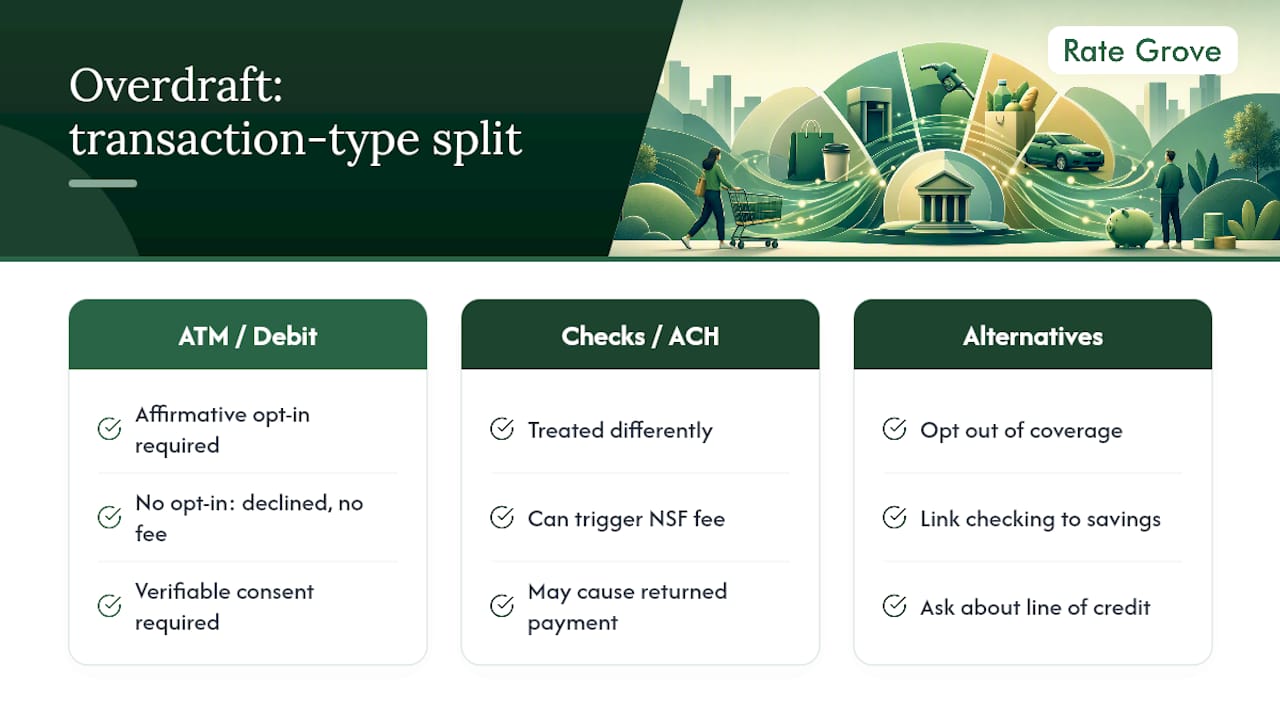
Call your bank and ask for written confirmation of your opt-in status, transaction type by transaction type, and a list of every alternative coverage option they offer. The Federal Reserve requires banks to disclose available lines of credit or transfer services, so that information should be on file somewhere. Ask for it directly.
How Do You Compare the Real Cost of Each Option?
Add up more than the sticker price of the overdraft fee itself. Include the per-item overdraft or NSF fee, any transfer fee for moving money between accounts, interest or draw fees on a credit line, merchant returned-payment fees, and any late-payment penalty the biller might charge on top.
For a one-time gap, a linked savings transfer usually wins on cost since it’s often free or close to it, assuming you actually have the funds sitting there. For a balance that stays negative for weeks, a low-rate credit line or small-dollar loan tends to beat repeated overdraft fees, since interest on a modest balance rarely stacks up to the average overdraft fee per transaction.
Before you rely on any alternative, ask your bank three questions:
- What’s the transfer fee, and is there a daily or monthly limit?
- What are the repayment terms on a linked credit line or loan?
- Does using it get reported anywhere that could affect your credit?
Reading your account’s fee disclosures closely answers most of this before you ever need to call.
Where Rate Grove Fits Into the Picture
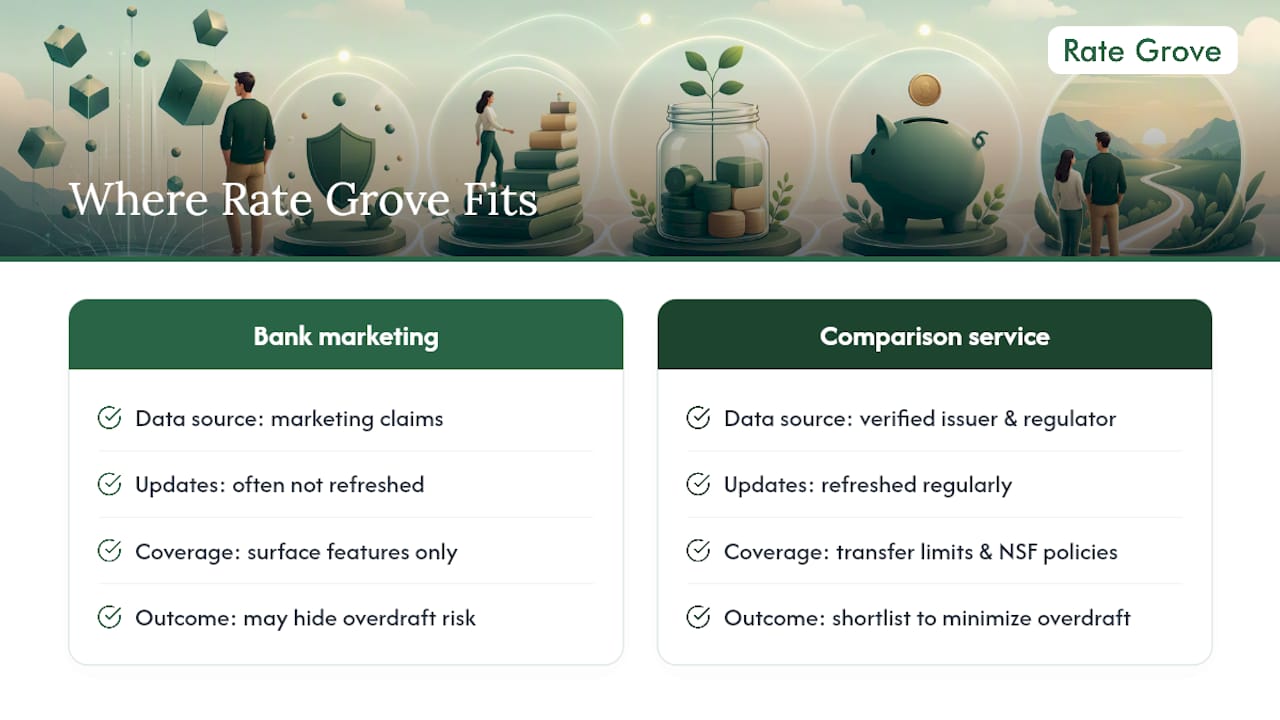
There are services that compare checking account fees, transfer policies, and overdraft terms side by side, based on verified issuer and regulator data and refreshed regularly. That matters because two accounts that look identical on the surface can have wildly different transfer limits or NSF policies buried in the fine print. Use the comparisons to shortlist accounts that minimize overdraft exposure before you switch, rather than guessing based on a bank’s marketing page.
Which Alternative Should You Actually Prioritize?
If this is a rare slipup, grab the fastest, cheapest fix: a linked savings transfer or a one-time fee waiver request. If you’re overdrawing most months, stop treating it as a one-off problem. Switch accounts, build a real cushion, and use budgeting tools instead of borrowing your way through it again.
— Mat C.
Find a Lower-Fee Account Before You Need One
One can find alternatives to guessing your way through bank fee pages by using side-by-side comparisons of checking account fees, transfer policies, and overdraft terms, verified against issuer and regulator data and refreshed periodically. This approach puts the tradeoffs in one place instead of digging through disclosure PDFs from multiple banks.
If you’ve read this far because an overdraft already cost you money, the smartest next move is checking whether your current account is even the right fit. Compare bank accounts on Rate Grove to see which ones offer lower-cost transfer options, fewer NSF fees, or no debit overdraft coverage at all, and find one that matches how you actually spend before the next shortfall hits.
Where to Verify These Rules Yourself
- The FDIC’s overdraft guidance covers prevention strategies and typical fee ranges.
- The CFPB’s overdraft options page breaks down opt-in mechanics and consumer choices.
- The Federal Reserve’s Regulation E text lays out required disclosures for overdraft services.
- Helpwithmybank explains where to file a complaint if a bank isn’t following the rules.
This article is general information, not a substitute for advice from a qualified financial advisor. Consult a qualified financial professional about your own circumstances before acting on anything here.
Sources
FAQ
What Are Some Alternatives to an Overdraft?
The main alternatives are opting out of debit and ATM overdraft coverage, linking checking to a savings account, and asking your bank about an overdraft line of credit or small-dollar loan. A credit card cash advance can work in a pinch, but it usually costs more in fees and interest than the other options.
What Banks Let You Overdraft Immediately?
This depends entirely on the individual bank’s opt-in settings and account type, not a universal industry rule. Ask your bank directly for written confirmation of your opt-in status for ATM and debit transactions, since Regulation E requires that consent to be verifiable.
What Are the Two Types of Overdrafts?
The two main categories are overdraft coverage that requires your opt-in, like ATM withdrawals and one-time debit card purchases, and coverage that doesn’t require opt-in, like checks and recurring ACH payments. The second category can still trigger NSF or returned-payment fees even if you’ve declined debit overdraft coverage.
What Are Two Ways to Avoid Overdraft Fees?
Link your checking account to savings for automatic transfers when your balance runs low, and set up low-balance alerts through your bank’s mobile app so you catch a shortfall before it happens. Comparing checking accounts for their overdraft and NSF policies before you open one also cuts your long-term risk.
Does Rate Grove Show Overdraft Fees When Comparing Accounts?
Some account comparison tools include fee structures, transfer policies, and overdraft terms pulled from verified issuer data and updated periodically. These can make it easier to spot which accounts charge less for situations like linked transfers or NSF fees.