

Inflation quietly erodes the real value of your cash savings every year your account’s annual percentage yield (APY) falls short of the Consumer Price Index (CPI). With CPI rising 3.8% year-over-year in April 2026, a $10,000 balance earning next to nothing lost roughly $380 in purchasing power over those 12 months. The fix is straightforward: move idle cash to an account whose APY actually keeps pace.
Your quick-start priorities:
- Check your APY vs. CPI. If your APY is below the current inflation rate, your real return is negative.
- Protect emergency liquidity. Keep three to six months of expenses in an accessible, high-yield savings or money market account.
- Shift longer-dated cash. Money you won’t need for six months or more belongs in a CD, Treasury bill, TIPS, or I-bond rather than a low-rate checking account.
Key Takeaways
Inflation reduces the real value of your savings whenever your account’s APY falls below the CPI rate, and the gap between a big-bank default account and a top high-yield savings account can cost you hundreds of dollars per year on a $10,000 balance.
| Point | Details |
|---|---|
| Real return is what matters | Subtract the annual CPI rate from your APY; a negative result means you’re losing purchasing power. |
| Big-bank defaults lose ground fast | A 0.01% APY account lost roughly $379 in real value per $10,000 at April 2026’s 3.8% CPI. |
| Top high-yield accounts can keep pace | High-yield savings paying 4.15%–5.00% APY have recently exceeded CPI, producing a small positive real return. |
| Match the vehicle to the timeline | Use liquid high-yield savings for emergencies, CDs or T-bills for 6–36 months, and diversified investments for long-term goals. |
| Rate Grove speeds the comparison | Rate Grove’s side-by-side tool compares APYs, fees, and terms using verified data so you can act quickly. |
Table of Contents
- How does inflation affect savings? Understanding CPI and purchasing power
- Nominal vs. real returns: a worked dollar example
- How inflation hits different savings vehicles
- Concrete strategies to protect your savings during inflation
- How to choose the right place for each portion of your savings
- Current numbers: how do today’s APYs compare to CPI?
- Your action plan: what to do with your savings this week
- What most savers get wrong about inflation and cash
- Rate Grove makes it faster to find accounts that beat inflation
- Sources
How does inflation affect savings? Understanding CPI and purchasing power
Inflation is the rate at which prices rise across the economy over time. When prices go up, each dollar you hold buys less than it did before. That loss of buying power is the core problem for savers.
The Bureau of Labor Statistics measures inflation through the Consumer Price Index, which tracks the average price change for a fixed basket of goods and services: food, housing, transportation, medical care, and more. The BLS releases CPI data monthly, and the headline figure is the 12-month percentage change. That annual rate is the number you should compare directly to your savings account’s APY.
Why does that comparison matter so much? Because a savings account paying 0.50% APY in a 3.8% inflation environment is not “earning” anything in real terms. It’s losing ground at roughly 3.3 percentage points per year. PNC’s guidance on inflation and savings frames it clearly: choosing higher-yield options or diversifying into investments is often necessary just to maintain value, not to grow it.
A few things worth tracking:
- Annual CPI rate: The 12-month change, published monthly by the BLS, is your inflation benchmark.
- Core CPI: Strips out food and energy prices, which are volatile. Useful for spotting underlying trends.
- Your account’s APY: The effective annual rate your savings actually earns, after compounding.
Statistic: CPI rose 3.8% year-over-year in April 2026 and 4.2% year-over-year in May 2026, according to reporting from The Motley Fool.
Nominal vs. real returns: a worked dollar example
The real return on any savings vehicle is roughly: nominal APY minus the inflation rate. If taxes apply, subtract those too, since interest income from savings accounts and CDs is generally taxable as ordinary income at the federal level and in most states.
The full calculation looks like this:
- Start with your nominal APY (the rate your bank advertises).
- Subtract the annual CPI rate to get your approximate real return.
- Subtract your marginal tax rate applied to the interest earned to get your after-tax real return.
As inflation.live explains, the after-tax, after-inflation return is what actually matters for preserving purchasing power, and it’s often lower than savers expect.
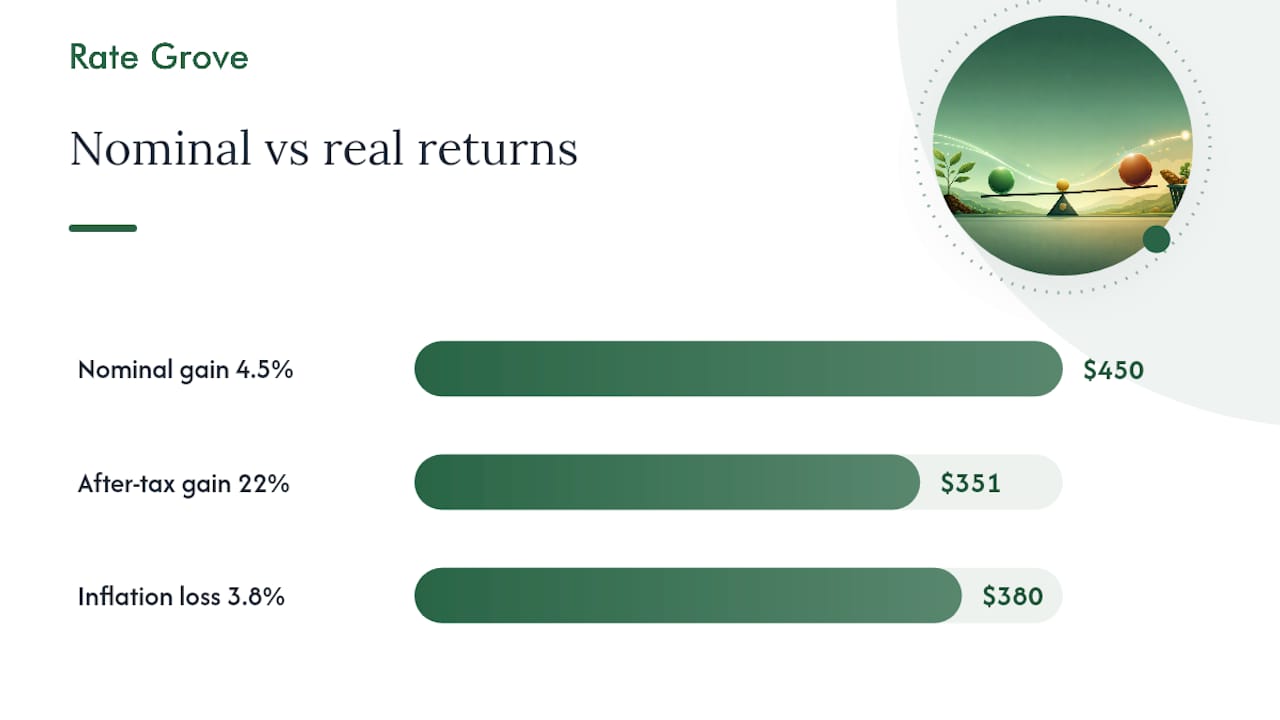
Worked example on $10,000 over one year:
The tax effect tightens those gains further. At a 22% federal marginal rate, the $450 nominal gain from a 4.50% APY account becomes roughly $351 after tax, leaving a real after-tax return of about $-29 on $10,000 at 3.8% inflation. That’s still far better than losing $379, but it shows why comparing nominal APY to CPI is only the first step.
Pro Tip: Use a simple formula before opening any account: (APY × balance) × (1 − your tax rate) − (CPI × balance). If the result is negative, that account is losing real value for you.
How inflation hits different savings vehicles
Not every account responds to inflation the same way. Here’s how the most common options stack up.
Checking and standard savings accounts
These are the biggest losers in an inflationary environment. At 3.8% inflation, that’s a real loss of nearly $380 per $10,000 per year. Checking accounts typically pay nothing at all. Keeping large balances here is one of the most common and costly mistakes savers make, and it’s entirely avoidable.
High-yield savings and money market accounts
High-yield savings accounts (HYSAs) and money market accounts (MMAs) offered by online banks and credit unions have recently paid 4.15%–5.00% APY, rates that can exceed or closely match current CPI readings. They’re FDIC-insured (or NCUA-insured at credit unions), liquid, and well-suited for emergency funds. The catch: rates are variable, so they can drop if the Federal Reserve cuts its benchmark rate.
For a deeper look at the different account structures available, the types of high-yield savings accounts guide at Rate Grove breaks down the tradeoffs across online banks, credit unions, and cash management accounts.
Certificates of deposit (CDs)
CDs lock your rate for a fixed term, typically three months to five years. The tradeoff is liquidity: early withdrawal usually triggers a penalty of 60–180 days of interest, depending on the institution and term. CD laddering, splitting your balance across multiple maturity dates, gives you periodic access to funds while keeping most of your money earning a competitive rate.
Treasury bills, TIPS, and I-bonds
Treasury bills (T-bills) are short-term U.S. government securities with maturities from four weeks to 52 weeks. Yields have recently been competitive with top CDs. Interest is exempt from state and local income taxes, which improves after-tax real returns for savers in high-tax states.
Treasury Inflation-Protected Securities (TIPS) adjust their principal value with CPI, so the real return is locked in regardless of where inflation goes. They’re best for longer-term holdings (five years or more) and are available through TreasuryDirect.gov.
Series I savings bonds (I-bonds) earn a composite rate tied to CPI. You can purchase up to $10,000 per person per year through TreasuryDirect. The main constraint: you can’t redeem them for the first 12 months, and redeeming before five years costs three months of interest.
Equities and real assets
Stocks, real estate investment trusts (REITs), and commodities have historically outpaced inflation over long periods, though with considerably more volatility than cash instruments. Equities are not appropriate for money you may need within one to three years. For long-term goals, a diversified portfolio that includes equities tends to preserve and grow real purchasing power more reliably than cash alone.
Pro Tip: If you’re holding more than six months of expenses in a checking account, that excess is almost certainly losing real value. Even a partial shift to a high-yield savings account or a short-term T-bill can meaningfully reduce the drag.
Concrete strategies to protect your savings during inflation
The right strategy depends on when you’ll need the money. Here’s a practical framework organized by time horizon.
Emergency fund: liquidity first
Your emergency fund (three to six months of essential expenses) needs to stay accessible. Financial advisors recommend high-yield savings or money market accounts for this purpose: they’re liquid, FDIC-insured, and currently paying rates that can offset much of the inflation drag. Avoid locking emergency cash in a CD or I-bond where early withdrawal penalties or holding-period restrictions apply.

For guidance on sizing and placing your emergency fund, the emergency fund best practices guide at Rate Grove covers the key decisions.
Mid-term cash (6–36 months): lock in competitive rates
For money you won’t need for at least six months, consider:
- CD ladder: Split the balance across three or four CDs with staggered maturities (e.g., 6-month, 12-month, 18-month). As each matures, reinvest at current rates or use the funds if needed.
- Short-term Treasury bills: Four-week to 52-week T-bills bought through TreasuryDirect or a brokerage offer competitive yields with the added benefit of state tax exemption.
- Ultra-short bond funds: Available through most brokerages, these hold a mix of short-duration investment-grade bonds and T-bills. Yields are competitive, but unlike CDs and T-bills, the principal value can fluctuate slightly.
Locking a CD rate now can protect you if deposit rates fall later, which is a real possibility if the Fed eases monetary policy. The fixed vs. variable rate CD guide at Rate Grove explains when each structure makes sense.
Long-term savings: diversify beyond cash
For goals five or more years out, cash instruments alone are unlikely to preserve real purchasing power over time. A mix of low-cost index funds (U.S. and international equities), TIPS, and I-bonds gives you exposure to assets that have historically grown faster than inflation. The specific allocation depends on your risk tolerance and timeline.
Tax-advantaged accounts, including 401(k)s, IRAs, and HSAs, shelter interest and gains from annual taxation, which improves after-tax real returns meaningfully over long periods.
Pro Tip: Automate transfers from checking to your high-yield savings account on payday. Idle cash in checking is the single most common source of preventable inflation losses.
How to choose the right place for each portion of your savings
Before opening any account, run through this checklist:
- Liquidity: Can you access the money within one to two business days without a penalty? If yes, it’s liquid. Emergency funds must be liquid.
- Time horizon: Money needed in under six months stays liquid. Six months to three years fits CDs or T-bills. Three-plus years can tolerate more volatility.
- Expected real return: Subtract the current CPI rate from the account’s APY. If the result is negative, you’re losing purchasing power.
- Safety: Is the account FDIC-insured (up to $250,000 per depositor per institution) or NCUA-insured? For brokerage accounts, is there SIPC coverage?
- Fees: Monthly maintenance fees, minimum balance fees, and wire transfer fees all reduce effective yield. A $10/month fee on a $5,000 balance wipes out 2.4% of your balance annually before interest is even considered.
- Tax treatment: Interest from savings accounts and CDs is taxable as ordinary income. T-bill interest is exempt from state and local taxes. I-bond interest is deferred until redemption and exempt from state taxes.
Questions to ask before committing
- Is the APY variable (can change anytime) or fixed (locked for the term)?
- What is the early withdrawal penalty, and how is it calculated?
- Is there a minimum opening deposit or ongoing minimum balance requirement?
- Does the institution have clear FDIC or NCUA insurance documentation?
Red flags to watch for
- Teaser rates: An introductory APY that drops sharply after 90 days is a common tactic. Check the ongoing rate, not just the promotional one.
- Maintenance fees: Any fee that reduces your effective yield below CPI makes the account counterproductive.
- Unclear penalty terms: If the early withdrawal penalty isn’t stated clearly in the account agreement, that’s a problem.
- No deposit insurance: Any institution that can’t confirm FDIC or NCUA coverage should be avoided for cash savings.
The savings account fee checklist at Rate Grove walks through every fee category to check before opening an account.
Pro Tip: Always verify the ongoing APY, not just the headline rate.
Current numbers: how do today’s APYs compare to CPI?
Here’s a snapshot of where rates stand relative to recent inflation readings, so you can run the math yourself.
Sources: BLS CPI data; Investopedia top rates reporting; CNBC Select rate tracking.
How to run the math yourself:
- Find your account’s current APY (check your bank’s website or monthly statement).
- Look up the most recent 12-month CPI change at BLS.gov.
- Subtract CPI from APY. A positive result means you’re ahead of inflation; a negative result means you’re losing real value.
- Multiply your balance by that real return percentage to see the dollar impact over one year.
- Adjust for taxes: multiply your nominal interest earned by your marginal tax rate and subtract that from the real gain.
Example: $10,000 at 4.50% APY earns $450. At 3.8% CPI, the real gain before taxes is $70. At a 22% federal rate, taxes on $450 interest total $99, leaving a real after-tax result of approximately -$29. Still far better than the -$379 loss at 0.01% APY.
Your action plan: what to do with your savings this week
Small moves made now compound over time. Here’s a short checklist organized by urgency.
This week:
- Log in to your bank and find your current savings APY.
- Compare it to the latest CPI reading at BLS.gov.
- If your APY is below CPI, identify one high-yield savings account or money market account to open.
- Move any checking balance above one month of expenses into that higher-yield account.
This month:
- Open a high-yield savings account if you haven’t already, and set up an automatic transfer from checking on payday.
- If you have mid-term cash (money you won’t need for 6–12 months), purchase a short-term Treasury bill through TreasuryDirect.gov or your brokerage, or open a short-term CD.
- Check whether your emergency fund is in a liquid, FDIC-insured account earning a competitive APY.
This quarter:
- Review all account APYs. Rates change, and the account that was competitive six months ago may have dropped.
- If you started a CD ladder, note upcoming maturity dates and decide whether to reinvest or redirect funds.
- Revisit your long-term savings allocation and confirm it includes assets that can outpace inflation over time.
What most savers get wrong about inflation and cash
The conventional advice is to “keep cash safe.” That framing is incomplete, and it leads to a specific, costly mistake: treating any FDIC-insured account as automatically safe. An account is safe from bank failure, yes. It is not safe from inflation.
The real risk for most savers isn’t losing money to a bank collapse. That loss is just as real as a market decline, but it doesn’t show up as a red number on a statement, so people ignore it.
There’s a second mistake worth naming: chasing the highest possible APY without considering liquidity. Locking all your savings into a 5-year CD to capture a slightly higher rate, then needing the money in month eight, results in an early withdrawal penalty that wipes out months of interest. The goal isn’t the highest rate in isolation. It’s the highest real return you can earn given your actual liquidity needs and time horizon.
A comparison-first workflow, checking current rates across multiple account types before deciding where to park each layer of your savings, is the most practical way to avoid both mistakes.
Rate Grove makes it faster to find accounts that beat inflation
Knowing you need a higher APY is the easy part. Finding the right account, one that matches your liquidity needs, has no hidden fees, and is backed by verified FDIC data, takes longer when you’re checking each bank individually.
Rate Grove compares high-yield savings accounts, money market accounts, and CDs side by side using verified data from issuer and regulator sites, updated monthly. You can filter by APY, minimum deposit, liquidity, and account type in one place, without wading through outdated rate tables or promotional fine print. Every listing shows the tradeoffs clearly: variable vs. fixed rate, early withdrawal terms, and fee structure. If you’re ready to move idle cash to an account that actually keeps pace with inflation, start comparing rates at Rate Grove and find your best option in minutes.
Sources
Use these primary sources to check current inflation readings and account rates before making any moves.
This article is for general informational purposes only and does not constitute financial advice. Confirm current rates, terms, and tax treatment with your financial institution or a qualified financial advisor before making any changes to your savings.
This article is general information, not a substitute for advice from a qualified financial advisor. Consult a qualified financial professional about your own circumstances before acting on anything here.