

Starting a youth savings account is one of the most practical money lessons you can give your child. Savings rates, the interest a bank pays on deposited funds, directly shape how much a child’s balance grows and how motivated they stay about saving. Kids who save early are more likely to save consistently as adults, with research showing childhood saving habits raise the probability of monthly adult saving by 12 percentage points. Compound interest amplifies that head start: interest earned on a balance generates its own interest over time, turning small, regular deposits into a noticeably larger sum.
Here is why savings rates matter for kids at a glance:
- Higher rates mean visible growth. A competitive annual percentage yield (APY) makes the balance climb faster, which kids can actually see.
- Compound interest rewards patience. The longer money sits, the more it earns on itself.
- Early habits stick. Childhood saving habits correlate with lower debt and higher net worth in adulthood.
- Youth accounts teach real skills. Watching a balance grow teaches goal setting, delayed gratification, and basic budgeting.
What are youth savings accounts and how do they work?
Youth savings accounts are bank or credit union accounts designed for children and teenagers, typically held jointly with a parent or guardian until the child reaches adulthood. The parent maintains oversight, but the account is tied to the child’s name and financial identity.
- Joint ownership: A parent or guardian is listed on the account and can monitor transactions.
- FDIC insurance: Deposits at FDIC-insured banks are protected up to $250,000, giving families peace of mind.
- Higher introductory rates: Top youth accounts can pay up to 10.38% APY, though that rate typically applies only to balances between $500 and $1,000.
- Lower balance caps: Once a balance exceeds the promotional tier, the rate drops to a standard level.
- Different from custodial accounts: Youth savings accounts give parents ongoing control; custodial investment accounts are irrevocable gifts for investing and work differently.
- Kid-friendly features: Many accounts include mobile apps, savings trackers, and no monthly fees to keep children engaged.
Understanding the account fee structure before you open one prevents small charges from quietly eating into your child’s balance.
Key benefits of youth savings accounts for teaching money management
Youth savings accounts do more than hold money. They create a hands-on classroom for financial skills your child will use for life.
- Goal setting: Kids learn to save toward something specific, whether a toy, a bike, or a future trip.
- Delayed gratification: Waiting for a balance to reach a target builds patience and self-control.
- Visible growth: Watching interest post to the account makes abstract concepts like “earning money on money” concrete.
- Budgeting basics: Deciding how much to deposit versus spend introduces the core idea of a budget.
- Responsibility: Managing a real account, even with parental oversight, gives children a sense of ownership over their finances.
Pro Tip: Sit down with your child when the monthly statement arrives. Point out the interest line and ask them what they want to do with it. That five-minute conversation reinforces every lesson the account is designed to teach.
Building a saving habit matters more than chasing the highest rate. Regular deposits, even small ones, predict financial success far more reliably than a single high-yield windfall.
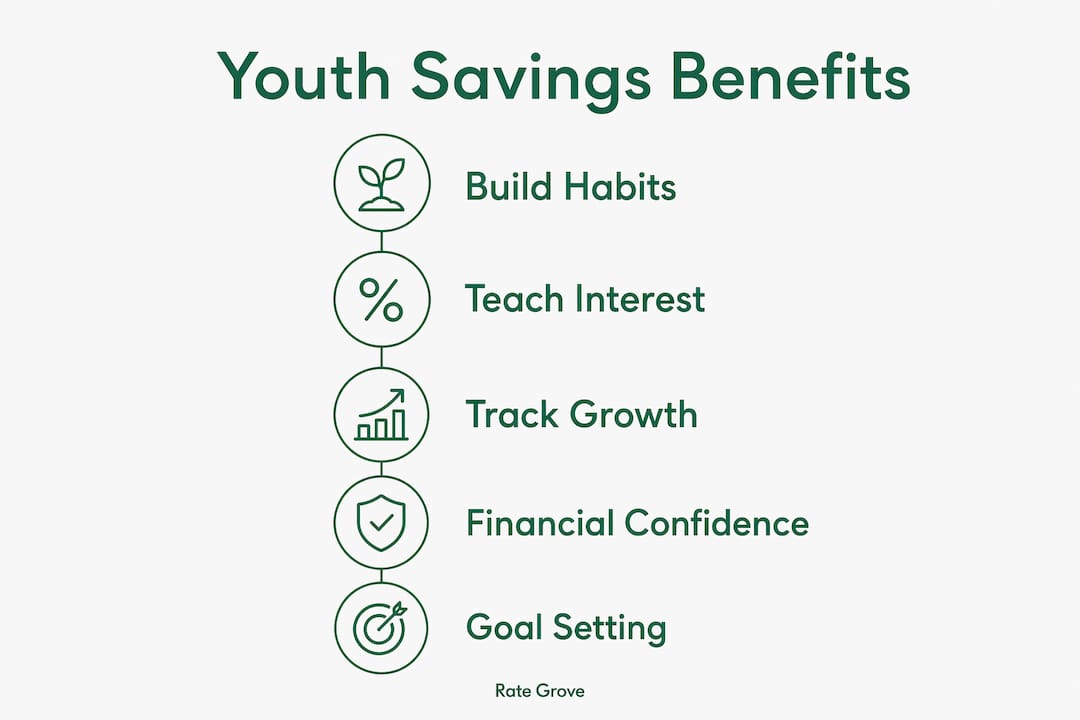
How savings rates motivate kids and show real financial growth
A higher savings rate is not just a number. It is the feedback loop that keeps children interested in saving.
When a child deposits $200 and earns a few dollars in interest without doing anything extra, the concept of money working for you clicks in a way no textbook can replicate. Compound interest accelerates this: interest earned in month one becomes part of the balance that earns interest in month two. Over several years, that compounding effect produces a noticeably larger sum than simple interest would.
Saving 40% of income with a moderate return outperforms saving 20% with a higher return over 20 years. The savings rate itself drives wealth accumulation more than chasing returns, especially in the early years.
Financial planners consistently point to savings as a positive reinforcement loop: as kids watch balances grow, they develop discipline and responsibility, which reduces reliance on credit later in life. That cycle starts with a rate high enough to make growth visible.
Pro Tip: Show your child a simple projection. If they save $10 a month at a 5% APY, walk them through what the balance looks like in one year versus five. Seeing future numbers on paper turns saving from a chore into a goal.

Practical tips for helping kids build regular saving habits
Getting started is the hardest part. These steps make it easier to build a routine your child will actually stick with.
- Involve kids in account selection. Let them compare a few options with you. Ownership of the decision increases commitment.
- Set a savings goal together. A specific target, like saving $150 for a new game, is far more motivating than “save more.”
- Automate small deposits. Even $5 from a weekly allowance, transferred automatically, builds the habit without requiring willpower every week.
- Celebrate milestones. When the balance hits a goal, acknowledge it. A small reward reinforces the behavior.
- Choose accounts with no monthly fees. Bank fees on small balances can erase interest earnings quickly, especially at the low balances kids typically hold.
- Open the account in the child’s name. Interest earned at a child’s tax rate is often taxed at 0% for lower earners, preserving more of the growth.
Pro Tip: The FDIC recommends teaching by doing: take your child to the bank, include them in a grocery budget, or let them handle the deposit slip. Active participation beats any lecture.
What savings growth actually looks like for kids
Real numbers make the case better than theory. Consider a child who starts saving at age 8 with $100 and adds $20 a month into a youth account earning 5% APY. By age 18, that account holds roughly $3,100, with a meaningful portion coming from interest alone rather than deposits.
Now compare that to a child who waits until 16 to start. With the same $20 monthly deposit and the same rate, the balance at 18 is closer to $520. The difference is not the rate. It is the time. Starting earlier gives compound interest more runway, and that gap widens every year the habit continues into adulthood.
The FDIC notes that saving for a child’s future gives them a financial head start, whether the goal is education, a first car, or simply a cushion when they leave home.
Potential drawbacks of youth savings accounts to keep in mind
Youth savings accounts are useful tools, but they come with a few limitations worth knowing before you open one.
Rate caps are common. The highest advertised APYs usually apply only to a low balance tier, often $500 to $1,000. Once the balance exceeds that cap, the rate drops sharply. Parents should calculate the effective yield across the full expected balance, not just the headline rate.
Parental access cuts both ways. Joint ownership means parents can monitor and guide, but it also means the account is visible on the parent’s financial profile. For families with specific financial aid goals, this is worth discussing with a financial advisor.
Transition gaps exist. Many youth accounts automatically convert to standard adult accounts when the child turns 18, sometimes with lower rates or new fees. Planning that transition in advance avoids surprises.
Savings bonds and 529 plans serve different goals. A youth savings account is ideal for short-term goals and habit building. For college savings specifically, a 529 plan offers tax-free growth on qualified education withdrawals, which a standard savings account cannot match.
Key Takeaways
Starting a youth savings account early gives compound interest the time it needs to produce meaningful growth, and the habit itself predicts stronger financial outcomes throughout adulthood.
| Point | Details |
|---|---|
| Early saving predicts adult behavior | Saving as a child raises the probability of saving monthly as an adult by 12 percentage points. |
| Rate caps matter | Youth savings accounts offer interest rates often much higher than adult accounts but typically cap the balance earning that rate at $500 to $1,000. |
| Habit beats rate | Regular deposits build the discipline that drives long-term financial health more than any single high rate. |
| Parental involvement amplifies results | Active teaching, like reviewing statements together, turns an account into a real financial education. |
| Account ownership affects taxes | Opening the account in the child’s name can reduce the tax burden on interest earned, preserving more growth. |