

Savings rate comparison factors are the criteria that determine the true value of a savings account, covering annual percentage yield (APY), fees, insurance limits, and accessibility features. The APY is the single most important standardized metric for comparing savings accounts, because it reflects your actual annual earnings after compounding. Fees and minimum balance requirements can quietly cancel out a higher APY, while FDIC and NCUA insurance limits protect your deposits up to $250,000 per depositor, per institution. Knowing how these factors interact gives you a real picture of what each account delivers, not just what the headline rate promises.
1. Why APY is the most critical savings rate comparison factor
APY, or annual percentage yield, is the true measure of what a savings account pays you each year. It differs from a simple interest rate because it incorporates compounding frequency, meaning it reflects how often your interest earns interest. Two accounts with the same nominal rate but different compounding schedules will produce different APYs. Always compare APYs directly, not nominal rates.
The gap between top-tier and average accounts is significant. Top high-yield savings accounts in mid-2026 offer APYs between 4% and 5%, while the national bank average sits near 0.46%. That difference on a $10,000 balance means hundreds of dollars more per year at a high-yield account versus a traditional one.
Here is what to check when evaluating APY:
- Compounding frequency: Daily compounding produces slightly more than monthly compounding at the same stated rate.
- Promotional vs. ongoing APY: Some accounts advertise a high rate that applies only for the first few months.
- Conditional APY: Certain accounts require direct deposits or minimum transactions to unlock the top rate.
- Variable rate risk: Savings account APYs change with Federal Reserve policy, sometimes without advance notice.
Pro Tip: Always look for the ongoing APY, not just the introductory rate. The rate you earn in month four matters more than the rate you earn in month one.
2. How fees and minimum balance requirements affect your real return
Fees are the silent killers of savings account returns. Traditional banks commonly charge $5 to $15 in monthly maintenance fees unless you maintain a balance between $300 and $1,500. Online banks, by contrast, typically charge no fees and require no minimum balance. That structural difference matters enormously when you are comparing accounts.

The math is straightforward. A $10 monthly fee costs you $120 per year. If your account earns $80 in annual interest at a modest APY, you are losing money despite having a positive rate. A fee-free account with a slightly lower APY often beats a fee-charging account with a higher headline rate.
Watch for these common fee and balance traps:
- Monthly maintenance fees that apply unless you meet a balance threshold
- Minimum opening deposit requirements that lock out smaller savers
- Excess withdrawal fees triggered by more than six transactions per month at some banks
- Paper statement fees that add a few dollars monthly if you do not go paperless
Pro Tip: Use a bank account comparison checklist to calculate your net annual return after fees before committing to any account. A 4.5% APY with a $10 monthly fee can underperform a 4.2% APY with zero fees on smaller balances.
3. The role of FDIC and NCUA insurance in your savings decision
Federal deposit insurance is a non-negotiable safety factor when comparing savings accounts. FDIC insurance covers deposits up to $250,000 per depositor, per insured institution, per ownership category, at no cost and with no enrollment required. Credit unions offer equivalent protection through NCUA. This coverage means your money is safe even if the bank fails.
The ownership category rule is where things get interesting. A joint account held by two people effectively doubles coverage to $500,000 at a single institution, because each co-owner receives the $250,000 limit. Sophisticated savers with balances above $250,000 can structure ownership across accounts and institutions to stay fully insured.
Here is how to use insurance limits strategically:
- Confirm the bank or credit union carries FDIC or NCUA insurance before opening any account.
- Keep individual account balances at or below $250,000 per institution.
- Use joint ownership to extend coverage to $500,000 at a single bank.
- Spread balances across multiple insured institutions if your total savings exceed those thresholds.
- Check that multiple accounts at the same bank share the same insurance limit, not separate ones.
4. Why compounding frequency and accessibility features matter
Daily compounding produces a slightly higher return than monthly compounding at the same stated rate. The difference on a typical savings balance is small, but it adds up over years. More practically, the APY metric already accounts for compounding frequency, so comparing APYs directly removes the need to calculate this manually.
Accessibility features carry more weight than most savers realize. Fast ACH transfers, same-day deposit availability, and a reliable mobile app determine how usable your account actually is. A high APY means little if you cannot move money quickly when you need it.
| Feature | Why it matters |
|---|---|
| Daily compounding | Slightly boosts effective yield over monthly compounding |
| Fast ACH transfers | Lets you move money in 1–2 business days without delays |
| Mobile app quality | Affects ease of monitoring balances and initiating transfers |
| Customer support | Resolves issues faster, reducing risk of missed transactions |
| Conditional rate requirements | Activity-linked APYs can drop sharply if conditions go unmet |
5. Common pitfalls when comparing savings rates
The biggest mistake savers make is chasing the highest advertised APY without reading the fine print. Promotional rates typically revert to a lower base rate after roughly 90 days. If you switch banks for a promotional rate and miss that reversion, you may end up with a rate lower than what you started with.
Small APY differences rarely justify the effort of switching accounts. A 0.10% APY advantage on a $10,000 balance produces only $10 more per year. Switching banks involves closing accounts, updating direct deposits, and waiting for transfers to clear. That friction has a real cost in time and potential missed payments.
“The best savings account is not always the one with the highest rate. It is the one that fits your balance size, your banking habits, and your need for reliable access. A slightly lower but stable APY with no fees and fast transfers often delivers more real value than a flashy headline rate that drops after three months.”
Experts recommend switching banks only if your APY consistently trails top rates by more than 0.50% for several months. Below that threshold, the switching cost outweighs the gain. Factor in your full banking ecosystem too. If you use checking, savings, and a credit card at the same institution, the convenience of linked accounts may outweigh a marginal rate advantage elsewhere.
Key takeaways
The most effective way to evaluate savings accounts is to compare APY, fees, insurance coverage, and accessibility together, not APY alone.
| Point | Details |
|---|---|
| APY is the core metric | Always compare APYs directly; they account for compounding and reflect true annual returns. |
| Fees can erase rate gains | A $10 monthly fee costs $120 per year, which can outweigh a higher APY on smaller balances. |
| Insurance limits protect deposits | FDIC and NCUA cover up to $250,000 per depositor, per institution, per ownership category. |
| Promotional rates expire | Most introductory APYs revert to a lower base rate within 90 days. |
| Switching has a threshold | Only switch banks if your APY trails top rates by more than 0.50% for several months. |
What I have learned from years of watching savers chase rates
People consistently overweight APY and underweight everything else. I have seen savers move $8,000 to a new bank for a 0.20% APY bump, earn an extra $16 for the year, and then get hit with a $12 monthly fee they did not notice. The net gain was $4. The time spent switching was worth far more than that.
The accounts that actually build wealth are the ones you stick with because they work for your life. That means no fees eating into your balance, fast access when you need cash, and a rate that stays competitive without requiring you to jump through hoops. Online banks consistently pay more than traditional banks because their cost structure is lower, and that advantage tends to be stable rather than promotional.
My honest advice: check your current APY against the top rates every three to six months. If you are more than 0.50% below the market leaders and your account charges fees, that is a real signal to move. If you are within 0.25% of the top rate with no fees and good access, stay put and let compounding do its work. Rate chasing is a distraction. Rate awareness is a habit worth building.
— Mat C.
Rate Grove makes savings comparisons faster and clearer
Finding the right savings account takes more than a quick search. Rate Grove pulls verified rate data from issuer and regulator sites so you can compare savings account rates side by side, including APY, fees, minimum balances, and insurance details, all in one place.
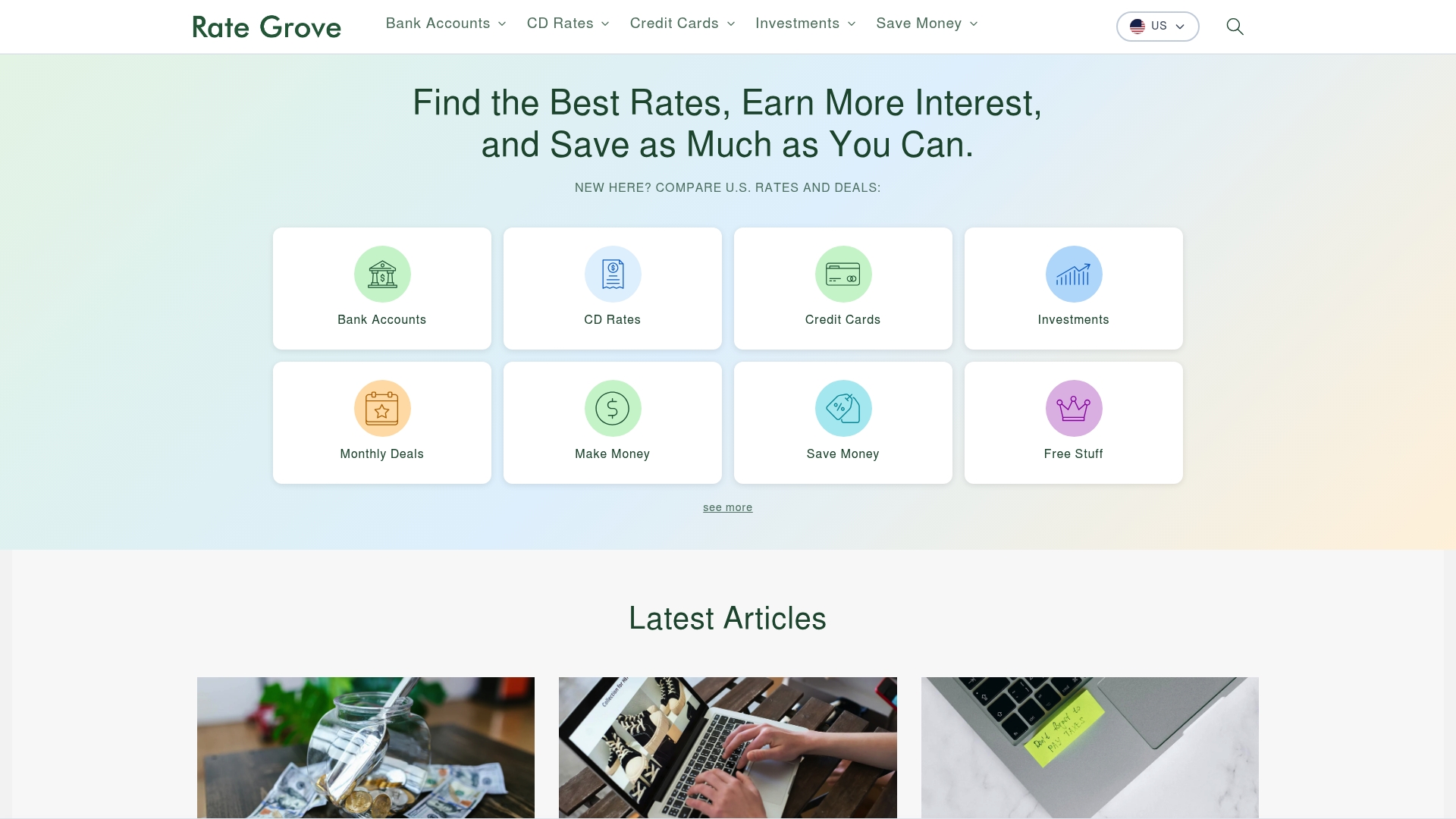
Rate Grove updates its guides monthly, so the numbers you see reflect current market conditions, not last quarter’s rates. If you want to see how your current account stacks up against today’s top options, Rate Grove gives you a clear, side-by-side view without the clutter. Check the latest verified rates before you open or switch any account.
FAQ
What is the most important factor when comparing savings rates?
APY is the most important factor because it reflects your true annual return after compounding. Always compare APYs directly rather than nominal interest rates.
How do fees affect my savings account return?
Monthly maintenance fees reduce your effective return dollar for dollar. A $10 monthly fee costs $120 per year, which can outweigh a higher APY on balances under $10,000.
How much does FDIC insurance cover?
FDIC insurance covers up to $250,000 per depositor, per insured bank, per ownership category. Joint accounts effectively double that coverage to $500,000 at a single institution.
Are promotional savings rates worth chasing?
Promotional rates typically revert to a lower base rate within 90 days. Verify the ongoing APY before switching banks to avoid ending up with a rate lower than your starting point.
When should I switch savings accounts?
Switch when your APY consistently trails top market rates by more than 0.50% for several months and your current account charges fees. Below that gap, the effort of switching rarely pays off.