

A high-yield savings account (HYSA) is defined as a deposit account that pays significantly more interest than a standard savings account, making it the most effective low-risk tool for growing cash. To maximize high-yield savings contributions, you need more than just opening the right account. You need consistent deposits, smart timing, and a clear strategy for how your money sits and compounds. HYSAs typically offer APYs between 4.00% and 5.50%, compared to 0.01%–0.10% at traditional banks. That gap represents a real, measurable difference in how fast your savings grow.
What are high-yield savings accounts and how do they differ from regular savings?
A high-yield savings account works like a standard savings account but pays far more interest. Most are offered by online banks, which carry lower overhead than brick-and-mortar institutions and pass those savings to depositors as higher rates. The result is an APY advantage of up to 500 basis points over traditional savings accounts. That means a $20,000 balance earns hundreds more per year, not pennies.

The mechanics behind that growth matter. Daily compounding outperforms monthly or quarterly compounding by allowing interest to build on itself every single day. A monthly compounding account at the same APY will always produce less than a daily compounding account. When you compare accounts, compounding frequency is just as important as the stated rate.
Here is how HYSAs stack up against traditional savings accounts:
| Feature | High-yield savings account | Traditional savings account |
|---|---|---|
| Typical APY | 4.00%–5.50% | 0.01%–0.10% |
| Compounding frequency | Daily (most accounts) | Monthly or quarterly |
| FDIC insurance | Yes, up to $250,000 | Yes, up to $250,000 |
| Minimum balance | Often $0 | Varies widely |
| Account access | Online or mobile | Branch or online |
FDIC insurance covers both account types up to $250,000 per depositor, per institution. Your principal is protected regardless of market conditions. That security, combined with a competitive APY, makes HYSAs the right home for emergency funds and short-term savings goals. Financial experts recommend keeping 3 to 6 months of expenses in a HYSA for liquidity and steady growth. A household spending $5,000 per month should target $15,000 to $30,000 in this type of account.
To understand why savings rates differ by bank, it helps to know that online banks, credit unions, and fintech platforms each operate under different cost structures. That directly affects the APY they can offer you.
How can automating contributions and timing deposits maximize savings growth?
Automation is the single most reliable way to grow a HYSA consistently. Setting up automatic transfers on payday removes the decision from your hands and treats saving like a fixed expense. You never have to remember, and you never have to choose between saving and spending. The money moves before you can redirect it elsewhere.
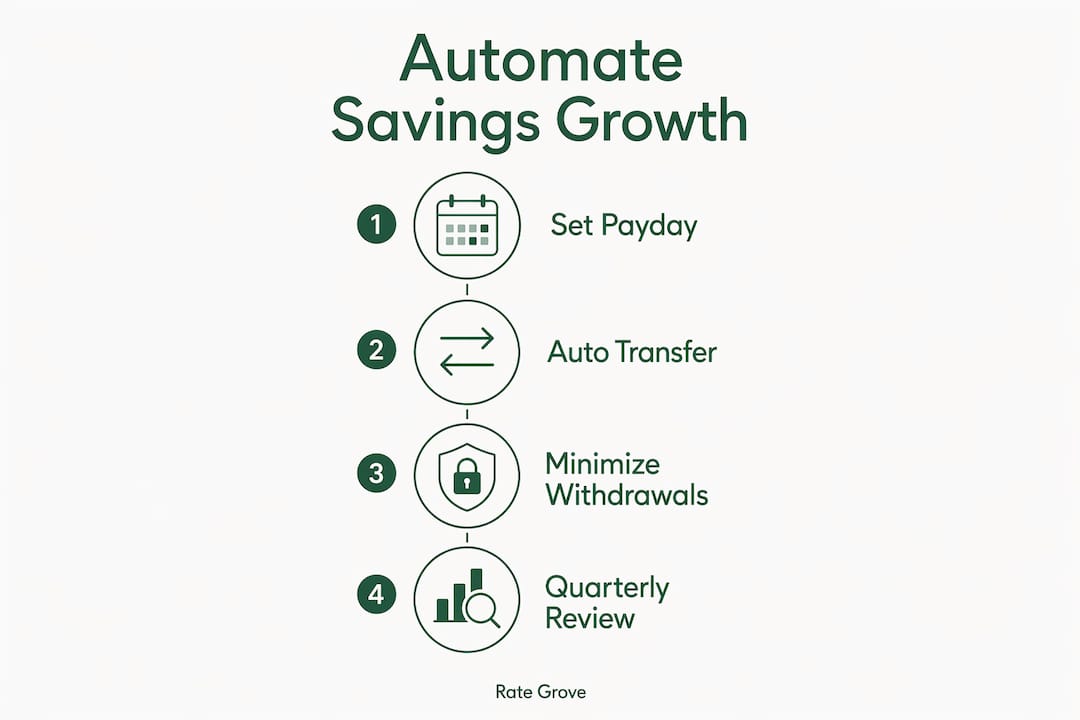
Timing matters more than most savers realize. Funding your account early in the monthly cycle prevents losing days of potential interest due to bank transfer delays. A deposit that arrives on the 3rd of the month earns interest for 27 or 28 days. The same deposit arriving on the 15th earns interest for only 15 or 16 days. Over a year, those lost days add up to a meaningful reduction in your total return.
Here is what a strong automated savings habit looks like in practice:
- Schedule a transfer for the same day your paycheck clears, not the day after.
- Start with a fixed dollar amount, even if it feels small. Consistency beats size in the early stages.
- Increase the transfer amount by a set percentage each time you get a raise or reduce a recurring expense.
- Review your automation settings quarterly to make sure the amount still reflects your current income and goals.
Pro Tip: Set your automatic transfer for the morning of payday, not the evening. Some banks process same-day transfers before end-of-business, which means your money starts earning interest a full day earlier.
What strategies can optimize your savings accounts and balance risks?
The most effective savers do not use a single HYSA for everything. They use separate accounts for separate goals. One account holds the emergency fund. Another holds a vacation fund. A third might hold a sinking fund for a car or home repair. This structure keeps your goals visible and prevents you from accidentally spending money earmarked for something specific.
Multiple accounts also increase your FDIC coverage and reduce risk if one bank experiences issues. Each account at a different FDIC-insured institution covers up to $250,000. For savers with larger balances, spreading funds across two or three banks is a practical protection strategy.
Here is a step-by-step approach to structuring your accounts:
- Open a dedicated emergency fund account. Target 3 to 6 months of expenses. Do not mix this with other savings goals.
- Create goal-specific accounts. Label each one clearly. Seeing “Vacation 2027” or “New Car Fund” in your banking app reinforces the purpose and discourages casual withdrawals.
- Chase promotional rates with intention. Some banks offer introductory rate boosts for new accounts. A 0.35% APY increase for 6 months on a $5,000 balance adds noticeable interest above the standard rate. Just read the terms before moving money.
- Switch accounts when rates drop significantly. Rate loyalty costs you money. If your current bank drops its APY and better options exist, moving your balance is a legitimate strategy.
- Avoid accounts with maintenance fees or high minimum balances. Fees erode your gains faster than most savers expect. A $10 monthly fee on a $5,000 balance wipes out a meaningful portion of your annual interest.
Pro Tip: When evaluating a promotional rate, calculate the total interest earned during the promo period, then compare it to what you would earn at the standard rate at a competing bank. The promo is only worth it if the math works out in your favor.
For a full breakdown of your options, the types of high-yield savings accounts guide at Rate Grove covers the key differences between online bank HYSAs, money market accounts, and credit union savings products.
How does managing your checking and savings balances affect your overall yield?
Most savers leave too much money in checking. Checking accounts at major banks pay little to no interest, which means every dollar sitting there above what you need for monthly expenses is losing potential return. The ideal checking balance is 1 to 2 months of expenses. Everything above that threshold belongs in a HYSA.
The math is concrete. A family with $15,000 excess cash in checking misses roughly $675 per year at a 4.5% APY. That is not a rounding error. Over five years, assuming the rate holds, that lost interest compounds into a significantly larger gap.
Here is how to manage your balances more effectively:
- Calculate your average monthly spending across the last three months. That is your baseline for what checking needs to hold.
- Keep a small buffer above that baseline, around $500 to $1,000, to cover unexpected charges or timing gaps.
- Transfer everything above that buffer into your HYSA at the start of each month.
- Automate the transfer so it happens without requiring a manual decision each time.
The psychological shift here is important. Checking is a transaction account. Savings is a growth account. Treating them as interchangeable is the habit that costs you the most over time.
What common mistakes prevent long-term high-yield savings success?
The biggest mistake savers make is treating their HYSA like a checking account. Withdrawing funds interrupts compounding on the withdrawn amount until you replace it. Every withdrawal resets the clock on that portion of your balance. Frequent withdrawals from a HYSA undermine the compounding advantage you opened the account to capture.
Rate changes are the second most overlooked risk. Banks adjust APYs based on Federal Reserve policy and competitive pressure. An account paying 5.00% today may drop to 3.50% within a year. Savers who set it and forget it often discover months later that their rate has quietly declined. Checking your APY quarterly takes five minutes and can save you hundreds of dollars annually.
Behavioral automation treats saving as a fixed recurring expense, not a discretionary choice. Consistent contributions that compound steadily over time build more wealth than occasional large deposits made irregularly.
Other habits that quietly reduce your returns:
- Skipping deposits during busy months breaks the compounding rhythm and reduces your ending balance.
- Ignoring welcome bonuses leaves free money on the table, but welcome bonuses are temporary. Long-term growth depends on consistent deposits and rate monitoring, not one-time promotions.
- Failing to track progress removes the motivation to keep contributing. Even a simple spreadsheet showing your balance growth month over month reinforces the habit.
- Choosing accounts with hidden fees because the APY looks attractive. Always check the impact of bank fees before committing to an account.
For goals under three years, a HYSA offers the right mix of security and growth. Longer-term goals beyond five years benefit from diversified investment strategies that can outpace savings account rates over time.
Key Takeaways
Maximizing high-yield savings contributions requires daily compounding accounts, automated deposits timed to payday, and a clear separation between emergency funds and goal-specific savings.
| Point | Details |
|---|---|
| Choose daily compounding | Daily compounding builds interest faster than monthly or quarterly schedules at the same APY. |
| Automate on payday | Scheduling transfers on payday ensures consistent contributions and captures more compounding days. |
| Keep checking lean | Hold only 1–2 months of expenses in checking; move the rest to a HYSA to avoid lost interest. |
| Use multiple accounts | Separate accounts for each goal protect funds, increase FDIC coverage, and reinforce saving habits. |
| Monitor rates and fees | Check your APY quarterly and avoid accounts with maintenance fees that erode your annual return. |
Why I think most savers leave real money on the table
After years of tracking how people actually use savings accounts, the pattern I see most often is not a lack of discipline. It is a lack of structure. Savers open a HYSA, make a few deposits, and then treat it like a passive holding tank. The account does some work, but nowhere near what it could.
The behavioral automation piece is where I see the biggest gap. Most people know they should save consistently. Very few set up a system that removes the decision entirely. When saving requires a conscious choice each month, life gets in the way. When it is automatic, it just happens. That difference compounds over years into a meaningful wealth gap.
I also think the multiple-account strategy gets dismissed as complicated when it is actually the opposite. Seeing a labeled account called “Emergency Fund: $18,400” is clearer and more motivating than a single account holding everything. The psychological clarity alone tends to reduce unnecessary withdrawals.
One thing I watch closely is the fee structure. A high APY headline number means nothing if the account charges a $12 monthly maintenance fee or requires a $10,000 minimum balance to earn the advertised rate. Always read the full terms before moving money. The accounts worth using are the ones that pay you without conditions.
Starting small is also underrated. A $100 automatic transfer per month is not going to make you wealthy on its own, but it builds the habit. Once the habit is solid, increasing the amount is easy. The hardest part is always getting the system in place.
— Mat C.
How Rate Grove helps you find the best savings accounts
Finding a HYSA with a genuinely competitive APY, no fees, and daily compounding used to require hours of research across dozens of bank websites. Rate Grove cuts that process down to minutes.
Rate Grove compares bank accounts, CDs, and credit cards side by side using verified data pulled directly from issuer and regulator sources. Every listing shows the APY, fees, minimum balance requirements, and compounding frequency in one place. The guides are updated monthly, so you are always looking at current rates, not figures from six months ago. When market rates shift and your current bank falls behind, compare savings accounts at Rate Grove to find a better option without the guesswork of manual research.
FAQ
What is a high-yield savings account?
A high-yield savings account is an FDIC-insured deposit account that pays significantly more interest than a standard savings account, typically offering APYs between 4.00% and 5.50% compared to 0.01%–0.10% at traditional banks.
How much should I keep in a high-yield savings account?
Financial experts recommend keeping 3 to 6 months of living expenses in a HYSA. A household spending $5,000 per month should target a balance between $15,000 and $30,000.
Does compounding frequency really make a difference?
Yes. Daily compounding accumulates interest faster than monthly or quarterly compounding at the same APY, because each day’s interest becomes part of the balance that earns the next day’s interest.
How do I avoid losing interest on my savings?
Minimize withdrawals, automate deposits on payday, and check your APY quarterly. Withdrawing funds interrupts compounding on the withdrawn amount, and a rate drop you do not notice can quietly reduce your annual return.
Are fees a big deal on high-yield savings accounts?
Fees matter significantly. A monthly maintenance fee can offset a large portion of the interest a competitive APY generates, especially on smaller balances. Always choose accounts with no maintenance fees and no minimum balance requirements.