

A savings account fee checklist is the structured tool you use to identify every charge a bank can legally apply to your account before you deposit a single dollar. Monthly maintenance fees, transaction limits, and hidden penalties like paper statement charges all reduce your net return. A higher advertised APY can be completely wiped out by fees you never noticed. This guide covers every fee category you need to review, the waiver conditions that let you avoid them, and how to use your checklist to pick the account that actually keeps more of your money.
1. Monthly maintenance fees and how to avoid them
Monthly maintenance fees are the most impactful charges for savers because they occur regardless of account activity. Common fees range from $4.50 to $10 per month at traditional banks, while many online banks charge $0 with no conditions attached. That difference adds up to $54–$120 per year in pure cost before you earn a single cent of interest.
Most banks waive the monthly fee if you meet one of these conditions:
- Maintain a minimum daily balance between $300 and $1,500
- Keep an average daily balance above a set threshold (often $500 or more)
- Set up qualifying direct deposits each month
- Link the savings account to an eligible checking account at the same bank
The waiver condition that trips up the most savers is the daily minimum balance rule. Your balance must stay above the threshold every single day of the statement cycle. Dipping below it even once on a weekend can trigger the full monthly fee. The average daily balance calculation is more forgiving because it averages your balance across the month.
Pro Tip: Set up a low-balance alert at $100 to $200 above your required minimum. That buffer gives you time to transfer funds before the fee triggers.

2. Transaction fees: withdrawal limits and wire transfer costs
The Federal Reserve suspended Regulation D withdrawal limits in 2020, but most banks still enforce their own six-transaction monthly cap on savings accounts. Exceeding that limit typically costs $3–$5 per excess withdrawal. That means three extra transfers in one month can cost you $9–$15 on top of any maintenance fee.
Wire transfers carry their own separate fee structure:
- Domestic outgoing wire: $15–$30 per transfer
- International outgoing wire: $35–$50 per transfer
- Incoming wire (domestic or international): $0–$15, depending on the bank
- ACH transfers: Usually free, but may take 1–3 business days
Wire transfer fees hit hardest when you make a single large transaction, like moving a down payment to an escrow account. A $50 international wire fee on a $20,000 transfer is a small percentage, but it is still money you did not plan to spend. Plan large transfers in advance and confirm whether your bank offers any fee waivers for premium account holders.
Statistic to know: Excess withdrawal fees of $3–$5 per transaction can accumulate quickly if you use your savings account like a checking account. Keep routine spending in a checking account to protect your savings balance.
3. Hidden fees and less obvious charges that erode savings returns
Fee creep is real. Even accounts advertising no monthly fees can carry paper statement, inactivity, or account closure fees that quietly reduce your interest gains. These charges rarely appear in the headline marketing copy, which is exactly why you need a checklist.
| Fee type | Typical amount | When it applies |
|---|---|---|
| Paper statement | $2–$5 per month | Every month you receive a mailed statement |
| Inactivity fee | Up to $10 per month | After 6–12 months of no transactions |
| Early account closure | $10–$25 flat | If you close within 90–180 days of opening |
| Returned deposit | $10–$20 per item | When a deposited check bounces |
Paper statement fees of $2–$5 per month add up to $24–$60 per year. That is a meaningful reduction on a $1,000 balance earning 4% APY, which generates only $40 in annual interest. Switching to electronic statements eliminates this fee immediately at virtually every bank.
Inactivity fees apply after 6–12 months of no transactions. If you open an emergency fund account and leave it untouched, you may return to find the balance shrinking rather than growing. Making one small deposit or withdrawal every few months keeps the account active and avoids this charge.
Pro Tip: Review the bank’s official “Truth in Savings” disclosure, not just the product page. This legally required document lists every fee and every waiver condition in plain language.
4. Minimum balance requirements and their long-term financial impact
Minimum balance rules come in two distinct forms, and confusing them costs savers money. The first is the minimum balance to open an account, which is a one-time threshold you meet at deposit. The second is the minimum balance to avoid fees, which you must maintain continuously. Many banks advertise a $0 minimum to open while requiring $500 or more to waive the monthly fee.
Minimum balance thresholds typically fall between $300 and $1,000, depending on the institution and account tier. Here is what to check on your bank account fee guide:
- Daily minimum balance: Your balance must stay above the threshold every day of the cycle
- Average daily balance: Your balance is summed and divided by the number of days in the cycle
- Combined balance: Some banks count balances across multiple linked accounts toward the threshold
- Relationship banking discounts: Premium checking customers sometimes get fee waivers on linked savings accounts
Failing to meet the minimum balance requirement even once can cost you the full monthly fee for that cycle. The impact compounds over time. A $10 monthly fee on a $500 balance earning 4% APY wipes out the entire year’s interest and then some. Automated balance alerts are the most effective tool to prevent this. Set them through your bank’s mobile app or online portal, and check them weekly.
5. How to use a savings account fee checklist to choose the best account
A fee checklist works only if you apply it to the right documents. The bank’s product page shows the best-case scenario. The official fee schedule and Truth in Savings disclosure show the full picture. Always read fee disclosures before opening any account.
Use this checklist for bank fees when comparing options:
- Monthly maintenance fee: What is the amount, and what are the exact waiver conditions?
- Minimum balance type: Is it daily, average daily, or combined across accounts?
- Transaction limit: Does the bank enforce a six-transaction cap, and what is the excess fee?
- Wire transfer fees: What are the domestic and international outgoing wire costs?
- Paper statement fee: Is there a charge, and can you opt out online?
- Inactivity fee: After how many months does it apply, and what triggers activity?
- Account closure fee: Does a penalty apply if you close within 90–180 days?
- ATM fees: Does the bank reimburse out-of-network ATM charges?
After collecting this data, calculate your true net return. Subtract your expected annual fees from your projected annual interest. A savings account paying 4.5% APY with a $10 monthly fee delivers a net return well below what a no-fee online account paying 4.0% APY provides. Online banks generally offer $0 monthly fees, $0 minimums, and competitive APYs, making them the strongest starting point for fee-conscious savers.
6. How small balances make fees hurt more
The relationship between fees and balance size is not linear. It is punishing. A $10 monthly fee on a $10,000 balance represents 1.2% of your annual return. The same $10 fee on a $500 balance wipes out 24% of the balance in a single year. This is why fees on small balances deserve their own line on your checklist.
If you are building an emergency fund from scratch, your balance will be low for months. During that period, a fee-free account is not just preferable. It is the only rational choice. Look for accounts with no minimum balance requirement and no monthly maintenance fee. Once your balance grows past the waiver threshold, you can reassess whether a higher-APY account with a minimum balance requirement makes financial sense.
Key takeaways
A savings account fee checklist is the most direct way to protect your returns. Monthly maintenance fees, hidden charges, and minimum balance rules all reduce what you actually earn.
| Point | Details |
|---|---|
| Monthly fees are the biggest risk | Fees of $4.50–$10 per month can erase annual interest on low balances. |
| Waiver conditions vary widely | Daily minimums, average balances, and direct deposits each work differently. |
| Hidden fees add up fast | Paper statements, inactivity, and early closure fees can cost $24–$60 per year. |
| Online banks eliminate most fees | Zero-fee accounts with competitive APYs are widely available and worth comparing. |
| Net return beats headline APY | Always subtract expected fees from projected interest before choosing an account. |
What I’ve learned from years of reviewing savings account fees
The most common mistake I see is savers fixating on APY while ignoring the fee structure entirely. A 5% APY sounds great until a $10 monthly fee turns it into a net loss on a $1,500 balance. I have reviewed hundreds of fee schedules, and the pattern is consistent: the fees that hurt most are the ones buried in the fine print, not the ones advertised on the product page.
My honest advice is to start your comparison with the monthly maintenance fee and its waiver conditions. That single number tells you more about the true cost of an account than any other figure. If the waiver condition requires a balance you cannot reliably maintain, the fee is effectively guaranteed.
Fee creep is the second thing I warn people about. I have seen accounts marketed as “no monthly fee” that still charge $3 per month for paper statements and $10 for inactivity after six months. Those charges do not show up in the headline, but they show up in your balance. Always read the full fee schedule, not just the summary card.
My recommendation for most savers is to start with a no-fee online account, build the balance, and then reassess. Chasing a slightly higher APY at a traditional bank with a $500 minimum and a $10 monthly fee is rarely worth it in the first two years. Prioritize fee avoidance first, then optimize for rate.
— Mat C.
Rate Grove makes savings account comparisons straightforward
Comparing savings accounts across multiple banks is time-consuming when fee schedules are buried in PDFs and disclosures. Rate Grove pulls verified fee data and APY information from issuer and regulator sources, so you can see the full picture in one place.
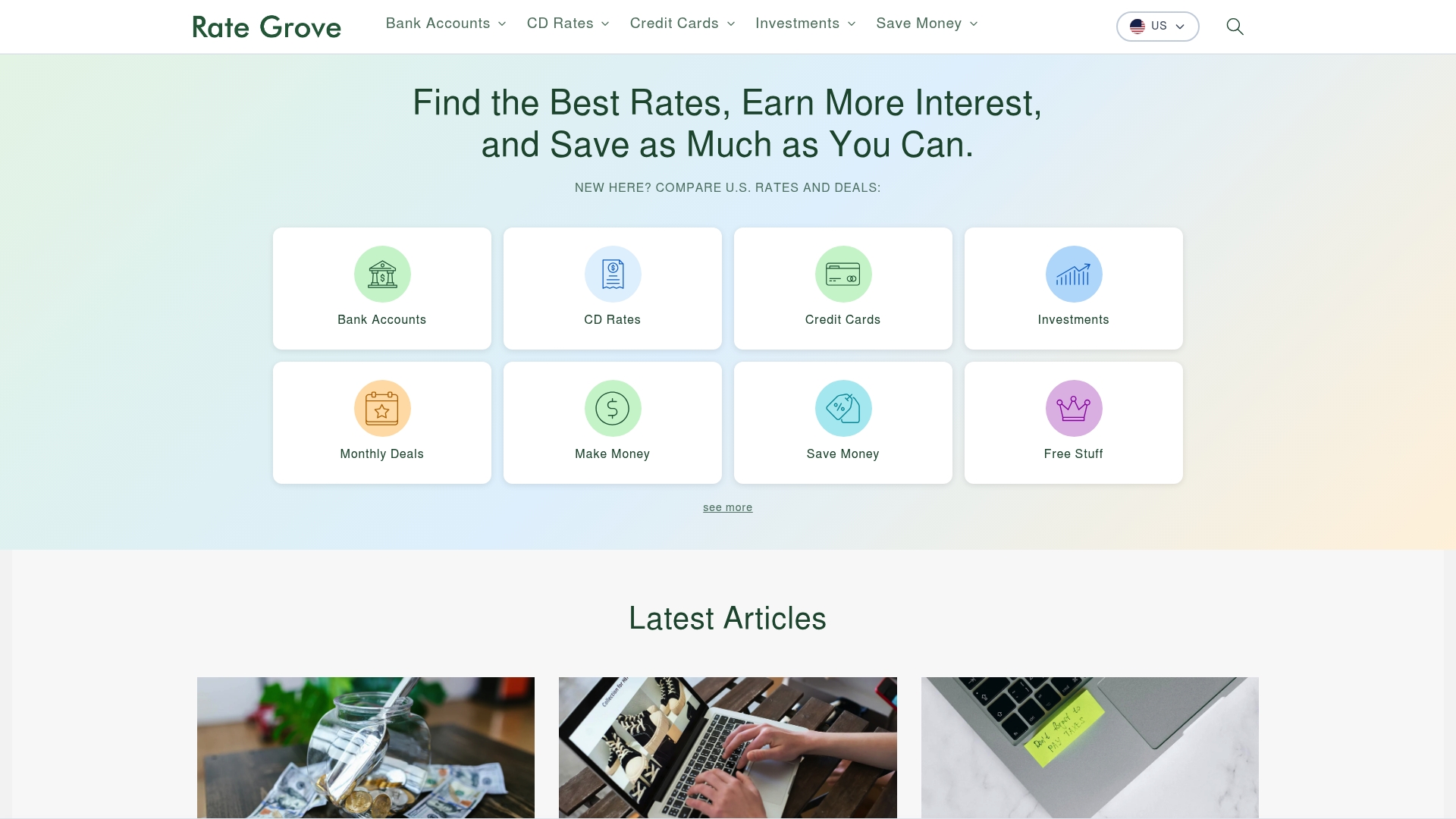
Rate Grove’s savings account comparison tools show monthly fees, minimum balance requirements, waiver conditions, and current APYs side by side. You can identify which accounts charge paper statement fees, which enforce transaction limits, and which online banks offer zero-fee options with competitive rates. Every guide on Rate Grove is fact-checked and updated monthly, so the numbers you see reflect current terms, not last year’s promotions.
FAQ
What fees should I check first on a savings account?
Start with the monthly maintenance fee and its waiver conditions. This single charge has the largest predictable impact on your net return and applies every month regardless of how you use the account.
Do online banks really charge no fees?
Online banks generally offer $0 monthly maintenance fees and $0 minimum balance requirements, along with competitive APYs. Some still charge for wire transfers or paper statements, so review the full fee schedule before opening.
What is a Truth in Savings disclosure?
A Truth in Savings disclosure is a legally required document that lists every fee, rate, and waiver condition for a deposit account. It is the most reliable source for building your checklist for bank fees.
How do inactivity fees work?
Inactivity fees apply after 6–12 months of no account transactions and can reach $10 per month. Making at least one deposit or withdrawal every few months keeps the account active and avoids the charge.
Can a high APY offset savings account fees?
A higher APY does not automatically offset fees. A $10 monthly fee on a $1,000 balance earning 4% APY costs more than the account earns in interest. Calculate your net return by subtracting annual fees from projected annual interest before choosing any account.