

The bank accounts with the best signup bonuses right now can put up to $5,000 in your pocket — if you know exactly which offers to target and what each one actually requires. Here are the top offers worth your attention today:
- Chase Total Checking® — $400 bonus; set up direct deposits totaling $1,000 within 90 days of opening.
- Wells Fargo Everyday Checking — $325 bonus; receive qualifying electronic deposits within the required window.
- Huntington Perks Checking® / Platinum Perks Checking® — tiered bonuses; qualify via direct deposit or a large new-money deposit.
- SoFi Checking and Savings — tiered bonus structure; higher deposits unlock the larger payout.
- HSBC Premier Checking — headline bonuses reaching into the thousands; requires substantial new-money deposits maintained for a set period.
Before you apply anywhere, pull up the issuer’s current promotional terms page and cross-check the offer on Rate Grove to confirm it hasn’t expired or changed since this guide was last verified.
Table of Contents
- What are the best bank account signup bonuses right now?
- What do banks actually require you to do to earn a bonus?
- How do you pick the signup bonus that’s actually worth it for you?
- What you need to know about timelines, credit checks, and taxes
- How Rate Grove verifies these offers
- Key Takeaways
- Why chasing the headline number is the wrong strategy
- Get live, filtered comparisons on Rate Grove
- Issuer terms and authoritative references
What are the best bank account signup bonuses right now?
The table below covers the featured offers on the dimensions that determine real value: the headline bonus, what you must do, the minimum deposit, how long you have, when you get paid, and the monthly fee you need to manage.
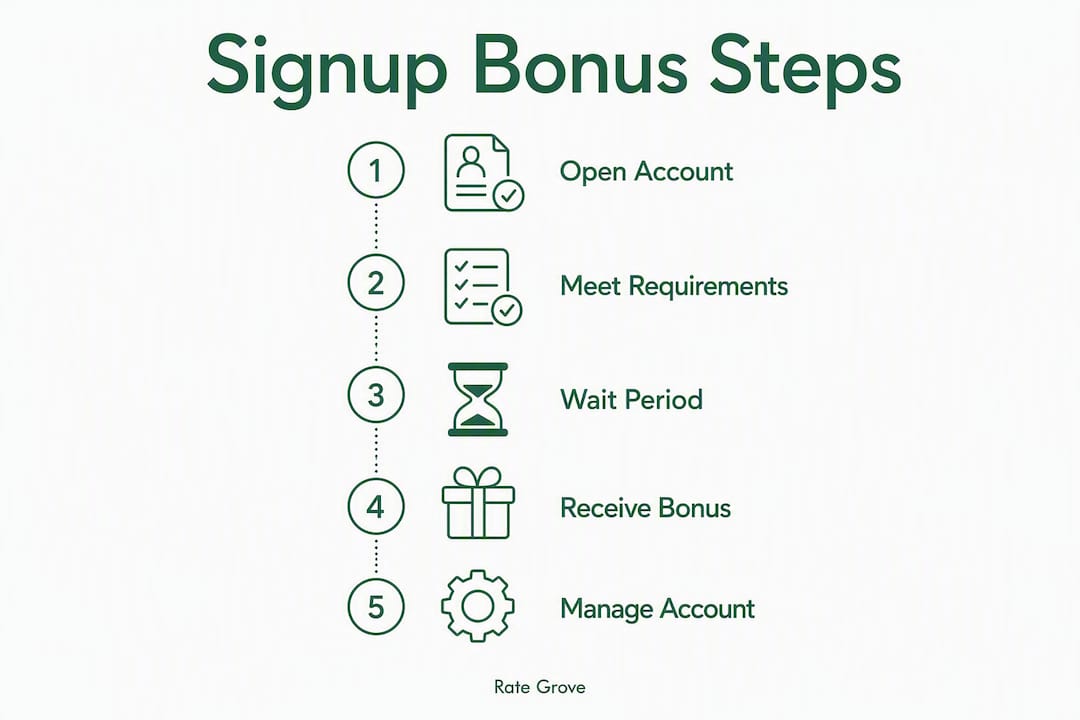
| Account | Bonus Amount | Required Actions | Min. Deposit / Balance | Time to Qualify | Payout Timeline | Monthly Fee | Eligibility |
|---|---|---|---|---|---|---|---|
| Rate Grove | Comparison tool | Filter live offers | — | — | — | Free | All users |
| Chase Total Checking® | $400 | Direct deposits totaling $1,000 | No stated minimum | 90 days | ~15 days after qualifying | $12 (waivable) | New customers; lookback in terms |
| Wells Fargo Everyday Checking | $325 | Qualifying electronic deposits (ACH, RTP, OCT) | No stated minimum | Per promo window | 30 days after qualifying | $12 (waivable) | New customers |
| Huntington Perks / Platinum Perks Checking® | Tiered | Direct deposit OR large new-money deposit | Varies by tier | Per promo window | ~14–30 days after qualifying | Varies | New customers |
| SoFi Checking and Savings | Tiered | Direct deposit; higher deposits = larger bonus | Varies by tier | Per promo window | Per issuer terms | — | New customers |
| HSBC Premier Checking | Up to thousands | Large new-money deposit; maintain balance | Very high | Extended window | Per issuer terms | Waivable | New customers; high balance |
| PNC Virtual Wallet with Performance Select | Varies | Direct deposit; regional eligibility | Higher thresholds | Per promo window | Per issuer terms | Waivable | Eligible ZIP codes |
| U.S. Bank Smartly® Checking | Varies | Direct deposit or debit transactions | Per promo | Per promo window | Per issuer terms | Waivable | New customers |
| Bank of America Advantage Checking | Tiered | Tiered direct-deposit levels | Varies | Per promo window | Per issuer terms | $12 (waivable) | New customers |
| Citibank / Citi Checking | Varies | Enhanced direct deposit | Varies | Per promo window | Per issuer terms | Varies | New customers |
| — | Varies | Simple digital onboarding; deposit activity | Low | Per promo window | Per issuer terms | — | New customers |
| KeyBank Key Smart Checking | Varies | Direct deposit; promo code required | Varies | Per promo window | Per issuer terms | Waivable | Regional / promo code |
| TD Complete Checking | Varies | Direct deposit or min. deposit | Varies | Shorter windows | Per issuer terms | Waivable | New customers |
| Chime Checking Account | Varies | Card purchases / spending activity | Low | Per promo window | Per issuer terms | — | New customers |
| BMO Checking | Varies | Direct deposit; promo code | Varies | Per promo window | Per issuer terms | Waivable | Promo code required |
| Huntington Unlimited Business Checking | Higher tiers | Large new-money deposit | Very high | Extended window | Per issuer terms | Waivable | Business owners |
| Ally Bank | Varies | Digital enrollment; automated funding | Low | Per promo window | Per issuer terms | — | New customers |
| American Express Rewards Checking | Varies | Existing AmEx customer; account activity | Varies | Per promo window | Per issuer terms | — | AmEx customers |
| E*TRADE Premium Savings | Varies | Large deposit or transfer-in | High | Extended window | Per issuer terms | — | Investors |
| Alliant Credit Union Ultimate Opportunity Savings | Varies | Membership + deposit criteria | Varies | Per promo window | Per issuer terms | Low | Members only |
A note on offer dates: Promotional terms change frequently. Every offer above was verified against issuer pages, but confirm the current terms directly on the issuer’s site before you apply. The Rate Grove comparison tool rechecks these offers monthly.
The biggest takeaway from this table: headline bonuses up to $5,000 exist, but they’re tied to very large new-money deposits and longer maintenance windows. For most people, the $300–$400 range from Chase or Wells Fargo delivers a better return on the effort required.
What do banks actually require you to do to earn a bonus?
Banks structure signup bonuses to build lasting customer habits, not just hand out cash. Understanding the mechanics helps you spot which offers you can realistically hit.

Direct deposit is the most common requirement. You need an ACH credit from a qualifying source — typically payroll, Social Security, or government benefits. Transfers from Venmo, Zelle, or your own savings account usually don’t count. Community trackers document which ACH sources each issuer accepts, and the list varies more than most people expect.
New-money deposits show up on premium offers like HSBC Premier Checking and Huntington’s business accounts. The bank wants funds that weren’t already sitting in one of its accounts — moving money between your own Chase accounts, for example, won’t satisfy a Chase new-money requirement.
Debit-card transactions are the qualifying action for some fintech accounts like Chime. Instead of a direct deposit, you make a set number of purchases within the promo window.
Promo codes and enrollment are required by BMO and KeyBank for some offers. If you open the account without entering the code, you forfeit the bonus entirely — there’s usually no retroactive fix.
“New customer” lookback periods are the eligibility rule most people miss. Banks define a new customer as someone who hasn’t held a qualifying account within a specific window — often 12 to 24 months. That window is spelled out in the fine print of the issuer’s terms page.
Pro Tip: To find the lookback period and any required promo code, search the issuer’s terms page for the phrase “not have had” or “previous account.” That’s where banks bury the eligibility cutoff date.
How do you pick the signup bonus that’s actually worth it for you?
The headline number is rarely the real number. Here’s how to convert a bonus into its actual value before you commit.

Work the net-value math first. Take the Chase Total Checking® offer as a worked example: $400 bonus, minus a $12 monthly fee if you don’t meet the waiver condition, over a 90-day qualification window equals $36 in potential fees. After fees, your net is $364. Then factor in taxes on bank bonuses — if you’re in the 22% federal bracket, you owe roughly $88 on a $400 bonus, bringing your after-tax net to about $276. That’s still a solid return, but it’s not $400. Use this same math on every offer you consider, and check the savings account fee checklist to catch hidden costs.
Use this checklist before you apply:
- Am I eligible? Check the lookback period in the issuer’s terms.
- Can I meet the direct-deposit or new-money requirement with my actual income sources?
- What’s the monthly fee, and can I realistically waive it?
- How long must I keep the account open to avoid an early-closure penalty?
- When does the bonus post, and does that timing work for my cash flow?
- Will this trigger a hard credit pull or a ChexSystems inquiry?
- Have I accounted for the tax hit at my marginal rate?
Red flags to watch: large minimum balances you’d have to lock up, minimum-open periods of six months or more, fees that exceed the bonus if you miss the waiver, and exclusions for customers who closed a similar account within the past two years. Comparing bank account tradeoffs before you fund an account saves you from discovering these catches after the fact.
What you need to know about timelines, credit checks, and taxes
Qualification windows typically run 60–90 days from account opening, though some offers are shorter. Chase gives you 90 days to hit the direct-deposit threshold; Wells Fargo’s window is defined in its current promo terms. Don’t assume — read the specific window for each offer.
Payout timing varies widely. Chase pays within 15 days of meeting requirements. Wells Fargo deposits the bonus within 30 calendar days after qualification. Huntington’s timeline runs about 14–30 days after you meet all requirements. Some premium offers take up to 90 days. Always rely on the issuer’s posted timeline, not a third-party estimate.
Credit and screening checks are worth knowing about before you apply. Most deposit-account openings use a soft credit inquiry, which doesn’t affect your credit score. However, some banks run a hard pull, and nearly all consult ChexSystems or similar screening services for negative deposit history. A prior account closure with unpaid fees can get your application declined outright.
Tax reporting: the IRS treats most bank signup bonuses as interest income. Banks commonly report cash bonuses on Form 1099-INT, which you’ll receive in January for the prior tax year. Plan for this when you calculate net value.
Pro Tip: Keep a simple spreadsheet: account name, opening date, bonus amount, qualification deadline, expected payout date, and the 1099-INT amount. That record makes tax filing straightforward and helps you track multiple offers without missing a deadline.
How Rate Grove verifies these offers
Every offer in this guide was checked against the issuer’s primary promotional terms page. The verification process follows these steps:
- Primary source check: pull the issuer’s current promo URL and extract qualification steps verbatim.
- Cross-reference: compare against publisher roundups (Investopedia, CNBC/Select, Bankrate) to flag discrepancies.
- Monthly re-verification: offers are rechecked each month; any reader-flagged change triggers an immediate review.
- Last verified: this guide was last updated in 2026. Promotional terms can change without notice — confirm the current offer on the issuer’s page before applying.
This guide was written by Mat C., a finance contributor focused on deposit account comparisons and rate tracking. If you spot an expired offer or a changed requirement, use the contact page on Rate Grove to flag it. Issuer terms are always the definitive source — this guide is a starting point, not a substitute for reading the fine print.
Rate Grove operates independently; issuers do not pay for placement in this list.
Key Takeaways
The highest-value bank signup bonuses require direct action within a defined window — calculate net value after fees and taxes before you commit to any offer.
| Point | Details |
|---|---|
| Check eligibility first | Confirm the lookback period in issuer terms before applying; most banks exclude recent customers. |
| Calculate net value | Subtract monthly fees and estimated taxes from the headline bonus to get your real return. |
| Watch payout timelines | Payout windows range from 15 days (Chase) to 90+ days; keep the account open until the bonus posts. |
| Plan for tax reporting | Banks report most bonuses on Form 1099-INT; factor your marginal rate into the net-value math. |
| Use Rate Grove to compare | Rate Grove’s monthly-verified comparison tool lets you filter offers by qualification type and deposit level. |
Why chasing the headline number is the wrong strategy
The most common mistake I see is treating a $500 or $1,000 headline bonus as free money. It isn’t. Every dollar of that bonus has a cost attached — the time to meet requirements, the fees you might pay if you miss a waiver condition, the tax hit at your marginal rate, and the opportunity cost of parking a large balance in a low-yield account to satisfy a new-money threshold.
The offers that deliver the best real-world return are usually in the $300–$400 range from large national banks, where the qualification bar is low enough that most people can clear it with their existing payroll deposit. The multi-thousand-dollar bonuses from HSBC Premier or similar premium accounts are genuinely valuable — but only if you were already planning to move that much money and can maintain the balance without disrupting your finances.
One more thing worth flagging: if you plan to open multiple accounts to stack bonuses, space your applications. Opening several accounts in a short window can trigger multiple ChexSystems inquiries and may push you into a lookback exclusion on a later offer. A multi-account banking strategy works best when you sequence openings deliberately, not all at once.
Get live, filtered comparisons on Rate Grove
Sorting through dozens of bank offers on your own takes time, and the terms change constantly. Rate Grove gives you a single place to see current signup bonuses side by side, filtered by what actually matters to you: qualification type, minimum deposit, monthly fee, and payout timeline — all verified against issuer sources monthly.
Every comparison on Rate Grove links directly to the issuer’s terms page so you’re always working from the primary source. Whether you’re targeting a quick $300–$400 direct-deposit bonus or evaluating a premium offer that requires a larger balance, the filters help you find the offers you can realistically qualify for. Start comparing current offers on Rate Grove and confirm the one that fits your situation before you fund a new account.
Issuer terms and authoritative references
Confirm terms directly with issuers before applying. Promotional offers expire and requirements change.
- Chase Total Checking® promotional offer page
- Wells Fargo Everyday Checking offer page
- Huntington checking account promotions
- Alliant Credit Union Ultimate Opportunity Savings
- IRS Form 1099-INT guidance — for understanding how bank bonuses are reported as taxable income
- IRS Form 1040 overview — for reporting interest income on your federal return
- Equifax deposit account screening information — for understanding ChexSystems and account-screening practices
Issuer promotional terms are the binding source for all qualification rules, eligibility windows, and payout timelines. Re-check the offer page immediately before you apply.
This article is general information, not financial advice. Confirm current terms with the issuer or a qualified financial professional before opening any account.