

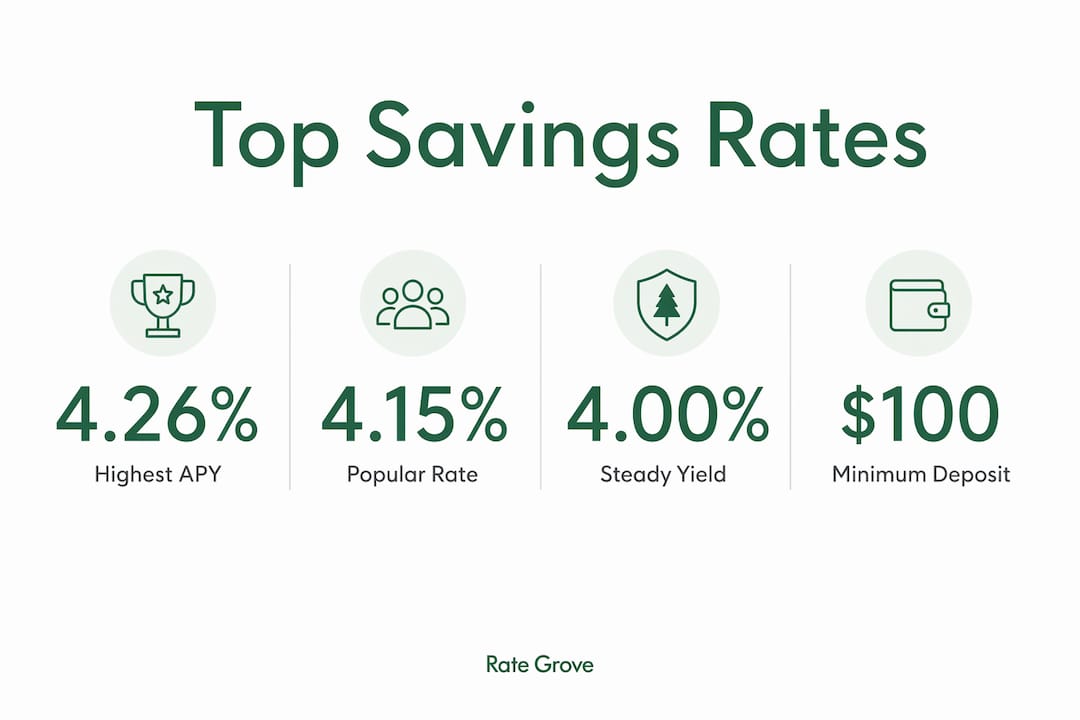
Top usable APYs on nationally available high-yield savings accounts currently range from roughly 4.00% to 4.26% APY, with online-only banks and credit unions holding nearly every top spot. If you want the short answer: Forbright Bank, Vio Bank, and Bread Savings are among the strongest ongoing-rate options right now, while accounts like SoFi and GO2bank add promotional boosts worth checking if you meet their conditions.
Rates are accurate as of July 2026. All accounts listed carry FDIC or NCUA insurance. Verify current APYs directly on each issuer’s site before opening.
Quick picks:
- Forbright Bank – Growth Savings: Among the highest advertised APYs in mid-2026 rankings, with no monthly fee and a low opening deposit.
- Vio Bank: Consistently appears in top-APY lists; straightforward online savings with modest minimums.
- Bread Savings: Competitive headline APY, simple sign-up, and no gimmicks tied to fitness goals or step counts.
| APY band | Min. to open | Promo or ongoing? | FDIC/NCUA |
|---|---|---|---|
| Up to 4.26% | $0–$100 | Ongoing (verify caps) | Yes |
Rates accurate as of July 2026. APYs change frequently. Always confirm the current rate on the issuer’s own rate page before funding your account.
Table of Contents
- How do the top high-yield savings accounts compare right now?
- How do you choose the right high-yield savings account?
- What does APY actually measure, and how do you compare it?
- How do fees and balance limits reduce what you actually earn?
- How Rate Grove collects and verifies the rates in this guide
- Why do savings rates vary so much between banks?
- Key Takeaways
- Why this comparison matters more than you might think
- See how your options stack up with Rate Grove
- Where to verify rates and the sources behind this guide
How do the top high-yield savings accounts compare right now?
The table below covers every account in this comparison. APYs shown are advertised rates; check each issuer for balance caps, tier rules, and any promo expiration before opening.
| Account | APY (advertised) | Min. to open | Monthly fees | Compounding | Promo term | FDIC/NCUA | Access & features | Best for |
|---|---|---|---|---|---|---|---|---|
| Rate Grove | Comparison tool | — | Free | — | — | — | Web, side-by-side filters | Comparing all options fast |
| Forbright Bank – Growth Savings | 4.26% | $0 | None | Daily | Ongoing | FDIC | Online/mobile | Top advertised APY seekers |
| Vio Bank | 4.20% | $100 | None | Daily | Ongoing | FDIC | Online/mobile | Simple high-rate savings |
| Bread Savings | ~4.20% | $100 | None | Daily | Ongoing | FDIC | Online | Headline APY, easy sign-up |
| Valley Direct High Yield Savings | ~4.20% | $1 | None | Daily | Ongoing | FDIC | Online | Top-list rate chasers |
| Popular Direct | ~4.20% | $100 | None | Daily | Ongoing | FDIC | Online | Online division of larger bank |
| Live Oak Bank | 4.10% | $0 | None | Daily | Ongoing | FDIC | Online/mobile | Straightforward online savings |
| Colorado Federal Savings Bank | 4.10% | $0 | None | Daily | Ongoing | FDIC | Online | Competitive ongoing rate |
| Limelight Bank | 4.10% | $1,000 | None | Daily | Ongoing | FDIC | Online | Higher-balance savers |
| Zynlo Bank | ~4.10% | $0 | None | Daily | Ongoing | FDIC | Online/mobile | Fee-free digital savings |
| EverBank | ~4.10% | $0 | None | Daily | Ongoing | FDIC | Online/mobile | Savings + CD combo |
| UFB Portfolio Savings | 4.00% | $0 | None | Daily | Ongoing | FDIC | Online/mobile | No-minimum high-yield |
| Openbank | 4.00% | $500 | None | Daily | Ongoing | FDIC | Online/mobile | Digital-first savers |
| Western Alliance Bank | 4.00% | $1 | None | Daily | Ongoing | FDIC | Online | Institutional-backed online rate |
| Axos ONE (Axos Bank) | ~4.00% | $0 | None | Daily | Ongoing | FDIC | Online/mobile | Checking + savings bundle |
| Sallie Mae | ~4.00% | $0 | None | Daily | Ongoing | FDIC | Online | Brand-name online savings |
| Barclays Tiered Savings | ~4.00% | $0 | None | Daily | Ongoing | FDIC | Online | Tiered-rate savers |
| Synchrony Bank High-Yield Savings | ~4.00% | $0 | None | Daily | Ongoing | FDIC | Online/mobile | Established online bank |
| Marcus by Goldman Sachs | — | $0 | None | Daily | Ongoing | FDIC | Online/mobile | Brand trust + simplicity |
| Ally Online Savings | — | $0 | None | Daily | Ongoing | FDIC | Online/mobile | No-frills, steady rates |
| Alliant High-Rate Savings | — | $5 | None | Daily | Ongoing | NCUA | Online/mobile | Credit union APY seekers |
| American Express High Yield Savings | — | $0 | None | Daily | Ongoing | FDIC | Online | Brand-conscious savers |
| Capital One Performance Savings | — | $0 | None | Daily | Ongoing | FDIC | Online + branches | Digital + physical access |
| SoFi Checking and Savings | — | $0 | None | Daily | Promo (direct deposit req.) | FDIC | App-first | Fintech/integrated banking |
| CIT Bank | Varies | $100 | None | Daily | Promo codes available | FDIC | Online | Promo-code rate hunters |
| E*TRADE Premium Savings | Varies | $0 | None | Daily | Promo (new accounts) | FDIC | Online/brokerage | Existing E*TRADE customers |
| GO2bank | Up to 4.50% | $0 | $5 (waivable) | Daily | Promo (conditions apply) | FDIC | Mobile-first | Mobile users, promo seekers |
| Happen Bank – LevelUp Savings | Varies | $0 | None | Daily | Activity-linked boost | FDIC | Online/mobile | Deposit-condition meeters |
| Fitness Bank – Ultra Savings | Varies | $0 | None | Daily | Step-goal linked | FDIC | Mobile | Fitness-habit savers |
| Varo Bank | Up to 5.00% | $0 | None | Daily | Conditional (balance + deposit) | FDIC | Mobile-first | Conditional high-APY seekers |
| Citi Accelerate Savings | Varies | $0 | None | Daily | Ongoing (select markets) | FDIC | Online + branches | National-bank customers |
| Peak Bank | Competitive | $0 | None | Daily | Ongoing | FDIC | Online | Community bank savers |
| Centier Bank | Competitive | Varies | None | Daily | Ongoing | FDIC | Online + branches | Midwest savers |
| Zynlo Bank | ~4.10% | $0 | None | Daily | Ongoing | FDIC | Online/mobile | Fee-free digital savings |
| Alliant | — | $5 | None | Daily | Ongoing | NCUA | Online/mobile | Credit union members |
| Ally | — | $0 | None | Daily | Ongoing | FDIC | Online/mobile | Steady-rate savers |
| American Express (Savings) | — | $0 | None | Daily | Ongoing | FDIC | Online | Amex cardholders |
| Forbright Bank | 4.26% | $0 | None | Daily | Ongoing | FDIC | Online/mobile | Top-APY seekers |
| Happen Bank | Varies | $0 | None | Daily | Activity-linked | FDIC | Online/mobile | Active depositors |
| Synchrony Bank | ~4.00% | $0 | None | Daily | Ongoing | FDIC | Online/mobile | Established online savings |
A note on balance caps and promo rates: Several accounts above advertise elevated APYs that apply only up to a balance ceiling (often $5,000–$25,000) or require a qualifying action like direct deposit. Promotional boosts commonly expire after a fixed term, often six months, after which the rate reverts to a lower base. Always check the ongoing APY, not just the headline figure.
Pro Tip: Before opening any account, search the issuer’s own “rates” or “disclosures” page directly. Marketing pages sometimes show the promotional rate more prominently than the ongoing base rate.
Accounts worth a closer look
Forbright Bank – Growth Savings has appeared at or near the top of mid-2026 rate rankings. No monthly fee, daily compounding, and FDIC coverage make it a clean choice if the advertised rate holds for your balance tier.

Vio Bank shows up consistently in aggregated APY lists. The $100 minimum is modest, and the account keeps things simple: no tiers, no fitness goals, no promo codes required.
Varo Bank advertises up to 5.00% APY, but that rate applies only when you meet both a minimum monthly deposit and a balance cap. The base rate is considerably lower. It suits disciplined savers who can reliably hit those conditions every month.
GO2bank offers a promotional APY boost, but the $5 monthly fee (waivable with qualifying direct deposit) is a real cost to factor in. At a $1,000 balance, a $5 monthly fee wipes out roughly 6% of your annual interest earnings at a 4% APY.
SoFi Checking and Savings bundles spending and saving in one app with a competitive APY for direct-deposit customers. The catch: the higher rate requires a qualifying direct deposit, so confirm your payroll setup before treating it as a guaranteed yield.
Fitness Bank – Ultra Savings ties your APY to step-count data from a connected fitness tracker. Unique, but the rate depends on hitting non-financial goals each month. Worth it if you already track steps; less reliable if your activity varies.
How do you choose the right high-yield savings account?
Not every high APY is equally usable. A 5.00% rate capped at $1,000 earns you $50 a year. A 4.10% rate on an unlimited balance earns far more if you hold $20,000. Here’s how to cut through the noise.
Priority checklist
- Effective APY on your actual balance. Calculate what you’ll earn on the amount you plan to deposit, not the maximum advertised rate. Balance caps and tiers change the math significantly.
- Ongoing rate vs. promotional rate. Confirm whether the APY is a permanent feature or a short-term teaser that expires. Ask: “What does the base rate drop to after the promo ends?”
- Monthly fees. A $10/month fee on a $5,000 balance costs 2.4% annually, which can erase most of your yield at a 4% APY.
- Compounding frequency. Daily compounding slightly outperforms monthly compounding at the same nominal rate. The gap is small on modest balances but meaningful at $50,000+.
- Liquidity and access. High-yield savings accounts are not checking accounts. Confirm transfer speeds (same-day vs. 1–3 business days) and whether you can link external accounts easily.
- FDIC or NCUA insurance. Every account on this list carries federal deposit insurance up to $250,000 per depositor, per institution. If you hold more than that, consider diversifying across accounts.
Questions to ask before opening
- Is this APY guaranteed for existing deposits, or only for new money?
- Are there balance tiers where the rate drops above a certain amount?
- Does the rate require a direct deposit, minimum monthly transaction, or other qualifying action?
- What is the base APY if I stop meeting the promotional conditions?
- How long does it take to transfer funds out in an emergency?
Red flags to watch for
Watch out for these patterns: A rate advertised prominently with the base rate buried in the fine print. Membership-only accounts that don’t clearly explain eligibility. Deposit channels restricted to ACH only (no wire, no mobile deposit). Tiered rates that apply only to the first $500 or $1,000. Any account that requires linking a fitness tracker or third-party app to maintain the rate.
Match account type to your goal
For an emergency fund, prioritize liquidity and a steady ongoing APY over a flashy promo rate. Ally, Marcus by Goldman Sachs, and Synchrony Bank are reliable here. For a short-term savings goal (6–18 months), a promo rate can work if you track the expiration date and plan to move funds or renegotiate. For laddered savings across multiple goals, consider splitting between two or three accounts to stay under the $250,000 FDIC cap per institution and capture different rate tiers. A solid bank account comparison checklist helps you run this evaluation consistently.

What does APY actually measure, and how do you compare it?
APY, or annual percentage yield, is the true apples-to-apples metric for savings accounts because it folds in compounding frequency. A nominal interest rate of 4.00% compounded daily produces a slightly higher effective return than 4.00% compounded monthly. The difference is small on a $5,000 balance but grows at higher amounts.
A quick worked example
Suppose two accounts both advertise a 4.00% nominal rate:
- Account A compounds monthly. APY = approximately 4.074%.
- Account B compounds daily. APY = approximately 4.081%.
On $10,000 held for one year, Account B earns roughly $0.70 more. Not dramatic at that balance, but at $100,000 the gap approaches $7. The real lesson: standardize all offers to APY on your actual balance and time horizon before deciding.
Now compare a promo vs. ongoing rate on the same account:
- Promo APY: 4.50% for the first 6 months, then reverts to 2.00%.
- Blended APY for the full year: roughly 3.25%.
- Competing account: 4.00% ongoing APY for the full year.
The ongoing 4.00% account pays more over 12 months, even though its headline number looks lower. This is the single most common mistake savers make when comparing rates.
Pro Tip: Use a free APY calculator (such as the one at Omni Calculator) to plug in principal, APY, compounding frequency, and term. Run the same inputs for each account you’re comparing. The output is your real dollar return, not a marketing number.
How do fees and balance limits reduce what you actually earn?
Fees and balance caps are the two most common ways a strong advertised APY becomes a weaker real return. Understanding both takes about five minutes and can save you hundreds of dollars a year.
Common fee types and their annual cost
- Monthly maintenance fee: $5–$15/month. At $10/month on a $5,000 balance, you lose $120/year, which is 2.4% of your balance annually.
- Excess withdrawal fee: Some accounts charge $5–$10 per transaction beyond a monthly limit.
- Paper statement fee: Minor ($1–$3/month) but avoidable by going paperless.
- Inactivity fee: Charged after 12–24 months of no activity; rare among top-tier online savings accounts but worth checking.
A detailed savings account fee checklist can help you catch the ones that are easy to miss.
Effective yield after fees: three saver profiles
| Balance | Advertised APY | Monthly fee | Annual interest earned | Annual fee cost | Effective yield |
|---|---|---|---|---|---|
| $2,000 | 4.10% | $10 | — | $120 | Negative |
| $10,000 | 4.10% | $10 | — | $120 | — |
| $50,000 | 4.10% | $0 | — | $0 | ~4.10% |
The $2,000 example is not hypothetical. Several accounts on this list charge a monthly fee that is waivable only with a direct deposit or minimum balance. If you don’t meet that condition, you lose money relative to a fee-free account at a lower APY.
How balance tiers change the math
Some accounts pay the top APY only on balances up to a cap, then drop to a much lower rate on anything above it. If an account pays 4.50% on the first $5,000 and 0.50% on everything above, your blended APY on a $20,000 balance works out to roughly 1.49%. That’s well below what a straightforward 4.00% account pays on the full $20,000.
Statistic to keep in mind: The FDIC’s national average savings rate sits well below 1.00%. The best high-yield accounts pay four to five times that. The gap between the national average and the top online rates is where the real opportunity lives for savers who take the time to compare.
How Rate Grove collects and verifies the rates in this guide
Rate Grove pulls APY data directly from issuer rate pages and regulator disclosures, then spot-checks each figure before publication. Here’s exactly how that works.
Data sources and verification:
- Issuer rate pages: Each APY is sourced from the bank or credit union’s own published rate disclosure, not from third-party aggregators alone.
- FDIC and NCUA records: Insurance status is confirmed against FDIC BankFind and NCUA records.
- Spot-check cadence: Rates are reviewed and updated monthly, with spot checks triggered by known Fed rate decisions or major market moves.
- Promo flagging: Any rate tied to a promotional term, balance cap, or qualifying condition is labeled explicitly in the comparison table.
Selection criteria for inclusion:
- National availability (open to U.S. savers regardless of state, with limited exceptions noted).
- FDIC or NCUA insurance confirmed.
- Minimum opening deposit under $1,000 (higher-minimum accounts are noted).
- Publicly disclosed APY on the issuer’s own site.
Exclusion rules: Accounts with undisclosed fees, no public rate page, or rates available only to existing customers with no clear eligibility path are excluded from the main table.
A note on advertiser relationships: Rate Grove may earn a referral fee if you open an account through a link on this page. That relationship never influences which accounts are included or how they are ranked. Rankings are based on advertised APY, fee structure, and account terms as verified from issuer disclosures.
Why do savings rates vary so much between banks?
The short answer: online banks and credit unions consistently lead on APY because their cost structures are fundamentally different from traditional branch-based banks. No teller lines, no physical real estate, no ATM networks to maintain. Those savings get passed to depositors as higher rates.
Structural reasons for APY dispersion:
- Overhead differences. A bank with 3,000 branches carries far higher fixed costs than a digital-only institution. That cost gap shows up directly in the rates each can afford to offer.
- Promotional windows. Some banks use elevated APYs to attract new deposits during specific periods, then reduce rates once funding targets are met. These are genuine but temporary.
- Balance-driven tiers. Institutions that want large depositors structure rates to reward higher balances. Smaller savers may not qualify for the advertised top rate.
- Funding channel requirements. “New money” rules mean some top rates apply only to funds transferred from outside the bank, not to existing balances rolled over from another product.
- Deposit strategy. Credit unions like Alliant pass earnings back to members structurally, which is why their rates often compete with the best online banks even without a promotional push.
Top rates in mid-2026 cluster around the 4.00% APY range, with the very best accounts reaching 4.26%. That clustering reflects a competitive online savings market where multiple institutions are chasing the same pool of rate-sensitive depositors.
How Rate Grove standardizes the comparison:
Rate Grove’s comparison tool converts every advertised rate to a consistent APY basis, flags promotional vs. ongoing rates, and surfaces balance caps so you see the effective rate on your actual deposit amount. Tools like CompoundVision take a similar approach for modeling returns across different product types and time horizons, which is useful if you’re also weighing CDs or other yield sources alongside a savings account.
Pro Tip: If a rate looks significantly higher than every competitor, check whether it’s a new-money rate, a promo with an expiration date, or a balance-capped tier. Rates that seem too good to be true usually have a condition attached.
Key Takeaways
Top usable APYs on nationally available high-yield savings accounts currently reach 4.26% APY as of July 28, 2026, with online-only banks and credit unions holding every top spot.
| Point | Details |
|---|---|
| Compare on APY, not nominal rate | APY includes compounding and is the only consistent metric for side-by-side savings comparisons. |
| Verify ongoing vs. promo APY | Promotional rates often expire after six months; the base rate is what you’ll earn long-term. |
| Factor in fees and balance caps | A $10/month fee on a $2,000 balance can turn a 4.10% APY into a net loss. |
| Online banks dominate top rates | Institutions without branch overhead consistently offer the highest APYs in mid-2026. |
| Rate Grove simplifies the process | Rate Grove’s verified comparison tool flags promos, caps, and fees so you see the real effective yield. |
Next steps:
- Identify the balance you plan to deposit, then use the table above to find accounts where that balance qualifies for the top advertised APY.
- Confirm the ongoing rate (not just the promo) on the issuer’s own rate page before funding.
- Check for monthly fees and balance caps that could reduce your effective yield.
- Open your account and set up automatic transfers to keep the balance growing.
- Bookmark Rate Grove or set a 30-day calendar reminder to recheck rates. APYs move with Fed decisions and bank funding needs.
Why this comparison matters more than you might think
There’s a version of this topic that gets written every month: a table of rates, a few bullet points about FDIC insurance, and a reminder to “shop around.” That version is fine. But it misses the thing that actually costs savers money.
The real risk isn’t picking a 4.00% account over a 4.20% one. The gap there is $20 on a $10,000 balance. The real risk is funding a promotional account, forgetting about the expiration date, and sitting at 1.50% for the next two years while the market offers 4.00%+. That happens more than most people realize, and it happens to careful, informed savers who just got busy.
Chasing headline rates without tracking promo expirations is the savings equivalent of signing up for a gym membership in January and never canceling it. The cost is invisible until you add it up. Before you fund any account with a significant sum, pull up the issuer’s rate disclosure page directly, not the marketing landing page, and confirm the base rate. That one step is worth more than any comparison table.
See how your options stack up with Rate Grove
Comparing APYs manually across 30+ accounts takes time, and rates change faster than most guides update. Rate Grove does the heavy lifting for you.
Rate Grove pulls APY data from issuer disclosures and regulator sources, flags every promotional rate with its expiration condition, and lets you filter by balance, insurance type, and fee structure. You see the effective yield on your actual deposit amount, not just the headline number a bank wants you to notice.
- Verified rates sourced directly from issuer pages and FDIC/NCUA records.
- Promo flagging so you always know whether a rate is ongoing or temporary.
- Side-by-side filters for balance tiers, fees, compounding frequency, and account type.
Start comparing APYs on Rate Grove now and find the account that actually pays you the most on your balance.
Rate Grove may earn a referral fee if you open an account through a link on this page. This does not affect rankings or editorial decisions.
Where to verify rates and the sources behind this guide
Before funding any account, confirm the current APY directly on the issuer’s rate page. Rates move frequently, and no third-party guide, including this one, updates in real time.
Verification steps:
- Visit the bank or credit union’s official site and navigate to their “rates” or “disclosures” page.
- Cross-check FDIC insurance status at FDIC BankFind.
- For credit unions, verify NCUA coverage at the NCUA’s official site.
- Read the full account disclosure for balance caps, promo expiration dates, and fee schedules.
- Use a free APY calculator to model your actual dollar return before committing.
Primary sources used in this guide:
| Source | What it covers |
|---|---|
| FDIC National Rates | National average savings rates and FDIC insurance verification |
| Investopedia – Best HYSA Rates July 2026 | Top advertised APYs and ranked institution table |
| Bankrate – Best High-Yield Savings | Promo rate guidance and ongoing APY benchmarks |
| Omni Calculator – APY Calculator | APY formula and compounding frequency modeling |
| APY Calculator – Financial Toolset | Compounding behavior and realized return modeling |
| Chase – Consumer Banking Guidance | APY vs. nominal rate explanation |
| CompoundVision Yield Comparison | Cross-product APY normalization tool |
| Rate Grove | Verified side-by-side APY comparison for U.S. savers |
Rate Grove updates its rate guides monthly and runs spot checks after major Fed decisions. The timestamp at the top of this article reflects the most recent verification date.
This article is general financial information, not personalized financial advice. Confirm current rates, terms, and eligibility directly with each institution before opening an account.