

For most families, a bank-linked teen checking and savings bundle is the right call for teens 15 and older. For younger teens or kids just starting out, a feature-rich fintech or prepaid bundle gives you tighter controls and more teaching tools. Both categories carry FDIC or NCUA insurance through their issuing institutions, but only bank-linked accounts give your teen a real checking history and a smoother path to adult banking. Start by running your family’s priorities through the three-question checklist in the “How to choose” section below, or open Rate Grove’s comparison tool to see verified options side by side.
- Younger teens (under 15): Fintech or prepaid bundles with chore automation, merchant blocking, and spending approvals tend to fit best.
- Older teens (15+): Bank-linked teen checking plus a savings account builds real banking habits, offers broader ATM access, and converts more cleanly to an adult account.
- Both categories: Confirm FDIC or NCUA insurance before opening. Prepaid cards are often insured through a partner bank, but that is not the same as holding a full bank account.
- Next step: Use the checklist in Section 4 to identify your family’s top priority, then verify fees and transition rules on the issuer’s own disclosure page.
Table of Contents
- What are teen debit and savings bundles, exactly?
- How to compare teen debit and savings bundles side by side
- How do you choose the right teen banking bundle for your family?
- How parents use different bundles to teach real money skills
- How Rate Grove verifies teen account data
- Key Takeaways
- The control vs. independence tradeoff is real
- Rate Grove makes it easier to find the right teen account
- Where to verify teen account claims yourself
What are teen debit and savings bundles, exactly?
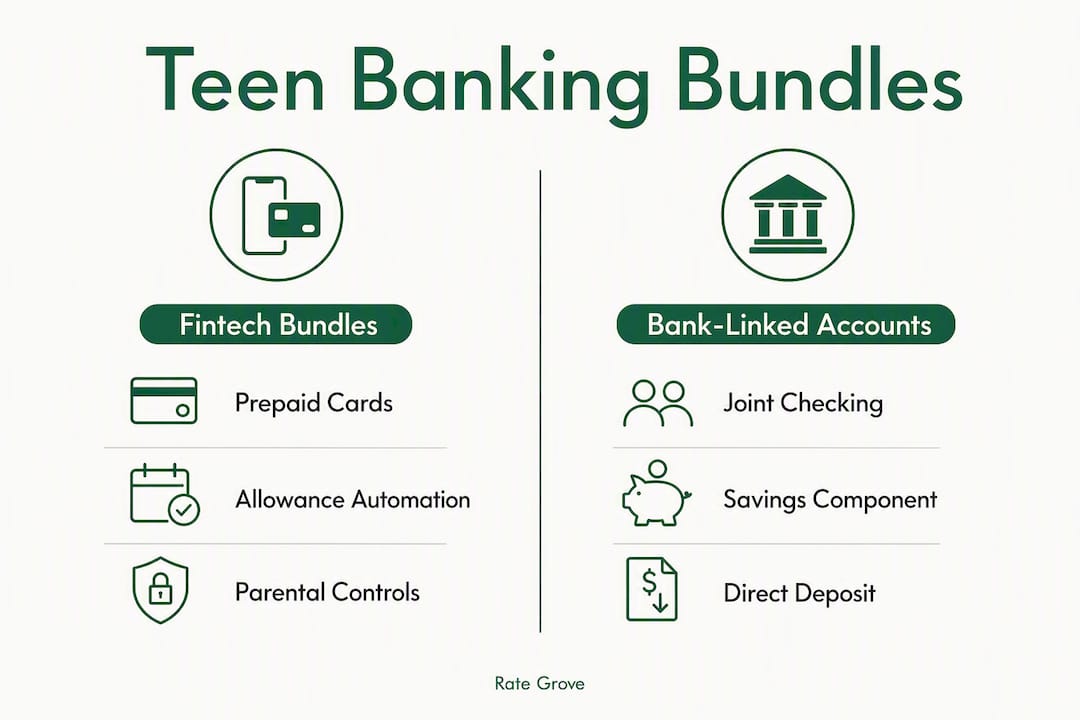
“Teen debit and savings bundle” is a marketing phrase, not a regulatory category. The industry actually offers three distinct models, and the differences matter more than the branding.
1. Prepaid or fintech teen bundles
These are debit-style cards issued by a fintech company through a partner bank. The card carries FDIC insurance on the stored balance, but it is not a traditional bank account. Prepaid accounts differ from bank accounts in merchant acceptance and feature depth. The upside is control granularity: fintech apps can offer merchant-level blocking, category limits, chore-linked allowances, and purchase approvals that most bank teen products do not match. The tradeoff is a monthly subscription fee, typically ranging from a free basic tier up to $5–$15 per month for premium family features, plus potential cash reload or out-of-network ATM fees.
2. Bank-linked teen checking plus savings bundles
These are joint accounts opened at a bank or credit union, with the parent as co-owner. The teen gets a debit card tied to a real checking account, and a linked savings account earns interest. Some bank teen checking products carry no monthly fee, no minimum balance requirement, and offer shared login visibility for parents alongside standard banking features like direct deposit. ATM access is often broader: some teen checking accounts advertise access to tens of thousands of fee-free ATMs through national networks. FDIC or NCUA insurance applies directly, not through a partner arrangement.
3. Custodial or custodial-style youth savings products
UGMA and UTMA accounts are custodial accounts where the parent controls assets until the teen reaches the age of majority (18 or 21, depending on the state). Some credit unions and community banks offer branded youth savings accounts that function similarly, pairing a savings account with a debit card under parental oversight. These products focus on savings growth and sometimes investment education rather than everyday spending. FDIC or NCUA insurance applies to the deposit portion; investment assets held in a UGMA/UTMA are not insured.
Pro Tip: Check whether the “bundle” you are considering is actually two separate accounts (checking + savings) or a single prepaid wallet with a savings “pod.” The distinction affects FDIC coverage, interest eligibility, and how the account converts when your teen turns 18.
How to compare teen debit and savings bundles side by side
When you sit down to compare teen bank accounts, eight dimensions separate a good fit from an expensive mistake. Use this table as your evaluation grid.

| Dimension | Prepaid / Fintech Bundle | Bank-Linked Teen Checking + Savings | Custodial / Youth Savings |
|---|---|---|---|
| Fees / monthly cost | $0–$15/mo subscription; reload and ATM fees possible | Often $0/mo; standard ATM fees may apply | Often $0/mo; may require minimum balance |
| Parental controls | High granularity: merchant blocking, category limits, chore automation | Moderate: spend alerts, shared visibility, overall limits | Low to moderate: account-level oversight |
| Account type | Prepaid card via partner bank | Joint checking + savings (real bank account) | Custodial deposit or investment account |
| Savings features / APY | Savings “pods” or goals; reward rates vary by tier | Linked savings account earning stated APY | Savings account APY or investment returns |
| ATM access | Limited network; out-of-network fees common | Large fee-free networks common | Varies; savings-focused, less ATM emphasis |
| Age range & transition | Typically 6–18; conversion policies vary widely | Typically 13–17; converts to adult account at 18 | Transfers to teen at age of majority (18–21) |
| FDIC / NCUA protection | FDIC via partner bank (not a direct bank account) | Direct FDIC or NCUA coverage | FDIC/NCUA on deposits; investments not insured |
| Credit-building capability | Rarely; some secured products report to bureaus | No direct credit building; some linked products do | No direct credit building |
Reading this table: the “right” column depends on your family’s top priority. If control is the goal, the fintech column wins on granularity. If real banking experience matters, the bank-linked column wins on ATM access, direct deposit, and transition smoothness.
Out-of-network ATM fees and cash reload fees can quietly erase the savings from a “no monthly fee” product if your family relies on cash. Always read the full fee disclosure, not just the headline.
Pro Tip: Ask the issuer specifically how cash reloads work and what they cost. Many fintech products charge per reload at retail locations, which adds up fast for families who pay allowances in cash. This single detail often changes the true monthly cost more than the subscription tier does.
For a deeper look at how to uncover hidden account fees, Rate Grove’s fee checklist walks through every line item to verify.
How do you choose the right teen banking bundle for your family?
Start with a short self-assessment. Your family’s primary goal will point you toward the right bundle category before you ever look at a product page.
Self-assessment: what matters most to you?
- Tight parental controls: You want to approve purchases, block categories, and automate chores. Go fintech/prepaid.
- Savings growth and APY: You want a real interest rate on your teen’s balance. Go bank-linked or credit union bundle. Alliant Credit Union’s teen checking pairs a checking account with a high-rate savings account earning well above the national average.
- Real banking experience: You want your teen to use direct deposit, write checks, and build habits that carry into adulthood. Go bank-linked.
- Credit building: You want the account to help establish a credit file. Look specifically for secured teen credit products or credit-building add-ons; standard debit and prepaid cards do not report to credit bureaus.
- Low cost, multiple kids: Compare family subscription tiers on fintech products against no-fee bank accounts. Family pricing on fintech apps can lower per-child cost significantly.
Checklist: questions to ask before opening any account
- Who legally owns this account, and what happens to the balance if the teen turns 18 mid-year?
- Does the account convert automatically to an adult product at 18, and does that conversion change the fee structure?
- Are cash reloads free, or is there a per-transaction fee at retail locations?
- What ATM network does the card use, and what is the out-of-network fee?
- Is FDIC or NCUA insurance applied directly to this account, or through a partner bank arrangement?
- Does the mobile app support both parent and teen logins, and what can each party see and do?
- What customer service channels are available (phone, chat, in-app), and what are the hours?
Red flags to watch for
- Vague FDIC language like “funds may be insured” without naming the insuring institution.
- Account transition policies that convert to adult accounts with abruptly different fees at age 18 with no grace period.
- No clear fee schedule on the issuer’s website (a fee page should be one click from the product page).
- Apps with no parent-specific login or monitoring dashboard.
- Customer service limited to email only, with no phone or live chat option.
Understanding how banks calculate and waive monthly fees is worth a few minutes before you commit to any product.
How parents use different bundles to teach real money skills
The best teen banking product is the one your teen actually engages with. Here is how each bundle type maps to common teaching goals.

Chore-tied allowance automation
Fintech bundles are built for this. Apps with chore tracking let you assign tasks, set a dollar value, and release funds automatically when the teen marks a chore complete. This creates a direct, visible link between work and money that a plain bank account cannot replicate as easily. It also removes the “I forgot to pay you” problem for busy parents.
Paying part-time job wages via direct deposit
Bank-linked teen checking accounts handle this cleanly. Many accept direct deposit, and some even offer early pay features. The Venmo Teen Debit Card, for example, supports direct deposit with the option to receive paychecks up to two days early for eligible users aged 13–17. Once a teen has a real paycheck hitting a real account, the conversation about budgeting and saving becomes concrete rather than theoretical.
Teaching bills and autopay responsibility
A bank-linked account with a linked savings component is the right tool here. Set up a small recurring transfer from checking to savings each month, and let your teen watch the balance grow. Reviewing statements together monthly, even for 10 minutes, builds the habit of reconciling income against spending. A multi-account approach (separate spend, save, and give buckets) works well for teens who respond to visual goal tracking.
Stock market and investing education
Some custodial and fintech bundles include investing features or in-app financial literacy modules. Certain fintech products pair a prepaid debit card with built-in financial education content and activity tracking for parents. If investing education is a priority, look specifically for products that include a custodial brokerage component or at minimum a savings pod with a visible interest calculation so your teen can see compounding in action.
Quick tips for making the learning stick
- Set one savings goal at account opening (a specific item, a trip, a car fund) and review progress monthly.
- Match a percentage of what your teen saves independently, the same way an employer matches a 401(k).
- Let the teen make one low-stakes spending mistake without intervention, then debrief together.
Why savings rates matter for young savers is a useful read to share with your teen when explaining why APY is worth paying attention to.
How Rate Grove verifies teen account data
Rate Grove’s comparisons are built on issuer and regulator sources, not editorial guesswork. Here is what that process looks like in practice.
| Verification step | What Rate Grove checks | Primary source |
|---|---|---|
| Fee accuracy | Monthly fees, ATM fees, reload fees, inactivity fees | Issuer fee disclosure pages |
| FDIC / NCUA status | Direct coverage vs. partner bank arrangement | FDIC BankFind, NCUA Credit Union Locator |
| Age rules | Minimum age, maximum age, transition policy at 18 | Issuer product pages and terms of service |
| ATM network | Network name, fee-free ATM count, out-of-network fee | Issuer ATM locator and fee schedule |
| Parental controls | Feature availability: merchant blocking, spending limits, chore tools | Issuer feature pages and app store descriptions |
| Savings / APY | Current APY, savings pod structure, interest calculation method | Issuer rate pages and account disclosures |
Rate Grove cross-checks these data points monthly against issuer pages and regulator listings. Rates and fees change, and a figure that was accurate three months ago may not be today.
How you can verify claims yourself
- Go directly to the issuer’s product page and find the “fees” or “pricing” link, not the marketing homepage.
- Search the FDIC’s BankFind tool or the NCUA’s credit union locator to confirm the institution’s insurance status.
- Read the account agreement or terms of service for the age transition clause, usually buried in the fine print.
- Check the app store listing for recent user reviews mentioning customer service issues or unexpected fees.
Rate Grove flags any product where the fee page is not publicly accessible or where FDIC/NCUA language is ambiguous. If a product cannot pass a basic transparency check, it does not appear in Rate Grove’s verified comparisons.
Key Takeaways
Choosing the right teen banking bundle comes down to three things: how much parental control you need now, what the account costs over time, and how cleanly it transitions when your teen turns 18.
| Point | Details |
|---|---|
| Match bundle type to teen’s age | Fintech/prepaid bundles suit younger teens needing tight controls; bank-linked accounts suit teens 15+ building real banking habits. |
| Always verify FDIC/NCUA coverage | Prepaid cards are insured through a partner bank, not directly; confirm the insuring institution before opening. |
| Read the full fee page | Out-of-network ATM fees and cash reload fees can cost more than a monthly subscription on a “no-fee” product. |
| Check the age-18 transition clause | Some accounts auto-convert to adult products with new fees; confirm whether a grace period or opt-out exists. |
| Use Rate Grove to compare | Rate Grove’s monthly-verified comparison tool surfaces fees, protections, and transition rules side by side so you can decide faster. |
The control vs. independence tradeoff is real
There is a version of this decision that parents get wrong consistently: they pick the most feature-rich fintech app for a 16-year-old who is already working a part-time job, then wonder why the teen resents the merchant-blocking and purchase approvals. The controls that make sense for a 10-year-old with an allowance are the same controls that undermine trust with a teenager who is earning real money.
My honest recommendation is to treat the bundle decision as a two-stage process. Start with a fintech bundle for younger teens, use it actively (review statements together, adjust spending limits as trust builds), and then transition to a bank-linked teen checking account around the time your teen starts earning income. That transition is also the moment to have the conversation about what happens at 18, because the surprise fee hit when an account auto-converts to an adult product is one of the most avoidable financial setbacks a young adult faces.
The one thing I would check first on any product is the age-18 transition clause. Not the APY, not the app design. The transition clause. A product that converts to a $15/month adult checking account with no grace period and no notification is a problem waiting to happen. Families who catch this in advance can either choose a different product or set a calendar reminder to act before the conversion date.
If you are genuinely unsure where to start, a no-fee bank-linked teen checking account with a linked savings component is the lowest-risk entry point. It costs nothing to open, builds real banking habits, and gives you time to decide whether you need more control features.
Rate Grove makes it easier to find the right teen account
Comparing teen banking products on your own means visiting a dozen issuer pages, cross-referencing fee disclosures, and hoping the information is current. Rate Grove does that work for you. The comparison tool pulls verified data directly from issuer fee pages and regulator listings, then presents fees, FDIC/NCUA status, parental control features, and age transition rules in a single, side-by-side view.
Parents who use Rate Grove’s tool typically spot fee differences and transition policy gaps they would have missed reading marketing pages alone. The data is updated monthly, so you are not making a decision based on a rate or fee that changed last quarter. Whether you are weighing a fintech bundle against a bank-linked account or trying to figure out which credit union youth product actually pays a competitive APY, Rate Grove’s teen and youth account comparisons give you a verified shortlist in minutes. Start your comparison now and find the bundle that fits your family’s goals.
Where to verify teen account claims yourself
Use these primary sources to confirm any fee, insurance status, or account rule before opening an account.
- FDIC BankFind Suite: Search any bank by name to confirm it is FDIC-insured and find its certificate number. Use this to verify that a fintech’s “partner bank” is a real, insured institution.
- NCUA Credit Union Locator: Confirm NCUA insurance for any credit union offering a teen checking or savings bundle. Alliant Credit Union and similar institutions are listed here.
Rate Grove cross-checks all of the above sources monthly. If a fee or feature changes between updates, the issuer’s own disclosure page is always the authoritative source.
This article is for general informational purposes only and does not constitute financial advice. Confirm current fees, rates, and account terms directly with the issuer or a qualified financial professional before opening any account.