

A CD rate lock means the quoted APY is contractually fixed, either from the moment you fund the account or for the entire term, depending on the issuer’s terms. Once your deposit settles, a fixed-rate certificate of deposit pays exactly the disclosed rate until maturity, regardless of what the Federal Reserve does in the meantime. The industry term for this guarantee is a “fixed-rate CD,” and the legal backing comes from your deposit contract, plus the Truth in Savings disclosure required under Regulation DD.
The single most important action: before you fund, ask the bank for the Truth in Savings disclosure and confirm the funding-window deadline in writing. Missing that window can cost you the quoted rate entirely.
Three quick facts to keep in mind:
- The rate guarantee is contract-based, not just a marketing promise. Regulation DD requires issuers to disclose the APY and the period the rate stays in effect.
- FDIC insurance protects your principal and accrued interest up to $250,000 per depositor, per insured bank, but it does not guarantee the rate if an acquiring bank changes terms after a failure.
- Rate Grove verifies CD rate data monthly against issuer and regulator sources, so the figures you see in its comparison tools reflect current, confirmed offers.
Table of Contents
- What a CD rate lock actually covers
- How different CD types handle rate guarantees
- How long does a CD rate lock last?
- What happens at maturity and during auto-renewal
- Real-world rate-lock scenarios
- Key Takeaways
- The case for locking sooner rather than later
- Rate Grove makes CD comparisons straightforward
- Useful sources
What a CD rate lock actually covers
The phrase “rate lock” gets used loosely in CD marketing, so it helps to separate three distinct things: the advertised offer rate, the APY in the Truth in Savings disclosure, and the issuer’s funding rules.
The advertised offer rate is what you see on a bank’s website or in a promotion. It can change before you fund. The APY in the Truth in Savings disclosure is the legally binding figure, and it reflects how interest compounds over the term. Those two numbers should match, but the APY is the one that governs your payout.
The funding rules determine when the lock actually starts. Some issuers apply the rate as of your application date; others apply it as of the settlement date. Promotional “lock in APY” offers are time-limited and conditional on your funds settling within the promotion’s window. If you miss that window, the issuer is not obligated to honor the original quote.
Key distinction: “rate guaranteed upon funding” and “offer subject to change before funding” are not the same thing. The first means you are protected once the deposit clears; the second means the bank can reprice before your money arrives.
Pro Tip: Always ask whether the rate is “as of opening date” or “as of settlement date,” and get that answer in writing, whether by email, chat transcript, or printed disclosure.
How different CD types handle rate guarantees
Not every CD locks a rate for the full term. The type of account you open changes what “guaranteed” actually means.
- Traditional fixed-rate CDs lock the disclosed APY for the entire term once funded. Early withdrawal typically costs several months of interest as a penalty, but the rate itself does not change. See Rate Grove’s fixed vs. variable CD comparison for a side-by-side breakdown.
- Callable CDs give the bank the right to redeem the CD early. You receive your principal plus accrued interest, but you lose the remaining locked earnings. The initial rate is real; the bank just controls the timeline.
- Step-up and bump-up CDs offer a partial lock with scheduled rate increases or a one-time option to request a higher rate. They are not the same as a full-term fixed lock, because the starting rate is lower to offset the flexibility.
- Variable-rate and market-linked CDs tie returns to an index or benchmark. There is no fixed-rate guarantee; your APY moves with the underlying reference.
- Liquid and no-penalty CDs let you withdraw early without a fee, but they usually carry lower rates than traditional fixed CDs to compensate for that flexibility.
Longer-term fixed-rate CDs generally pay higher interest than shorter terms, though promotional offers can invert that pattern. Always check the specific term and issuer before assuming a longer lock pays more.
How long does a CD rate lock last?
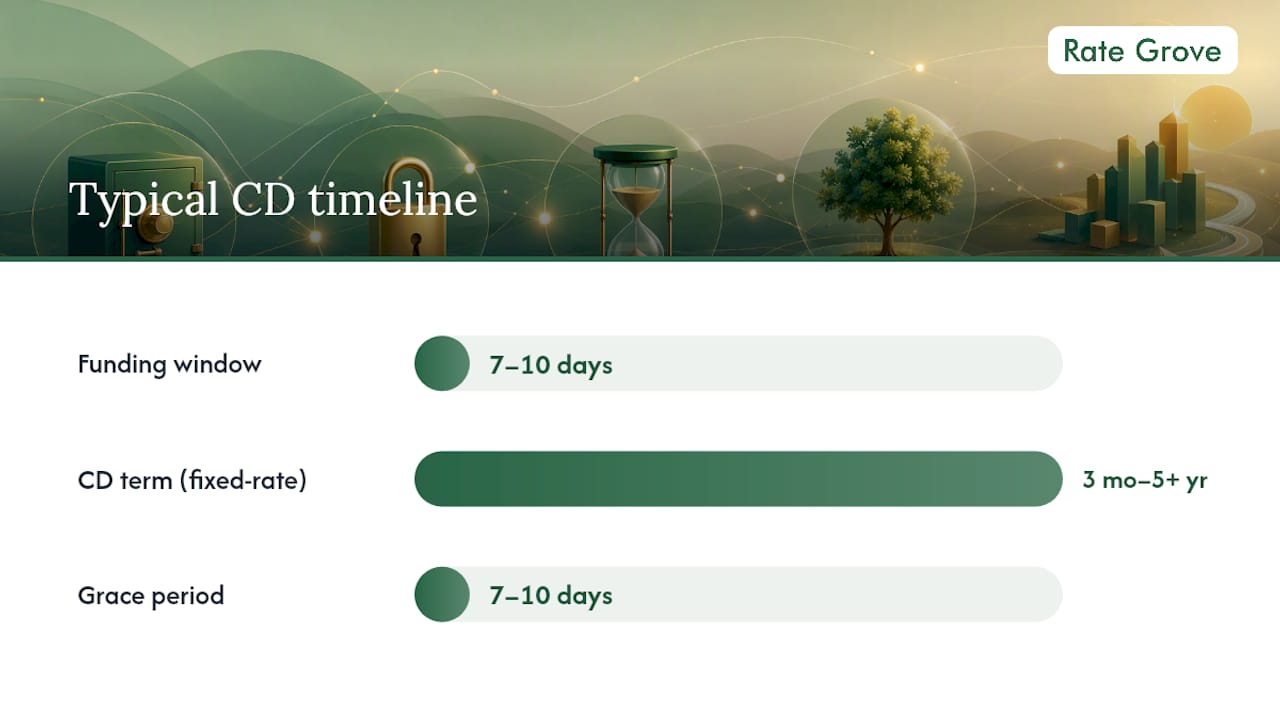
There are two separate time windows to understand: the funding window (how long the offer holds before you deposit) and the CD term (how long the rate is fixed after you fund).
| Stage | Typical window | What it means for you |
|---|---|---|
| Funding / settlement window | Often 7–10 days from application | Fund before this deadline or the quoted rate may not apply |
| CD term (fixed-rate) | 3 months to 5+ years | APY is locked for the full term once funded |
| Grace period at maturity | Commonly 7–10 days | Window to withdraw or change instructions without penalty |
E*TRADE’s CD terms, for example, apply the higher of the opening-date or settlement-date rate when settlement occurs within 10 days of account opening. That kind of rule benefits you if rates tick up between application and funding, but it also means settlement timing matters.
Once a fixed-rate CD is funded and confirmed, the APY holds for the entire term. The lock does not carry forward past maturity, though. If you do nothing at maturity, most banks auto-renew your balance into a new CD at whatever rate is current that day.
The rate guarantee ends at maturity. An automatic renewal uses the bank’s then-current rate, not the rate you originally locked.
What happens at maturity and during auto-renewal
The moment your CD matures, the locked rate expires. Here is the typical sequence and how to stay in control.
- Set a calendar reminder one week before maturity. Use that time to compare current CD rates on Rate Grove and decide whether to renew, switch terms, cash out, or build a CD ladder.
Pro Tip: When the Federal Reserve signals rate cuts ahead, locking into a longer-term CD before those cuts take effect preserves your current yield. Existing CDs keep their locked APY while new CD rates fall with the Fed.
Real-world rate-lock scenarios
| Scenario | What happens | Outcome |
|---|---|---|
| Quoted 4.50% APY, 2-year CD, 10-day funding window; deposit posts late | Issuer’s window has closed; bank applies current rate | You may receive a lower rate than quoted |
| Callable 5-year CD called after 2 years at locked APY | Bank returns principal + 2 years of interest | You lose 3 years of expected locked earnings |
| 1-year CD auto-renews; grace period missed | Balance rolls into new CD at bank’s current rate | If rates fell, you earn less than the prior term |
- In the funding-window scenario, a same-day wire transfer instead of ACH would have settled on time and secured the 4.50% APY.
- In the callable scenario, the bank’s call option was disclosed in the original contract. Reviewing the Truth in Savings disclosure before opening would have flagged it.
- In the auto-renewal scenario, a calendar reminder set at opening would have triggered a rate review before the grace period closed.
Key Takeaways
A funded fixed-rate CD pays the disclosed APY for the full term unless the contract includes a callable provision or another exception, making it one of the most predictable savings tools available.
| Point | Details |
|---|---|
| Rate lock starts at funding | The APY is guaranteed once your deposit settles, not when you apply. |
| Funding windows are short | Most issuers allow only 7–10 days to fund before the quoted rate may change. |
| Rate guarantee ends at maturity | Auto-renewal uses the bank’s current rate; the prior lock does not carry forward. |
| Exceptions are narrow but real | Callable CDs, bank failures, and missed funding windows can all alter your effective return. |
| Rate Grove for comparisons | Use Rate Grove’s monthly-verified comparison tools to check current CD offers before renewing or opening. |
The case for locking sooner rather than later
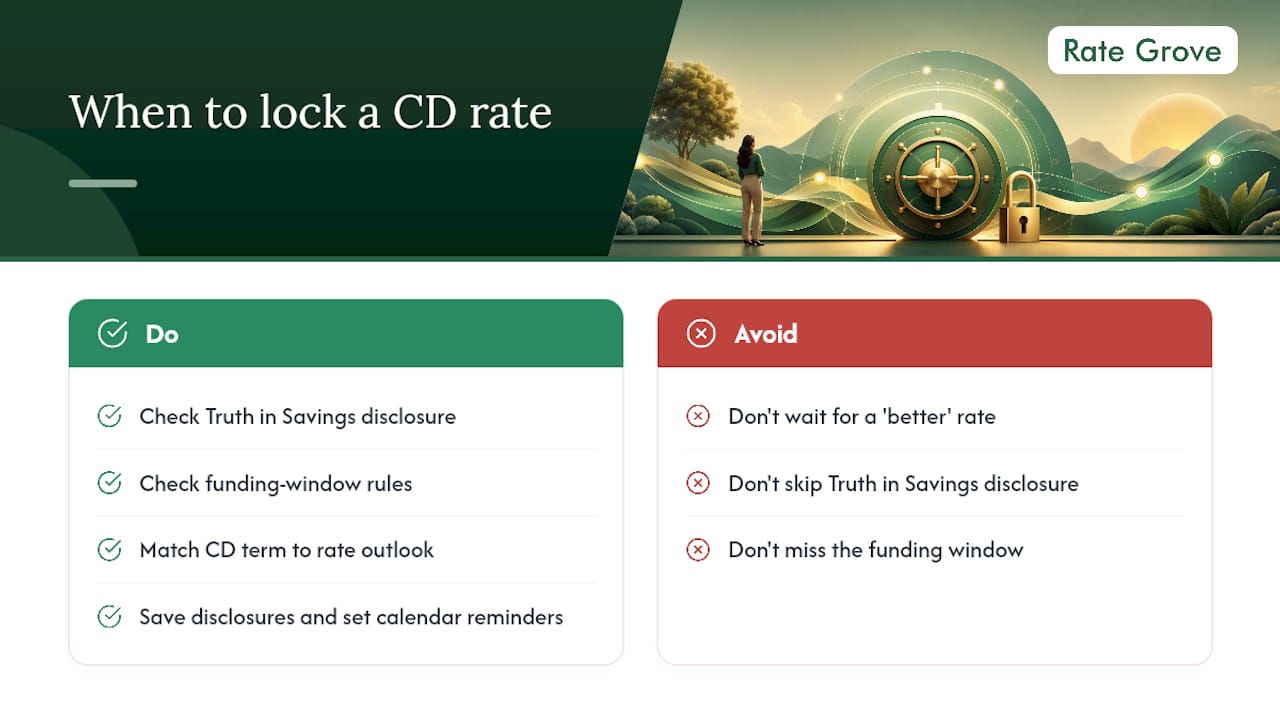
Most savers spend too much time waiting for a “better” rate and not enough time confirming the terms of the rate they already have in front of them. The rate-lock question is really two questions: is this rate actually guaranteed, and for how long? The first answer lives in the Truth in Savings disclosure. The second answer lives in the funding-window rules, which most people never ask about.
Timing matters too. When the Fed signals cuts, a longer-term CD locks in today’s yield before new offers drop. When rates are rising, shorter terms or a CD ladder keep your options open. Neither strategy works if you miss the funding window or skip the disclosure.
One habit that costs nothing: save every rate-related email and disclosure in a dedicated folder, and set a calendar reminder for one week before maturity. Those two steps prevent the most common and avoidable CD mistakes.
Rate Grove makes CD comparisons straightforward
Finding a competitive CD rate is only half the job. Confirming the funding window, the APY, and the callable status before you commit is the other half, and that is where most savers lose money to fine print.
Rate Grove publishes monthly-verified, side-by-side comparisons of CD rates, terms, and fees drawn directly from issuer and regulator sources. You can see the APY, the term, and the key conditions in one place, without digging through multiple bank websites. When you are ready to compare current offers or check funding windows before applying, start your CD search at Rate Grove and use the comparison tools to find the rate that fits your timeline.
Useful sources
- Fixed-rate certificate of deposit (Investopedia)
- CD Rates: Compare Certificate of Deposit Rates | PrimeRates
- Are CD Rates Guaranteed? Fixed Rates and Exceptions - LegalClarity
- Certificate of Deposit: CD Rates Up to 4.40% | E*TRADE
- When Should You Lock In a CD? (SavvySaver)
This article is general information, not financial advice. Confirm current rates, terms, and insurance coverage with your bank, credit union, or the FDIC/NCUA directly before opening any account.