

If you’re a U.S.-based saver looking for low-risk alternatives to PickTheBank.eu, the strongest options are FDIC-insured online banks like Ally Bank and Axos Bank, U.S. Treasury and corporate bond funds, money market funds, and fintech savings platforms. Each offers a different mix of yield, safety, and flexibility. The table below gives you a fast side-by-side view.
| Option | Available in U.S. | Typical APY / Yield | FDIC / SIPC Coverage | Min. Deposit | Liquidity | Fees |
|---|---|---|---|---|---|---|
| Ally Bank (HYSA / CD) | Yes | Competitive | FDIC up to $250,000 | $0 | High (HYSA) / Low (CD) | None |
| Axos Bank (HYSA / CD) | Yes | Competitive | FDIC up to $250,000 | $0 | High (HYSA) / Low (CD) | None |
| U.S. Treasury / Gov. Bonds | Yes | 2–5% depending on duration | Not FDIC; backed by U.S. gov. | Low | Medium | Low |
| Corporate Bond Funds | Yes | 2–5% depending on credit and duration | SIPC (brokerage account) | Varies | Medium | Fund expense ratio |
| Money Market Funds | Yes | 2–4% | SIPC (not FDIC) | Low | High | Low |
| Fintech Savings Platforms | Yes | 3–5%+ | FDIC via partner banks | Varies | Medium | Varies |
PickTheBank.eu is a European deposit comparison platform that aggregates savings and fixed-deposit rates from licensed EU banks. It works well for European residents, but U.S. savers face real friction: cross-border KYC processes, foreign withholding taxes, and EU deposit guarantee schemes that operate differently from FDIC insurance. The options above sidestep all of that.
Table of Contents
- What are the best low-risk alternatives to PickTheBank.eu?
- How do risk and return compare across these options?
- Which U.S. platforms work best for conservative savers?
- How do you choose the safest low-risk saving option?
- Why Rate Grove makes comparing these options easier
- Rate Grove helps you find the right account without the guesswork
- Key Takeaways
What are the best low-risk alternatives to PickTheBank.eu?
The U.S. market offers a clear set of low-risk categories that match or beat what PickTheBank.eu provides for European savers, without the cross-border complexity.
- FDIC-insured online savings accounts and CDs. Online-only banks carry the same federal insurance as traditional banks but typically pay higher rates because they operate without branch overhead. Ally Bank and Axos Bank are two of the most recognized names in this space, both offering no-minimum, no-fee savings accounts with daily compounding.
- U.S. government bonds. Treasury bills, notes, and bonds are backed by the full faith and credit of the U.S. government. They yield in the 2–5% range depending on duration and are exempt from state and local income tax, which adds to their after-tax return.
- Corporate bond funds. Investment-grade corporate bond ETFs or mutual funds typically yield 2–5% depending on credit and duration, slightly higher than Treasuries in exchange for modest credit risk. They are held in brokerage accounts covered by SIPC insurance up to $500,000, though SIPC does not protect against investment losses.
- Money market funds. These funds invest in short-term, high-quality debt instruments and yield roughly 2–4% with high liquidity. They are a practical parking spot for cash you may need within weeks or months.
- Fintech savings platforms. A growing category of digital platforms aggregates deposit offers from multiple FDIC-insured banks, letting you earn higher yields without opening separate accounts at each institution. The line between these platforms and neobanks is increasingly blurred; the key distinction is whether the platform prioritizes a full digital banking experience or pure yield optimization.
- Tax note. U.S. investors owe federal income tax on interest from savings accounts, CDs, and most bond funds. Treasury interest is exempt from state tax. Foreign interest income from platforms like PickTheBank.eu may also trigger withholding tax, reducing net returns further.
How do risk and return compare across these options?
Conservative savers often focus on nominal yield, but the number that actually matters is your real return, which is your APY minus the current inflation rate. If inflation runs above your savings rate, your purchasing power shrinks even as your balance grows.
| Option | Risk Level | Return Potential | Liquidity | Inflation Hedge |
|---|---|---|---|---|
| FDIC-insured HYSA | Very low | Low to medium | High | Partial |
| U.S. Treasury bonds | Very low | Medium | Medium | Partial |
| Corporate bond funds | Low | Medium | Medium | Partial |
| Money market funds | Low | Medium | High | Partial |
| Fintech savings platforms | Low to medium | Medium to high | Medium | Moderate |
| Conservative blended portfolio | Medium | Medium to high | Medium | Better |
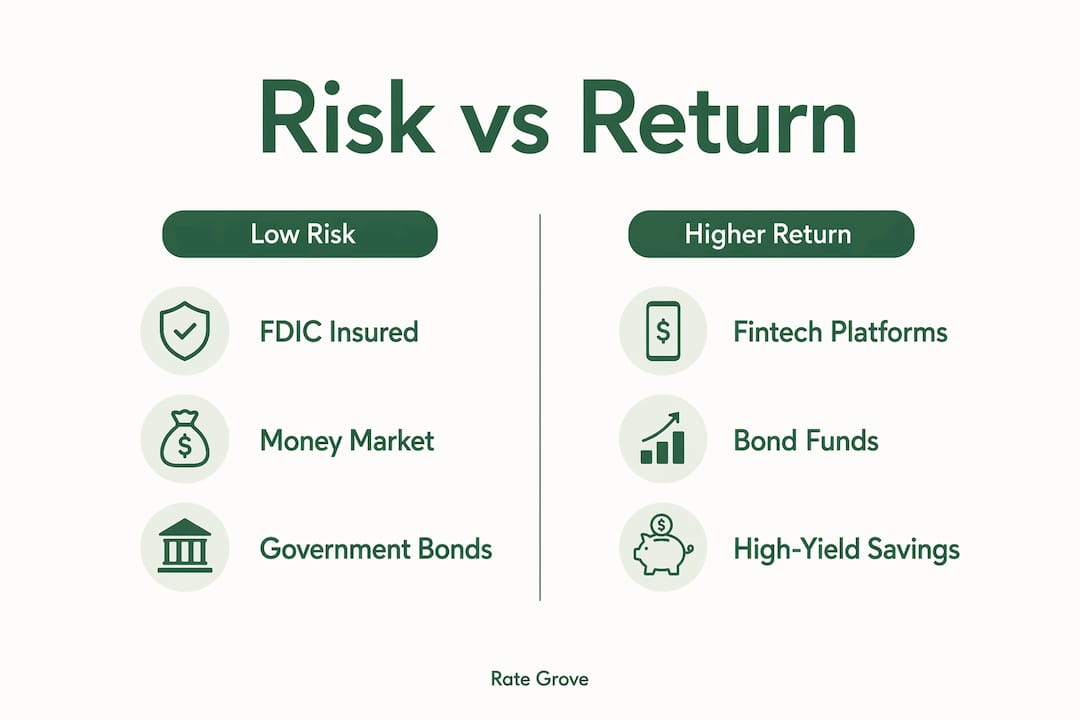
Inflation erodes nominal returns in 2026 just as it did in prior years, so a 4% APY in a high-inflation environment may deliver a real return close to zero. That is why experts recommend combining insured fixed deposits with conservative bond ETFs or money market funds, a blend that tends to outperform inflation on a low-risk basis.
FDIC and SIPC insurance affect perceived risk in different ways. FDIC covers deposits dollar-for-dollar up to $250,000 per depositor per bank, with no investment risk involved. SIPC protects the securities and cash in a brokerage account up to $500,000 if the broker fails, but it does not cover a decline in the value of your investments. Knowing which type of coverage applies to each account you hold is not optional; it is the foundation of any conservative strategy.
A blended low-risk portfolio typically allocates 30–40% to savings or CDs for liquidity, 30–40% to bonds or fixed deposits, 10–20% to money market funds, and 10–20% to fintech platforms for yield optimization. That spread gives you both a liquid cushion and a better shot at a positive real return.
Which U.S. platforms work best for conservative savers?
Two FDIC-insured online banks stand out for U.S. savers who want simplicity, safety, and competitive rates without the friction of cross-border platforms.

Ally Bank
Ally Bank has earned recognition as a top online bank for several consecutive years. Its high-yield savings account carries no monthly fees and no minimum balance requirement for opening, and interest compounds daily. Ally also offers CDs at fixed rates for savers who want to lock in a yield for a set term. The entire deposit relationship is FDIC-insured up to $250,000, and the mobile app is consistently rated among the best in digital banking. For savers who want a full-featured online banking experience alongside competitive yields, Ally is a natural starting point.
Axos Bank
Axos Bank markets itself as a full-service online bank with a particular strength in savings and checking products. Like Ally, it carries FDIC insurance and charges no monthly maintenance fees on its core accounts. Axos tends to appeal to savers who want both a high-yield savings account and lending products under one digital roof. Its CD offerings let you choose from multiple term lengths, giving you flexibility to ladder deposits across different maturity dates.
Fintech savings platforms
Beyond traditional online banks, a range of fintech platforms aggregates deposit offers from multiple FDIC-insured partner banks. This structure lets you spread deposits across institutions automatically, potentially increasing your effective FDIC coverage beyond the standard $250,000 single-bank limit. These platforms vary in fee structure and minimum deposit requirements, so comparing rates and fees before committing is worth the time. The tradeoff is that some platforms prioritize yield optimization over a full banking experience, meaning you may still need a separate checking account elsewhere.

Pro Tip: If you want to maximize FDIC coverage without opening multiple accounts manually, look for fintech platforms that use multi-bank deposit spreading. Some allow coverage well above $250,000 by distributing your funds across their network of partner banks.
How do you choose the safest low-risk saving option?
Picking the right platform comes down to four factors: insurance coverage, liquidity, fees, and real return after inflation. Getting all four right at once is the goal.
- Verify FDIC or SIPC status first. You can confirm any bank’s FDIC membership at the FDIC’s official BankFind tool. For brokerage accounts, SIPC membership is listed on the SIPC website. Never assume coverage; always check.
- Match liquidity to your timeline. A high-yield savings account gives you access to your money within one to two business days. A CD locks your funds for a fixed term, typically three months to five years, and charges an early withdrawal penalty. Money market funds settle in one business day in most cases.
- Calculate real return, not just APY. Subtract the current inflation rate from your nominal APY. If your savings account pays 4.5% and inflation is running at 3%, your real return is roughly 1.5%. That is the number that tells you whether your savings are actually growing in purchasing power.
- Watch platform fees closely. Fees and minimum deposit tiers can quietly erode net yield. A platform offering 5% APY with a $1,000 minimum and a $5 monthly fee may deliver less net return than a no-fee account at 4.5%.
- Understand the KYC burden. PickTheBank.eu historically required separate KYC verification for each partner bank, which adds friction and time. U.S. platforms like Ally and Axos use a single onboarding process for all their products.
- Account for taxes on interest. Interest from savings accounts and CDs is taxed as ordinary income at the federal level. Treasury interest avoids state tax. Foreign interest income may trigger additional withholding, reducing your effective return.
- Avoid chasing yield without checking safety. A fintech platform offering unusually high yields deserves extra scrutiny. Confirm which FDIC-insured bank holds your deposits and whether the platform itself is regulated.
Pro Tip: Before opening any new savings account, run a quick high-yield savings account comparison to see current rates side by side. Rates shift monthly, and a 0.5% difference on a $50,000 balance adds up to $250 per year.
Why Rate Grove makes comparing these options easier
Rate Grove publishes monthly-updated, fact-checked financial data covering savings accounts, CDs, and credit cards, all sourced directly from issuer and regulator sites. The comparison format is built for savers who want to see fees, rates, insurance status, and tradeoffs side by side without digging through multiple bank websites or outdated guides.
Key benefits of using Rate Grove for this kind of research:
- Verified data, updated monthly. Every rate and fee figure on Rate Grove is pulled from primary sources, so you are not relying on numbers that may be months out of date.
- Side-by-side fee and rate comparison. The platform shows you not just the headline APY but also minimum deposit requirements, fee structures, and liquidity terms in one view.
- FDIC and insurance status clearly labeled. Rate Grove flags insurance coverage for each product, so you can confirm safety without hunting through fine print.
- Designed for savers who want clarity fast. The interface is built around reducing the time it takes to reach a confident decision, not around maximizing page views.
- Expert-authored guides. Each Rate Grove guide is written by financial writers with direct knowledge of the products covered, and every article goes through a fact-check process before publication.
Rate Grove’s online bank rate analysis also explains why FDIC-insured online banks consistently pay more than traditional brick-and-mortar banks, a common point of confusion for savers who assume higher rates must mean higher risk. They do not. Lower operating costs translate directly into better rates for depositors, with the same federal insurance backing.
Rate Grove helps you find the right account without the guesswork
Sorting through savings accounts, CDs, bond funds, and fintech platforms on your own takes time you probably do not have. Rate Grove cuts through that by putting verified, current comparisons in one place, built specifically for savers who want low-risk options with competitive returns.
Whether you are moving money away from a European deposit platform or simply looking for a better yield on your U.S. savings, Rate Grove gives you the data to make that call with confidence. The comparison covers fees, rates, insurance status, and minimum deposits, all fact-checked and updated every month. Head to Rate Grove to compare your options and find the account that fits your goals today.
Key Takeaways
FDIC-insured online banks, U.S. government bonds, money market funds, and fintech savings platforms are the strongest low-risk alternatives to PickTheBank.eu for U.S. savers in 2026.
| Point | Details |
|---|---|
| FDIC coverage limit | Deposits at U.S. online banks are insured up to $250,000 per depositor per bank. |
| Bond yield range | U.S. government and corporate bonds typically yield 2–5% depending on credit quality and duration. |
| Real return focus | Subtract the current inflation rate from your nominal APY to find your true purchasing power gain. |
| Portfolio blending | A conservative allocation of 30–40% savings, 30–40% bonds, and 10–20% money market funds balances liquidity and yield. |
| Rate Grove comparison | Rate Grove provides monthly-updated, side-by-side comparisons of rates, fees, and insurance status for U.S. savers. |