

Every bank account comes with a deal. You get some features, and you give up others. That’s the core of a bank account tradeoff: the compromise between competing benefits like interest earnings, easy access, low fees, and convenience.
No single account does everything well. A checking account keeps your money instantly accessible but pays little to no interest. A savings account grows your balance faster but limits how often you can tap it. Understanding these tradeoffs helps you pick the right accounts for how you actually live and spend.
The main tradeoff categories to know:
- Interest vs. access: Higher-yield accounts often restrict withdrawals or require minimum balances.
- Fees vs. features: Premium accounts with perks like overdraft protection or ATM reimbursements often carry monthly fees.
- Security vs. convenience: Online banks offer better rates but no branch access; local banks offer in-person service at the cost of lower yields.
- Simplicity vs. coverage: One account is easy to manage, but FDIC insurance covers only $250,000 per depositor per bank.
What is a bank account tradeoff in practice?
The clearest way to see these tradeoffs is by comparing account types side by side.
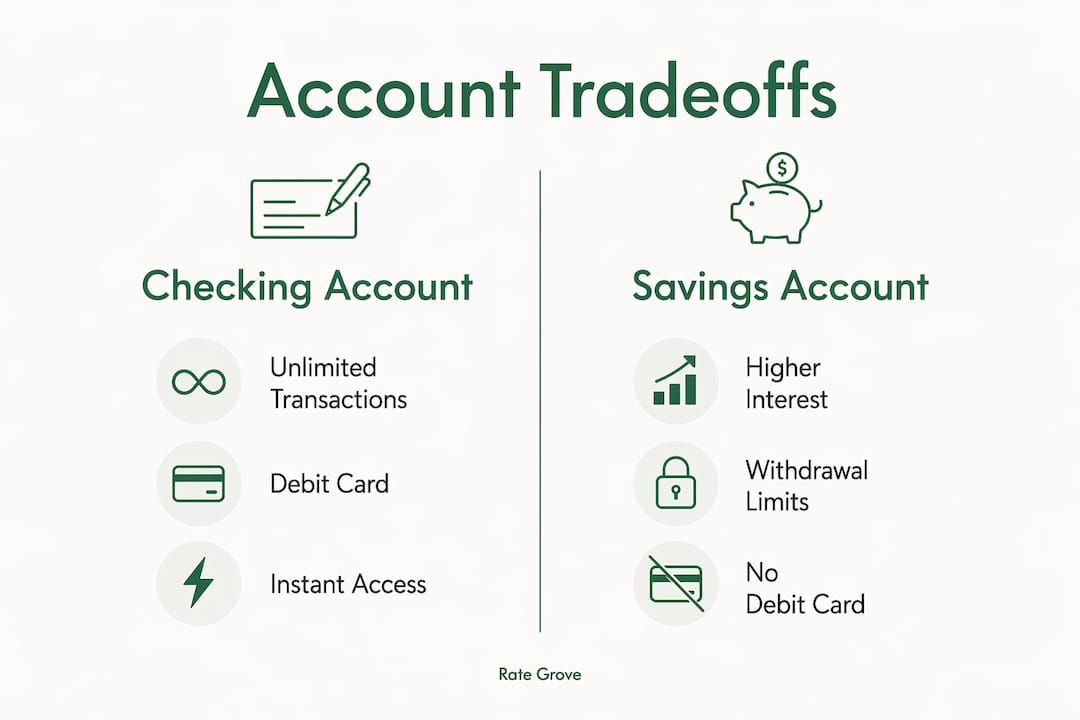
A checking account gives you unlimited transactions, a debit card, and instant access to your money. The cost? Traditional banks pay as little as 0.01% APY on checking balances. A high-yield savings account at an online bank can pay around 4–5% APY, but some banks limit you to six withdrawals per month and offer no physical branch.

Minimum balance requirements add another layer. Some accounts waive monthly fees only if you keep $1,500 or more on deposit. If your balance dips below that, the fee can eat into whatever interest you earned. Reading fee disclosures carefully before opening any account saves you from that trap.
Common tradeoff examples at a glance:
- Checking account: high liquidity, low or zero interest
- Savings account: higher interest, limited monthly withdrawals
- Online bank: top-tier rates, no branch access
- Local bank: in-person service, lower savings yields
- Overdraft protection: prevents declined transactions, but often charges a fee per use
- ATM fee reimbursements: convenient, usually tied to premium or online accounts
How layering accounts helps you manage these tradeoffs
Layering means using two or more accounts with distinct purposes so each one does a specific job. The most practical setup pairs a local checking account for daily spending with an online high-yield savings account for your emergency fund and savings goals. Local banks pay around 0.01% APY on savings; online banks pay around 4–5% APY. That gap adds up fast on any meaningful balance.
Spreading money across multiple FDIC-insured banks also extends your deposit coverage beyond $250,000 if you have a larger cash balance. That’s a real advantage for anyone sitting on a down payment or an inheritance.
Pros and cons of layering accounts:
- Pro: Captures higher savings rates without sacrificing daily convenience
- Pro: Extends FDIC coverage across institutions
- Pro: Separates spending money from savings, reducing the temptation to dip in
- Con: More accounts mean more logins, transfers, and things to track
- Con: Poorly managed transfers can cause missed payments
- Con: Dormant accounts can trigger fees or even closure after a year of inactivity
Practical tips for managing multiple accounts without the headache
Keeping two or three accounts hits the sweet spot between organizational benefit and manageable complexity. Having many accounts, especially beyond several, increases the risk of missed payments, forgotten balances, and unnecessary fees.
Give every account one clear job. If you can’t explain what an account is for in one sentence, you probably don’t need it. Automation does the heavy lifting: schedule automatic transfers from checking to savings right after payday so the money moves before you spend it.
Watch out for opportunity cost when chasing bank bonuses. If a bonus requires you to park $10,000 at a bank paying 0.5% APY while your regular savings account pays 4.5%, the yield you forfeit over the holding period can easily exceed the bonus itself.
Pro Tip: Keep each dormant or secondary account alive with at least one small transaction per year. A $1 transfer counts. Banks typically flag accounts as dormant after 12 months of inactivity, which can trigger fees or force closure.
- Set up two to three accounts for most households—going beyond five accounts typically introduces unnecessary complexity.
- Automate transfers so savings happen before spending
- Review each account quarterly to confirm it still earns its place
- Use soft switching to test a new bank’s features without closing your existing accounts
Key Takeaways
Every bank account tradeoff comes down to one question: which features matter most to your financial goals right now?
| Point | Details |
|---|---|
| Tradeoffs are unavoidable | Every account trades off interest, access, fees, or convenience — no single account wins on all four. |
| Layering captures the best of both | Pairing a local checking account with an online HYSA earning 4–5% APY captures rate and convenience together. |
| Two to three accounts is the sweet spot | Having more than five accounts often leads to missed payments, fees, and forgotten balances. |
| Automation prevents “bucket fatigue” | Scheduling automatic transfers removes the manual step where most multi-account setups break down. |
| Opportunity cost is real | Locking funds in a low-rate bonus account can cost more in foregone yield than the bonus pays out. |