

A savings acceleration strategy is an active, systematic approach to growing your money faster than traditional passive saving allows. Instead of depositing whatever is left over at the end of the month, you deliberately structure your finances using tools like high-yield savings accounts (HYSAs), automated transfers, tax-advantaged retirement accounts, and targeted debt reduction. The goal is to make every dollar work harder and move through a clear sequence of priorities.
The core components typically stack in this order:
- Emergency fund in a HYSA covering several months of expenses
- Employer 401(k) match captured in full
- High-interest debt paid down aggressively
- Retirement accounts (Roth IRA, traditional IRA, HSA) funded beyond the 401(k)
- Education or goal-based accounts (529 plans, CDs) added last
Each layer builds on the one before it. Skipping steps, like funding a 529 before capturing your employer match, leaves guaranteed returns on the table.
Table of Contents
What is a savings acceleration strategy in everyday practice?
The most accessible savings growth techniques require no special income or financial expertise. They work because they remove friction and decision fatigue from the saving process.
Automate transfers on payday. Set a recurring transfer from your checking account to your HYSA the same day your paycheck hits. Money moves before you see it, before you spend it. The U.S. personal savings rate sits at roughly 3.6%, and behavioral research consistently points to automation as the single most effective fix. People who automate savings keep significantly more than those who save manually.
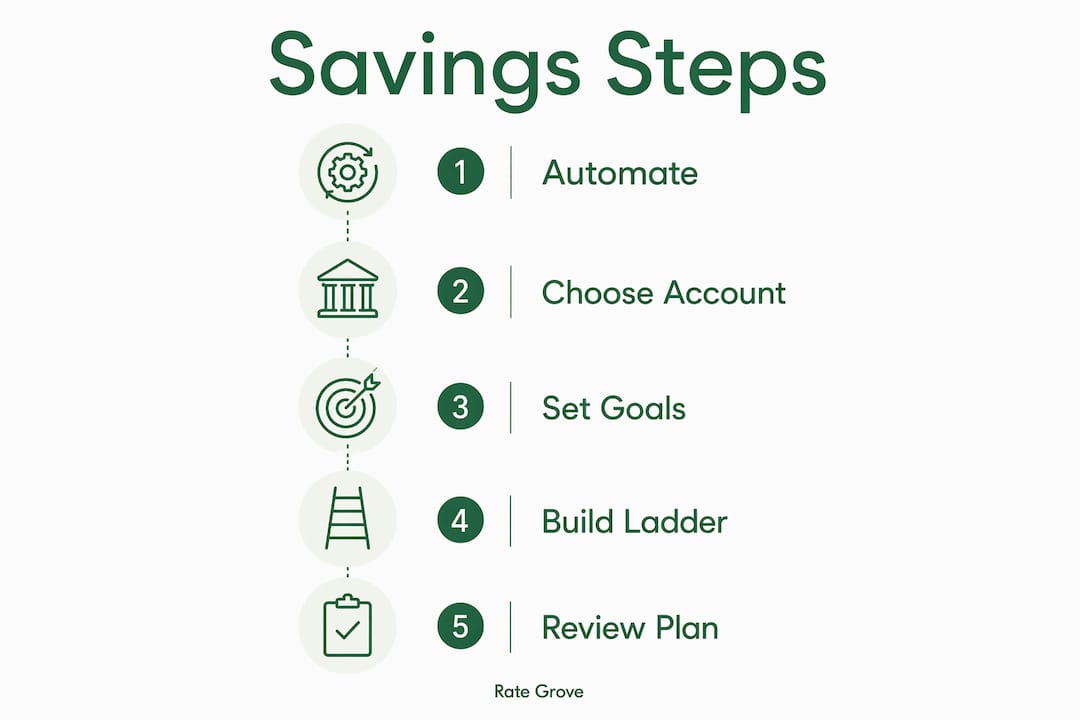
Choose a HYSA without fees or minimum balances. Switching from a traditional bank to an online HYSA can increase interest earnings by 10x or more. Saving $25,000 at 4.5% APY earns about $1,125 annually; the same balance at a traditional bank earning 0.01%–0.05% earns $2.50–$12.50. That gap compounds year after year.
Set specific, time-bound goals. Vague intentions like “save more” rarely stick. Assign a dollar amount and a deadline to each goal, then work backward to a monthly savings figure. Vanguard recommends saving 10%–20% of net monthly income as a baseline, with 20% as the target for faster progress.
Build a CD ladder for short-to-mid-term funds. If you expect HYSA rates to drift lower, locking in today’s rates through staggered CDs protects your yield. Split a lump sum across CDs with maturities of one, two, three, four, and five years. As each matures, reinvest at the prevailing rate. You maintain partial liquidity while capturing higher yields than a variable-rate account provides.
Review subscriptions monthly. Canceling two or three unused services often frees $30–$60 per month, which redirected to a HYSA compounds meaningfully over time.
Here is a quick-reference list of foundational strategies:
- Automate payday transfers to a fee-free HYSA
- Set specific savings goals with dollar amounts and deadlines
- Apply the 50/30/20 budget rule (50% needs, 30% wants, 20% savings)
- Build a CD ladder with staggered maturities for locked-in rates
- Cancel unused subscriptions and redirect the savings
- Keep your emergency fund in a HYSA earning competitive interest
- Compare savings account rates regularly to avoid earning below-market yields
How do you accelerate retirement savings specifically?
Retirement accounts offer tax advantages that amplify every dollar you contribute. Using them well is one of the highest-leverage moves in any effective savings plan.
Capture 100% of your employer match. An employer match is an immediate 50%–100% return on your contribution, depending on the match formula. Not contributing enough to capture the full match is the most common and costly savings mistake. If your employer matches 50% of contributions up to 6% of your salary, contribute at least 6%.
Use the auto-increase feature. Most 401(k) plans let you set an automatic annual contribution increase, often 1% per year. This gradual approach means you rarely feel the difference in your paycheck, but your savings rate climbs steadily. Combined with employer matching contributions and profit-sharing deposits, your account can grow substantially faster than your own contributions alone suggest.
Make catch-up contributions at 50+. Savers aged 50 and older can contribute beyond the standard annual 401(k) limit through IRS-approved catch-up contributions. This provision exists precisely for people who want to accelerate retirement savings in their peak earning years.
Fund accounts beyond the 401(k). A Roth IRA grows tax-free and allows tax-free withdrawals in retirement, making it a powerful complement to a traditional 401(k). A Health Savings Account (HSA) offers a triple tax advantage: contributions are pre-tax, growth is tax-free, and qualified medical withdrawals are tax-free. A 529 plan handles education savings with tax-free growth for qualifying expenses.
Account for inflation. A savings rate that felt adequate five years ago may fall short today. Fidelity notes that food prices rose 22% between July 2021 and July 2025. Revisit your retirement contribution rate annually and adjust upward when income grows.
Key retirement-specific acceleration strategies at a glance:
- Contribute at least enough to capture your full employer 401(k) match
- Enable auto-increase to raise your contribution rate by 1% annually
- Use catch-up contributions once you reach age 50
- Open a Roth IRA for tax-free retirement growth
- Fund an HSA for triple-tax-advantaged medical and retirement savings
- Use a 529 plan for education savings with tax-free growth
- Revisit contribution rates every year to offset inflation
Behavioral and advanced techniques that keep your savings growing
Knowing the right strategies is one thing. Sticking with them through income changes, unexpected expenses, and competing priorities is where most people struggle. These techniques address the psychological side of saving.
Account bucketization. Keeping all your savings in one account creates confusion. You cannot tell whether you are on track for a vacation fund without mentally subtracting your emergency reserve. Naming separate accounts for each goal, such as “Emergency Fund,” “Car Down Payment,” and “Vacation 2027,” makes progress visible and reduces the temptation to raid one goal for another. This behavioral approach reinforces the non-negotiable nature of each savings target.

Stair-step automation increases. Rather than jumping from saving 5% of your income to 20% overnight, increase your automated transfer gradually. Start with an amount you will not miss, then raise it by a small increment each quarter. This progressive approach supports higher long-term savings rates without the psychological shock of a sudden large reduction in take-home pay. Most people find they adapt quickly and barely notice each incremental change.
Reduce high-interest debt first. Carrying a credit card balance at 20%+ APR while saving at 4.5% APY is a net loss. Paying down high-interest debt frees cash flow that can then be redirected to savings and investment accounts at a much higher effective return. Tackle the highest-rate balances first, then redirect those monthly payments to your HYSA or retirement account once the debt is cleared.
Generate side income and direct it entirely to savings. Freelance work, selling unused items, or a part-time gig can meaningfully lift your savings rate without touching your primary budget. The key is to treat that income as invisible to your regular spending and route it automatically to a savings or investment account. For guidance on pairing irregular income with a HYSA, Rate Grove’s high-yield savings guide covers the mechanics in detail.
Review and adjust periodically. A savings plan built around last year’s income and expenses will drift out of alignment after a raise, a new expense, or a major life change. Schedule a quarterly check-in to confirm your automated transfers still match your goals and that your account rates remain competitive.
Pro Tip: Automate first, then optimize. A modest savings rate running on autopilot consistently outperforms a perfect plan you execute manually. Once automation is in place, use periodic reviews to fine-tune the amounts, not to decide whether to save at all.
Behavioral and advanced tactics summarized:
- Name separate accounts for each savings goal (bucketization)
- Increase automated transfers gradually each quarter
- Pay down high-interest debt before aggressively building savings
- Direct all side income automatically to savings or investment accounts
- Schedule quarterly reviews to adjust rates and account allocations
- Avoid teaser-rate traps by calculating the blended APY over the full account term
- Prioritize institutions with daily compounding and zero maintenance fees
Key Takeaways
A savings acceleration strategy works best when automation, goal clarity, and the right account structure work together from day one.
| Point | Details |
|---|---|
| Automate before anything else | Payday transfers to a HYSA remove willpower from the equation and build consistency. |
| HYSA vs. traditional bank | Saving $25,000 at 4.5% APY earns about $1,125 annually versus $2.50–$12.50 at a traditional bank. |
| Capture your full employer match | An unmatched 401(k) contribution leaves an immediate guaranteed return unclaimed. |
| Use tax-advantaged accounts | Roth IRA, HSA, and 529 plans each offer tax benefits that compound the impact of every dollar saved. |
| Review and adjust quarterly | Income changes and inflation erode a static savings plan; periodic adjustments keep it on track. |